As there has yet to be any substantial scrutiny of the complex confluences a more sustained dialogue between disability studies and comics studies might suggest, Disability in Comic Books and Graphic Narratives aims through its broad range of approaches and focus points to explore this exciting subject in productive and provocative ways.
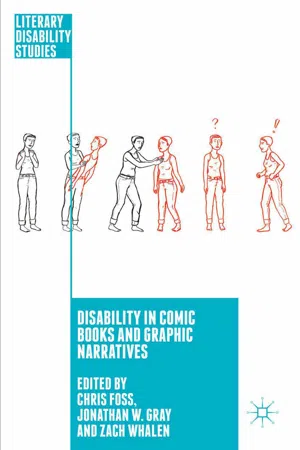
eBook - ePub
Disability in Comic Books and Graphic Narratives
- English
- ePUB (mobile friendly)
- Available on iOS & Android
eBook - ePub
Disability in Comic Books and Graphic Narratives
About this book
Information
1
Mutable Articulations: Disability Rhetorics and the Comics Medium
Jay Dolmage and Dale Jacobs
In our earlier collaborative essay, “Difficult Articulations: Comics Autobiography, Trauma, and Disability,” we argued that as multimodal texts, comics in general and comics autobiography in particular allow for multiple modes of representation, while also providing, or at least potentially providing, the means to question the limitations of these modes. As well, comics demand that we attend closely to the multiple forms of expression available in the medium, while seeing these forms as interconnected rather than hierarchical. Finally, comics allow meanings to multiply in the tension created by the act of representation. In this way, we see the potential of comics to go beyond the use of disability as narrative prosthesis—a kind of multimodal, narrative shorthand—and to become a form of prosthesis themselves, an additional tool in making meaning accessible and for intervening in and interrogating disability as what Rosemarie Garland-Thomson calls a “representational system” (19).1 In what ways, then, can existing theories of the rhetoric of comics also be (re)framed as disability rhetorics?
For instance, how can we question multimodal literacy from the perspective of sensory access, affordance, and constraint? How do disability studies theories of embodiment and identity map onto graphic narratives, in particular through the multiple iterations of (a transitional or fragmented) self in the comics medium? How can comics concepts like arthrology (Groensteen), transtextuality (Genette), or multimodality (Jacobs) be considered for their prosthetic possibilities? By examining Georgia Webber’s Dumb in some detail, we attempt to put comics theory into productive dialogue with disability theory, as a means to interrogate and develop a disability rhetoric for the comic form.
Comics theory/disability theory
As readers engage with a comics text, they make sense of the multimodal elements (including the visual, the linguistic, the gestural, the audio, and the spatial) of each page or page spread, the arthrological connections between panels, and the multiple kinds of transtextual connections between this text and myriad other texts, including intertextuality (direct references to other texts), paratextuality (elements such as the title, chapter headings, epigraphs, and so on that work as an entry point to the text for readers), metatextuality (critical commentary of one text on another), hypertextuality (modification of one text by another, as in spoof or parody), and architextuality (assignation of a text to a given genre or genres). Thierry Groensteen’s notion of arthrology and Gerard Genette’s concept of transtextuality help explain how readers make connections within and between texts as additional meanings accrue through this layering of connections. These linkages can account for how readers move beyond the individual page and make sense of a comics text as a whole. Taken together, multimodality, arthrology, and transtextuality account for the multiple modes of meaning-making, the mutability of expression, and the tensions inherent in the act of representation itself.
In this essay we will amplify these inherent connections by focusing on comics as both a space for negotiating the meanings around bodies/minds and an embodied form of expression, what Hilary Chute calls “a haptic form” that “demands tactility, a physical intimacy with the reader in the acts of cognition and visual scrutiny” (112). In doing so, we will build on recent disability studies work that calls for attention not just to how meaning is attached to disability, but that views the knowledge and meaning which disability generates, moving beyond policing negative portrayals of disability to recognizing disability as an engine of innovation and rhetorical invention.
Scholars have recently explored how comics can be used to teach critical approaches to medicine and medicalization (Green, Vaccarella); how the medium allows for the representation of a wider range of sensory engagement, for instance, for autistics (Birge); how comics challenge normalcy and invite a more “genuine encounter with the experience of disability” (Squier); and how comics encourage the reader to recognize disease and disability in individuated, non-monolithic ways (Engelmann). This work builds upon early critiques of comics’ simplified representation of disability as evil or as a pitiable sign of weakness (Johnson) and the common “super-crip” or overcoming narratives within comics (Carpenter). Importantly, recent disability studies work also dovetails with a larger trend in theories of comics autobiography, in which the form itself is seen as capable of enhancing, even as it problematizes, relationships between self and other. As Gillian Whitlock writes, “the unique vocabulary and grammar of cartoons and comic drawing might produce an imaginative and ethical engagement with the proximity of the other” (978). Jared Gardner elaborates that comics, especially “autography,” can allow attachment and distance, doubt and certainty, common and individual suffering, to share the frame (12). Within this discussion, disability studies is uniquely and ideally positioned to trouble and interrogate meanings around the bodies and experiences of comics selves and others, to question how the form both represents and creates non-normative transformations of body and mind, and to develop new disability rhetorics.
Diagnosis
In order to explore these concepts and the connections between comics theory and disability rhetorics, let us now turn to Georgia Webber’s comics series, Dumb.2 Independently produced and distributed (and, as of this writing, on Issue 5), Dumb is, in Webber’s words, “a comics series about my prolonged voice loss, and the slow crawl of recovery” (n.p.). Copies of the comic can be purchased at http://georgiasdumbproject.com. In the first issue, in which Georgia’s persistent throat pain is diagnosed as an injury resulting from her overuse/abuse of her vocal chords, Webber sets the stage for the chronicle of voice loss in the subsequent issues. As well, this issue establishes the connection between the color red (the only color used other than black, gray, and white) and voice/sound, a connection to which she will turn repeatedly throughout the series.
As is the case in many disability narratives, it is only when Webber has been diagnosed by a doctor that this story becomes officially about disability. That is, disability often seems to demand to be defined in medical terms by a medical professional in films, novels, and comics narratives: for example, in the canonical Rain Man, a film that many people associate with disability, we are “properly” introduced to Raymond when Dr. Bruner offers an inventory of his disabilities and an assessment of his ability to “function” despite his autism. The disability needs to be “ablesplained” by a medical authority—and these explanations often usurp the voice or perspective of the narrator and overwrite their identity in scientific and pathological terms.3 When Ellen Forney depicts the scene of diagnosis in her memoir Marbles, she quotes at length from the Diagnostic and Statistical Manual (DSM), filling her pages with this medical language in a manner that completely disrupts the pattern of storytelling in previous or subsequent panel sequences. Here the oracular voice of medicine dominates arthrological patterns of connection between panels; the reader is encouraged to create meaning in medical terms through linkages between the various words, images, and actions depicted in the panels in the sequence. As well, in both Marbles and Dumb, the DSM and/or the voice of a doctor create important intertexts to both specific medical textbooks and to the discourse of medicine itself, thus creating an architextual connection—at least momentarily—between these texts and other narratives of medical trauma. In Dumb, Webber concludes her first issue with a section entitled, in red ink, “diagnosis.” The image accompanying this title is of Webber sitting in front of a bronchoscope machine, and the subsequent panels allow the young male doctor to explain Webber’s disabling condition. Webber accompanies this explanation with images borrowed from a medical textbook, including one specific image that reveals a cross-section of her own upper body, showing how the bronchoscope is fed down her throat.
Within disability studies, such images are quite recognizable, as one of the key visual frames for disability has been medical or pathological. This framing is best exemplified by the medical textbook itself, wherein disabled bodies are cropped, dissected, their “defective” parts put on display for the education of the viewer, their subjectivity removed. These images train medical professionals to gaze at people with disabilities in a similarly objective manner, focusing on their defects and limiting their subjectivity and agency. Thus any image of disability asks to be looked at medically and pathologically. These images also serve as an emblem for the medical model of disability, a model in which disability can only be understood as a natural aberration, in need of therapeutic or surgical intervention, cure, or eradication. This model offers very little space for living with disability, for understanding the role of culture and society in dictating the terms of disability; this model funnels narratives of disability toward either kill or cure. It is perhaps unsurprising, then, that Webber (and Forney) temporarily gives the graphic narrative over to the medical model and framing of disability, or that this medical model brings with it its own multimodal and intertextual grammars that likewise dominate.
After she has been told to rest her voice over the coming months, the issue ends with a full-page image of Georgia standing, coat in her right hand and instructions from her doctor in her left hand, a lost, defeated expression on her face. The reader is here mimicking the role of the doctor in examining Georgia. However, so too has she depicted herself as staring back at the reader, challenging the practice of staring at people with disabilities. As Garland-Thomson (or others, like Ann Millett) would argue, medicalized images of disability, like those used by Webber in her “diagnosis” section, invite or sanction staring (see Garland-Thomson, Staring). In Dumb, the viewer is invited to actually become bronchoscopic. Yet as Millett argues, “the gaze/stare is inevitably embodied and transforming to subjects on both sides of it” (n.p.). In this spirit of reversal, or at least channeling the dual trajectory of any stare, to end the first issue, Webber draws herself engaged in what Frederik Byrn-Køhlert has called the “counter-stare,” staged as a way to resist the gaze that has too often constructed people with disabilities as passive, medicalized subjects. Even through her evident distress at the diagnosis, Webber uses the counter-stare to assert her own agency, both to act and to represent herself.
In this image, we see arranged around Georgia’s upper body overlapping red circles, already associated with sound/voice, but here depicted as empty, the internalization of sound/voice that, for her, is to come in the remainder of the series. For readers familiar with comics, the red circles will also suggest the convention of the thought balloon, in which a series of circles leading to a word balloon are used to designate that the thoughts, rather than the speech, of a character are being represented. Since she cannot speak, her “voice” becomes internalized and attached to her thoughts, especially as she finds alternative ways to express herself. While the color red will still be used to indicate external sounds (such as the voices of other people) as the series moves forward, so too will red be used to make manifest this internalized voice.4 That is, as readers encounter the red of this internal voice (as will be seen in the next example), they will make arthrological connections back to this final image from Issue 1 in which Webber begins to tease out this internalized voice.
In all drawings of Georgia, she has close-cropped hair, with her bangs cut straight across the top of her forehead. Her clothes are generally plain (jeans or a skirt, a white shirt with or without sleeves), and she is often depicted wearing boots. Webber depicts herself as a line drawing in black ink, and this accentuates the features on her face and her gestures, which are the only noticeable elements of her appearance that change from frame to frame. Thus the reader learns to “read” these facial and bodily changes, and also to place great emphasis on the presence (and absence) of other markers.
Through multiple modes—the gestural depiction of her body language and facial expression, the visual use of the iconography of both the color red and the circles of the thought balloon, the spatial layout of these elements on the page, and, notably, the absence of both linguistic and audio markers—Webber establishes control of her own self-representation on the comics page. As Sarah Birge writes, “Comics can depict combinations of motor, sensory, emotional, social and cognitive factors affecting a person, thereby avoiding the reduction of that person to a stereotype” (n.p.). Through the affordances of the medium of comics, Webber has Georgia stare back at the reader, asserting that her identity (both in the comic and in real life) is beyond stereotype.
Splitting and “crip time”
In Issue 2 of the series, readers are invited to enter Webber’s new “normal” and make meaning from her representations of it. The first section of the issue, appropriately titled “aftermath,” opens with a small panel that shows Georgia from the shoulders up, surrounded by overlapping red circles; this panel makes a direct arthrological connection to the final panel of the Issue 1, making the reader remember that panel and make connections between it and this opening panel. This kind of arthrological connection pushes readers to make meaning from the sequence that follows in light of the meanings they derived from the earlier panel, just as it pushes readers to reassess the meaning of the previous panel in light of this sequence. On the facing page, we see an image of Georgia walking tentatively to the left, a paratextual and extra-diegetic interlude that precedes the beginning of the narrative, from which she seems to be walking away. What’s more, she is drawn in red rather than in the black lines that have been used for all previous images of people. How is the reader to make sense of this image? How does it connect to the narrative? To Webber’s representation of self? While readers will certainly begin to establish such meanings at this point, as the narrative proceeds, the import of this image will become clear through arthrological linkages to repeated panels in the “splitting” section of Issue 2. It is in this sequence that Webber really begins her attempt to deconstruct disability by “demonstrating the pathology and psychic impairment within the seemingly productive art of comic book writing” (Squier 88). The red-penciled Georgia is but one articulation of self, and in “splitting,” Webber endeavors to come to terms with how she is to manage these multiple selves.
In “splitting,” Webber takes advantage of the possibility in the comics medium of articulating multiple narratives simultaneously. Along the bottom of the 11 pages that make up this section, Webber utilizes three panels per page to tell the story of the tasks she must perform in order to best engage her new situation: quitting her job at the café, telling friends, applying for other jobs, requesting emergency financial aid, registering as temporarily disabled, applying for welfare, and requesting a higher credit limit. As Webber shows through these 33 panels, the process is clearly exhausting, but she does end with a panel that shows a hand attaching a note to the wall next to her computer which reads, “it’s going to be okay.” Parallel to this narrative, the upper two-thirds of each page are taken up with a series of unbordered panels in which Georgia is shown to be wrestling with her divided self. On pages 3 and 4 of the “splitting” section, we see the initial process of separation in which the red-penciled version of Georgia is shown to emerge from the drawing of Georgia done in black, a representation in keeping with the way she has been drawn throughout the comic to this point. As readers encounter this image of two Georgias, they will (or at least could) make connections back to the way the color red was linked to sound in Issue 1, the red circles of the final page of that issue (as discussed earlier), and the earlier depiction of this image in the paratext to this issue (and its proximate association with the first panel of “aftermath”). All of these c...
Table of contents
- Cover
- Title
- Copyright
- Contents
- List of Illustrations
- Foreword
- Acknowledgements
- Notes on Contributors
- Introduction: From Feats of Clay to Narrative Prose/thesis
- 1 Mutable Articulations: Disability Rhetorics and the Comics Medium
- 2 “When you have no voice, you don’t exist”?: Envisioning Disability in David Small’s Stitches
- 3 The Hidden Architecture of Disability: Chris Ware’s Building Stories
- 4 Standing Orders: Oracle, Disability, and Retconning
- 5 Drawing Disability: Superman, Huntington’s, and the Comic Form in It’s a Bird …
- 6 Reading in Pictures: Re-visioning Autism and Literature through the Medium of Manga
- 7 Graphic Violence in Word and Image: Reimagining Closure in The Ride Together
- 8 “Why Couldn’t You Let Me Die?”: Cyborg, Social Death, and Narratives of Black Disability
- 9 “You Only Need Three Senses for This”: The Disruptive Potentiality of Cyborg Helen Keller
- 10 Cripping the Bat: Troubling Images of Batman
- 11 Breaking Up [at/with] Illness Narratives
- 12 Thinking through Thea: Alison Bechdel’s Representations of Disability
- Index
Trusted by 375,005 students
Access to over 1.5 million titles for a fair monthly price.
Study more efficiently using our study tools.
Frequently asked questions
Yes, you can cancel anytime from the Subscription tab in your account settings on the Perlego website. Your subscription will stay active until the end of your current billing period. Learn how to cancel your subscription
No, books cannot be downloaded as external files, such as PDFs, for use outside of Perlego. However, you can download books within the Perlego app for offline reading on mobile or tablet. Learn how to download books offline
Perlego offers two plans: Essential and Complete
- Essential is ideal for learners and professionals who enjoy exploring a wide range of subjects. Access the Essential Library with 800,000+ trusted titles and best-sellers across business, personal growth, and the humanities. Includes unlimited reading time and Standard Read Aloud voice.
- Complete: Perfect for advanced learners and researchers needing full, unrestricted access. Unlock 1.5M+ books across hundreds of subjects, including academic and specialized titles. The Complete Plan also includes advanced features like Premium Read Aloud and Research Assistant.
We are an online textbook subscription service, where you can get access to an entire online library for less than the price of a single book per month. With over 1.5 million books across 990+ topics, we’ve got you covered! Learn about our mission
Look out for the read-aloud symbol on your next book to see if you can listen to it. The read-aloud tool reads text aloud for you, highlighting the text as it is being read. You can pause it, speed it up and slow it down. Learn more about Read Aloud
Yes! You can use the Perlego app on both iOS and Android devices to read anytime, anywhere — even offline. Perfect for commutes or when you’re on the go.
Please note we cannot support devices running on iOS 13 and Android 7 or earlier. Learn more about using the app
Please note we cannot support devices running on iOS 13 and Android 7 or earlier. Learn more about using the app
Yes, you can access Disability in Comic Books and Graphic Narratives by C. Foss, J. Gray, Zach Whalen, C. Foss,J. Gray,Zach Whalen in PDF and/or ePUB format, as well as other popular books in Literature & Art General. We have over 1.5 million books available in our catalogue for you to explore.