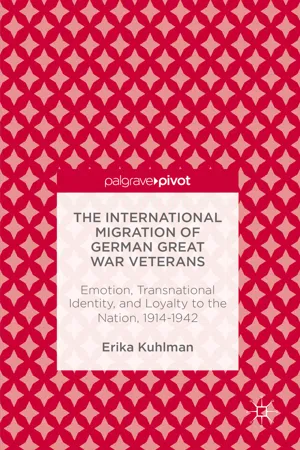
This book uses story-telling to recreate the history of German veteran migration after the First World War. German veterans of the Great War were among Europe's most volatile population when they returned to a defeated nation in 1918, after great expectations of victory and personal heroism. Some ex-servicemen chose to flee the nation for which they had fought, and begin their lives afresh in the nation against which they had fought: the United States.
eBook - ePub
The International Migration of German Great War Veterans
Emotion, Transnational Identity, and Loyalty to the Nation, 1914-1942
- English
- ePUB (mobile friendly)
- Available on iOS & Android
eBook - ePub
The International Migration of German Great War Veterans
Emotion, Transnational Identity, and Loyalty to the Nation, 1914-1942
About this book
Information
© The Editor(s) (if applicable) and The Author(s) 2016
Erika KuhlmanThe International Migration of German Great War Veterans10.1057/978-1-137-50160-8_11. Introduction
Erika Kuhlman1
(1)
Idaho State University, Pocatello, Idaho, USA
Abstract
This chapter presents the significance of international migration after the First World War, as demobilized soldiers, colonial units, and displaced persons were sent home. German Great War veterans returned to a defeated nation, a defeat that had a specifically negative impact on those men who had been sent off to war with great expectations of a swift victory and glorified heroism. The humiliated nation-state attempted to retain control of its population by minimizing, if not reversing, the notion of defeat. As veterans grew disillusioned with overreaching Germany bureaucracies, many of them wanted to leave the country. The German government, again demonstrating its desire to control its people, took steps to prevent them from emigrating.
The end of the First World War in November 1918 marked a watershed moment in the international migration of human beings. Soldiers demobilized and returned home, colonial soldiers were dispatched back to their native lands, and the redrawing of the world map by the treaty-makers at Versailles sparked a shift among people who did not care for the new boundary lines. Nation-states, emboldened by their strengthened wartime authority, began controlling the movement of their citizens in unheard of ways. Restrictive immigration laws meant that people were no longer welcome where they once had been, and could less often choose where they wanted to live. People’s racial and ethnic identities more often restricted their ability to change their residences. 1 An additional development, the requirement that travelers carry government-issued passports, indicated that citizens’ movements were now being monitored by state bureaucracies, and it was in the pages of those passports where people’s names, nationality, appearance, and sometimes their religion—their identities—were recorded for the world to see. World War veterans, members of the younger and more volatile generation of Europeans, whose heads had been filled with expectations of victory and heroism in 1914, were among those most likely to want to change their postwar circumstances. German ex-servicemen found the defeated society to which they returned in late 1918 particularly burdensome, considering their recent experiences with that colossal, bureaucracy-to-end-all-bureaucracies, the German military.
Before August 1914, Great War veteran Johann Grossmann had fought fires around the shipyards in the northern port city of Hamburg. He spent the war years aboard ship in the German Navy. Upon his discharge in 1918, the attempts he made at regaining the order and pleasures of his former civilian life were met by failure, and nearly all his shortcomings he attributed to the war and to his nation’s defeat in it. Grossmann readily expressed his disillusionment with German postwar society when he relocated back to his childhood home of Fürth, in northern Bavaria. As he later explained in his memoir, the much-revered Field Marshal Paul von Hindenburg, commander of the Germany military and later president of the Weimar Republic, had promised all honorably discharged servicemen the opportunity to own a piece of land “with which to grow their own cabbage.” This gift was to be regarded as a reward for their military service. Grossmann, an aspiring farmer, first felt the scales drop from his eyes when he learned the truth about Hindenburg’s promise:
As my child was about to be born, I asked at the bank how I could obtain the land that Hindenburg had promised. The bank official rejected my query in one sentence. So, I asked a member of the Bavarian Parliament how I could acquire the land that veterans had been guaranteed. He replied, “You’ll need 21,000 German Marks to buy land.” He was a war cripple. The two of us, a war cripple and a man without a Fatherland, laughed the laugh of two cuckolded fools. 2
Grossmann undoubtedly felt foolish to have believed Hindenburg’s outlandish promise. In the last sentence of the passage, the veteran compared different losses that had occurred as a result of the war: loss of limbs and renunciation of homeland. In referring to both men as having been cuckolded by the war, he compared soldiering with the intense shame of sexual betrayal. The nation, for which he had made the heroic, larger-than-life sacrifice expected of him when he went to war, had humiliated him, making him feel small.
Grossman’s experiences mirror what historian Adam R. Seipp has called the “crises of reciprocity” that plagued postwar nations during the period of demobilization. Veterans expected rewards commensurate with the sacrifices that they had made, and nations, according to Seipp, fell far short of the payback expected by returning Great War soldiers. 3 As the navy man’s setbacks continued, his cynicism deepened. Upon his discharge, he had looked for work in Hamburg for two years without success. Moving back to Fürth had not relieved his unemployment. He began to imagine emigration as the answer to his problems. He visited the local office of the Reichswanderungsamt (RWA), or German Immigration Bureau. Here, he asked for information about circumstances in other countries. The RWA, established in 1919, was set up by the government ostensibly to act as a sort of clearinghouse of information for prospective emigrants. The RWA official inquired whether he would stay in Germany, if he were to find a job. “Of course,” Grossmann replied. The next day, according to his memoir, he was offered a job at a factory. He did not believe this development to be coincidental. Grossmann interpreted his encounters at the RWA office with sarcasm. He believed that instead of helping Germans who were desperate to leave the economic and political chaos that was Weimar Germany, the RWA was actually trying to keep would-be emigrants from leaving the country. 4
The only solace he found in postwar Germany was a philosophy course he took through a Volkshochschule, or worker educational program. Like nearly everything else he encountered in his postwar life, the veteran interpreted the program through the lens of Germany’s defeat. Because of war reparations outlined in the Treaty of Versailles, he opined, German goods would not be competitive in world markets. One avenue to making German products more attractive was to educate workers, so the Volkshochschulen were established to facilitate that need. Adult education courses had existed prior to Weimar, but their numbers exploded in the 1920s. Explicitly mentioned in the Weimar constitution, the Volkshochschulen idea was designed to foster unity throughout German society and personal happiness in the individual. 5 Since the philosophy course did not require examinations, Grossmann chose to enroll in it. He and his fellow students made excursions together in the Bavarian countryside. The course captivated him and “held him prisoner”; thoughts of leaving Germany faded. He found an inner peace in the natural world, although his dream of farming never left him. Right before he boarded a ship bound for North America, he told an emigration official that he wanted to farm so that he could grow his own food in order to feed and sustain himself. 6
Grossmann did not marry the mother of his child, and was therefore obliged to pay child support under German law. Suddenly, the owner of the factory where he worked reduced his hours. His sister began paying his rent for him. The veteran’s frustrations with the contradictory directions he received from officials at the social services office, as to how much child support he would have to pay under his reduced income, reawakened his desire to leave the country. It is possible that escaping the child support payments motivated him to leave Germany, too. In any case, he finally made his move in 1927. Once aboard the steamer bound for Canada, he met a fellow German émigré who summed up his own sorry departing circumstances: “Father scolded, mother cried, and the policeman refused to give me a passport” (Germans owing taxes could not obtain a passport 7 ). Grossmann disembarked in Nova Scotia, traveled west and eventually purchased land and established his farm in the Peace River region of British Columbia. 8 Johann Grossmann was one of just over 600,000 Germans emigrating abroad during the Weimar Republic from 1919 to 1932. The vast majority of those disembarked on Ellis Island. 9
The Bavarian’s inability to reach his life’s dream—planting crops on his own plot of land in Germany—constituted a common motivating factor for leaving the Fatherland, according to RWA chief Walter Jung. The desire for Selbständigung, or the ability to stand on one’s own two feet, prompted all emigrants who left Germany in the early 1920s, according to Jung. The war, and especially their nation’s defeat in it, had translated among Germans into a desire to “nicht mehr Knecht sein,” or to no longer be a slave. Jung believed that workers wanted to stop being slaves to capital. 10 But the master Grossmann sought to escape from was the German government and perhaps memories of the war itself, but not capitalism. German Great War widows, too, sought independence from men and from government authority, according to Helena Hurwitz-Stranz’s Kriegerwitwen gestalten Ihr Schicksal. 11 Widows such as Johanna Boldt, who lost her husband in the war, relished the new economic freedom they achieved when they earned their own bread. 12
Grossmann’s memoir says nothing about his war experiences, though one might judge by the opening passage that they had not been positive. His irritations with German bureaucrats may have begun during his military service. Of the German veterans immigrating to USA, those who wrote their memories of their time in military service expressed a recurring frustration with (among other things) a lack of knowledge. The enlisted complained of not being told by their commanding officers where they were marching to, of not knowing what they would be doing once they arrived, nor even the reasons why their nation was at war. If servicemen assumed their superiors were privy to inside information, officers’ memoirs indicate the presence of the same irritating shroud of ignorance darkening their mental horizons. 13 Decisions were made elsewhere and were changed for inexplicable reasons. By autumn 1918, soldiers were indicating their frustrations with not-knowing more frequently by refusing orders. 14 The feeling of powerlessness hit home for surviving soldiers who returned to wives and children, because the authority once presumed to be wielded by the father no longer operated in the old, expected ways in postwar German society. 15 Problems reintegrating back into German society affected veterans—such as Johann Grossmann and another immigrating veteran, Bruno Richard Hauptmann—for whom flight seemed to hold the only answer to their vexations. Although much has been written about the war dead, and while the multitude of war memorials demonstrate that postwar societies’ focus remained on those sacrificed, in fact, most soldiers mobilized did not die in the war. 16
The possibility of revolution hung in the air as German soldiers demobilized, and some were politicized as they shifted from battle front to home front. Others were not. Benjamin Ziemann’s study reveals that in rural Germany, most returning veterans’ only desire was to return to their former lives, and their families simply wanted them back. The hoped-for shift from wartime to peacetime, however, blurred as the German government increased its centralized authority after the war, and millions of Germans, war veterans, war widows, and citizens not direct...
Table of contents
- Cover
- Frontmatter
- 1. Introduction
- 2. The Weapons They Carried: Brutality and Veterans’ Memories of the First World War
- 3. Desertion: Emigrants’ Wartime Mobility, Their Transnational War Experience, and the Myths of War
- 4. Emigration, National Loyalty and Identity, and Anti-Semitism During the Weimar Republic and Nazi Germany
- Backmatter
Trusted by 375,005 students
Access to over 1.5 million titles for a fair monthly price.
Study more efficiently using our study tools.
Frequently asked questions
Yes, you can cancel anytime from the Subscription tab in your account settings on the Perlego website. Your subscription will stay active until the end of your current billing period. Learn how to cancel your subscription
No, books cannot be downloaded as external files, such as PDFs, for use outside of Perlego. However, you can download books within the Perlego app for offline reading on mobile or tablet. Learn how to download books offline
Perlego offers two plans: Essential and Complete
- Essential is ideal for learners and professionals who enjoy exploring a wide range of subjects. Access the Essential Library with 800,000+ trusted titles and best-sellers across business, personal growth, and the humanities. Includes unlimited reading time and Standard Read Aloud voice.
- Complete: Perfect for advanced learners and researchers needing full, unrestricted access. Unlock 1.5M+ books across hundreds of subjects, including academic and specialized titles. The Complete Plan also includes advanced features like Premium Read Aloud and Research Assistant.
We are an online textbook subscription service, where you can get access to an entire online library for less than the price of a single book per month. With over 1.5 million books across 990+ topics, we’ve got you covered! Learn about our mission
Look out for the read-aloud symbol on your next book to see if you can listen to it. The read-aloud tool reads text aloud for you, highlighting the text as it is being read. You can pause it, speed it up and slow it down. Learn more about Read Aloud
Yes! You can use the Perlego app on both iOS and Android devices to read anytime, anywhere — even offline. Perfect for commutes or when you’re on the go.
Please note we cannot support devices running on iOS 13 and Android 7 or earlier. Learn more about using the app
Please note we cannot support devices running on iOS 13 and Android 7 or earlier. Learn more about using the app
Yes, you can access The International Migration of German Great War Veterans by Erika Kuhlman in PDF and/or ePUB format, as well as other popular books in History & European History. We have over 1.5 million books available in our catalogue for you to explore.