eBook - ePub
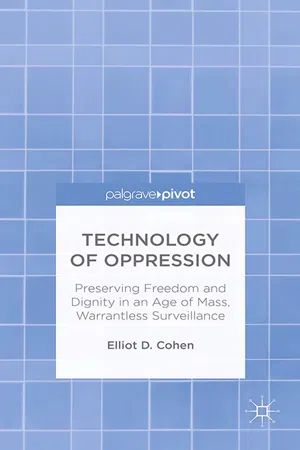
Technology of Oppression
Preserving Freedom and Dignity in an Age of Mass, Warrantless Surveillance
- English
- ePUB (mobile friendly)
- Available on iOS & Android
eBook - ePub
Technology of Oppression
Preserving Freedom and Dignity in an Age of Mass, Warrantless Surveillance
About this book
In the aftermath of the Edward Snowden leaks, the Obama administration has been hard pressed to yield to greater transparency and openness to constructive change. This book provides a catalyst toward greater transparency, increased public awareness of the urgent need for constructive change, and the insight into what such change would require.
Information
1
A History of the Mass Warrantless Surveillance Network
Abstract: This chapter discusses the historical progress of mass, warrantless surveillance technologies beginning in the late 1960s through the years of the George W. Bush and the Barack Obama administrations to date, in light of the recent Snowden disclosures. It describes the development of a single, integrated Mass Warrantless Surveillance Network (MWSN).
Cohen, Elliot D. Technology of Oppression: Preserving Freedom and Dignity in an Age of Mass, Warrantless Surveillance. New York: Palgrave Macmillan, 2014. DOI: 10.1057/9781137408211.0004.
The United States’ mass warrantless surveillance network (MWSN) is a constantly evolving global set of integrated technologies. Over time, its code names and technologies have changed; it has grown new tentacles to suck up different types and greater amounts of information; and it has relocated its equipment to different corners of the earth; but, because it is possible to trace its growth and development through all these successive changes, it makes sense to think of this technological development as one massive, self-same system. The evolutionary history of this unified surveillance system has proven to be one of incremental encroachment on privacy with the development of increasingly more effective ways of spying on the electronic communications of the masses.
ECHELON
The origins of the MWSN can be traced to a transnational network code named ECHELON, which was deployed in the late 1960s, with the emergence of satellite technologies. ECHELON was a joint undertaking of the US and the UK, along with the Commonwealth nations of Canada, Australia, and New Zealand (dubbed “the Five Eyes”), which aimed largely at intercepting satellite communications by operating listening stations throughout the world; and filtering the captured signals through a dictionary of predefined search terms. As with later versions of the MWSN, the official purpose for ECHELON was that of national security, in this case, to gather signal intelligence that could be used to ward off the threat posed by the Soviet Union during the Cold War years. This system was operated by the National Security Agency (NSA) and its British counterpart, the Government Communications Headquarters (GCHQ). According to an August 1988 report in the New Statesman, it comprised “a network of monitoring stations in Britain and elsewhere,” which was “able to tap all international and some domestic communications circuits, and sift out messages which sound interesting.” Further, it states that, “Computers automatically analyse every telex message or data signal, and can also identify calls to, say, a target telephone number in London, no matter from which country they originate.”1
The report chronicled how Margaret Newsham, a Lockheed software designer who worked at the listening post at Menwith Hill in North Yorkshire, England, could listen through earphones to telephone calls, including those of politicians, being monitored at the base. The report also alleges that investigations have produced documents revealing that the “targeting of US political figures would not occur by accident, but was designed into the system from the start”.
ECHELON appears to have been just part of a broader set of spying technologies that were then operative. In addition to ECHELON, other clandestine projects connected to Menwith Hill include SILKWORTH, MOONPENNY, SIRE, RUNWAY, STEEPLEBUSH, and BIG BIRD. SILKWORTH was allegedly the code name for long-range radio monitoring; MOONPENNY, another system for monitoring satellite communications; RUNWAY, a control network for a spy satellite called VORTEX, orbiting the then Soviet Union; STEEPLEBUSH, a control center connected with overhead listening satellites; BIG BIRD, a low-orbiting, photographic reconnaissance-carrying listening equipment.
The satellite-based technologies of ECHELON and its sister systems were, however, soon to become outdated. Beginning in the late 1970s, fiber optic cables began to replace copper wiring in telephone networks because they were more cost effective and could carry more data and much faster (at the speed of light). Since fiber optic cables transmit digital signals (light signals switching on and off to send bits of information), analog telephones (ones that work by sending electrical signals) had to be replaced or interfaced with digital telephone networks over fiber optic cables. Computer networks also began to use fiber optic cables instead of copper phone lines, thus allowing transmission over longer distances without regeneration and increased bandwidth (data transmission rates).
Starting in 1988, fiber optic cables connected continents through undersea installation, which largely replaced the use of satellites in intercontinental communications. Because fiber optic cables made communications more secure (they were harder to hack than radio and microwaves), the latter presented a new challenge for the MWSN. Thus, the changing face of technology changed the realities of mass surveillance.
Because underwater fiber optic cables, especially the emerging generations of them, were very difficult, dangerous, and costly to tap (through the use of specially equipped submarines),2 they were usually tapped when they surfaced on dry land at routing switches. This meant that the switches located at telecommunication companies needed to be the junctures for connecting up transnational, mass spying equipment.
The Total Information Awareness Project
Converging with this technological reorientation, geopolitics also began to shift from focus on what was left of the old Soviet Union (disbanded in 1991) to greater interest in the Middle East as a focal point of US military involvement. In particular, the Project for the New American Century (PNAC), a neoconservative political action organization, founded in 1998, consisting of many of the soon-to-be cabinet members of the George W. Bush administration, launched an aggressive campaign for removing Saddam Hussein from Iraqi leadership. This campaign was brought to a head when, on September 11, 2001, the World Trade Center in New York City and the Pentagon in Washington were attacked, thus giving the Bush administration its “official” reason for invading Iraq. Here was a new geopolitical rationale for an even more aggressive MWSN, in the name of national security.3 But this time it was to be anchored to the administration’s proclaimed “war on terror” rather than to the prior “cold war” with the Russians.4 Because terrorists could be plotting anywhere and everywhere, there was now an argument for expanding the tentacles of the MWSN to cover all communications, both domestic and foreign. This alleged need became the catalyst for the “The President’s Surveillance Program,” also known as the “Total Information Awareness” (TIA) project, which was authorized by George W. Bush within a couple weeks of the September 11 attacks.5
Subsequent to this presidential authorization, in January 2002, the Department of Advanced Research Projects Agency (DARPA), a branch of the US Department of Defense (DOD) established the “Information Awareness Office” (IAO) to direct the research and development of the TIA project. The IAO’s mission was accordingly to “imagine, develop, apply, integrate, demonstrate, and transition information technologies, components and prototype, closed-loop, information systems that will counter asymmetric threats by achieving total information awareness.” In other words, it sought to take the earlier MWSN to the next logical step, by building a massive network of integrated computer technologies for intercepting, storing, searching, monitoring, reading, and analyzing all private, computerized records of 300 million Americans in addition to the electronic messages of millions of foreign users passing through it switches.
Former Reagan National Security advisor, John Poindexter, was named the director of the TIA project. It was, in fact, Poindexter along with Hicks & Associates executive, Brian Sharkey, who had proposed the idea of this all-seeing spy network to the DOD after the 9/11 attacks. Poindexter attained notoriety when, in 1990, he had been convicted of multiple felonies in the Iran-Contra scandal. Although these convictions were later reversed, his appointment to oversee this massive, spy operation did not help to foster a positive public perception of this already ethically contentious program when it soon came to public attention.
The IAO and TIA were publicized in February 20026 when The New York Times published an article about it. The article stated,
One component of the new computer information system that is being emphasized by Mr. Poindexter’s new office are ‘data mining’ techniques intended to scan through vast collections of computer data, which may include text, images, sound and other computer data, and find significant patterns.
On November 21, 2002, the American Civil Liberties Union (ACLU) began an aggressive campaign against TIA, stating,
Recent news reports have revealed the development of a new federal program dubbed “Total Information Awareness”. The program will create a computer system that will search through a vast centralized database that contains information about your purchases, your medical history, your school records, and more. Help stop th...
Table of contents
- Cover
- Title
- Introduction: Why Privacy Matters
- 1 A History of the Mass Warrantless Surveillance Network
- 2 Foreign Intelligence Surveillance Law
- 3 Network Searches and Applications
- 4 Transparency of Policies and Practices
- 5 Democracy in Cyberspace
- 6 Next Generation Technologies
- 7 The Technological Imperative
- 8 Network Surveillance Regulations
- Bibliography
- Index
Trusted by 375,005 students
Access to over 1.5 million titles for a fair monthly price.
Study more efficiently using our study tools.
Frequently asked questions
Yes, you can cancel anytime from the Subscription tab in your account settings on the Perlego website. Your subscription will stay active until the end of your current billing period. Learn how to cancel your subscription
No, books cannot be downloaded as external files, such as PDFs, for use outside of Perlego. However, you can download books within the Perlego app for offline reading on mobile or tablet. Learn how to download books offline
We are an online textbook subscription service, where you can get access to an entire online library for less than the price of a single book per month. With over 1.5 million books across 990+ topics, we’ve got you covered! Learn about our mission
Look out for the read-aloud symbol on your next book to see if you can listen to it. The read-aloud tool reads text aloud for you, highlighting the text as it is being read. You can pause it, speed it up and slow it down. Learn more about Read Aloud
Yes! You can use the Perlego app on both iOS and Android devices to read anytime, anywhere — even offline. Perfect for commutes or when you’re on the go.
Please note we cannot support devices running on iOS 13 and Android 7 or earlier. Learn more about using the app
Please note we cannot support devices running on iOS 13 and Android 7 or earlier. Learn more about using the app
Yes, you can access Technology of Oppression by E. Cohen in PDF and/or ePUB format, as well as other popular books in Politics & International Relations & Civil Rights in Law. We have over 1.5 million books available in our catalogue for you to explore.