- English
- ePUB (mobile friendly)
- Available on iOS & Android
eBook - ePub
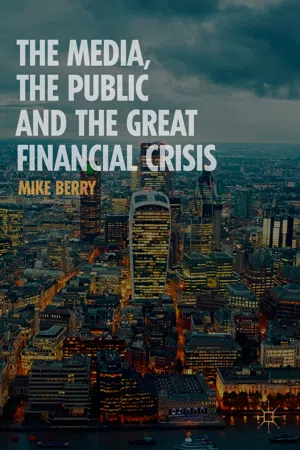
The Media, the Public and the Great Financial Crisis
About this book
Information
© The Author(s) 2019
Mike BerryThe Media, the Public and the Great Financial Crisishttps://doi.org/10.1007/978-1-137-49973-8_11. The Rise and Fall of British Finance
Mike Berry1
(1)
Cardiff University, Cardiff, UK
Mike Berry
This chapter examines the background to the GFC. It focuses on how regulatory and tax policies introduced by both Conservative and Labour governments fostered the development of financial innovation in the City of London, radically changing the structure of the British economy. The chapter also examines why political elites chose to favour the interests of finance over other sectors of the economy. In part, this was a consequence of extensive lobbying by the sector but it was also because financial innovation came to underpin a new growth model based on expanding consumer debt which helped to compensate for stagnant wage growth. However as the events of 2008 proved it was a model that was both dangerous and unstable.
The Financialisation of the UK Economy
Since the dawn of the Imperial Age the City of London has held a central place in Britain’s economic life. As Cain and Hopkins (2016) note, the City played a key role in the development of ‘Gentlemanly Capitalism’ manifested through domestic economic development and the spread of Empire. However, this review will concentrate primarily on the period after 1979 when the finance sector expanded rapidly whilst manufacturing as a share of national output declined (Coates 1995).
The key reason for the rapid expansion of finance was the decision by the Conservative government to progressively remove the regulations on banking, capital and credit that had been introduced during and after the Great Depression. Three decisions in particular were to prove pivotal to the growth of the finance sector. The first was to remove exchange controls in 1981. This shifted the balance of power against labour and towards capital as investment was free to flow to areas where it could secure greater returns (Davis and Walsh 2016). It also hindered domestic manufacturing and accelerated financial globalisation—which increased the power of the City. As former City trader David Buik put it, ‘by abolishing exchange controls in 1981, Margaret Thatcher pulled the trigger that made London the international financial centre of the world’ (cited in Butcher 2013: 3).
The second key decision was to deregulate the provision of consumer credit. The restrictions on higher purchase agreements were abolished, ownership of credit cards expanded and mortgage lending boomed as consumer borrowing tripled during the 1980s (BBC 2013). The final decision was to deregulate the activities of the City through the ‘Big Bang’ reforms of October 1986. These were in part driven by technological change as in the shift from trading on ‘open-outcry’ exchange floors to screen based electronic exchanges. However, the Big Bang also altered the structure of the City by abolishing the distinction between stockbrokers, advisers and ‘jobbers’ (who created the market in shares), and broke up the clubby old boy networks of the Square Mile by allowing foreign firms—primarily large American and European investment banks—to move into the market. As Will Hutton argues, this allowed foreign banks to evade Wall Street’s regulations which separated commercial from investment banking activities and banned proprietary trading:
The decision by policy makers to favour the interests of the City over manufacturing had a profound effect on the structure of the British economy and patterns of regional development (Hutton 1996; Davis and Walsh 2016). Inward capital flows increased markedly, pushing up sterling, damaging exports and widening the UK’s trade deficit. As Tony Dolphin, senior economist at the Institute for Public Policy Research, noted, the bias towards finance ‘produced a casualness about the decline of manufacturing and the collapse of all competing sectors which is really quite jaw-dropping’ (cited in Stewart and Goodley 2011: 23).‘Big Bang’ in 1986 allowed the brokers and jobbers on London’s stock market to be bought up by American, European and Japanese investment banks so they could do in London what was outlawed in New York by Roosevelt’s Glass-Steagall Act, introduced in the aftermath of the credit crunch that caused the Great Depression. They could manage huge investment funds, trade in any kind of financial security both on their own account and for clients, advise on deals and act as large banks – all under the same roof despite the conflicts of interest that were prohibited in New York. London began to rise in the league tables of international finance. The foundations of Anglo-American financial capitalism were being laid – and with them the seeds of its own demise. (Hutton 2008: 9)
Such structural shifts were accelerated in the mid 1990s with the rise of financial innovation—particularly securitisation and derivative trading. Although securitisation was not a new process—it can be traced back to the late eighteenth century when Dutch capital helped to fund real estate speculation in North America (Frehen et al. 2012)—the late 1990s saw a sharp increase in its use. Securitisation involved the process of taking assets (such as the revenue streams from loans, credit cards or mortgage payments), pooling them and then turning them into securities (or risk weighted tiers of securities) which could then be traded in secondary markets. These new securities were a type of derivative because their value was based on the price of an underlying asset. As Engelen et al. (2011) note, the growth of securitisation and derivatives was at the time seen as a positive development by regulators and financial economists due to four interlinked prospects:
Between 1998 and 2009 the global value of over the derivatives (OTC) market grew from $80,309 billion to $614,674 billion, equivalent to a rise from about 2.4 times to 10 times global GDP (Engelen et al. 2011: 42). Most of this rise was driven by an increase in interest rate contracts which as Engelen et al. note, reflected ‘innovation in other markets, and in particular the rapid expansion of securitization in the 2000s which increased the financial sector’s appetite for floating, mainly LIBOR-linked securities’ (2011: 42). New financial products such as the credit default swap (CDS), effectively insurance contracts against loan defaults—although you didn’t need to hold the insured loan to buy a CDS so that they could operate as purely speculative instruments—also expanded rapidly during the period, rising from a market of less than a $2,000 billion in 2001 to $62,000 billion by the end of 2007 (Hjort et al. 2013).1First, that financial innovation would de-risk core financial institutions; second, that it would free up capital in those institutions which would boost returns safely; third, that it would lead to a superior allocation of capital at a system level and produce liquidity in new markets and stimulate growth; and fourth, that it would ‘democratize’ finance – permitting the extension of loans to those households that had hitherto been excluded from the benefits of cheap credit. (2011: 44)
A number of factors have been cited for the explosion in financial innovation from the late 1990s. On the supply side the large increase in consumer debt from the 1980s onwards provided the raw materials for the creation of mortgage and other asset backed securities. On the demand side Wall Street and the City of London saw huge influxes of foreign capital from the Petro-states, awash with cash from a commodity boom, and China eager to recycle its trade surpluses and savings glut (Wolf 2010). This wall of money on the ‘hunt for yield’—and in America encountering record low interest rates—fuelled the demand for complex products which paid a good coupon rate. Furthermore, the low interest rate environment offered the opportunity for financial firms to gear up and gamble on derivatives. Other factors were also significant such as the role of higher maths graduates (‘Quants’) in creating the complex models (e.g. Black–Scholes, Capital Asset Pricing Model) which underpinned trading strategies, and the role of tax havens used extensively for tax and regulatory arbitrage (Keeler 2009; Shaxton 2012).
As financial innovation accelerated finance and real estate begun to play an increasingly central role in the British economy. Whilst the UK economy as a whole grew by 3 per cent per annum between 1997 and 2007 the finance sector expanded by an annual rate of 6 per cent (Burgess 2011). Finance grew from less than 6.6 per cent of the economy to 9 per cent, and the real estate sector grew from 12.6 per cent to 16.2 per cent (Giles 2009). Even more dramatic was the increasing share of corporate profits generated by the finance, real estate and insurance (FIRE) sectors. Between 2002 and 2007 companies from oil and mining plus the FIRE sector accounted for more than 70 per cent of all FTSE 100 profits (Engelen et al. 2011). Finance alone accounted for 30 per cent of all FTSE profits during this period when its share of UK employment was static and it accounted for only 8 per cent of UK output (Engelen et al. 2011). Underlying this profit was the high returns on equity that were being generated by investment and retail banks. This was commonly above 15 per cent per annum and at some banks such as Lloyds TSB between 23 per cent and 34 per cent (Engelen et al. 2011). However this profit surge was not the result of high-value innovation—returns on assets were very low typically less than 1 per cent—but instead was primarily achieved by expanding bank balance sheets which increased from 50 per cent of UK GDP in the 1970s to 300 per cent in 2000, to 550 per cent in 2007 (Smaghi 2010). As Haldane notes increased leverage was the key factor in the growth and profitability of the sector:
One flipside of swelling bank balance sheets was a sharp rise in household indebtedness which increasingly came to underpin the growth in UK GDP, public spending and employment. This temporarily obscured the weaknesses in other parts of the economy, especially the non-financial private sector and in particular manufacturing—which lost two million jobs between 1997 and 2010 (Comfort 2013). Replicating the Thatcher government, growth under New Labour became heavily reliant...During the golden era, competition simultaneously drove down returns on assets and drove up target returns on equity. Caught in this cross-fire, higher leverage became banks’ only means of keeping up with the Joneses. Management resorted to the roulette wheel… leverage increased across the financial system as a whole. Having bet the bank on black, many financial firms ended up in the red. (Haldane 2009: 3, cited in Engelen et al. 2011: 108)
Table of contents
- Cover
- Front Matter
- 1. The Rise and Fall of British Finance
- 2. The Banking Crisis: Content Studies
- 3. The Banking Crisis: Audience Studies
- 4. The Deficit Debate: Content Studies
- 5. The Deficit Debate: Audience Studies
- 6. Long-term Media Socialisation and Support for Austerity
- 7. The Production of GFC News
- 8. Conclusions
- Back Matter
Trusted by 375,005 students
Access to over 1.5 million titles for a fair monthly price.
Study more efficiently using our study tools.
Frequently asked questions
Yes, you can cancel anytime from the Subscription tab in your account settings on the Perlego website. Your subscription will stay active until the end of your current billing period. Learn how to cancel your subscription
No, books cannot be downloaded as external files, such as PDFs, for use outside of Perlego. However, you can download books within the Perlego app for offline reading on mobile or tablet. Learn how to download books offline
Perlego offers two plans: Essential and Complete
- Essential is ideal for learners and professionals who enjoy exploring a wide range of subjects. Access the Essential Library with 800,000+ trusted titles and best-sellers across business, personal growth, and the humanities. Includes unlimited reading time and Standard Read Aloud voice.
- Complete: Perfect for advanced learners and researchers needing full, unrestricted access. Unlock 1.5M+ books across hundreds of subjects, including academic and specialized titles. The Complete Plan also includes advanced features like Premium Read Aloud and Research Assistant.
We are an online textbook subscription service, where you can get access to an entire online library for less than the price of a single book per month. With over 1.5 million books across 990+ topics, we’ve got you covered! Learn about our mission
Look out for the read-aloud symbol on your next book to see if you can listen to it. The read-aloud tool reads text aloud for you, highlighting the text as it is being read. You can pause it, speed it up and slow it down. Learn more about Read Aloud
Yes! You can use the Perlego app on both iOS and Android devices to read anytime, anywhere — even offline. Perfect for commutes or when you’re on the go.
Please note we cannot support devices running on iOS 13 and Android 7 or earlier. Learn more about using the app
Please note we cannot support devices running on iOS 13 and Android 7 or earlier. Learn more about using the app
Yes, you can access The Media, the Public and the Great Financial Crisis by Mike Berry in PDF and/or ePUB format, as well as other popular books in Social Sciences & Journalism. We have over 1.5 million books available in our catalogue for you to explore.