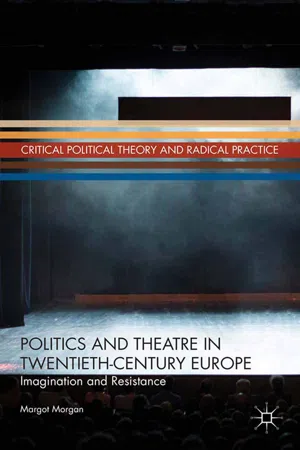
This book explores the connection between politics and theatre by looking at the works and lives of Shaw, Brecht, Sartre, and Ionesco, providing a cultural history detailing the changing role of political theatre in twentieth-century Europe.
- English
- ePUB (mobile friendly)
- Available on iOS & Android
eBook - ePub
About this book
Information
CHAPTER 1

Introduction: Political Theatre and the Theatre of Politics
For thousands of years, the study of politics has been understood as inseparable from the study of social life as a whole. Art, religion, history, politics, and morality were all understood as interconnected, as constituted by and constitutive of one another. To segregate the study of each from the others would have been inconceivable to the ancient Greeks, ancient Romans, medieval Christians, philosophes of the European Enlightenment, Romantics, and the radical intellectuals of the late nineteenth and early twentieth centuries. An ecological conception of politics, which views politics as part of a dynamic whole that is best understood—and possibly, only understood—as a whole, is still operative in many cultures to this day, and it lost its position of dominance in the West only very recently. Today it is simply taken for granted, even among most academic scholars, that politics is politics, and art is art, and the two domains share no obvious or essential connections. But this was not always so.
This widespread assumption has, unsurprisingly, been reflected in the contemporary academy. The organized sections of the American Political Science Association (APSA) traditionally have granted only a minor role to the contribution of art and culture to the modern conception of politics and its study. A review of the programs of recent APSA conferences reveals the pervasive preoccupation with governmental institutions and actors who seek to influence them, whether they be individuals, interest groups, or nongovernmental organizations. The exceptions to this preoccupation—certain types of political theory and the subset of comparative politics that deal with political culture—seem to prove the rule, as they are relatively undervalued and still pressured to conform to the methodological requirements of politics as a social science. Divisions that seek to expand the narrow working definition within which they operate, such as Politics and Literature and Film, often spend much of their energy providing justifications for their very existence as part of their constant quest for recognition and legitimacy.
What is most fascinating about this is that the delimitation of the study of politics to institutions and practices of government is a strikingly recent historical development limited to specific global geographic regions (i.e., the North and/or West). Yet, there seems to be little to no acknowledgment of this fact or of the implications that arise from it in the consciousness of the men and women who spend their lives professionally analyzing “politics.”
My main purpose in this book is to counter this tendency, by identifying the important connections between politics and theatre, and then deploying this perspective to shed light on four of the most compelling, and most political, playwrights of the twentieth century—George Bernard Shaw, Bertolt Brecht, Jean-Paul Sartre, and Eùgene Ionesco.
The present tendency to compartmentalize aspects of the human experience is a deeply rooted result of the liberal “art of separation,” our successful legal division of public life from private life. As Michael Walzer writes, “Society was conceived as an organic and integrated whole . . . Confronting this world, liberal theorists preached and practiced an art of separation. They drew lines, marked off different realms, and created the sociopolitical map with which we are still familiar. The most famous line is the ‘wall’ between church and state, but there are many others. Liberalism is a world of walls, and each creates a new liberty.” 1 In our drive to prevent the state from controlling our private lives, we “depoliticized”2 culture—the production of art, the practice of religion, and the exchange of goods and services—relegating it to the private sphere. Over time, the separation between private and public, art and politics has become naturalized. Because we practice these areas of life separately, we are finding it hard not to think of them as inherently divided.
The compartmentalization of academic disciplines is a reflection of this broader change in the way we conceptualize our world. The division of labor, combined with our faith in positivism as the key to truth, has led us to privilege the scientific and social-scientific disciplines over those in the humanities and the arts. The incentive to make the study of politics as scientific as possible creates a situation in which we narrow our study of human behavior to elements that can be quantified, measured, predicted, and controlled. We learn to see human beings as objects of study and lose the ability to appreciate them as creative subjects. Capricious acts are seen as aberrations of the norm, indicative of problems in the models; when the science is perfected, presumably, there will be no human acts we cannot predict, no human creation that cannot be controlled, and, therefore, prevented.
Yet it is our capacity to imagine that which does not yet exist and our ability to create the new—to “act,” in Hannah Arendt’s terms—that define us as human beings. Spontaneity and creativity are defining characteristics of humanness, and in weeding out that which we cannot measure as unnecessary, burdensome, and problematic, we remove from the human experience what we should be celebrating. The end result may be a totalitarian world, as Arendt feared, or a much more benign future where humans are valued the more they behave like robots; either way, the result of our self-alienation would be a world where the human imagination is snuffed out.
To counter this tendency to compartmentalize and hierarchize aspects of the human experience, we need to remind ourselves of the historical and contingent nature of our current situation. In other words, we need to reimagine the human world as a synthesized whole, where theory and practice, and art and politics, are not only equally valued, but also seen as two sides of the same coin.
A celebration of human agency begins in moments when that agency is exercised and in the realm in which human creativity flourishes more than in any other: the realm of art. The power of art is that it is both the stimulus for and the product of imagination. Art is possibility, it is potential, it is becoming. And when art becomes a tool for introducing social change, our social scientific models often fail us, as the separated realms of human experience combine before our eyes to produce unpredictable outcomes. In these contexts, we can see just how narrow our understanding of the political has become and how we can think about it differently.
Against the mainstream tendency to define “politics” in terms of governmental institutions and the acts of professional political agents, in this study I employ a broader definition that harkens back to a time when politics was considered possible in the course of daily life. Drawing on Arendt, I see politics as the space that exists between and among individuals in their attempt to create the new. Discussing the Athenian understanding of politics, Arendt writes, “The political realm rises directly out of acting together, the ‘sharing of words and deeds.’ Thus action not only has the most intimate relationship to the public part of the world common to us all, but is the one activity that constitutes it.”3 Politics is intersubjectivity, communication, and the commitment to some form of community. It involves taking responsibility for the effects of one’s actions, and a rejection of determinism in all its guises, whether religious, scientific, or deriving from some other source.4 As art is about imagining the new, it has a place in politics—as a source of inspiration, as a tool of reflection, and as a way of communicating ideas that language alone cannot adequately describe. And as the theatre arts are defined by their “imitation of acting”5 in the world—that is, their imitation of political life—they are especially relevant to the study of politics.
This study focuses on moments in recent history when politics and art were regarded as inseparable. More specifically, it focuses on moments when the performance art of the theatre was inspired by politics and, in turn, played a political role. I have chosen to focus on the art of theatre for two reasons: its age and its inherent social quality. Unlike many art forms that have come into being only in the modern era—for example, the novel, the photograph, and the film—theatre has existed since the beginnings of human history. And because theatre was and is designed to foster “a simultaneous collective experience,” like architecture, or the epic poem of ancient Greece,6 it is intimately tied to the public and to truly existing social life.
Like all art, theatre can serve as a window into the life-world of a specific time and place, providing a glimpse of a culture’s value systems, underlying ideologies, and understandings of human nature and the human condition. Yet theatre differs from other art forms in that it is dialogic in structure—the very form of theatre requires interaction between and among human beings. Structurally dependent on human connection, theatre takes as its subject the human condition, and the issues of judgment, affect, power, communication, and change that are intrinsic to humanity. It dramatizes the power of human misunderstandings and conflicts, the problematic nature of morality, and the ways in which unintended consequences can play havoc with human plans, lives, and relationships. According to Arendt, “play-acting actually is an imitation of acting” in the public (political) sphere. This is why she maintained that “the theatre is the political art par excellence; only there is the political sphere transposed into art. By the same token, it is the only art whose sole subject is man in his relationship to others.”7
In political theory, there exists a body of literature on the political importance of theatre; yet it tends to be limited to the study of a specific time and place. Scholars committed to the study of political theatre focus almost exclusively on ancient theatre, particularly that of Greece and Rome. Since the ancients understood politics as inseparable from other spheres of social life, art—and theatre in particular—had a large role to play in politics. Hence, ancient theatre provides ample material for theorists interested in theatre as a tool of civic education in democracies, especially in terms of the way ancient virtues were reflected in and promoted through performance; Aristotle’s notion of catharsis and its role in strengthening political unity through the shared experience of purged emotion; and the way that ancient plays often problematized, and then resolved, tensions within the social order.8 In sum, this literature is helpful in exploring the functioning of healthy democracies, the role of art in education, and the connection between art and democratic politics.
Yet, it is not enough to study the ancients in order to understand the relevance of theatre for politics. Every culture has its own theatrical traditions, and the political role of theatre varies widely from one space to another. What is universal about theatre is its inherently social character, its ability to push its audiences to expand their imaginations, and its ability to simulate on stage what is all too real in society, and to make real on stage what is not quite real in society—and which can thus serve as a spur or an inspiration. Yet, the modern world is very different from that of the ancients, and its theatre serves different functions. The modern world is the world of “the masses”—a political concept that arose as a result of the French Revolution and that has colored our understanding of politics ever since—and home to political movements that did not previously exist: Marxism, Fascism, Communism, and liberalism. In this context, theatre has been used, not only by the state, but also by the masses, by revolutionary groups, and by rebels, students, and political parties. Civic education is no longer monopolized by the state. Estrangement has taken the place of catharsis. Modern circumstances—and the theatre they produce—lead to new questions and new avenues for thinking about politics.
While the importance of ancient theatre is often acknowledged by political theorists, modern theatre is mostly ignored.9 This is true in spite of the fact that theatre has played an important—albeit different—political role in the modern world. For example, in the nineteenth century, theatre served as one of many tools by which France, England, and the United States constituted themselves as nations. Emerging alongside the rise of mass national politics, national popular theatre was a contested space where various interests fought to create—and represent—the identity of “the people.”10 In the twentieth century, theatre functioned as a tool for disseminating state ideology and establishing official narratives of history. The establishment of state-approved theatres in places such as Indonesia, the Soviet Union, and the nations of Eastern Europe was meant to limit the discourse on nationhood and stifle the creative imaginings of dissidents. Yet this was not successful, for theatre also served as a political tool of groups opposed to the state, as a means of expressing dissent and of stoking the desire for change.
In Chile, under the rule of Augusto Pinochet, the state lashed out at theatre companies that produced theatre critical of the president’s actions: hundreds of actors were imprisoned, tortured, exiled, slandered, and/or murdered.11 In the Philippines between 1965 and 1986, similar actions were taken by the state to crush the popular theatre movement. In the fight to end the rule of Ferdinand Marcos, the New People’s Army used theatre as its principal means of cultivating dissent among the people. It organized theatre workshops in which its members worked with villagers to help them develop their own local narratives and performances of repression and resistance. In aiding villagers to practice acts of defiance in the context of a theatrical performance, the army believed it was providing them with the tools necessary to confront the state in real-world contexts. In the terminology of the army, it was producing not actors, but ATORS—artists, teachers, organizers, and researchers—individuals capable of understanding and acting according to their own best interests.12
Over the course of the twentieth century, theatre proved to be a powerful political tool for both the state and its dissidents in Turkey,13 Spain,14 France, Germany,15 Greece,16 the Eastern European bloc, Rhodesia/Zimbabwe,17 Uganda,18 Southern Africa,19 Brazil,20 Argentina,21 India,22 Indonesia,23 Thailand, and South Korea.24 This is not an exhaustive list. And in most of these power contests between the dissidents and the state, engaging in political theatre was an action people were willing to die for. The separation we take for granted in the West between art and politics, between private life and public/political life, is not shared by the rest of the world. There, art is politics and is treated as such.
It is almost exclusively in Western democracies that theatre creators and performers are free to express themselves on stage without the fear of governmental reprisal. Yet ironically, though theatre is “free” to flourish in the West, its existence—not only as a political art but also as a functioning art in any sense—is in jeopardy. Since World War II, the numbers of theaters that have had to close their doors for lack of funds has steadily increased, both in the United States and in Europe. The statistics regarding Broadway—the cornerstone of the US theatre market—reveal troubling trends:25 The household income of the average Broadway theatregoer is $195,000. Eighty-one percent of Broadway play attendees have a college degree compared...
Table of contents
- Cover
- Title
- Chapter 1 Introduction: Political Theatre and the Theatre of Politics
- Chapter 2 George Bernard Shaw: The Theatre of Bourgeois Radicalism
- Chapter 3 Bertolt Brecht: The Theatre of Proletarian Revolution
- Chapter 4 Jean-Paul Sartre: The Theatre of Situations
- Chapter 5 Eugène Ionesco: The Theatre of the Absurd
- Chapter 6 Conclusion: Political Theatre as Political Practice
- Notes
- References
- Index
Trusted by 375,005 students
Access to over 1.5 million titles for a fair monthly price.
Study more efficiently using our study tools.
Frequently asked questions
Yes, you can cancel anytime from the Subscription tab in your account settings on the Perlego website. Your subscription will stay active until the end of your current billing period. Learn how to cancel your subscription
No, books cannot be downloaded as external files, such as PDFs, for use outside of Perlego. However, you can download books within the Perlego app for offline reading on mobile or tablet. Learn how to download books offline
Perlego offers two plans: Essential and Complete
- Essential is ideal for learners and professionals who enjoy exploring a wide range of subjects. Access the Essential Library with 800,000+ trusted titles and best-sellers across business, personal growth, and the humanities. Includes unlimited reading time and Standard Read Aloud voice.
- Complete: Perfect for advanced learners and researchers needing full, unrestricted access. Unlock 1.5M+ books across hundreds of subjects, including academic and specialized titles. The Complete Plan also includes advanced features like Premium Read Aloud and Research Assistant.
We are an online textbook subscription service, where you can get access to an entire online library for less than the price of a single book per month. With over 1.5 million books across 990+ topics, we’ve got you covered! Learn about our mission
Look out for the read-aloud symbol on your next book to see if you can listen to it. The read-aloud tool reads text aloud for you, highlighting the text as it is being read. You can pause it, speed it up and slow it down. Learn more about Read Aloud
Yes! You can use the Perlego app on both iOS and Android devices to read anytime, anywhere — even offline. Perfect for commutes or when you’re on the go.
Please note we cannot support devices running on iOS 13 and Android 7 or earlier. Learn more about using the app
Please note we cannot support devices running on iOS 13 and Android 7 or earlier. Learn more about using the app
Yes, you can access Politics and Theatre in Twentieth-Century Europe by M. Morgan in PDF and/or ePUB format, as well as other popular books in Politics & International Relations & Theatre. We have over 1.5 million books available in our catalogue for you to explore.