eBook - ePub
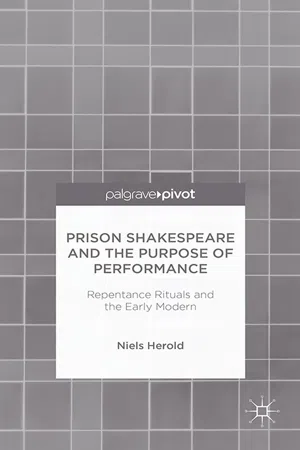
Prison Shakespeare and the Purpose of Performance: Repentance Rituals and the Early Modern
Repentance Rituals and the Early Modern
- English
- ePUB (mobile friendly)
- Available on iOS & Android
eBook - ePub
Prison Shakespeare and the Purpose of Performance: Repentance Rituals and the Early Modern
Repentance Rituals and the Early Modern
About this book
Over the last decade a number of prison theatre programs have developed to rehabilitate inmates by having them perform Shakespearean adaptations. This book focuses on how prison theatre today reveals certain elements of the early modern theatre that were themselves responses to cataclysmic changes in theological doctrine and religious practice.
Information
Subtopic
Art General1
Penitential Communities
Abstract: After describing the conflicted moral attitudes of Shakespeare’s own society to the theater, this chapter shows members of the Shakespeare Behind Bars theater company seeking to reform themselves through Shakespeare performance. Shakespeare Behind Bars is a company of “goodfellows” (Elizabethan for actors, Modern American for criminal rogues) that also functions as a penitential community. The case of the Marine, Lu Lobello, who felt “excommunicated” from the Marine Corp after the war, supplies an example of the way early moderns felt when they were deprived of the penitential religious community Roman Catholicism had provided. Just as Filkins created the means for Lobello to ask forgiveness from the family he wounded during the Iraq War, SBB players construct around their performances of Shakespeare a surrogate penitential community. Their labor resonates with an early modern dramaturgy that had historically claimed ideological independence from an orthodoxy of religious mediation and ordination.
Herold, Niels. Prison Shakespeare and the Purpose of Performance: Repentance Rituals and the Early Modern. New York: Palgrave MacMillan, 2014. DOI: 10.1057/9781137432674.0005.
As a collaborative poet playwright, Shakespeare belonged to a community of theatrical laborers larger than that of the company of players he in part owned and wrote for—a community nevertheless derided by the Puritan William Prynne as “good fellows.”1 Prynne’s ironic epithet for Elizabethan players was meant to remind the zealous faithful that the feisty and enduring world of the theater was indeed a roguish and iniquitous one. Strolling players, after all, had been identified by statute as vagabonds as early as 1572, and, true to the title of his book about them, Prynne’s anti-theatrical diatribe appeared a good ten years after Shakespeare’s death in The Perpetuitie of a Regenerate Man’s Estate (London, 1626).2 In the spirit of both perpetuity and paradox we might note several reiterations of the appellation “goodfellows” closer to us in time. Fast-forwarding first to the outrageous criminality celebrated in Martin Scorcese’s film Goodfellas, according to Wikipedia, “one of the greatest films of all time,” in another prestigious ranking, Scorcese’s depiction of sociopathic monsters comes in “twelfth in the list of films that most frequently use the word “fuck”!3 “Goodfellows,” it so happens, is also the name of an affiliation of independent tax-except charities “whose sole mission is to ensure that there is ‘No Kiddie without a Christmas’.”4 In its own age of communal players and preaching divines, Elizabethan writing about their theater seems to have captured, as if proleptically, the moral doubleness of “good fellows”—“minions of the moon,” as Falstaff temporizes (reveling in the mood) his counter-kingdom of tapsters, thieves, prostitutes, and bawds over which his extensive set of “guts and midriff” preside,” “gross as a mountain, open, palpable,” “that villainous misleader of youth, . . . that old white-beared Satan” (2.5.421 ff.). Whoever performed the part of the “shrewd and knavish” sprite Robin Goodfellow, “that merry wanderer of the night,” he wore two goodfellow hats, those of trickster Puck and the alacritous boy actor in the Lord Chamberlain’s Men.
Whether criminally tax-evading or charitably tax-exempt, communities of fellows then and now have always had a way of proving that what’s good for them may or may not be good for “the nation.” As Jeffrey Knapp put the case in Shakespeare’s tribe, “The godly in churches, the good fellows in alehouses and playhouses: these were the rival camps in which “hot” Protestant writers divided Renaissance England, and their coupling of tavern with theater remains hard to refute” (Knapp 23). Although Knapp’s study of “Church, Nation, and Theater in Renaissance England” begins with theater culture’s insatiable thirst for the devil’s brew, from ale tippling poets to besotted audiences, his historical reference comes to include jail-time for poets (Ben Jonson and Christopher Marlowe, to name two more famous “poets” who did time), fist and knife-fighting, adultery, thievery, and murder: the theater of Shakespeare and his contemporaries bubbled with toil and trouble. But as Shakespeare’s Tribe importantly argues, it was an entertainment industry that espoused a pervasive mission of inclusivist religious moralism. Seeking, like the apostle Paul, “to be all things to all men,” plays more than atoned for their breeding connections to roguishness and criminality. In their realistic and imaginative stagings of a world they sought to educate and reform, playwrights welcomed with open arms the plurality of beholders who made up their multifarious, freely-consenting, devoted, and paying audience.
It is important to keep in mind these originary conditions of the early modern theater while in the following pages we look at a group of goodfellows doing time now, fellows who have fashioned themselves into a semi-professional Shakespeare Theater behind bars, dedicated not only to annual public performances of full-length and fully dressed Shakespeare plays but to the habilitation of themselves through their close engagement with these performance texts. Inmate actors delight in the fact that much of their fun with Shakespeare has to do with playing demi-monde characters such as Mistresses Quickly and Overdone, pickpocketing Autolychus, and the drunk clowns of Alonzo’s shipwrecked party, brought to Prospero’s island for his belated practice upon them of long premeditated revenges—all these characters reveal their true colors as rebellious stage subjects to the social peace. Shakespeare’s confraternity of goodfellow actors was teeming with superimpositions of player and rogue personations, a teaming-up of identities that furnish comically transmuting connections to the worlds SBB inmates now serving time leave behind. Keenly aware themselves of the colorful origins of the theater they re-create inside prison walls, they have transformed themselves into a company of goodfellows that also functions as a penitential community of self-reformers, and their prison theater confronts us with a surprising conundrum: how does the crime-infested if Christian-minded early modern playworld of Shakespeare become for them an agency of personal reform and redemption? What kind of critical pressure, we might ask, would incarcerated circumstances apply to their reading of Prospero’s valedictory couplet: “As you from crimes would pardon’d be, / Let your indulgence set me free.” Do inmates reading or enacting these lines hear themselves addressed, for example, as Prospero’s (Shakespeare’s) audience or as beseeching Prospero-types themselves—that is, beseeching toward those of us outside who have the place and inclination to be merciful toward their crimes? The famous epilogue, moreover, must hint for them at a peculiar spectral resonance, one that must have been heard with equal poignancy in Shakespeare’s time as it can in ours, indeed, whenever The Tempest is performed in uncanny places like prison yards and re-commissioned chapel spaces:
Now ’tis true,
I must be here confined by you
Or sent to Naples. Let me not,
Since I have my dukedom got,
And pardon’d the deceiver, dwell
In this bare island by your spell;
But release me from my bands
With the help of your good hands. (5.1.3–10)
In the Philomath Films documentary, Shakespeare Behind Bars,5 we find ourselves inside a vast correctional complex situated on the agrarian outskirts of a Civil War era town in Kentucky called—an irony surely not lost on those who recall the fourth act of Measure for Measure—“La Grange.” Toward the end of this film we’re in attendance at a public performance of The Tempest by prison inmates who ask us visitors from the outside, like audiences everywhere at all times have been asked, to imagine an after-life to the play Prospero’s epilogue amends, to fantasize about a future for its characters, even as those fictions, like early modern ghosts (so superstition had it) were thought to be dispelled by the clapping of “good hands”6: Put your hands together for us inmate players, deliver us from the fictions we’ve tried faithfully to render but no doubt have marred, and let those fictions find a dwelling place of forgiveness in your after-thoughts about the play. As the documentary artfully shows, these actors have toiled for a full year to bring The Tempest to life so that its theatrical realization can be shared with visiting academic Shakespeareans like myself, with their own family members, with prison authorities and correctional dignitaries, and with the prison guards who in watching them perform never cease “to observe” the committed objects of their surveillance, no matter how cunning the scene they put on. By the same token, the players never put away their identities as numbers in the Kentucky Department of Corrections, even when they’re on stage “in character”; their petitioning to their audience in the words of Prospero’s epilogue must unfold in full consciousness of the play’s closing moment, that while Shakespeare’s audience is walking homeward over London Bridge, or while we’re exiting the prison as easily as we entered 3 hours ago, in 15 minutes they will be remanded to their cells. If one of them has morphed into Prospero during the two-hour traffic of the stage, he remains a character “confined” who cannot leave his magic behind for a life of retirement in Milan.
As I want to ask, what happens to Prospero’s after-thoughts when we extend them into alternative contexts like a prison playing space, which not even Shakespeare’s magister “mouthpiece” in Prospero could have foretold? As he seeks to end the play he’s in, Prospero’s epilogue may sound to us moderns like a distant echo of dramatic closure, but to inmate actors in the SBB program, its language of beseeching forgiveness establishes a connection with something in the early modern text that is to them immediate and relevant. Across a wide divide, Luther Luckett inmates and the early modern plays they bring to life are speaking to each other in important ways about criminality and its consequences—consequences to a “penitential community in exile” behind bars, a community that yearns through Shakespearean enactments for the practice and promise of certain rituals of repentance and renewal.
Peering into the concrete wilde of their penitentiary existence where class differences are replaced by hierarchies of brutality, where ethnic and racial differences are organized and inflamed by tribal allegiances, can feel like looking into the backward “abysm” of an early modern past. The other-worldliness of this life behind bars and what we take for normal outside summon in the mind King Lear’s handy-dandy discourse of mutability—“there but for the grace of God go I”—even as our present certitudes about the Shakespearean “invention of the human” are recognized as having brought us to this juncture:
A man may see how this world goes with no eyes. Look with thine ears. See how yond justice rails upon yond simple thief. Hark, in thine ear. Change places, and, handy-dandy, which is the justice, which is the thief? (4.6.146–149, Conflated Text)
Curt Tofteland, the founding artistic producer of SBB, has written evocatively about the places “inside” and about the “inside” of those inside (“… these men dwell in obscurity on the fringe of society… they are the ‘other’.”); his journey into their world has effectively deconstructed the subjectivity-terms that mark their obscurity and our normalcy: “I have traveled back and forth to the Luther Luckett Correctional Complex in La Grange, Kentucky where some of the worst of us are kept” (emphasis mine) (Tofteland 430). For academic Shakespeareans, prison theater provides an important set of metaphors for reading in to Shakespeare our connections to his past, for releasing the historical “otherness” of his early modern culture.
Early modernists of a certain “presentist” conviction have for a number of years been writing the cultural history of Shakespeare’s time from the viewpoint of our own social and political problems. Whether this reaction is against, from one side, the New Historicist/Cultural Materialist agenda, or from another, an arguably aphasic return to an old historiography, is less my concern in this chapter than situating prison performances of Shakespeare in the context of a Long Early Modernity (longue durée). In The Grammar of Forgiveness, for example, Sarah Beckwith “rehearses some of the attempts to redefine the nature of forgiveness in the peculiar English settlement, when penance is abolished as a sacrament, yet when some of the institutions and speech acts connected with it are still an integral part of the economy of salvation” (Beckwith 35). In such a “presentist” vein, Beckwith’s study of the consequences of the English Reformation to Catholic penitential communities and their practices makes contact with the present through the Forgiveness Project, “a UK based charity that uses storytelling to explore how ideas around forgiveness, reconciliation and conflict resolution can be used to impact positively on people’s lives, through the personal testimonies of both victims and perpetrators of crime and violence.”7 As its website proclaims, “The Forgiveness Project uses the real stories of victims and perpetrators to explore concepts of forgiveness, and to encourage people to consider alternatives to resentment, retaliation and revenge.” The Project’s “aim is to provide tools that facilitate conflict resolution and promote behavioral change. Central to the work is our commitment to work with ex-offenders and victims of crime as a way of modeling a restorative process.”8 Their stories raise a central question of agency for how forgiveness can be handled in a secular society and context, unmediated, that is, by religious intervention. “Who,” Beckwith asks about them from her ea...
Table of contents
- Cover
- Title
- Introduction
- 1 Penitential Communities
- 2 Eating the Text: Shakespeare and Change
- 3 Shakespeare and Incarceration
- 4 Others: There but for the grace of God...
- Epilogue: Underworld of Shadows
- Works Cited
- Index
Trusted by 375,005 students
Access to over 1.5 million titles for a fair monthly price.
Study more efficiently using our study tools.
Frequently asked questions
Yes, you can cancel anytime from the Subscription tab in your account settings on the Perlego website. Your subscription will stay active until the end of your current billing period. Learn how to cancel your subscription
No, books cannot be downloaded as external files, such as PDFs, for use outside of Perlego. However, you can download books within the Perlego app for offline reading on mobile or tablet. Learn how to download books offline
Perlego offers two plans: Essential and Complete
- Essential is ideal for learners and professionals who enjoy exploring a wide range of subjects. Access the Essential Library with 800,000+ trusted titles and best-sellers across business, personal growth, and the humanities. Includes unlimited reading time and Standard Read Aloud voice.
- Complete: Perfect for advanced learners and researchers needing full, unrestricted access. Unlock 1.5M+ books across hundreds of subjects, including academic and specialized titles. The Complete Plan also includes advanced features like Premium Read Aloud and Research Assistant.
We are an online textbook subscription service, where you can get access to an entire online library for less than the price of a single book per month. With over 1.5 million books across 990+ topics, we’ve got you covered! Learn about our mission
Look out for the read-aloud symbol on your next book to see if you can listen to it. The read-aloud tool reads text aloud for you, highlighting the text as it is being read. You can pause it, speed it up and slow it down. Learn more about Read Aloud
Yes! You can use the Perlego app on both iOS and Android devices to read anytime, anywhere — even offline. Perfect for commutes or when you’re on the go.
Please note we cannot support devices running on iOS 13 and Android 7 or earlier. Learn more about using the app
Please note we cannot support devices running on iOS 13 and Android 7 or earlier. Learn more about using the app
Yes, you can access Prison Shakespeare and the Purpose of Performance: Repentance Rituals and the Early Modern by N. Herold in PDF and/or ePUB format, as well as other popular books in Media & Performing Arts & Art General. We have over 1.5 million books available in our catalogue for you to explore.