eBook - ePub
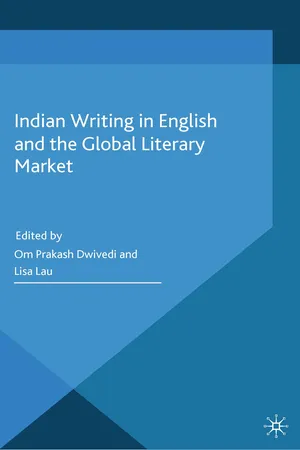
Indian Writing in English and the Global Literary Market
- English
- ePUB (mobile friendly)
- Available on iOS & Android
eBook - ePub
Indian Writing in English and the Global Literary Market
About this book
Indian Writing in English and the Global Literary Market delves into the influences and pressures of the marketplace on this genre, which this volume contends has been both gatekeeper as well as a significant force in shaping the production and consumption of this literature.
Information
Topic
LetteraturaSubtopic
Letteratura generaleMarketing Theory of IWE
1
Writing India Right: Indian Writing and the Global Market
Vrinda Nabar
Writing India
There used to be a story doing the rounds in the 1970s about an Indian poet unsuccessfully attempting to have his poems published in Western literary journals. Frustrated by the repeated rejections and convinced that he was at least as good as many of the poets routinely published by the same journals, he had apparently devised a strategy of adding ‘translated from the original [an Indian language] by the poet’ to the end of his next submission. The strategy worked: his submission was accepted.
Apocryphal or otherwise, this story encapsulates the experienced realities of Indian writing from the ‘margins’ – a term that has, ironically, increasingly come to mean India, even in today’s globalized world. In fact, globalization has increased the centre–margin divide, reversing concepts of centre and margin through new hegemonies governed by the dictates of consumerism and the global markets. It is doubtful whether the Indian poet mentioned above could have been published in the West today merely with the help of a translation tag, for even the exotic is now generally subject to market criteria and to location. This chapter looks at some of the ways in which global Indian writing1 reflects these market compulsions and how geographies of representation in the West may be grounded in the politics of First World/Third World discourse. The complexities of such hegemonies, the impact they have on which ‘India’ gets represented and by whom, and the politics implicit in these are not easy to reconcile, especially when writing about India has for various reasons become the global flavour of the season.
A fairly recent example of this may be seen in Anand Giridhardas’s reaction to Indian criticism of his 2011 book India Calling: An Intimate Portrait of a Nation’s Remaking. Writing in The New York Times after a visit to India to promote this book, Giridhardas had deplored ‘the sensitivity of a segment of the country’s intelligentsia to outsiders who seek to chronicle India’s ways’,2 adding that he was familiar with this kind of ‘sensitivity’, because his parents were from India and he himself had spent long periods there as a newspaper correspondent (for The New York Times, of course). More recently, however, the ‘sensitivity’ had ‘flared into a bout of vigorous literary nativism...’; William Dalrymple’s writing had been critiqued as ‘an act of re-colonization’, Patrick French charged with not knowing the ‘real India’, and Giridhardas himself with displaying a ‘“full-throated Orientalism”’.
Giridhardas also mentioned a report by The Wall Street Journal on this kind of ‘Indian literary feuding’. The report was captioned ‘Who gets to write about India?’, which he saw as a ‘complicated question, not least because to decide who gets to write about India, you would need to decide who gets to decide who gets to write about India.’ Giridhardas’s solution was simple, almost facilely so: ‘Rather than conjecturing some Committee for the Deciding of the Deciding of Who Gets to Write About India, it might be easier to let writers write what they please and readers read what they wish.’
Does Giridhardas really believe that it is that easy? Has working (and Writing About India) for The New York Times made him impervious to the power of gatekeepers and the centre–margin dialectic; or to the real (and valid) questions that the Indian intelligentsia was asking: (a) Who decides that only certain kinds of India material can be published? (b) Why do only people located abroad get to write about India? and (c) Why can Indians who live in India ‘write about India’, but to ‘Write About India’ requires a different pedigree? The issue, moreover, is not merely about writing. It is also about being able to publish what you write and where. Sadly, going by the evidence, it helps if (a), (b) and (c) all work in your favour. For it is significant that the three individuals Giridhardas mentions as victims of ‘literary nativism’ are an Indian from the diaspora (himself) and two Caucasians.
I emphasize the Giridhardas article because it reveals the ambivalence towards India implicit in the responses of Indians in the diaspora, even those like him who, one would like to believe, are sensitive to the nuances of political correctness. It is perhaps natural for Giridhardas to feel defensive. It allows him to obfuscate the real point, that in a so-called globalized world, his positioning allows him the last word on the subject. Moreover, being published in The New York Times gives him access to a global audience that will read and perhaps accept his perspective. Any rebuttal of his arguments by a resident Indian, however well reasoned, would be construed as nativist hysteria. Even The New York Times would in all likelihood have no place for it.3
Meenakshi Mukherjee cites Timothy Brennan’s observation in the late 1980s: ‘What we are seeing is a process by which Western reviewers are selecting as the interpreters and authentic public voices of the Third World, writers who, in a sense, have allowed a flirtation with change that ensures continuity, a familiar strangeness, a trauma by inches’4 (emphasis added). Brennan’s observation is unfortunately just as valid today: as Mukherjee comments, not all outstanding writers from other cultures (writing in English or in English translation) receive this attention: ‘The new receptivity in London or New York may have made it easier for some writers from outside the western world to get a hearing but only within a field of reception already defined by metropolitan parameters and agendas.’5
Whether Giridhardas admits it or not, the decision as to who gets to Write About India (and how) has long been made by some of the most widely circulated Western newspapers and journals and by the markets that they supply and represent. Their selective worldview of India reflects the point made by postcolonial critics who argue that colonialism does not disappear in a postcolonial world but takes on other avatars.
Ania Loomba speaks of the contemporary imbalances between ‘first’ and ‘third’ world nations and the ways in which they reinscribe unequal relations of colonial rule.6 Joanne P. Sharp observes that while postcolonial identities are a result of cultural mixing and hybridization, they are not free combinations, that certain parts of the mix have greater power to influence the direction of change. Examples include the power of English over Arabic as a global language; the constraints of movement over the US–Mexican border for Mexicans over citizens of the USA; and, most relevant to this chapter, the power of the Western imagination to conjure up the exotic East.7
Sharp’s last category is not very different from the Orientalism of colonial times, and it finds expression in countless different ways in the India representations of the Indian diaspora. For instance, according to Giridhardas, the Indian elite resent the new social mobility of the hitherto ‘huddled masses’ that people like him write about, although the newly mobile masses are in turn ‘delighted that … some foreigners … love their country as much as they do’.
This assumption that he is among the first to write about India’s masses (and their allegedly new awakening, which forms the backbone of his book8) and that they love him for it, is, however, not new to the India analysts of the right pedigree referred to earlier, never mind the evidence to the contrary in Indian writing, both in English and in English translation: Premchand, Mulk Raj Anand, Bhabhani Bhattacharjee, U. R. Anantha Murthy, Narayan Surve, Bhalchandra Nemade, Jaywant Dalvi and Namdeo Dhasal, to name just a few. More than 20 years earlier, in India: A Million Mutinies Now (1991), published 26 years after his first visit to India, V. S. Naipaul (who had by then authored two India books) had actually expressed surprise that ‘in the small spaces of Bombay, and with all the crowd and frenzy, there was a living Marathi literature, with all the high social organization that such a literature implied: the existence of publishers, printers, distributors, critics, buyers…’9
To most of the First World, ‘Indian Literature’ meant and still means simply the literature of the diaspora. It is a myth that most diaspora writers appear to be in no hurry to debunk. What is glibly termed ‘globalization’ has unfortunately reinforced unreal stereotypes and essentialized cultural and national spaces, especially in First World/Third World formulations of societies and identities. The centre–margin dialectic is grounded in the power discourse that being positioned in the right place confers on writers and artists who become spokespeople for their country of origin, often making outrageous claims with authority and impunity. Though separated by two generations from India, Naipaul was among the first in a long line of such spokespeople: there are no pensions in India10; the Indian government’s investment in bullock carts is equivalent to its total investment in railways11; the residents of cooperative housing societies in India are generally vegetarians, and the non-vegetarians who live there tie up goats in the yard, kill them and eat them.12 Despite his closer links to the Indian subcontinent, Salman Rushdie has not been exempt from this kind of distortion, literary and otherwise.13
Patrick French’s India: A Portrait (2011),14 to which Giridhardas referred, was written after his authorized biography of Naipaul (2008),15 one of the most thorough studies of the writer. Non-judgemental, French had kept himself out of the biography as far as possible, which is what a good biographer should do. The outcome was a Naipaul with whom one was unfamiliar. Whether French was wholly convincing remains open to debate, but the method humanized Naipaul far more than either his work or his critics have done – something that, perhaps, was long overdue.
However, even the biography contained the kind of perceptions that Indian readers were to critique in India: A Portrait, with French describing An Area of Darkness as ‘the most influential study of India published since independence, offering a passionate analysis of what was wrong and right with the country ... over the next five decades Indians were to show a remarkable willingness to be lectured about their failings by a Trinidadian’.16
Did they? Naipaul had certainly liked to think so. Around the time he reportedly reacted with disarming surprise and disbelief to the news of his having won the Nobel Prize for Literature (2001), he was busy telling those who would listen that Indian intellectuals had been too ignorant to appreciate him some 40 years ago. If Indians saw him differently now, it is because they had ‘improved’: ‘This is one of the things I have helped India with’, he is reported to have grandly told an audience at a literary festival in the UK. Why, thank you, Mr Naipaul!
Indians in India have long learned to handle the diaspora’s flights of fancy about its role in representing (even educating) them. They have taken on the more problematic claims and assertions when necessary, usually in the form of reasoned debate. Those in the diaspora who have grown accustomed to the unquestioned acceptance in the West of their ways of ‘writing India’ have not generally taken kindly to such critiquing from their counterparts on the margins. Naipaul saw it as ignorance, Rushdie as intolerance, Giridhardas as sensitivity rooted in nativism.
Such debates are part of a ‘des-pardes’ (India-diaspora) dialectic, although not necessarily confined to India and the diaspora, and are perhaps inevitable. If the debate has become more vitriolic in recent times, it is because globalization has reinforced binaries wherein ‘human geographies become filled with politics and ideology’.17 As Chris Tiffin and Alan Lawson argue, the hegemony of Europe did not end with the raising of a hundred national flags.18 One may add that this hegemony now extends across the Atlantic, where it has assumed a dominant, defining role. Mukherjee points out that Brennan’s ‘new category of novelists: the “Third World Cosmopolitans”’ was exclusive. The criteria of evaluation were naturally selective and determined by the demands of the recipient culture.19
Salman Rushdie, for instance, had justified his exclusion of regional Indian literature from a special issue of The New Yorker (June 23 & 30, 1997)20 to commemorate 50 years of Indian independence, of which he was guest editor, on the grounds that he knew very little about it. In any case this exclusion did not really matter, said Rushdie imperiously, because all worthwhile post-Independence Indian writing had been in English. Not surprisingly, this specious argument went unchallenged by readers for whom the Rushdie mystique (shining brighter in the post–Satanic Verses era) perhaps camouflaged the fact that he had taken the uninformed and lazy way out or, worse, arrogantly assumed that it was not necessary to commission quality translations. The most charitable thing one could say is that Rushdie may have correctly surmised that the New Yorker’s gesture was mere tokenism and that no one was really that interested in either the truth or in Indian writing from the margins, whether in English or in English translation.
The efforts of postcolonial cultural theorists in the West to address some of these issues have unfortunately not decreased the pervasive power of such hegemonic discourse. For instance, bell hooks writes of havi...
Table of contents
- Cover
- Title
- Copyright
- Contents
- Foreword by Tabish Khair
- Acknowledgements
- Notes on the Contributors
- Introduction: The Reception of Indian Writing in English (IWE) in the Global Literary Market
- Part I Marketing Theory of IWE
- Part II Indian Women Writers
- Part III Indian Men Writers
- Bibliography
- Index
Trusted by 375,005 students
Access to over 1.5 million titles for a fair monthly price.
Study more efficiently using our study tools.
Frequently asked questions
Yes, you can cancel anytime from the Subscription tab in your account settings on the Perlego website. Your subscription will stay active until the end of your current billing period. Learn how to cancel your subscription
No, books cannot be downloaded as external files, such as PDFs, for use outside of Perlego. However, you can download books within the Perlego app for offline reading on mobile or tablet. Learn how to download books offline
Perlego offers two plans: Essential and Complete
- Essential is ideal for learners and professionals who enjoy exploring a wide range of subjects. Access the Essential Library with 800,000+ trusted titles and best-sellers across business, personal growth, and the humanities. Includes unlimited reading time and Standard Read Aloud voice.
- Complete: Perfect for advanced learners and researchers needing full, unrestricted access. Unlock 1.5M+ books across hundreds of subjects, including academic and specialized titles. The Complete Plan also includes advanced features like Premium Read Aloud and Research Assistant.
We are an online textbook subscription service, where you can get access to an entire online library for less than the price of a single book per month. With over 1.5 million books across 990+ topics, we’ve got you covered! Learn about our mission
Look out for the read-aloud symbol on your next book to see if you can listen to it. The read-aloud tool reads text aloud for you, highlighting the text as it is being read. You can pause it, speed it up and slow it down. Learn more about Read Aloud
Yes! You can use the Perlego app on both iOS and Android devices to read anytime, anywhere — even offline. Perfect for commutes or when you’re on the go.
Please note we cannot support devices running on iOS 13 and Android 7 or earlier. Learn more about using the app
Please note we cannot support devices running on iOS 13 and Android 7 or earlier. Learn more about using the app
Yes, you can access Indian Writing in English and the Global Literary Market by O. Dwivedi, L. Lau, O. Dwivedi,L. Lau in PDF and/or ePUB format, as well as other popular books in Letteratura & Letteratura generale. We have over 1.5 million books available in our catalogue for you to explore.