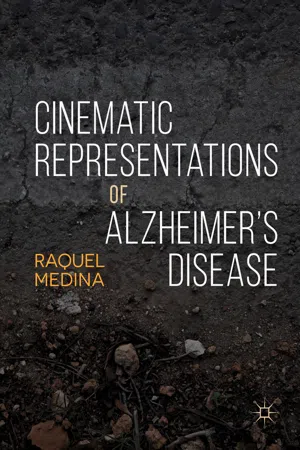
This book offers a cross-cultural approach to cinematic representations of Alzheimer's disease in non-mainstream cinema. Even though Alzheimer's disease, the most common form of dementia, is a global health issue, it is not perceived or represented homogenously around the world. Contrary to very well-known mainstream films, the films discussed do not focus on the negative aspects normally associated with Alzheimer's disease, but on the importance of portraying the perspective of the persons living with Alzheimer's and their personhood. Similarly, this book analyses how the films use Alzheimer's as a trope to address issues relating to different areas of life and society such as, for example, family matters, intergenerational relationships, gender issues, national traditions versus global modernity, and caring for people with dementia. By examining an array of films, from crime fiction to documentary, that each present non-stigmatising representations of Alzheimer's disease, this in-depth study ultimately demonstrates the power of culture in shaping meaning.
- English
- ePUB (mobile friendly)
- Available on iOS & Android
eBook - ePub
Cinematic Representations of Alzheimer's Disease
About this book
Information
Subtopic
Film & Video© The Author(s) 2018
Raquel MedinaCinematic Representations of Alzheimer’s Diseasehttps://doi.org/10.1057/978-1-137-53371-5_11. Introduction
Raquel Medina1
(1)
School of Languages and Social Sciences, Aston University, Birmingham, UK
In 2010 I was invited to present a paper on one of my favourite Spanish female poets, Juana Castro, who was also going to speak at the conference. When I accepted the invitation, I decided to explore her 2005 book of poetry Dark Bodies (Los cuerpos oscuros), which had been awarded the prestigious Jaén Poetry Prize (Premio Jaén de Poesía). Dark Bodies is a collection of poems written by Juana Castro during and after the time that she had to look after both of her parents, both living at the same time with Alzheimer’s disease. While her 1982 poetry book devoted to the death of her child had had a profound impact on me, the reading of Dark Bodies opened my mind to the world of Alzheimer’s disease. The lyricism, beauty, and love encapsulated in these poems did not prevent the soreness of the experience as both daughter and caregiver from emerging, but it was shaped in a way that celebrated life, despite what the title of the book might initially indicate: pain is transformed into beauty.
Prior to reading Castro’s book and writing about it (Medina 2012), my relationship with dementia had been merely linked to my role as a reader and viewer of the news. For instance, a few years before I read Castro’s book , two important Spanish politicians disclosed that they had been diagnosed with Alzheimer’s disease. In 2005, it was announced that Adolfo Suárez —the first Prime Minister appointed by the King Juan Carlos I after the dictator Francisco Franco’s death in 1975—had been diagnosed with the disease ; this news was followed in 2007 by the news that Pasqual Maragall , Barcelona’s mayor during the 1992 Olympic Games and later President of the Generalitat de Catalunya, also had Alzheimer’s. 1 The very same year in which Maragall gave a press conference to announce that he had been diagnosed with Alzheimer’s disease, Adolfo Suárez received a home visit from King Juan Carlos I of Spain . A photograph taken by Suárez’s son of that encounter was sent to the press as a record of the event. The photograph showed the King and the former Prime Minister walking away from the camera, thus not showing their faces. After the photograph had been widely circulated, Adolfo Suárez ’s son told the press that his father had not recognised the King. This was the last time the former Prime Minister was seen in public . By contrast, Pasqual Maragall ’s public announcement served as the starting point of his advocacy and support for, and campaigning on behalf of, the search to find a cure. Even today, almost a decade after being diagnosed, Maragall continues to make some public appearances, clearly demonstrating the need to normalise what it means to live with Alzheimer’s disease. The contrast between hiding and displaying what it is to live with Alzheimer’s struck me as something which represented two opposite perceptions of Alzheimer’s, the private and public: it is seen on the one hand as a stigmatic disease , and on the other as a disease with no cure, that should not be hidden.
In his book of memoirs, My Last Sigh (1983), Luis Buñuel devoted the first chapter to the effects of ageing in the subject ’s memory, the main effect being that of forgetting . Having witnessed his mother’s lost battle against forgetting , Buñuel expresses his anxiety about facing the same health problem.
I’m overwhelmed by anxiety when I can’t remember a recent event, or the name of a person met in recent months, or the name of a familiar object. I feel as if suddenly my whole personality has disintegrated … The obligation to find a metaphor to describe ‘table’ is a monstrous feeling, but I console myself that there is something even worse—to be alive and yet not recognize yourself, not know anymore who you are… You have to begin to lose your memory, if only in bits and pieces, to realize that memory is what makes our lives. Life without memory is no life at all … Our memory is our coherence, our reason, our feeling, even our action. Without it, we are nothing. (Buñuel 2003, 4–5) 2
Buñuel’s words serve as an excellent example of the fear we have as individuals with regards to losing our memories, and our inclination to associate memory with well-being and being alive. Almost 35 years after Buñuel published his memoirs, dementia has become a global matter of concern. Dementia is predicted to affect 25–30% of the over-65s in developed countries by 2050, and it is present in many areas of our society, from family relations to policymaking. The need to address the health and social problems that dementia is creating globally, nationally, and locally appears simultaneously in many different disciplines: medicine, pharmaceutics, biotechnology, social sciences, care practices, health policies , architecture, and culture . For instance, as early as 1994 one could find a description of Alzheimer’s as the epidemic of the twenty-first century in the Spanish newspaper El País (Sánchez 1994). Since then, and during the first decade of this century, not only has the labelling of Alzheimer’s disease as an epidemic burgeoned but also new concepts have become attached to it, such as ‘tsunami ’ and ‘challenge ’. These labels have been regularly used by the media , national governments, and international institutions , so it is not surprising that they have had a double impact on the public . On the one hand, neo-liberal agendas have been persistently highlighting two ‘challenges’ for national budgets: that of the ageing population and that of dementia . Having to fund pensions and provide healthcare for a longer period are areas that have created clear divisions between the young and the old, with old age being blamed for the pressure on financial resources to fund welfare systems. On the other hand, the sense of horror associated with dementia that has been introduced to the public through a variety of cultural texts has alarmed and increased anxiety about it in public opinion ; this applies to especially the fear of becoming a zombie, a hollow body (Behuniak 2011; Bitenc 2012; Zeilig 2013). I consider these depictions, which stereotype and dehumanise people living with dementia , to b...
Table of contents
- Cover
- Front Matter
- 1. Introduction
- 2. Old Age and Alzheimer’s Disease in Film
- 3. Intergenerational Interactions and Alzheimer’s Disease
- 4. Gender and Alzheimer’s Disease: The Power of Words, Herbs, Water, Veils, and Mountains
- 5. Agency and Masculinity in Alzheimer’s Disease: Cortex (2008) and The Memory of a Killer (2003)
- 6. Recovering the Past: Historical Memory and Alzheimer’s Disease
- 7. Conclusion
- Back Matter
Trusted by 375,005 students
Access to over 1.5 million titles for a fair monthly price.
Study more efficiently using our study tools.
Frequently asked questions
Yes, you can cancel anytime from the Subscription tab in your account settings on the Perlego website. Your subscription will stay active until the end of your current billing period. Learn how to cancel your subscription
No, books cannot be downloaded as external files, such as PDFs, for use outside of Perlego. However, you can download books within the Perlego app for offline reading on mobile or tablet. Learn how to download books offline
We are an online textbook subscription service, where you can get access to an entire online library for less than the price of a single book per month. With over 1.5 million books across 990+ topics, we’ve got you covered! Learn about our mission
Look out for the read-aloud symbol on your next book to see if you can listen to it. The read-aloud tool reads text aloud for you, highlighting the text as it is being read. You can pause it, speed it up and slow it down. Learn more about Read Aloud
Yes! You can use the Perlego app on both iOS and Android devices to read anytime, anywhere — even offline. Perfect for commutes or when you’re on the go.
Please note we cannot support devices running on iOS 13 and Android 7 or earlier. Learn more about using the app
Please note we cannot support devices running on iOS 13 and Android 7 or earlier. Learn more about using the app
Yes, you can access Cinematic Representations of Alzheimer's Disease by Raquel Medina in PDF and/or ePUB format, as well as other popular books in Media & Performing Arts & Film & Video. We have over 1.5 million books available in our catalogue for you to explore.