eBook - ePub
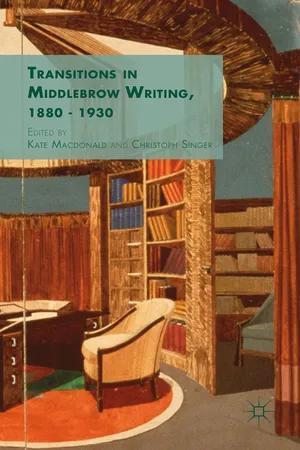
Transitions in Middlebrow Writing, 1880 - 1930
- English
- ePUB (mobile friendly)
- Available on iOS & Android
eBook - ePub
Transitions in Middlebrow Writing, 1880 - 1930
About this book
This book examines the connections evident between the simultaneous emergence of British modernism and middlebrow literary culture from 1880 to the 1930s. The essays illustrate the mutual influences of modernist and middlebrow authors, critics, publishers and magazines.
Information
1
Introduction
Transitions and Cultural Formations
Kate Macdonald and Christoph Singer
British popular and avant-garde literatures from the late nineteenth and early twentieth centuries are often conceptualized as dichotomies, as mutually exclusive opposites. The trajectory of their taxonomies, from the lowbrow and mass market to the middlebrow to the highbrow, appears to be clearly delineated. Their respective authors, genres, magazines and publishers are allocated their places, their cultural functions and their critical merits. Yet this normative and often very synchronic approach stands in the way of understanding the transitional elements of culture(s), their perception, and most importantly their production. The period from 1880 to the 1930s is critical in this respect. The transition from the Victorian to the Edwardian period, from the Boer Wars to the end of the First World War, manifested in many changes in the political, social, economic and scientific domains. In the words of Christopher Lane, the end of the long nineteenth century resulted in an ‘Age of Doubt’. In historicizing such an age of epistemic ruptures, however, it is equally dubious to simply accept strict taxonomies as outlined above, rather than trying to identify their transitional nature. One person’s establishment norm is another person’s avant garde. Raymond Williams was aware of this, writing in the 1950s:
The temper which the adjective Victorian is useful to describe is virtually finished in the 1880s; the new men who appear in that decade, and who have left their mark, are recognisably different in tone. To the young Englishman in the 1920s, this break was the emergence of the modern spirit, and so we have tended to go on thinking. But now, in the 1950s, the bearings look different. The break no longer comes in the generation of Butler, Shaw, Wilde, who are already period figures. For us, our contemporaries, our moods, appear in effect after the war of 1914–18. [...] As a result we tend to look at the period 1880–1914 as a kind of interregnum. It is not the period of the masters, of Coleridge or of George Eliot. Nor is it the period of our contemporaries, of writers who address themselves, in our kind of language, to the common problems that we recognise.1
By examining identifiable transitional works and producers, the chapters in this volume consider the contemporary reception of works produced at the dawn of what would be later called middlebrow writing. The chapters also consider our present-day responses, looking for evidence of how reading and literature developed in what Williams called an interregnum, that brought forth the avant garde and consolidated a new taste for middlebrow reading. The contributors to this volume look closely at the late-Victorian, Edwardian and First World War years, in which works of fiction and literary culture that bear clear relationships to middlebrow ideas were published. We also consider the transition of ideas and themes, to discern when or whether a divide existed, and how better to reconsider how the literature of the early twentieth century was read and judged, and by whom.
The sense of an exclusive separation between works of British modernism and all that was not avant garde is now regarded as unhelpful for a proper understanding of this period and culture. Nicola Humble has observed change in how middlebrow has been perceived:
It has become increasingly apparent that the entire category [of middlebrow] is provisional, existing only ‘under description’. For many of those interested in the area, its provisionality is precisely what draws us to its study, but there is nonetheless a tendency for notions of the middlebrow to harden in debate, for it to be seen as a fixed category with a securely-bounded canon.2
In the early years of the twentieth century the increase in modernist and avant-garde writing in Britain displaced realism in literature from its previous position, in Bourdieu’s sense, as the only ‘legitimate’ form of culture. In the first decades of the century the approval of contemporary critics for the ‘highbrow’ avant garde moved from marginality to assume mainstream intellectual validity. This produced the corollary that all that was not ‘highbrow’ became excluded from increasingly influential critical approval. Works of an advanced and experimental nature were awarded a cultural value far greater than those which were not avant garde, whose authors were assumed to have inadequately middling literary aspirations or a mediocre quality of readers.
It began to be noticed that cultural production was no longer a dyad (solid, worthy, respectable; versus low, sensational, disposable) but tripartite. In the literary domain, ‘lowbrow’ had the clearest lineage: emerging from serialized sensation fiction and the penny dreadful periodicals of the nineteenth century, by way of the new form of the short story and the new genres of, for example, the detective, the thriller, the romance, and the anarchist plot. Its mode was formulaic, and its medium as often the weekly or monthly fiction magazine as the hard-bound novel. ‘Highbrow’ meant texts that required intellectual effort, challenged established mores and ideals, and demanded close attention. ‘Highbrow’ authors modified existing forms in pursuit of a new expression, and appeared in design-led media that paid little attention to commercial survival, being focused on aesthetic or radical projects. The third member of this grouping, ‘middlebrow’, did not emerge from nowhere, but was also not simply a downgraded version of the classical realist Victorian novel. Middlebrow fiction was driven first by the economics of a new readership rather than a literary impulse, emerging as established ways of selling stories changed from hefty and high-priced three-volume books, to the cheap edition and the multiple edition sold at different prices for a range of readers. The rapidly enlarging middlebrow readership of the turn of the century is normally categorized by its recent acquisition of literacy, and its new economic power. These readers required stories to enjoy, classic texts to study, poetry to respond to, and works of thought and theory to learn from. Lasting (re-readable) entertainment and auto-didactism co-existed on the middlebrow bookshelf, and the price of these texts was often as important a factor in their purchase as their content. Yet it would also be misleading to only consider a ‘middlebrow’ reader. Middlebrow reading was available to all, and highly productive authors, such as H G Wells, could deliver novels for readers from all three areas on the cultural continuum.
Yet, middlebrow has often been considered as monolithic, a stage on the way from low reading to high appreciation. In the 1920s British critics and popular commentators imposed order and a hierarchy of cultural values, arranging the indicators of cultural degree on a continuum of taste, which escalated into the ‘Battle of the Brows’. Even in this, there was complexity in the mix of different perspectives. John Baxendale has noted that:
If some saw the power of Hollywood and the popular press as the surrender of culture to the lowest common denominator, others regarded the novels of James Joyce and Virginia Woolf, the music of Stravinsky, the sculpture of Jacob Epstein and the paintings of the post-Impressionists as a deliberate attack against decency and popular taste on the part of a snobbish and self-indulgent “highbrow” elite; while yet others damned both Ulysses and the Daily Express as irrefutable evidence that the culture was going to the dogs.3
Awareness that these cultural divisions caused dissent began to appear in print in the early 1920s when ‘middlebrow’ was first used in popular media. The term seems to have reached a nadir of denigration in the early 1930s, when this defence of middlebrow values and identity in the weekly newspaper London Opinion appeared, in August 1930.
In the matter of public exhibition the ‘high’ and the ‘low’ have had it all their own way. The one has slung its arrows, the other its bricks, across this fair, smiling country of the ‘in-betweens’, and the in-betweens have looked up, wondered what all the fuss was about, and gone on with their job.
Frankly, we like this middlebrow country: it comprises the majority of decent men and women, and seems to us to stand for balance, sanity, substance, humour, the best of both worlds.
It lacks the precious posturing of the one extreme, the crude sensationalism of the other – which is probably why it is just taken for granted. […]
It does not represent solely the ‘middle-class’ or even the middle-aged, but bridges all classes and ages and most activities.
It is probably six people out of every ten one passes in city or village street, and so it has, in the end, the casting vote. It counts.4
This extract is part of an extensive commentary on what middlebrow meant at the beginning of the 1930s to those who claimed the appellation for themselves. It will not have been the only commentary from this period, or earlier, since it is a robust rejoinder, confident in the approval of its readers, to the privileging of the cultural taste of an approved minority. London Opinion is an example of the unexamined evidence of middlebrow cultural production in twentieth-century Britain that we present in this volume.
The modern critical literature on middlebrow rarely reproduces such positive remarks about middlebrow from a contemporary source, which has produced an impression that to be a middlebrow writer or reader in the interwar period in Britain was to fight a rearguard action, always on the defensive, and always culturally in the wrong. On examining the context we see that this cannot have been the case. Innumerable copies of novels and fiction magazines published in Britain over the decades offered reiterations to millions of middlebrow tastes in reading, and advertisements of what these readers were expected to buy, read, use and wear. As a vehicle for the propagation of middlebrow taste, fiction reinforced existing values and explored the extent of how middlebrow was one of several ways of reading and listening for pleasure and leisure. It was one way among several, but it was nonetheless ‘legitimate’.
The production, consumption and critique of middlebrow writing in Britain in the interwar period is now well understood, but remains less known at its beginnings. The earliest known use of ‘middlebrow’, at the time of this writing, dates from 1923.5 Its birth date is unknown, and may not exist in terms of the publication of a specific work. While the search for earlier examples of the use of the term ‘middlebrow’ in the public domain will help identify moments when a particular readership was expected to understand its meaning and socio-political significance in their casual reading, these are only pins in a timeline. More understanding can be gained from arrays of cultural evidence that had longer-term effects than those of a single feature in a daily newspaper. To understand better how middlebrow emerged in Britain as a cultural formation in the early years of the twentieth century, developing ‘different relations with broader trends in society’,6 we will learn more from the publication of a novel that sold well in several editions, or from the career trajectory of a novelist with a consistent record of production, or the marketing practices of a periodical that succeeded for many years in a difficult and crowded market. Long-term studies colour in the background, while analyses of a single work will provide representative detail.
To discern the impetus that drives a movement or a cultural phenomenon we need to examine its relationships with parallel cultures, and with its market as well as its producers. The difficulty with studying middlebrow in that way is that it never had any organization, and had no standard-bearing leaders or advance forces. Modernism had Futurists, Impressionists and Vorticists to attract the public’s attention and prime the market for the production of avant garde literature and art in the 1910s. There was no such trumpet-blast of a moment for middlebrow. Middlebrow never had its own manifesto. Middlebrow emerged as a miasmic force, an uneffaceable cultural presence that existed through market forces despite the semi-organized efforts of some modernist critics to restrict and shame its consumers. Innate conservatism in British readers and the newly consolidating middle-class marketplace for reading material, combined with a particularly British taste for the ordinary and recognizable in their leisure reading, enabled middlebrow to flourish as a counter to critical efforts to change what the modern reader ought to read.
Raymond Williams’s typology of the cultural formation is a useful way to think about what was happening to middlebrow at this time, because it includes two forms under which middlebrow might be considered: ‘“alternative” (which provide for forms of work excluded by present institutions); and “oppositional” (which directly oppose existing institutions and the social and political conditions which uphold them)’.7 If we consider middlebrow as an alternative cultural formation we become attentive to its function as a means of expression for those who read and wrote in parallel to the voices of the avant garde, dealing with similar subjects, perhaps, but in alternative ways. If we posit middlebrow as an oppositional formation, a suggestion of aggression is introduced that, so far, has not yet been found in the production of middlebrow. Middlebrow culture was denigrated by critics, whereas criticisms of the avant garde came from consumers. It is very uncommon (even allowing for the lack of evidence noted above) to hear the voice of British middlebrow readers and writers speaking consciously as middlebrow, rather than just readers or writers. If middlebrow were a true oppositional formation, middlebrow novels would routinely attack and expose the avant garde with accusations of, for example, pretentiousness and sham: it is not evident that they do. Rather, it is not uncommon in a middlebrow novel, in which aspects of ordinary, recognizable daily life are described with literary craftsmanship, for readers who read for pleasure and escape, not instruction, for its characters to attend an avant garde event or speak of a modernist work of art with respect and interest, but yet do not associate themselves so wholly with it as to invite readers to embrace the avant garde as well. Rather, there is room in a middlebrow novel for all tastes and cultures, since policing and exclusion was not part of the middlebrow project, if there can be said to have been one. Middlebrow culture offers an alternative formation for the understanding and appreciation of literature, art and music, without didacticism, and with confidence in its appeal to consumers. By reconsidering the period of the emergence of middlebrow in terms of the emergence of an alternative cultural formation, which enabled a transition between Victorian to the modern, we may gain a greater understanding of why middlebrow was produced, and for whom.
The boundaries of the scholarly study of modernism are also being rethought. The concept of what is modernist is being expanded, to recover forgotten producers and media, with the effect of accommodating less classically avant-garde material, and cultural productions that are a response to modernity rather than quintessentially modernist. Kristin Bluemel’s 2009 essay collection Intermodernism expresses this trend well, as does a recent conference in the UK on ‘Alternative Modernisms’ (Cardiff, 2013). In 2013 the Modernist Studies Association (MSA) described itself as ‘devoted to the study of the arts in their social, political, cultural, and intellectual contexts from the later nineteenth- through the mid-twentieth century ‘.8 By not prescribing modernism as a sine qua non for the period, this is a newly inclusive and welcoming stance that i...
Table of contents
- Cover
- Title
- Copyright
- Contents
- List of Figures and Tables
- Notes on Contributors
- 1 Introduction: Transitions and Cultural Formations
- 2 What People Really Read in 1922: If Winter Comes, the Bestseller in the Annus Mirabilis of Modernism
- Part I The Market
- Part II Middlebrow Reactions
- Part III Cross-Pollinations
- Bibliography
- Index
Trusted by 375,005 students
Access to over 1.5 million titles for a fair monthly price.
Study more efficiently using our study tools.
Frequently asked questions
Yes, you can cancel anytime from the Subscription tab in your account settings on the Perlego website. Your subscription will stay active until the end of your current billing period. Learn how to cancel your subscription
No, books cannot be downloaded as external files, such as PDFs, for use outside of Perlego. However, you can download books within the Perlego app for offline reading on mobile or tablet. Learn how to download books offline
Perlego offers two plans: Essential and Complete
- Essential is ideal for learners and professionals who enjoy exploring a wide range of subjects. Access the Essential Library with 800,000+ trusted titles and best-sellers across business, personal growth, and the humanities. Includes unlimited reading time and Standard Read Aloud voice.
- Complete: Perfect for advanced learners and researchers needing full, unrestricted access. Unlock 1.5M+ books across hundreds of subjects, including academic and specialized titles. The Complete Plan also includes advanced features like Premium Read Aloud and Research Assistant.
We are an online textbook subscription service, where you can get access to an entire online library for less than the price of a single book per month. With over 1.5 million books across 990+ topics, we’ve got you covered! Learn about our mission
Look out for the read-aloud symbol on your next book to see if you can listen to it. The read-aloud tool reads text aloud for you, highlighting the text as it is being read. You can pause it, speed it up and slow it down. Learn more about Read Aloud
Yes! You can use the Perlego app on both iOS and Android devices to read anytime, anywhere — even offline. Perfect for commutes or when you’re on the go.
Please note we cannot support devices running on iOS 13 and Android 7 or earlier. Learn more about using the app
Please note we cannot support devices running on iOS 13 and Android 7 or earlier. Learn more about using the app
Yes, you can access Transitions in Middlebrow Writing, 1880 - 1930 by K. Macdonald, C. Singer, K. Macdonald,C. Singer in PDF and/or ePUB format, as well as other popular books in Literature & Literature General. We have over 1.5 million books available in our catalogue for you to explore.