Roy Jenkins brought great talent to Europe's top job. He played a key role in re-launching European monetary integration, winning the right to attend the new global summits, and smoothing Greece's path to EC membership. But he fell short of other targets. Commission reform remained elusive, as did an improvement of the UK's troubled relationship with the EC. Indeed the row over Britain's contribution to the EC budget, meant that Britain's position in Europe was as difficult when he left Brussels as it had been when he arrived. This study will look at how Jenkins approached his role, identifying his priorities, examining his working methods, and exploring his rapport with the European and international statesmen with whom he had to work. In the process, the book will shed light on the nature of the job, on Jenkins' own talents and limitations, and on the European Community as it struggled with the global economic crisis of the 1970s.
eBook - ePub
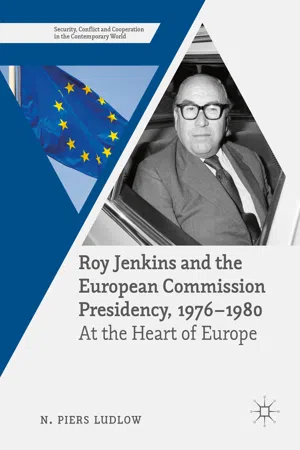
Roy Jenkins and the European Commission Presidency, 1976 –1980
At the Heart of Europe
- English
- ePUB (mobile friendly)
- Available on iOS & Android
eBook - ePub
Roy Jenkins and the European Commission Presidency, 1976 –1980
At the Heart of Europe
About this book
Information
© The Editor(s) (if applicable) and The Author(s) 2016
N. Piers LudlowRoy Jenkins and the European Commission Presidency, 1976 –1980Security, Conflict and Cooperation in the Contemporary World10.1057/978-1-137-51530-8_11. Introduction
N. Piers Ludlow1
(1)
London School of Economics, London, UK
Roy Jenkins was a remarkable politician who assumed the post of Commission president at a crucial time. Between 1977 and 1980 he found himself at the heart of a European Community that was in a troubled state, its institutions and policies struggling to cope with the global economic crisis underway since 1973. Jenkins’ own country, meanwhile, still appeared unable to come to terms with its ‘European choice’, uncertain whether its recently attained membership of the European Community was a help, a hindrance, or an irrelevance at a moment when the UK’s economic performance and political fortunes reached a post-war nadir. And Jenkins himself was at a personal moment of flux, his earlier rapid ascent towards the very summit of British politics interrupted by electoral misfortune and the changing mood of the Labour Party, the attainability of both his European and domestic ambitions undermined by the increasingly polarised nature of British domestic politics during the 1970s.
The aim of this book is to paint a closely observed portrait of the Jenkins presidency. By so doing it will provide a detailed study of a job, the Commission presidency—a job which is often referred to, yet little understood. A well-documented examination of how one talented and energetic politician sought to impose himself on the position, and the degree to which his ambitions succeeded or failed, will reveal much about the nature of the post and, more broadly, the strengths and limitations of the role that the European Commission is called upon to play. Far too political to be just a technocrat, but lacking the electoral mandate or the clout and influence that comes from occupying a leadership role within one of the larger EC member states, Jenkins as Commission president sought to engage with the European leaders of the era and win them over to his position on a wide range of European issues. His successes in doing so say much about the potential importance of the role; his even more numerous failures, by contrast, speak volumes about its inherent limitations. And a close engagement with how Jenkins operated as president, what he sought to do, what he achieved, and how he fell short, will also act as valuable foil to the much better studied Commission presidency of Jacques Delors. Jenkins’ successor-but-one dominates current scholarly writing about the Commission’s top job. An in-depth investigation of how an earlier and somewhat less successful president fared in the same post will therefore enrich our understanding of the position, and throw into sharper relief some of the methods, approaches, and innovations that helped Delors become the most powerful Commission president to date.
The book will also be a study of a man, or at least the very human story of one man’s engagement, both frustrating and rewarding, with a cause and a process of which he had become a prominent advocate. Jenkins’ career had become closely associated with the cause of European integration and the idea of Britain’s participation in that process. There was therefore logic to Jenkins’ decision to withdraw from British politics following the frustration of his ambitions to lead the Labour Party, and to concentrate instead on playing an active role in the integration process. How he fared—and how he regarded his 4 years in Brussels—reveals much not just about his post but also about his personality, his capabilities, and his limitations. This book will also therefore be a biographical contribution to a short, but interesting, important, and less well studied, chapter of Jenkins’ life.
It will be a study too of a brief moment when it seemed that Britain’s pro-Europeans, of whom Jenkins was one of the most prominent, might finally be able to exercise a degree of that leadership role which much of the UK political elite had assumed that they would automatically inherit upon joining the EEC, but which had proved stubbornly elusive for most of the early years of membership. The waning of such hopes, and Jenkins’ painful discovery of how little able he was to influence the evolution of the UK debate about the EEC from his Brussels vantage point, will be one of the sub-plots that run throughout the chapters that follow.
Lastly, the book will provide a snapshot of a vital period, both in Western Europe and in the world more generally.1 The late 1970s were a time when the leading Western powers were still attempting to comprehend the cessation of the lengthy period of economic growth and prosperity that they had enjoyed since the end of the Second World War. Over 20 years of almost continuous economic advance had come to an abrupt halt in the first years of the decade. Furthermore, the boom had ended in a fashion that seemed to challenge most of the basic assumptions about how growth could be secured and what policies were best designed to provide it.2 The relevance and value of European integration itself was suddenly unsure. Most of the founding members of the EEC had viewed their participation in the process of ever-closer cooperation with their neighbours as part of the formula that had helped underpin their almost ceaseless economic growth. Now that that growth had come to an end, however, what did this say about the value of integration? Was it part of the solution needed to rediscover economic advance? And if so, how should it change and what objectives should it aim at? Or was it instead another feature of the previous economic template that needed to be jettisoned in light of the economic downturn?
Also particularly challenging for Western Europe was its vulnerability to another of the salient features of the period, namely the sudden rise in oil prices and the realisation of how dependent was Western prosperity on energy and other resources flowing towards Europe, North America, and Japan from the countries of the developing world.3 Debates about ‘producer power’, about the need to lessen the ever-growing consumption of primary resources and especially of oil, about the proper relationship between the rich countries of the North and the poorer countries of an increasingly organised and militant Global South, and about how the North could organise itself so as to lessen its vulnerability, were very much a feature of these years.4 And alongside this new North–South axis of debate and confrontation, the 1970s also saw the persistence of the more established East–West conflict. This too was changing, though, the 1970s seeing the ebb and flow of détente, at its apogee in the middle years of the decade, in trouble by its end, as well as the continuation of a trend away from the superpower dominance of the early Cold War and towards greater multipolarity.5 Several European countries, either individually or collectively, hoped to benefit from this lessening of the indisputable American leadership of the Western bloc, thereby adding a further interesting but complex dynamic to the list above.6 And finally it was a period where the political stability of Western Europe itself seemed to be challenged not so much by the menace of terrorism, serious though this became in several European countries during these years, but much more by the collapse of dictatorships in Portugal, Greece, and Spain and the instability, but also the opportunities, that this collapse seemed to bring.7 Worrying too was the rise of communist electoral success, particularly in Italy but also in France during this period.8 Most of these problems and trends left some trace on the dossiers that crossed the Commission president’s desk and in the conversations that Jenkins had with most of the Western leaders of his time. A detailed study of what he said and how he regarded some of these issues can thus offer a valuable, if tightly focused, view of a rich and eventful period of recent history.
The pages that follow will thus have four main purposes. First and foremost they will be a study of the role that Jenkins filled, a portrayal of a presidency that will shed light not just on what Jenkins was and was not able to do, but also permit a better understanding of how his predecessors and successors have fared. Second, the book will offer an in-depth biographical contribution to a period in Jenkins’ life that has been less well captured by most of the existing literature. Third, it will add a further chapter to the troubled tale of Britain’s difficult relationship with the European Community/Union. And fourth, the study will offer one individual, but distinctive, vantage point from which to better understand the challenges and complexities facing both Europe and the wider Western world in the latter half of the 1970s.
A Unique Source Base
This close-up portrayal of Roy Jenkins’ 4 years as Commission president is made possible by a very full and highly distinctive source base. Indeed, this book differs from most other articles or books that I have written in as much as the source base led to the project, rather than the project defining the source base.
The roots of my decision to write a study of the Jenkins’ presidency lie in my earlier participation in a team of historians assembled to write a history of the European Commission during the period from 1973 to 1986. In order to produce this volume, those taking part in the project were granted extensive access to the Commission archives for the years in question. This was, for many of us, one of the key attractions of taking part. But we were also very strongly encouraged by the European Commission itself which was financing the project, and by Michel Dumoulin, who had assembled the consortium that was to write the volume, to interview over 200 of those who had worked in Brussels during the 1970s and the first half of the 1980s. Like the first volume of Commission history covering the 1958–72 period published in 2007, this analysis of a second tranche of the Commission’s past was to rest on oral sources and eyewitness testimonies as much as on archival documents.9
To make it feasible for a relatively small team of historians to interview so many eyewitnesses in a comparatively short period of time, one of the key criteria used in deciding who should interview whom, was geographical proximity. As the sole British member of the research consortium, I therefore ended up interviewing a large number of Britons who had played some role in Brussels between 1973, the year the UK joined the EEC, and 1986. In the process, I gradually realised, I was seeking out and talking to many of those who had worked most closely with Jenkins during his presidency. Between 2010 and 2012 I thus interviewed Sir Crispin Tickell, his chef de cabinet in Brussels (i.e. the head of his private office), Sir Hayden Phillips, his deputy chef, and Michael Emerson, another member of his inner team and Jenkins’ specialist advisor on monetary issues during the first part of the presidency. In addition, I spoke to Christopher Tugendhat and Richard Burke, both of whom were Commissioners during the 1977–80 period, Sir Christopher Audland, who was the deputy secretary-general of the Commission while Jenkins was president, and David Marquand, who like Jenkins had made the transition from being a Labour MP to working in Brussels in 1977. Without really aiming to do so, I had thus ended up speaking to most of those who had worked most closely with Jenkins. And as a member of the team collaborating on this Commission history volume, I also had access to several relevant interviews carried out by other colleagues, including those with Graham Avery and Michel Vanden Abeele, two further members of his cabinet, and with Étienne Davignon, another of his fellow Commissioners.10
All of these conversations served to increase my interest in Jenkins’ 4 years in Brussels. Along with the published European Diary which Jenkins had kept while president—itself another almost unique and fascinating source, since no other Commission president has published anything comparable—and his very well-written memoirs, these interviews also gave me more than enough material to write the short profile of Jenkins and his presidency which I had been asked to do as part of the Commission history volume.11 But valuable though these oral sources proved to be—and my participation in the Commission history project had served substantially to diminish my previous somewhat jaundiced view of how useful oral testimonies could be for political history—I was still too wedded to the importance of written sources to go any further ...
Table of contents
- Cover
- Frontmatter
- 1. Introduction
- 2. The Very British Trajectory of a Pro-European: Roy Jenkins and Europe Prior to 1976
- 3. Preparing for Brussels: Priorities, Personalities, and Portfolios
- 4. Growing into the Role: The Battle to Secure G7 Representation
- 5. Finding a Sense of Direction: Jenkins and the Launch of the European Monetary System
- 6. Reaching Out Beyond the Community: Enlargement and International Representation
- 7. The Search for a New Policy Priority: Commission Reform, Direct Elections, Agriculture, and Energy
- 8. The Curse of British Politics: Thatcher, the British Budgetary Dispute, and the Lure of Domestic Politics
- 9. Conclusions
- Backmatter
Trusted by 375,005 students
Access to over 1.5 million titles for a fair monthly price.
Study more efficiently using our study tools.
Frequently asked questions
Yes, you can cancel anytime from the Subscription tab in your account settings on the Perlego website. Your subscription will stay active until the end of your current billing period. Learn how to cancel your subscription
No, books cannot be downloaded as external files, such as PDFs, for use outside of Perlego. However, you can download books within the Perlego app for offline reading on mobile or tablet. Learn how to download books offline
Perlego offers two plans: Essential and Complete
- Essential is ideal for learners and professionals who enjoy exploring a wide range of subjects. Access the Essential Library with 800,000+ trusted titles and best-sellers across business, personal growth, and the humanities. Includes unlimited reading time and Standard Read Aloud voice.
- Complete: Perfect for advanced learners and researchers needing full, unrestricted access. Unlock 1.5M+ books across hundreds of subjects, including academic and specialized titles. The Complete Plan also includes advanced features like Premium Read Aloud and Research Assistant.
We are an online textbook subscription service, where you can get access to an entire online library for less than the price of a single book per month. With over 1.5 million books across 990+ topics, we’ve got you covered! Learn about our mission
Look out for the read-aloud symbol on your next book to see if you can listen to it. The read-aloud tool reads text aloud for you, highlighting the text as it is being read. You can pause it, speed it up and slow it down. Learn more about Read Aloud
Yes! You can use the Perlego app on both iOS and Android devices to read anytime, anywhere — even offline. Perfect for commutes or when you’re on the go.
Please note we cannot support devices running on iOS 13 and Android 7 or earlier. Learn more about using the app
Please note we cannot support devices running on iOS 13 and Android 7 or earlier. Learn more about using the app
Yes, you can access Roy Jenkins and the European Commission Presidency, 1976 –1980 by N. Piers Ludlow in PDF and/or ePUB format, as well as other popular books in History & European History. We have over 1.5 million books available in our catalogue for you to explore.