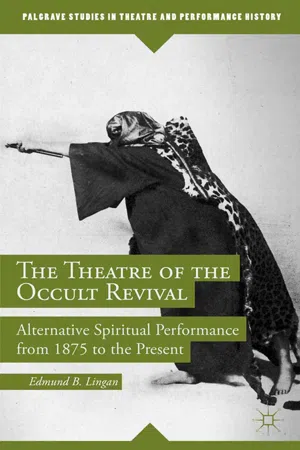
This book explores the religious foundations, political and social significance, and aesthetic aspects of the theatre created by the leaders of the Occult Revival. Lingan shows how theatre contributed to the fragmentation of Western religious culture and how contemporary theatre plays a part in the development of alternative, occult religions.
From the spiritualist mediums who apparently secreted ghostly ectoplasms from their bodies to members of secret societies who practiced ceremonial magic with pentagrams, candles, and swords, theatricality was central to the Occult Revival that flourished in Europe and the United States between the late nineteenth and early twentieth centuries. The boundaries between occultism and theatre blurred during the Occult Revival. During this time ritual, theatre and other forms of performance came to be viewed as part of a sacred tradition of mystery dramatics through which esoteric wisdom had been passed down to initiates for centuries. It was that idealized tradition of esoteric theatre that many spiritual leaders of the Occult Revival claimed to be reviving. This rise of interest in theatre during the occult revival was no random occurrence: it was a response to ideas about theatre and occultism that were incorporated into the teachings of some of the most famous leaders of the Occult Revival. In particular, Eliphas Lévi, Helena Petrovna Blavatsky, and Edouard Schuré did much to promote the idea of a sacred tradition of occult theatre that could be revived for the spiritual benefit of human beings.
ELIPHAS LÉVI
Eliphas Lévi (1810–1875) is sometimes identified as the inaugurator of the nineteenth-century Occult Revival in Europe, although his most famous occult books did not appear until several years after the Fox sisters’ first mediumistic demonstrations in 1848. Unlike spiritualists who were concerned with establishing communication with the spirits of the dead, Lévi promoted ceremonial magic as the key to communing with the spiritual realm. Lévi established magical practices, offered interpretations of occult symbols, and utilized terminology that were adopted by later ceremonial magicians—including Aleister Crowley and Gerald Gardner. Lévi’s ideas about ceremonial magic continue to inform the practice of occultism today.
In his book Triumph of the Moon: A History of Modern Pagan Witchcraft, Ronald Hutton credits Lévi with creating “a conceptual framework and a set of practical manuals for a new generation of magicians.”1 It was Lévi who popularized the term “occultism” in his 1856 book, The Dogma and Ritual of High Magic.2 He also established the convention of interpreting the five-point star—or pentagram—as a symbol of god when one point is on top, and of the devil when two points are up.3 Lévi also argued that his writings revealed the remnants of a primordial religion that predates the establishment of all other world religions: in other words, a primordial tradition. For Lévi, ceremonial magic represented the practical aspect of this primordial tradition. He suggested that the magician who mastered ceremonial magic would be able to invoke spiritual forces and, as a result, gain supernatural knowledge and power. Lévi accused Christian authorities of banning the practice of ceremonial magic as part of an effort to suppress the primordial tradition.
Lévi supported his claim that ceremonial magic was the practical side of “one sole, universal, and imperishable dogma” that is “the parent of all others”4 by weaving together content from medieval and early modern texts on alchemy and magic, eighteenth-century philosophy texts, and plays.5 In his writings, Lévi uses the term “universal dogma,” which can be equated with the concept of the primordial tradition. Lévi explains that this dogma existed before the dawn of recorded civilization and was passed down through the centuries by a chain of adepts. Included among these adepts are the initiates of the mystery religions of ancient Greece and Egypt, as well as the Knights Templar. Lévi claimed that the universal dogma almost disappeared due to attacks by the leaders of orthodox Christianity during the Middle Ages, but he also promised that it can be partially recovered through research into occult and the experimental practice of ceremonial magic.6 As these claims show, Lévi linked his teachings to an idealized notion of the past that includes the mystery dramatics of the ancient era and legends concerning the magical and spiritual adeptness of the Knights Templar.
By referencing the Knights Templar, Lévi followed in the mold of “speculative” forms of Freemasonry—that is, strains of Freemasonry whose adherents were interested in esoteric practices and philosophies. Such strains of Freemasonry began to appear by the late eighteenth century. These organizations established “High” or “Side” degrees that could be achieved, in addition to the traditional “Apprentice,” “Fellowcraft,” and “Master Mason” degrees. Faivre suggests that Freemasons were drawn to the Knights Templar, in particular, “because it was more possible to make use of a long dead order or to claim to be its successor, since proof to the contrary will almost always be lacking.”7 Faivre’s rational comment does not disprove that many of those who promoted the idea of a Templar tradition may have sincerely believed it as an historical fact.
The Freemasonic interest in the Templars eventually became bound up with the Rosicrucian tradition, which seems to have begun with the appearances of several manifestoes published between 1614 and 1616 in Tubingen, Germany.8 Two of the best known of these manifestoes are The Fame of the Fraternity of the Praiseworthy Order of the Rose-Cross, Written to all the Learned and Rulers of Europe (1614) and The Chemical Wedding of Christian Rosenkreuz in the Year 1459 (1616). Fame of the Fraternity is likely attributable to “the cooperation of several authors” who were members of the Learned Christian Society, and The Chemical Wedding was written by Johan Valentin Andreae, who founded that society. The Rosicrucian manifestos enjoyed a broad European readership and caused controversy. Many seventeenth-century critics considered them heretical works. Others saw them as part of the traditions of alchemy, pansophy, Brahmanism, ancient Hebrew religion, and Hermeticism, the tradition of esoteric philosophy and techniques that is based upon writings attributed to the legendary, pseudo-historical Egyptian mage known as Hermes Trismegistus.9
Many contemporary scholars who study the history of esotericism see in Rosicrucianism the expression of “a worldview based on an analogical apprehension of God and of the world on the part of man.”10 This worldview is encased in a body of literature that blends the chivalric romance genre, symbols of ancient Greek mythology, Kabbalistic concepts, alchemical imagery, and an idealized imagining of an imaginary “Orient” that is viewed as the locus of lost spiritual wisdom.11 Faivre and many others have presented the metaphysical journey that Christian Rosenkreutz undertakes in Chemical Wedding as an alchemical metaphor depicting the “interior voyage” of a human being who moves toward enlightenment by pursuing the Great Work of a sacred pilgrimage. It is through this process that Christian receives the title “Knight of the Golden Stone.” This story interiorizes the notion of the “Great Work,” by which the dutiful magician achieves greatness.12
It is not surprising that Freemasonry, with its penchant for degrees of initiation found inspiration in the rich symbolism of the Rosicrucian literary tradition, which told stories of perseverant mystics who rose to higher degrees of spiritual knowledge by surviving trials. The ceremonial magician, Lévi, also viewed the performance of rituals as the key to spiritual development. In fact, Lévi offered a mise-en-scène for ceremonial magic that continues to inform its ritual practice to this day.13 This mise-en-scène includes talismans, instruments, and furniture to be incorporated into the magician’s temple. These objects are essential to the reconstitution of what Lévi referred to as the “universal and primeval magic.”14 Among the “instruments magiques” that Lévi prescribed are the pentagram, the wand, the sword, the oil lamp, the chalice, and the candle.15 Arthur Edward Waite, who translated Lévi’s Dogme et ritual de le haute magie into English (Dogma and Ritual of High Magic), depicted these instruments in the “magician” card of the Rider-Waite Tarot deck, which remains one of the most popular Tarot books in world. The “Magician” card shows a magician standing before an altar upon which are many of the magical tools that Lévi suggested: a pentagram, a wand, a chalice, an altar, and a sword. The arrangement of objects on the “Magician” card is similar to the arrangement of objects and talismans that Aleister Crowley used in the practice of Thelemic magic and which Gardner employed in the practice of Wiccan magic. Similar objects are still used by practitioners of ceremonial magic today, which can be seen by visiting a ceremonial magic supply store.
Lévi drew inspiration for his occult worldview from not only Rosicrucianism and Hermeticism but also dramatic literature. Lévi credited the authors of ancient Greek tragedies with making significant contributions to the revelation and preservation of the universal dogma. According to Lévi, ancient Greek playwrights integrated into their plays disturbing details about the ancient initiatory mysteries of the primordial tradition. Lévi described the “the effusion of blood” in Sophocles’ Oedipus Rex as evidence of a frightening aspect of being initiated into the Greater Mysteries of the Tradition.16 (Lévi offered no documentation to support this claim.) Lévi described Aeschylus as the most secretive of the Greek tragedians, because Aeschylus offered only a “weak” representation of the esoteric mysteries into which he was initiated.17 By suggesting that Greek tragedies contained insight into a primordial tradition in The Dogma and Ritual of High Magic, Lévi established himself as one of the first nineteenth-century occultists to identify ancient theatre as part of a nearly vanished tradition of esoteric theatre through which the mysteries and powers of ancient pagan religions had once been passed down to initiates.
HELENA PETROVNA BLAVATSKY
References to plays and playwrights are numerous in the writings of Helena Petrovna Blavatsky (1831–1891), who cofounded the Theosophical Society in New York City with Henry Steel Olcott and William Quan Judge.18 Blavatsky viewed the Greek tragedians, in particular, as conveyors of esoteric wisdom who worked through the medium of theatre. Although Blavatsky agreed with Lévi that theatre played a key role in the transmission of the primordial tradition, she disagreed with him on the method for gaining that knowledge. Rather than presenting the practice of ceremonial magic as the key to gnosis, Blavatsky offered a more studious and contemplative form of occultism that was based upon a set of humanitarian principles. Blavatsky argued that studying literature, the arts, science, religion, and philosophy from the standpoint of certain occult concepts would lead one to divine knowledge. Blavatsky formed the Theosophical Society as an organization that would be dedicated to discovering the truths of a primordial tradition that she referred to as the “Secret Doctrine.”19 The Secret Doctrine, according to Blavatsky, provided the universal, theological basis for all later religions. Thus, it could also be referred to as a primordial tradition.
Blavatsky exemplified what she viewed as the ideal approach to theosophical study in her influential, two-volume work, The Secret Doctrine: The Synthesis of Science, Religion, and Philosophy. In The Secret Doctrine, Blavatsky deftly constructed links between Plato’s philosophical writings, Buddhist and Vedic reincarnation theory, esoteric traditions, and many other sources. Blavatsky asserted the existence of an “Infinite Principle” from which all life originates, announced the reality of a process of reincarnation that enables human beings to evolve through countless physical incarnations, and argued that Karma (which she understood as a law that rewards the good and punishes the bad) is central to the spiritual evolution of humanity.20 Blavatsky taught that the human soul fell from the realm of the spirit into the realm of matter through desire, and she claimed that reincarnation and karma were paths by which the soul returns to its divine place of origin.21
Blavatsky’s references to reincarnation and karma, as well as her use of other terminology from the Buddhist and Hindu traditions, are absent in Lévi’s work, which focused primarily upon Western notions of magic and esotericism. Blavatsky professed a mastery of both Western and Eastern traditions, and she distinguished herself from Lévi by offering “Eastern” explan...
Table of contents
Cover
Title
Introduction
1 The Occult Revival and Its Theatrical Impulses
2 Katherine Tingley and the Theatre of the Universal Brotherhood and Theosophical Society
3 The Anthroposophical Theatre of Rudolf and Marie Steiner
4 Aleister Crowley’s Thelemic Theatre
5 Rosicrucian Theatre and Wiccan Ritual
6 The Neo-Paganism Performance Current
Conclusion
Notes
Bibliography
Index
Trusted by 375,005 students
Access to over 1.5 million titles for a fair monthly price.
Study more efficiently using our study tools.
Frequently asked questions
Yes, you can cancel anytime from the Subscription tab in your account settings on the Perlego website. Your subscription will stay active until the end of your current billing period. Learn how to cancel your subscription
No, books cannot be downloaded as external files, such as PDFs, for use outside of Perlego. However, you can download books within the Perlego app for offline reading on mobile or tablet. Learn how to download books offline
Perlego offers two plans: Essential and Complete
Essential is ideal for learners and professionals who enjoy exploring a wide range of subjects. Access the Essential Library with 800,000+ trusted titles and best-sellers across business, personal growth, and the humanities. Includes unlimited reading time and Standard Read Aloud voice.
Complete: Perfect for advanced learners and researchers needing full, unrestricted access. Unlock 1.5M+ books across hundreds of subjects, including academic and specialized titles. The Complete Plan also includes advanced features like Premium Read Aloud and Research Assistant.
Both plans are available with monthly, semester, or annual billing cycles.
We are an online textbook subscription service, where you can get access to an entire online library for less than the price of a single book per month. With over 1.5 million books across 990+ topics, we’ve got you covered! Learn about our mission
Look out for the read-aloud symbol on your next book to see if you can listen to it. The read-aloud tool reads text aloud for you, highlighting the text as it is being read. You can pause it, speed it up and slow it down. Learn more about Read Aloud
Yes! You can use the Perlego app on both iOS and Android devices to read anytime, anywhere — even offline. Perfect for commutes or when you’re on the go. Please note we cannot support devices running on iOS 13 and Android 7 or earlier. Learn more about using the app
Yes, you can access The Theatre of the Occult Revival by E. Lingan in PDF and/or ePUB format, as well as other popular books in Theology & Religion & Art General. We have over 1.5 million books available in our catalogue for you to explore.