- English
- ePUB (mobile friendly)
- Available on iOS & Android
eBook - ePub
About this book
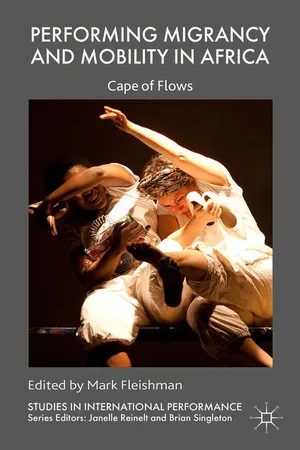
Performing Migrancy and Mobility in Africa focuses on a body of performance work, the work of Magnet Theatre in particular but also work by other artists in Cape Town and other parts of the continent or the world, that engages with the Cape as a real or imagined node in a complex system of migration and mobility. Located at the foot of the African continent, lodged between two oceans at the intersection of many of the earth's major shipping lanes, Cape Town is a stage for a powerful mixing of cultures and peoples and has been an important node in a network of flows, circuits of movement and exchange. The performance works studied here attempt to get to grips with what it feels like to be on the move and in the spaces in-between that characterises the lives, now and for centuries before, of multiple peoples who move around and pass through places like the Cape. The contributors are a broad range of mostly African authors from various parts of the continent and as such the book offers aninsight into new thinking and new approaches from an emerging and important location.
Information
Print ISBN
9781137379337
Subtopic
Art General1
Dramaturgies of Displacement in the Magnet Theatre Migration Project
Mark Fleishman
The end of apartheid and the advent of democracy have resulted in the forceful reintegration of South Africa into the global economy. One result of this has been the development of a new migratory sub-system centred on South Africa. Rather than attracting international migration from Europe and Asia to South Africa, as had been the case prior to 1994 and the dawn of democracy, this new system attracts migrants from surrounding states in sub-Saharan Africa. These migrants are attracted by the promise of economic prosperity, a supposed cosmopolitanism arising from the idea of the ‘rainbow nation’ with its championing of diversity, and an apparent commitment to the rule of law enshrined in the country’s much vaunted post-apartheid constitution.
Migration from other African countries to South Africa has traditionally been of the ‘labour-migration’ type (Adepoju, 2006, p. 25), primarily focused around recruiting mining labour from eastern and southern African countries with English or Portuguese as colonial languages. However, recently migrants from the francophone1 region of the continent have begun to see South Africa as an alternative ‘from the traditional destinations such as France, and to a lesser extent Belgium or other African countries such as Ivory Coast’ (Lekogo, 2006, p. 207). Bouillon suggests that ‘French-speaking African immigrants in South Africa are a marginal if not a negligible reality’ but that they are particularly distinguished by ‘their socio-cultural differences in language, dress, hair, behavior etc.’ (1998, p. 3). Despite their distribution throughout the country, there is some evidence that these more recent francophone immigrants are tending to favour Cape Town as a destination over other cities (Lekogo, 2006, p. 208).2
Concurrent to this rise in international migration, the country has experienced a rapid increase in urbanization as rural South Africans move to the cities from which they had been forbidden under apartheid’s Group Areas Act,3 in search of what the ruling African National Congress calls a ‘better life for all’. These newly arrived national migrants have established themselves in informal settlements around major cities or in the decaying inner city areas of Johannesburg in particular. Here they come into direct contact with migrants from other African countries and compete with them for shelter, employment and other social services such as health care and education in an environment in which all of the above resources are scarce.
This competition has given rise to tensions and to a particular stereotypical image of African migrants as inherently criminal and determined to ‘steal’ jobs, houses and women from South Africans living in the same poverty-stricken areas. This has resulted in what Loren Landau, drawing on Agamben, has described as:
‘Zones of Exception’ in which South Africa’s normal legal provisions are suspended or circumvented in an effort to regulate and alienate the country’s non-national population. Within these zones, vigilantism, extortion, illegal arrests and deportations are becoming normalized as the South African state, acting on behalf of its citizens, works outside its own commitments to universal rights and administrative justice in an attempt to assert its territorial sovereignty. (2005, pp. 3–4)
In May 2008, the above tensions reached boiling point in a seemingly spontaneous eruption of popular anger in which people from other African countries living in South Africa were, forcibly and without warning, evicted from their homes and from their communities across the country by marauding bands of South African township dwellers (see the Introduction to this collection). Ironically, of the 62 people killed in this violent series of events, 21 were South Africans mistakenly assumed to be foreign because of their darker than average (for South Africa apparently) skin colour, leading to comments that the attacks were not only xenophobic but negrophobic – an internalized hatred of blackness (Mngxitama, 2008).
One year on from the attacks of 2008 some of those displaced returned to their countries of origin, a few found new communities within the country, but most returned to the communities from which they were displaced. Here they continue to eke out a precarious existence.
The attacks of 2008 are unlikely to be the last incidents of violence against the migrant community in South Africa nor were they the first such incidents. In 2006, 29 Somali shopkeepers in Cape Town were killed in what the police described as criminal activity but which the community and activists insist was a systematic attempt by other local businessmen to rid themselves of competition (Le Roux, 2006).4 At that time and against this background, my company, Magnet Theatre, created the production Every Year, Everyday, I am Walking, initially as a commission for the African Festival of Children and Youth Theatre in Yaoundé, Cameroon (2006). The production traces the perpetual movement across the continent and towards Cape Town of a mother and daughter from an unnamed francophone African country whose home has been destroyed through violent action and then chronicles the difficulty of their integrating in Cape Town. Since 2006 the production has continued to tour throughout South Africa as well as to seventeen other countries on five continents.5
This chapter will focus initially on Every Year, the first of the four productions that make up Magnet Theatre’s Migration Project (outlined in more detail in the introduction to this collection). By way of comparison, and in order to extend the argument, two more of the productions, ingcwaba lendoda lise cankwe ndlela (2009) and Die Vreemdeling (2010), are examined at the end of the chapter. 6
Works such as those that make up the Magnet Migration Project can be defined as ‘boundary works’. Henk Borgdorff, in an interview on artistic research, suggests that art works that propose to be research projects are ‘boundary objects’, which he describes as objects ‘that [change their] ontological and epistemological nature depending on the context in which [they are] used’. He suggests that ‘artistic research places itself on the border between academia and the art world’ (Borgdorff, 2012, p. 177). I would extend this and suggest that projects such as the Migration Project exist on a threefold border between academia, the art world and the arena of political or social activism. This aligns with Dwight Conquergood’s description of performance studies as broadly made up of ‘the three a’s […] artistry, analysis, activism’ (2002, p. 152). Existing as they do on this complex border line, these works can often feel displaced – not quite academic enough because they belong to the art world; not quite artistic because they are tainted by academicism; not activist enough because they are after all playful.
In this chapter I am interested not so much in the works as activist projects but more in their existence as art works that have academic pretensions. I do not mean to suggest by this that I am indifferent to the political situation of refugees, asylum seekers and other migrants or uninterested in the connections between these performance works and the broader territories of migration or refugee studies. On the contrary it is one of Magnet Theatre’s primary objectives to intervene in the present, to engage with those aspects of the South African social fabric that remain difficult and troubled in our pursuit of what it means to be free in the aftermath of apartheid. It is just that, given limitations on space and other writing about these performances that already engages with these issues, 7 I have chosen to focus here on the link between the practice of making these art works and the ideas that underline these practices of making rather than on their political effect, or whether and how they interface with the community of migrants in Cape Town. Having said that, it is clear that the overlap cannot be entirely ignored either and the dramaturgical choices might well be described as being political in and of themselves.
As a practitioner/researcher I am particularly focused on what I call dramaturgy understood as the making of new works for performance. The emphasis here is on making rather than writing because it involves an embodied process of improvisation and play in collaboration with others rather than an isolated process of writing by a single playwright. Dramaturgy is a thing, an end product, the particular compositional logic of the work created. It is a relationship between a subject matter, its framing and the particular context in which it occurs. But dramaturgy is also the process of getting there, the multiple conversations, interactions and exercises that lead to that end product. André Lepecki suggests that dramaturgy is ‘the task of imaginative organization in order to communicate; the ensuring that after a long process there is a visible and cohesive something’ (cited in Van Imschoot, 2003, p. 59). However, Lepecki is critical of the common perception in theatre/performance studies that the ‘creative act’ is aligned ‘with chaos’ and dramaturgy ‘with the organising principles of reason and concept. As if the role of dramaturgy was to obliterate the catastrophic in the creation’ (Lepecki, 2003, p. 28, note 2). Van Imschoot develops this further:
[T]he dramaturg [as] a figure of coherence and consistency may at first sight seem to have become a less prominent feature since the 1980s. […] [T]he ‘new dramaturgy’ is precisely ‘new’ in that it seeks to distinguish itself from […] an all too stringent use of concepts as a pre-established grid to rule the theatre praxis from its conception to its reception. (2003, p. 59)
This, less rule-bound, less directed and pre-determined, more processual understanding of dramaturgy is in line with my particular conceptual approach to the practice that I have outlined more extensively in previous writing (Fleishman, 2011; 2012).
It is my intention in what follows to explore the various dramaturgical strategies – the ‘dramaturgies of displacement’ – employed in the making of the productions in the Migration Project. In particular, however, I wish to examine the ways in which the production Every Year, Everyday, I am Walking attempts to make the invisible community of migrants visible through theatre by using the body as a surface on which to read the traces of experience laid down through the perpetual movement to which those who have been displaced from the places they call home are doomed, and in ways that remain true to the silencing at the heart of the migrant experience, the loss of language, voice and agency.
This turn to the body is a feature of all of Magnet’s work since its inception in 1987 and is based on a contention that theatre originates with specific bodies in specific spaces rather than with words on a page, so there have only been a few occasions in the past 26 years when the script has been the starting point for a production rather than a record of what has been created through processes of physical making. But in this production the choice of the body and of movement as the basis for the dramaturgy is intricately linked to the migrant experience of the refugee who, once displaced from the ‘home space’, is in a state of constant movement. Furthermore, I would like to propose that through the body we can access the space ‘beyond language’ (Stuart Fisher, 2011, p. 114), producing experiences that are less about understanding and more about feeling; less cerebral and more visceral; able to grasp something of the ineffable experience of the traumatic event – to overcome perhaps, as Blanchot would have it, ‘[t]he danger that the disaster acquire meaning rather than body’ (1995, p. 41).
Every Year, Everyday, I am Walking
Every Year is a play about refugees and as such is one of a significant number of recent productions around the world that have dealt with the issue, so despite Michael Balfour’s protestations (2013, p. xxi), one could suggest that there is indeed an emergent category of performance that might be referred to as Refugee Theatre, attested to by a number of recent academic titles that investigate the phenomenon (Jeffers, 2012; Balfour, 2013).
As Emma Cox has pointed out, the dramaturgy of Every Year is different from that which predominates in ‘Britain, the United States and Australia’ where the ‘testimonial model for the representation of refugee trauma […] has come to particular prominence’ in recent times (2012, p. 124). As she makes clear, the verbatim theatre model with its emphasis on ‘authenticity’ and the ‘truth’ – the real words of refugees make up the text which is predominantly verbal whether spoken by refugees themselves on stage or by actors delivering the documented words of refugee subjects – is advocated as the most appropriate way to deal with the refugee narrative so as to ensure accuracy of representation and avoid claiming to speak on behalf of refugees.
However, there have been a number of counterarguments against this dramaturgical strategy from writers such as Salverson (2001), Thompson (2009) and Stuart Fisher (2011), all of whom outline the limitations of this approach. These are well documented by Cox (2012, p. 124 ff.) but I will summarize the main argument here because it is pertinent to the current discussion. Essentially what these authors argue is that the verbatim approach:
a. fails to understand the impact of imagination when dealing with traumatic events, suggesting instead that ‘real’ experiences of refugees, embodied in testimony, are ‘authentic and untouchable’ as opposed to imaginative exploration, or any exploration of aesthetics or theatrical form, by theatre makers (Salverson, 2001, p. 121 & p. 123);
b. produces a form of mimesis that is ‘a reductive and stationary model of “the event” that pays attention primarily to “the victim” and […] in an overtly determined way privileges injury’ (Salverson, 2001, p.123) and ‘recycle[s] scripts of melancholic loss’ (p. 124), imagining ‘testifying to be a monologue’ (p. 122) rather than a dialogical encounter between the event and the exploration; the refugee and the theatre maker; and the theatre maker and the audience, in which multiple worlds enter into engagement and negotiation in the present experience of making and performance;
c. assumes that words (testimony) – often harrowingly detailed descriptions – are the best means of representing traumatic experiences, failing to engage with the possibility that ‘trauma can […] be said to stand radically beyond language’ (Stuart Fisher, 2011, p.114, emphasis in original), and negating for example the potential power of physical imagery, or humour (Salverson, 2001, p. 124), or beauty ‘emerging from the very spaces in which conventional wisdom suggests it is least expected’ (Thompson, 2009, p. 139);
d. involves a limited and simplistic understanding of what constitutes ‘truth’ in relation to these experiences and testimonies, given that ‘[t]he truth of the traumatic event is arguably not transparent, knowable or even communicable’ (Stuart Fisher, 2011, p. 112); that in Caruth’s words, it ‘resists simple comprehension’ (Caruth, 1996, p. 6, cited in Stuart Fisher, 2011, p.112), and is not necessarily synonymous with fact.
In contrast to this, as Cox puts it, ‘Every Year eschews the literal/ literate personal account for the immediate specificity of the body’ and ‘pursues a non-factual truthfulness’ (2012, p. 124, italics in original).8 In doing so, I argue, it also makes use of visual and scenographic image and a conscious application of ‘the beautiful’ in particularly striking ways to produce a ‘visceral’ performance event (Machon, 2009) full of affective power (Thompson, 2009), in which experience exists prior to analysis or underst...
Table of contents
- Cover
- Title
- Copyright
- Contents
- List of Illustrations
- Series Editors’ Preface
- Acknowledgements
- Notes on Contributors
- Introduction
- Chapter: 1 Dramaturgies of Displacement in the Magnet Theatre Migration Project
- Chapter: 2 ‘Peel the Wound’ – Cape Town as Passage, Threshold, and Dead End: Performing the Everyday Traumas of Mobility and Dislocation
- Chapter: 3 Creating Communitas: The Theatre of Mandla Mbothwe
- Chapter: 4 Embodiment, Mobility and the Moment of Encounter in Jonathan Nkala’s The Crossing
- Chapter: 5 (Re)-membering the Cape and the Performance of Belonging(s)
- Chapter: 6 Uhambo: pieces of a dream – Waiting in the Ambiguity of Liminality
- Chapter: 7 Mobility, Migration and ‘Migritude’ in Afrocartography: Traces of Places and all points in between
- Chapter: 8 Mamma Africa: A Theatre of Inclusion, Hope(lessness) and Protest
- Chapter: 9 On Familiar Roads: The Fluidity of Cape Coloured Experiences and Expressions of Migration and Reclamation in the Performances of the Kaapse Klopse in Cape Town
- Chapter: 10 Tall Horse, Tall Stories
- Chapter: 11 Play Text: The Life and Work of Petrovic´ Petar
- Works Cited
- Index
Trusted by 375,005 students
Access to over 1.5 million titles for a fair monthly price.
Study more efficiently using our study tools.
Frequently asked questions
Yes, you can cancel anytime from the Subscription tab in your account settings on the Perlego website. Your subscription will stay active until the end of your current billing period. Learn how to cancel your subscription
No, books cannot be downloaded as external files, such as PDFs, for use outside of Perlego. However, you can download books within the Perlego app for offline reading on mobile or tablet. Learn how to download books offline
Perlego offers two plans: Essential and Complete
- Essential is ideal for learners and professionals who enjoy exploring a wide range of subjects. Access the Essential Library with 800,000+ trusted titles and best-sellers across business, personal growth, and the humanities. Includes unlimited reading time and Standard Read Aloud voice.
- Complete: Perfect for advanced learners and researchers needing full, unrestricted access. Unlock 1.5M+ books across hundreds of subjects, including academic and specialized titles. The Complete Plan also includes advanced features like Premium Read Aloud and Research Assistant.
We are an online textbook subscription service, where you can get access to an entire online library for less than the price of a single book per month. With over 1.5 million books across 990+ topics, we’ve got you covered! Learn about our mission
Look out for the read-aloud symbol on your next book to see if you can listen to it. The read-aloud tool reads text aloud for you, highlighting the text as it is being read. You can pause it, speed it up and slow it down. Learn more about Read Aloud
Yes! You can use the Perlego app on both iOS and Android devices to read anytime, anywhere — even offline. Perfect for commutes or when you’re on the go.
Please note we cannot support devices running on iOS 13 and Android 7 or earlier. Learn more about using the app
Please note we cannot support devices running on iOS 13 and Android 7 or earlier. Learn more about using the app
Yes, you can access Performing Migrancy and Mobility in Africa by Mark Fleishman in PDF and/or ePUB format. We have over 1.5 million books available in our catalogue for you to explore.