Simplicity in taxation has considerable potential advantages. However, attempts to simplify tax systems are only likely to be successful and enduring if they take account of the reasons why taxation is complex. There are strong pressures on tax systems to accommodate a range of important factors, as well as complex and changing national and international environments within which modern tax systems have to operate. This book explores the experiences of simplification in a range of countries and jurisdictions. The authors analyse a range of manifestations of simplification, including tax systems, tax law, taxpayer communications and tax administration. They also review the longer term or more fundamental approaches to simplification, suggesting that in order to strike the optimum balance between simplicity and the aims of a tax system in terms of efficiency and equity, a range of complex environmental factors must all be taken into account. With chapters reflecting on experiences from Australia, China, Canada, Malaysia, New Zealand, Russia, South Africa, Thailand, Turkey, the UK and the US, the authors illustrate differences between jurisdictions and the changing environment in which they operate.This book addresses the crucial balance between simplicity and the other objectives of tax design and reform, and suggests that reformers of the tax system should include simplicity as one of the key evaluators of any design or reform proposal.
eBook - ePub
The Complexity of Tax Simplification
Experiences From Around the World
- English
- ePUB (mobile friendly)
- Available on iOS & Android
eBook - ePub
The Complexity of Tax Simplification
Experiences From Around the World
About this book
Information
1
The Complexity of Tax Simplification: Experiences From Around the World
Tamer Budak, Simon James and Adrian Sawyer
1 Introduction
It seems clear that simplicity in taxation has considerable potential advantages, but there are important reasons why tax systems become complex. In a paper presented at the Conference of the Tax Research Network (TRN) in 2014, the present authors reviewed progress towards simplification in Australia, New Zealand, Turkey and the UK, finding that attempts towards greater simplicity in taxation had not been very successful (Budak et al., 2014). One of the main reasons is that attempts to simplify tax systems are only likely to be successful and enduring if they take account of the reasons why taxation is complex. It may then be possible to find the right balance between simplicity and the aims of a tax system in terms of efficiency, equity and so on, as well as taking account of the complex environment in which tax systems have to operate. Such factors will change over time, and so the appropriate balance between simplicity and complexity is also likely to change. In addition, the situation is likely to differ from jurisdiction to jurisdiction.
Furthermore, there are different dimensions to simplification. For instance, Cooper’s (1993) examination of tax simplification has been mentioned by the contributors in the following chapters: Australia, China, Thailand, and the UK. Cooper explored seven simplification issues: predictability, proportionality, consistency, compliance, administration, coordination and expression, and also suggested there were different levels of simplification: the choice of the tax base, the design of the rules applying to that tax base, the expression of those rules and the administrative requirements imposed on taxpayers.
To gain some idea of the experience of tax simplification in different jurisdictions, the authors of the chapters that follow were invited to report on the experiences of simplification in particular countries. They were also asked to include, if it were appropriate, relevant information on the following aspects of tax simplification:
•Simplification of tax systems
•Simplifying tax law
•Simplifying taxpayer communications
•Simplifying tax administration
•Longer-term or more fundamental approaches to simplification
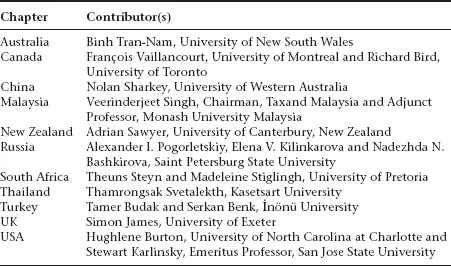
Table 1.1 provides details of the contributors to this collection of tax simplification country reports.
Their contributions offer further evidence that simplification is rarely the highest priority in tax design and reform, but it is often an important consideration. The chapters provide a wide range of experiences relating to tax simplification in different contexts and countries, and this chapter draws some of them together. Section 2 begins with a brief summary of general issues regarding the complexity of taxation followed by a more specific examination of the themes listed above. Section 3 discusses simplifying tax systems, and sections 4, 5 and 6 deal in turn with simplifying tax law, simplifying taxpayer communications and simplifying tax administration. Section 7 turns to longer-term and more fundamental approaches to simplification, such as the Office for Tax Simplification in the UK, that of the Turkish Tax Authority and the Tax Working Group (TWG) in New Zealand. Finally some conclusions are drawn.
Table 1.1 Contributors to The Complexity of Tax Simplification: Experiences From Around the World
2 Simplicity and complexity
Simplicity in taxation has, of course, advantages in terms of taxpayers being more likely to understand how they are being taxed, to be able to comply with their obligations and to be in a better position to make economic decisions. Nevertheless, as already indicated, there are powerful forces that can cause tax systems to become complex. These include the desirability of taking account of individual circumstances, the complexities of economic life, promoting certainty and countering tax avoidance. So the issue is how to identify unnecessary complexity as opposed to complexity necessary to ensure the tax system is reasonably fair, efficient and certain – see for example Ulph (2012).
It would be helpful if there were a reliable way of measuring complexity. This is certainly not an easy subject, though the work of the UK’s Office of Tax Simplification (OTS) in developing a complexity index shows a promising way forward. The OTS index includes factors such as the number of exemptions, the length and readability of the legislation, the number of times it has been changed, the number of taxpayers and their average ability and the risk of tax avoidance but there are considerable difficulties involved in estimating some of these variables. Tran-Nam and Evans (2014) look to construct their own index of tax system complexity, which they develop as a summary indicator of the overall complexity of a tax system measured at a particular point in time. The aim of such an index, if utilized, would be to facilitate comparisons of the relative complexity of different countries’ tax systems in the future, as well as enable assessment of the changing level of a country’s tax system complexity over time.
Collectively from the chapters that follow, it is clear that tax simplification is a matter of concern in many countries, with numerous attempts having been made to simplify taxation with differing degrees of success. Measuring the level of complexity is only part of the issue of identifying the level of complexity that is ‘necessary’ to accommodate the various pressures on tax systems. It is also likely that the views of the different participants, including taxpayers, tax agents, revenue authorities, policymakers and other interests will differ. Finally, there may be trade-offs between complexity and the various pressures on the tax system, so there are unlikely to be easy solutions.
Issues such as the meaning and measurement of complexity are clearly very important in developing simplification policies and are examined further by some of the authors such as Tran-Nam in the chapter on Australia and Vaillancourt and Bird in the chapter on Canada. However, the main content of contributions relating to each country is the experience of simplification, and the following section starts with the simplification of tax systems.
3 Simplification of tax systems
The most fundamental form of simplification is that of tax systems, including the number of taxes in any jurisdiction, the tax bases, the number and nature of exemptions and the structure of tax rates. Perhaps surprisingly, such simplification is not a common feature of tax reform, which perhaps provides further evidence that simplification is not the most important factor in tax design and reform. Nevertheless, there have been some significant moves in this area and one of these concerns the ‘flat tax.’ Essentially, this is a tax levied at a single rate on taxpayers’ income whether they are rich or poor (see, for example, Keen et al.. 2008). There has been much discussion about the merits of such a tax in the US and in OECD countries, among others, so of particular interest is the introduction of a flat tax in Russia. In 2000 the five rates of income tax of 12% to 35% were replaced with one basic rate of 13%. Some countries of Central and Eastern Europe have followed the Russian example; see for instance Belarus, Bulgaria, Hungary, Latvia and Czech Republic.
For some other countries, the reform process is yet to be completed. In China, the ongoing reform of its business income tax and value added tax may lead to a modern form of VAT, like those used in Europe. Inextricably linked to the reform of the tax base is reform of the tax administration itself, which is also the experience of China.
It is not hard to find other cases where simplification has been achieved. For instance, in Turkey in 2004, direct taxation was reformed resulting in a simpler system. Nonetheless the pattern that seems to emerge more generally in any particular country is one where sometimes simplification is achieved, but this is offset by increases in complexity elsewhere in the tax system. In Canada, the abolition of the federal and provincial succession duties and some other taxes reduced complexity, but the introduction of GST increased it. Many attempts at simplification have not been successful, as in the United States, where the U.S. Congress has tried and failed to simplify business taxation. It seems there is a general tendency to increasing complexity in tax systems but another possibility, given a particular tax system, is to simplify the tax law.
4 Simplifying tax law
The nature of law also poses some difficult challenges for simplification. Sir Ernest Gowers, a former chairman of the UK Board of Inland Revenue, produced a book, The Complete Plain Words, designed to help officials in their use of language. Gowers pointed out that the law is used to promote certainty rather than easy reading:
[The] sentence is constructed with that mathematical arrangement of words which lawyers adopt to make their meaning unambiguous. Worked out as one would work out an equation, the sentence serves its purpose; as literature it is balderdash (Gowers, 1954).
It is not hard to see why tax law tends to be complex, and hence Prebble (1994) took the view that complexity arises from trying to fit the law around the ‘natural facts of economic life’. Tax law also seeks to create artificial constructs, such as the annual measurement of income, along with seeking to tax what may be inherently complex transactions.
There have been tax law review projects in Australia, New Zealand and the UK and similar initiatives in other countries, such as Turkey. There have also been specific contributions to simplifying tax legislation such as the Tax Administration Act (TAA, 28 of 2011) in South Africa. The tax law reviews were major projects and have shown it is possible to make tax law easier to read and understand, but on their own, such initiatives are insufficient to simplify taxation generally – particularly for the vast majority of taxpayers who are very unlikely to consult the legislation themselves. At least as important as such tax law rewrite projects are communications that are aimed at taxpayers directly.
5 Simplifying taxpayer communications
Moves to simplify taxpayer communications have been made in a many countries. In the US, several presidents have sought to enhance taxpayer communications through improved access to government information and services facilitated by more clearly written documents. Such administrative action is intended to be rolled out to legislation and regulations. To this end, the US has led the way from the highest level.
The South African Revenue Service (SARS) has implemented a number of interventions that directly or indirectly contribute towards the simplification of communication including a ‘filing season’ campaign of high interaction between the government and taxpayers, and both permanent and mobile branches as well as online help services.
New Zealand’s Inland Revenue Department (IRD) has been proactive with respect to making its communications clearer, receiving numerous awards for its use of plain English in materials and for having the best government website. This is important given the IRD’s current aim that the principal means of interaction with its customers should be via its website. Some countries such as Thailand use social media to communicate with taxpayers.
There has also been particular success with simplified (including pre-filled) returns such as the United States’ 1040EZ.1 This consists of remarkably few questions for a tax return and may be used by US taxpayers with relatively simple circumstances. However, it is worth noting that the 1040EZ can only be as simple as it is because of arrangements elsewhere in the system, which leads on to the next aspect: tax administration.
6 Simplifying tax administration
There is considerable potential for simplifying tax administration for many taxpayers even when the tax system itself is both complex and extensive, for example by avoiding the requirement for large numbers of taxpayers having to complete a tax return at all. In the UK most taxpayers are not required to complete a tax return each year because the cumulative tax Pay-As-You-Earn system can, at least in principle, withhold tax to a very high degree of accuracy. New Zealand’s decision to remove the requirement for the majority of individual taxpayers to file tax returns (where their income is taxed at source and information is collected from third parties, and all employee deductions eliminated) has greatly reduced compliance costs and enabled the IRD and tax agents to focus on taxpayers with more complex tax affairs. From 2014 Malaysia also made a change in this direction so that employees with specified straightforward circumstances no longer have to complete an annual return.
Alongside efforts to simplify the return filing obligations is the pre-filling or pre-populating of tax returns with data already collected by the revenue authority. These are returns incorporating information received from third parties about the taxpayer’s income and other details and the development of pre-filled returns has been examined by Highfield (2006). The role of the taxpayer in this process is to confirm that the information on the return is correct or amend it and to supply any other information required. Pre-populated returns h...
Table of contents
- Cover
- Title
- 1 The Complexity of Tax Simplification: Experiences From Around the World
- 2 Tax Reform and Tax Simplification: Conceptual and Measurement Issues and Australian Experiences
- 3 Simplicity in the Chinese Context: The Categories of Differential Income Tax Treatment and Their Complications
- 4 Tax Simplification in Canada: A Journey Not yet Mapped
- 5 Tax Simplification: The Case of Malaysia
- 6 Complexity of Tax Simplification: A New Zealand Perspective
- 7 The Complexity of Tax Simplification: Russia
- 8 The Complexity of Tax Simplification: Experiences from South Africa
- 9 The Complexity of Tax Simplification: Experiences from Thailand
- 10 The Complexity of Tax Simplification: Turkey Perspective
- 11 The Complexity of Tax Simplification: The UK Experience
- 12 Complexity of Tax Simplification: USA Perspective
- Index
Trusted by 375,005 students
Access to over 1.5 million titles for a fair monthly price.
Study more efficiently using our study tools.
Frequently asked questions
Yes, you can cancel anytime from the Subscription tab in your account settings on the Perlego website. Your subscription will stay active until the end of your current billing period. Learn how to cancel your subscription
No, books cannot be downloaded as external files, such as PDFs, for use outside of Perlego. However, you can download books within the Perlego app for offline reading on mobile or tablet. Learn how to download books offline
Perlego offers two plans: Essential and Complete
- Essential is ideal for learners and professionals who enjoy exploring a wide range of subjects. Access the Essential Library with 800,000+ trusted titles and best-sellers across business, personal growth, and the humanities. Includes unlimited reading time and Standard Read Aloud voice.
- Complete: Perfect for advanced learners and researchers needing full, unrestricted access. Unlock 1.5M+ books across hundreds of subjects, including academic and specialized titles. The Complete Plan also includes advanced features like Premium Read Aloud and Research Assistant.
We are an online textbook subscription service, where you can get access to an entire online library for less than the price of a single book per month. With over 1.5 million books across 990+ topics, we’ve got you covered! Learn about our mission
Look out for the read-aloud symbol on your next book to see if you can listen to it. The read-aloud tool reads text aloud for you, highlighting the text as it is being read. You can pause it, speed it up and slow it down. Learn more about Read Aloud
Yes! You can use the Perlego app on both iOS and Android devices to read anytime, anywhere — even offline. Perfect for commutes or when you’re on the go.
Please note we cannot support devices running on iOS 13 and Android 7 or earlier. Learn more about using the app
Please note we cannot support devices running on iOS 13 and Android 7 or earlier. Learn more about using the app
Yes, you can access The Complexity of Tax Simplification by Simon James, Adrian Sawyer, Tamer Budak, Simon James,Adrian Sawyer,Tamer Budak in PDF and/or ePUB format, as well as other popular books in Business & Financial Accounting. We have over 1.5 million books available in our catalogue for you to explore.