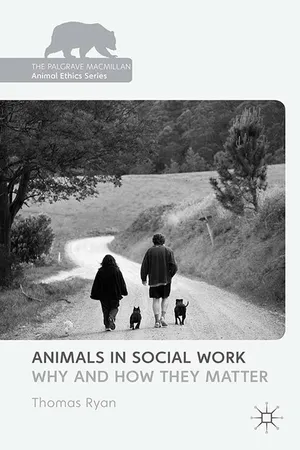
This collection of essays articulates theoretical and philosophical arguments, and advances practical applications, as to why animals ought to matter to social work, in and of themselves. It serves as a persuasive corrective to the current invisibility of animals in contemporary social work practice and thought.
- English
- ePUB (mobile friendly)
- Available on iOS & Android
eBook - ePub
About this book
Information
Part 1
The Why: Philosophical and Theoretical Explorations
1
Deep Ecological ‘Insectification’: Integrating Small Friends with Social Work
Fred H. Besthorn
A childhood filled with insects
As a child, I was raised in the vast, wide-open spaces of the boundless prairie grasslands of the central United States. This immense expanse is commonly known as the ‘Great Plains’. It was hot, dusty and windy, but afforded ample opportunity for out-of-doors play and exploration – a wild place of sorts, where birds, small animals and especially insects were prolific. During these formative years I forged deep connections with the wind-swept land, the wild flowers and grasses, and the tiny, ubiquitous creatures we simply referred to as bugs. I was particularly entranced by ants. I vividly remember spending hours tracking the movement, activities and community interactions of these small creatures as they navigated their way through the vast expanse of our backyard – an area that, from a child’s spatial perspective, seemed akin to hiking across continental North America.
On hands and knees, with heightened determination and tenacity that eluded most other areas of my life at the time, I spent endless hours following a single ant as it traversed its way from one corner of the yard to the other. I remember my astonishment at the dogged persistence of the ant’s journey. It moved much faster than I had anticipated, while repeatedly taking a seemingly endless number of alternative routes – often doubling back and ambling far afield time and time again before finally setting course straightaway for some ultimate but unknown destination.
Time passed quickly as all my childhood concerns were temporarily subsumed under the sheer exhilaration of participating in the existence of another living being who seemed oblivious to my presence and who did not judge, assault, or shame. On one particular five-hour tracking expedition, I observed my small ant friend find and then enter what seemed an insignificant ant colony some fifty yards or more from where we first began our journey together. I could not have been more pleased or amazed. I was beginning to learn in a child’s way that in nature there is wisdom, intellect, intention and perhaps even consciousness. Ants had become teachers, mentors, and small friends. They allowed me, for brief moments, to enfold myself in their world where words were unnecessary, dogmas and beliefs were superfluous, and social expectations were non-existent. By escaping into the ant’s world, I had begun to find a developing sense of my own self in complex relationships, which were, in one sense, far smaller and yet much greater than myself and the human world I inhabited.
Bug battles: a legacy of fear
I am a social worker, not an entomologist or a biological scientist. I work, teach and research within the context of the social and psychic life of human beings. I know few if any of the scientific names for insects; neither am I schooled in the classification system that experts find so important. I refer to common names and broad categories of insects used by the average person. And while I understand that not all small invertebrate animals (for example, spiders, centipedes) are technically insects, for convenience I use the term insect to refer to all small, flying, buzzing, striding, chirping, singing, slithering, scampering, climbing, hiding, creeping and crawling life-forms we commonly refer to as bugs or, perhaps more often, as pests.
My adult involvement with insects would not be terribly unlike what most in the Western world might experience when coming face to face with an ‘insect event’– those moments when, for example, a horde of ants invades one’s kitchen, or when nearly microscopic little mites known in my part of the world as ‘chiggers’ inject their digestive enzymes under the skin, creating a small hole and localised inflammation and the most intense itching one could ever experience. One treads lightly in grass and shrubbery when chiggers are on the prowl. And, for most in the Western world, insects are to be avoided at all costs.
Seldom does anything create as powerful an emotional or physical response in human beings as a close encounter with a member or members of the insect world. In fact, those encounters can scarcely be avoided. Recent estimates suggest that there are over one million known insect species with perhaps another ten to 30 million extant species yet unknown and/or unclassified (Raffles, 2011). Insects represent anywhere from 80 to 90 per cent of all living organisms on earth and at any one time there may be as many as 10 quintillion individual insects (Waldbauer, 2004). Insects outnumber human beings by a factor of approximately 200 million to one (Smithsonian Institute, 2013). It is truly a ‘bug’s life’ if one understands this to mean that, literally, insects rule the world.
Insects have a long geological and biological history on the planet. Their adaptive ability to survive under the most extreme circumstances and their remarkable fertility and reproductive capacities ensure that inestimable numbers of insects will continue to populate the world. Most people are at least vaguely aware that insects are sometimes beneficial to humans with respect to, for example, pollination, the creation of silk, the ingestion of carrion, their use for medicinal purposes, their important role in biological research, and occasionally as a source of food. Far fewer recognise that insects held religious, social, and cultural symbolism in many ancient aboriginal and tribal cultures. And, many of us on occasion have been fascinated, and at times awed, by the beauty of a butterfly, the intricacies of a dew enshrouded spider’s web, or the graceful aerobatics of a dragonfly. However important these periodic glimpses into the functions and experiences of insects might be, it is unfortunately true that, in the main, human interactions with insects are most often characterised by disaffection at best, and at worst, fear, loathing, and venal hatred.
Our hostile attitudes towards insects have deep roots both in evolution and in culture. Kellert (2012) suggests that human apprehension of and aversion to the natural world, especially of insects, reflects fears and anxieties that evolved over thousands of years when quick responses to unsafe features in the natural environment were critical to survival. These survival instincts were functional and are not easily suppressed or extinguished, at least from an evolutionary perspective. They are a part of our genetic heritage. Our pre-historic ancestors learned to be wary of and to avoid those things and circumstances in the natural world that could be harmful or fatal.
Unfortunately, the intrinsic distancing and precautionary tendencies of early humans have, over time, morphed into excessive, irrational and even genocidal responses to nonhuman members of the earth’s ecosystems. Lauck (2002) notes this is especially true with respect to our responses to insects. Lauck (2002) also suggests that the Cartesian/Newtonian paradigm shift of the seventeenth century ushered in a desacralised and mechanistic model of the natural world. This eventually gave rise to a Western cultural belief system suggesting that science could, indeed must, control nature, and that humans were wholly other than and above nature. That which was not us or not similar to us was suspect, frightening, monstrous and perhaps deserving of extermination. The demarcation between self and non-self, between I and other, between us and them, became quite rigid and intricately proscribed. Some ‘others’ might be allowed close to our sequestered human community – agricultural animals, domesticated pets, certain primates – but most others were strictly forbidden – snakes, aggressive carnivores and particularly insects. Again Lauck (2002, p. 5) notes:
By drawing our boundaries of self and community too small, we have created a world outside that frightens us. Imbuing the unfamiliar and strange with malevolence has transformed the once-sacred earth community into an environment populated by monsters. It has also exaggerated and distorted whatever survival instincts – whatever healthy fear – we had evolved as a species to keep us cautious and appropriately alert.
The myth of human domination: insects ‘r not us’
If one of the defining features of modern industrialised culture is the preoccupation with defining ourselves in contradistinction to all that is other, then there is likely no other that exhibits greater difference from us than insects. They are conspicuously not us. To begin with, they outnumber us by a factor of thousands. A single ant colony contains millions of living creatures, and there are millions of ant colonies. As suggested earlier, the population of insects is almost beyond our comprehension, and this profoundly threatens a deep cultural bias of a powerful, unique, unitary and dominant human species. From an insect’s perspective, our numbers are quite insignificant.
Secondly, insects pay us little mind. They do not flee from us as most vertebrates. They take up residence right under our noses, and some species seem to almost delight in targeting us and our so-called protected spaces with impunity. Indeed, it appears that they are quite indifferent to our presence. We claim to be the dominant species, but that seems to make little difference to an insect – most times they don’t even seem to notice us. Humans find being ignored terribly difficult to deal with, and insects ignore us at nearly every turn. Finally, insects are so wholly different that most look almost otherworldly. There are few outward similarities between an insect and a human being. They have multiple, if not hundreds, of legs or appendages. They have bulging multifunctional eyes and sensing antennae protruding from various parts of their bodies. Some look like a small stick or twig, yet they walk. Add to this that some insect species sting, destroy agricultural crops and transmit disease; then it is not difficult to see why insects are far more likely to be thought of as aliens from a science fiction movie than fellow members of the earth community (Imes, 2003).
Modern media culture exploits and accentuates this largely unexamined fear of and hostility towards insects. Rarely does a science fiction thriller not have at least some insect, or insect-like being, running rampant across the landscape, thirsting for human blood or the power to enslave humankind. This insect/monster/alien genre has been a common theme of the film industry for nearly sixty years. The alien life forms in the immensely popular Independence Day movie were conspicuously insect-like. The cinematic remake of Orson Welles’ War of the Worlds has the hero fending off three-legged, bloodlusting, mechanical extraterrestrials which cannot easily be mistaken for their similarity to giant, ambulating insects. The enormously popular Men in Black movie series depicts the alien villain as a cockroach-like being with a penchant for sloughing-off real cockroaches from its skeleton throughout the course of the movie.
Insects don’t fare much better in popular story and fairy tale. Little Miss Muffet wasn’t frightened by a big burly bear but by a spider. In Lewis Carroll’s classic novel Through the Looking Glass, when queried by a kindly gnat about what insects Alice rejoices in from her far away land, Alice responds that she doesn’t rejoice in insects at all.
In recent decades, there is no mistaking the fact that Western attitudes towards the natural world have changed markedly. Protecting endangered species, preserving wilderness areas, moderating global warming and sustaining fragile ecosystems are common themes of modern life. So, too, is the newfound emphasis on reincorporating the restorative powers of connection with the natural world and its healing potential for human physical, spiritual, sensory and community health. Finding affinity with, respect for, and opportunities for interactions with animals, both wild and domesticated, is a rapidly emerging part of what Louv (2011) refers to as the new or renewed mind/body/nature connection. Eco-therapy, nature therapy, animal-assisted therapy, green therapy, eco-psychology, and eco-social work are increasingly common areas of study for those in the helping professions. Unfortunately, however, this apparently newfound love for and connection to the natural world has not pervaded the insect world. How is it that we have come to embrace the preservation of and a deep affinity with whales, wolves, polar bears, cats, dogs and gerbils, to name just a few, while at the same time kill without hesitation any and all creeping, crawling things that have the misfortune of crossing our paths? For all the progress the human species has made in recent decades towards finding its way back to nature, the language of war, loathing and eradication still informs our attitude towards insects. We seem locked in an engrained specicide that sanctions the wholesale extermination of insects – as if by doing so the world would be a much better and safer place for everyone. When it comes to insects, it seems our mantra is ‘Kill often, kill on sight, and kill mercilessly’.
Nature and human/animal affiliation in social work
Due in large measure to the emergence in the 1970s and 1980s of the worldwide environmental movement, an expanded form of ecological social work began to take shape. A new generation of theorists began to recognise conceptual problems with social work’s conventional ecological/systems frameworks. While social work spoke the ecological and systems language of environments in interaction, in reality the focus was mainly on individual behaviour in static environments.
Beginning in the 1980s and early 1990s, several social work scholars (Hoff & McNutt, 1994; Hoff & Polack, 1993; Resnick & Jaffee, 1982) began to argue that the core values of social work and its conventional ecological/systems models must be extended to support the natural worl...
Table of contents
- Cover
- Title
- Part I The Why: Philosophical and Theoretical Explorations
- Part II The How: Practical Applications
- Select Bibliography
- Index
Trusted by 375,005 students
Access to over 1.5 million titles for a fair monthly price.
Study more efficiently using our study tools.
Frequently asked questions
Yes, you can cancel anytime from the Subscription tab in your account settings on the Perlego website. Your subscription will stay active until the end of your current billing period. Learn how to cancel your subscription
No, books cannot be downloaded as external files, such as PDFs, for use outside of Perlego. However, you can download books within the Perlego app for offline reading on mobile or tablet. Learn how to download books offline
Perlego offers two plans: Essential and Complete
- Essential is ideal for learners and professionals who enjoy exploring a wide range of subjects. Access the Essential Library with 800,000+ trusted titles and best-sellers across business, personal growth, and the humanities. Includes unlimited reading time and Standard Read Aloud voice.
- Complete: Perfect for advanced learners and researchers needing full, unrestricted access. Unlock 1.5M+ books across hundreds of subjects, including academic and specialized titles. The Complete Plan also includes advanced features like Premium Read Aloud and Research Assistant.
We are an online textbook subscription service, where you can get access to an entire online library for less than the price of a single book per month. With over 1.5 million books across 990+ topics, we’ve got you covered! Learn about our mission
Look out for the read-aloud symbol on your next book to see if you can listen to it. The read-aloud tool reads text aloud for you, highlighting the text as it is being read. You can pause it, speed it up and slow it down. Learn more about Read Aloud
Yes! You can use the Perlego app on both iOS and Android devices to read anytime, anywhere — even offline. Perfect for commutes or when you’re on the go.
Please note we cannot support devices running on iOS 13 and Android 7 or earlier. Learn more about using the app
Please note we cannot support devices running on iOS 13 and Android 7 or earlier. Learn more about using the app
Yes, you can access Animals in Social Work by T. Ryan in PDF and/or ePUB format, as well as other popular books in Social Sciences & Political Philosophy. We have over 1.5 million books available in our catalogue for you to explore.