- English
- ePUB (mobile friendly)
- Available on iOS & Android
eBook - ePub
About this book
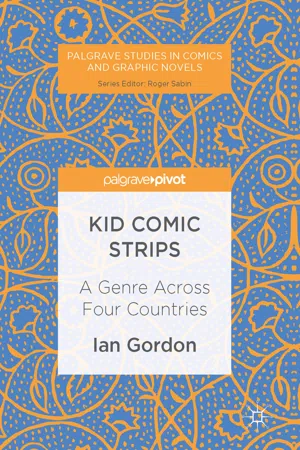
This book looks at the humor that artists and editors believed would have appeal in four different countries. Ian Gordon explains how similar humor played out in comic strips across different cultures and humor styles. By examining Skippy and Ginger Meggs, the book shows a good deal of similarities between American and Australian humor while establishing some distinct differences. In examining the French translation of Perry Winkle, the book explores questions of language and culture. By shifting focus to a later period and looking at the American and British comics entitled Dennis the Menace, two very different comics bearing the same name, Kid Comic Strips details both differences in culture and traditions and the importance of the type of reader imagined by the artist.
Information
© The Author(s) 2016
Ian GordonKid Comic StripsPalgrave Studies in Comics and Graphic Novels10.1057/978-1-137-55580-9_11. Why Kid Comics
Ian Gordon1
(1)
Department of History, National University of Singapore, Singapore, Singapore
Abstract
The chapter argues that by comparing comics from different countries it is possible to understand just what features American comic strips have contributed to the international form of comic art. The chapter offers a brief account of the passage of American comics to France, Italy and Brazil and a slight history of comics in Britain and Australia.
Keywords
Buster BrownWord BalloonsTranslationComics are international phenomena. To be sure they go by different names like bande dessinée, manga, fumetto, las historietas, and quadrinhos, and they come in different forms such as comic strips (with and without word balloons), comic books, and other forms of graphic sequential narrative, but the form itself is fairly ubiquitous. In the last 20 years or so, a broad group of scholars from across the world has produced an array of work detailing histories and analyzing the form and its impact to the extent that comics scholarship has become a field of inquiry. In this flurry of activity, many national histories have been told and the formal aspects of comics, panels, pages, word balloons, and the like, analyzed and dissected.
Kid Comics
A comparative study of kid comic strips across four different countries is an attempt to consider genre in comics as a way to approach international histories of comics. Kid comics refers to comics featuring kids, which may or may not have been read by children, but the majority of the works I study were aimed at audiences of diverse ages. In this book, I offer three comparative studies: The American strip Skippy with the Australian strip Ginger Meggs, the Perry Winkle Sunday episodes of the American strip Winnie Winkle with the French translation of that strip as Bicot, and both the American and British Dennis the Menace comics. These are but six kid comics that can usefully be compared and my study is exploratory rather than exhaustive.
The impact of recent scholarship on comics has led to more nuanced understandings of the way they developed in many countries. Gone are the days when a work could assert “the American newspaper comic strip…is a major innovation and creative cultural accomplishment of the United States, one that has spread around the world” seemingly disinterested in the long European antecedents that helped give birth to, and shape, American comics. And this despite acknowledging that Rudolph Dirk’s early American comic strip The Katzenjammer Kids “had originally been copied directly from the two schrecklichkinder of [Wilhelm] Busch.”1 The authors of this assessment Bill Blackbeard and Martin Williams did not make it clear if their meaning was that American comics spread around the world, or if they meant that comics spread from America to the world. Indeed, in 1977, it may have seemed to them that the two amounted to the same thing. In any case, in American accounts of comics the latter view was commonly referenced. Their statement and others like it were a little too quick to attribute accomplishments to the USA that were broader in origin. Scholars such as David Kunzle and Thierry Smoldren have done much to show the European roots of American comics and while popular perceptions still abound, that somehow comic strips are uniquely American, and Richard Outcault’s character the Yellow Kid the first comic strip, academics have moved on from this limited view.2 Studying kid comic strips across four countries helps shed more light on just what American comics contributed to the development of the form.
What marked American comic strips and made them different from comics elsewhere was their place in mass circulated newspapers. This gave American comic art a distinctively commercial bent and those comics were a constitutive element in shaping a culture of consumption in America. The importance of the Yellow Kid had nothing to do with the formal properties of comics, or the creation of strips in sequential panels as the form of newspaper comic strips, or the use of word balloons, since none of these were quintessential features of that comic. What was important was the distinctive character. When the American newspaper comic strip eventually coalesced into a recognizable form in the first six months of 1901, they had three key features: a distinctive character, sequential panels, and mostly used word balloons. All these features of course had existed in earlier European comic art. What made the American comics different was that they were ongoing features that appeared on a regular schedule and were so essential to the creation of mass circulated newspapers, the mass media, that it is difficult to separate the two.3
Kid comics were important to the development of comic strips in American newspapers and this had an international character. Busch’s Max und Mortiz inspired Dirks’s concept for the Katzenjammer Kids and quite early in their existence American comic strips were exported to other countries. This importing of American comics did not mean those countries had no comics traditions before the arrival of comics American style. Richard Outcault’s Buster Brown comic strip, which he began in 1902, and that was one of the most widely distributed comic strips in America, was sold by the Hearst syndicate to other countries such as Italy, France, and Brazil. In Italy, Buster Brown ran in Corriere dei Piccoli under the title Mimmo Mammolo. Often the word balloons that Outcault used were removed and rhyming captions used under the panels. Alex Valente discussed this comic along with several others at a conference in Glasgow in 2013. He focused on issues of translation and highlighted the problems of translating idioms. He also pointed to the way that onomatopoeia presented special problems in translation, in that the sounds these represent might not be the way such sounds are heard or understood in other languages.4 In France, Buster Brown appeared in comics albums published by Hachette. These volumes appear to be translations of American edition of Buster’s weekly strips that were published by F. A. Stokes and later Cupples & Leon. According to Antoine Sausverd, on his Topfferiana web site, in 1905 the weekly children’s supplement of the Parisian newspaper Le Petit Journal, Le Petit Journal illustré de la jeunesse ran an imitation Buster Brown titled “Les exploits de Turc, Jacasse et Cie” an example of which from December 24, 1905, he reproduces. This comic mostly used captions and not word balloons, but the last panel had the faux Buster talking with his dog and used word balloons.5
In Brazil, Renato de Castro adapted Buster Brown, apparently by tracing Outcault’s strips, for the children’s publication O Tico-Tico that commenced publication on October 1, 1905. In the O Tico-Tico version, Buster Brown became Chiquinho and his dog Tige, Jagunço. The episode appearing in the first issue of O Tico-Tico, “The Misadventures of Chiquinho: The Race With Jagunço” was a rather crude rendering, but nonetheless recognizable as Buster Brown. Chiquinho did not remain a simple copy of Buster Brown with O Tico-Tico’s artists reworking it in several fashions. For instance, in 1909, several issues of the strip featured a mash-up of Buster Brown and Winsor McCay’s Little Nemo in Slumberland. With the advent of World War I and difficulties in obtaining the America originals, Luis Gomes Loureiro, who had early taken over Chiquinho from de Castro, began to create material from scratch, thereby creating something different and more Brazilian in character. Outside of Brazil, Chiquinho and its impact remains little studied.6
The history of Buster Brown then is mostly told in national frameworks with some reference in Italian, France, and Brazilian reflections on the character of his American origins. Those writing on the American history of Buster Brown, myself included, have largely ignored or been unaware of the extent of the characters’ transnational dimensions. The sort of language skills and research time needed to address the international dimensions of Buster Brown are daunting and it is probably beyond the reach of a single scholar to do so. Nonetheless, Buster Brown was not the only American comic strip to have an international dimension and there are other ways at coming at the issue of the impact of kid comics in different countries.
At first it might seem surprising that American comics were not exported to English-speaking countries such as Britain or Australia. Certainly papers in Canada carried American comic strips. For instance, The Ottawa Journal carried Hearst strips like Mutt and Jeff and Bringing Up Father by 1915. The contiguous nature of the two North American countries probably accounts for this spread north. Both Britain and Australia had distinctive comics traditions of their own and this might explain the relative lack of imports. Roger Sabin has shown the importance of Ally Sloper, and the eponymous comic weekly, Ally Sloper’s Half Holiday, to the development of the form in Britain.7 Weekly comic magazines were more important in Britain to the development of comic art and it was not until 1915 that the first daily comic strip, Teddy Tail, appeared in the Daily Mail. 8Australia developed a tradition of its own in which all forms of comics and their artists came together for many years in the Black and White Artists’ Club.9 But these traditions had a heavy dose of American influence because so much of the work for these artists flowed from The Bulletin magazine, which at its founding in 1880 had imported American printers trained in photo engraving, and Livingston Hopkins an artist best known then for his work for the New York-based illustrated humor journal, Judge.10 Despite these American influences, comic strips did not develop in Australia until the 1920s. But there were some comics weekly magazines, in the manner of such British publications, including Vumps and The Comic Australian. Aimed at children, this latter publication ran for two years from 1911 to 1913. In its first issue, the magazine published a one-off comic strip, Jim and Jam, Bushrangers Bold, which transposed Max und Moritz or the Katzenjammer Kids, to the Australian bush as outlaws. The artist of this strip Hugh McCrae, a poet, actor and essayist, later lived in New York where he shared an apartment with fellow Australian Pat Sullivan, the creator of Felix the Cat. Late in life, McCrae told the story that Sullivan had asked him to draw that cartoon and comic, which he passed up, much to his regret.11 Whether or not the story is true, Sullivan’s success and McCrae’s presence in New York is indicative of the transnational nature of comic art and artists early in the twentieth century. In Australia on November 13, 1921, the Sund...
Table of contents
- Cover
- Frontmatter
- 1. Why Kid Comics
- 2. America and Australia: Skippy and Ginger Meggs
- 3. America and France: Perry Winkle and Bicot
- 4. America and Britain: Dennis the Menace (s)
- 5. Comics Scholarship and Comparative Studies
- Backmatter
Trusted by 375,005 students
Access to over 1.5 million titles for a fair monthly price.
Study more efficiently using our study tools.
Frequently asked questions
Yes, you can cancel anytime from the Subscription tab in your account settings on the Perlego website. Your subscription will stay active until the end of your current billing period. Learn how to cancel your subscription
No, books cannot be downloaded as external files, such as PDFs, for use outside of Perlego. However, you can download books within the Perlego app for offline reading on mobile or tablet. Learn how to download books offline
We are an online textbook subscription service, where you can get access to an entire online library for less than the price of a single book per month. With over 1.5 million books across 990+ topics, we’ve got you covered! Learn about our mission
Look out for the read-aloud symbol on your next book to see if you can listen to it. The read-aloud tool reads text aloud for you, highlighting the text as it is being read. You can pause it, speed it up and slow it down. Learn more about Read Aloud
Yes! You can use the Perlego app on both iOS and Android devices to read anytime, anywhere — even offline. Perfect for commutes or when you’re on the go.
Please note we cannot support devices running on iOS 13 and Android 7 or earlier. Learn more about using the app
Please note we cannot support devices running on iOS 13 and Android 7 or earlier. Learn more about using the app
Yes, you can access Kid Comic Strips by Ian Gordon in PDF and/or ePUB format, as well as other popular books in Social Sciences & Literary Criticism. We have over 1.5 million books available in our catalogue for you to explore.