eBook - ePub
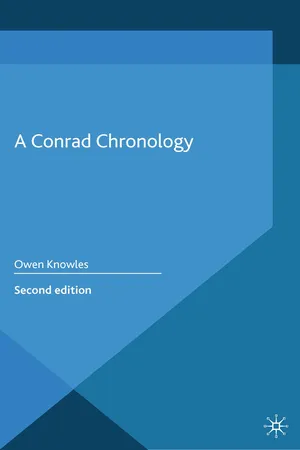
A Conrad Chronology
About this book
Newly revised and enlarged, the second edition of A Conrad Chronology draws upon a rich range of published and unpublished materials. It offers a detailed factual record of Joseph Conrad's unfolding life as seaman and writer as well as tracing the compositional and publication history of his major works.
Information
Publisher
Palgrave MacmillanYear
2014Print ISBN
9781349497379
9781137452382
Edition
2eBook ISBN
9781137452399
A Conrad Chronology
Early Years (1857–73)
1857
(3 Dec) Józef Teodor Konrad Nałęcz Korzeniowski is born in Berdichev in western Ukraine, a part of Poland annexed by Russia since 1795. He is the only child of Apollo Korzeniowski, a writer, translator and Polish patriot (born 1820) and Ewa (née Bobrowska, born 1832), who were married on 4 May 1856. Both parents are members of the landowning or szlachta class, although from families markedly different in their traditions and commitments. The politically active Korzeniowskis espouse soldierly and chivalric qualities, fervently upholding the tradition of patriotic action against Russia in the name of national independence, democratic reform and the birth of a ‘young Poland’. In the view of Tadeusz Bobrowski, Ewa’s brother and chief spokesman for the family, the Bobrowskis traditionally affirm the tenets of enlightened conservatism, trusting to ‘realistic’ political adjustment and conciliation as a means to eventual Polish autonomy; no less patriotic than Apollo in his view, Bobrowski asserts the need ‘to make a sober assessment of our position, to abandon our traditional dreams, to draw up a programme of national aims for many years to come, and above all, to work hard, to persevere, and to observe a strict social discipline’ (CUFE, p. 36). These varied inheritances come together in the three forenames chosen for JC, the first two derived from his grandfathers and the third (Konrad) from the name of the hero and Romantic patriot in Adam Mickiewicz’s poetic drama Dziady [‘Forefathers’ Eve’] (1823). JC is also a Nałęcz Korzenioswki, ‘Nałęcz’ being ‘the heraldic name of the family coat-of-arms’ (Baines, p. 1). JC’s father celebrates the christening of his son with a poem, ‘To My Son Born in the 85th Year of Muscovite Oppression’ (CUFE, pp. 32–3).
1859–60
After spending the first three years of their married life in Łuczyniec and Derebczynka (where Apollo had a brief, unsuccessful career as an estate-manager), the Korzeniowskis move at the beginning of 1859 to Zhitomir. Here Apollo can devote himself to his literary and political activities: he writes and translates extensively, adding to his first play Comedy (1855) another satirical comedy, For the Love of Money, published and successfully staged at this time. During his two years in Zhitomir, Apollo also helps to run a publishing company and is increasingly engaged in underground political activities.
1861
Leaving his family in Zhitomir, Apollo moves in May to Warsaw (scene of recent patriotic demonstrations) ostensibly to establish a new literary journal Dwutygodnik [‘Fortnightly’], but mainly to devote himself to clandestine political activity. Ewa writes to Apollo on 17 July that ‘Konrad is growing into a lovely boy. He has a heart of gold and with the ground you prepare for him[,] there should be no problems with his conscience and mind. He often goes to church with me and almost always gives alms’ (CUFE, p. 53). When she and her son join Apollo in the autumn, their home at 43 Nowy Świat becomes a centre for the underground Committee of the Movement. On 20 October, Apollo is arrested on four counts of subversive activity and spends seven months awaiting trial in the Warsaw Citadel; Ewa too is later accused of unlawful conspiracy against the state.
1862
After military trial, Apollo and Ewa are sentenced on 9 May to exile and, with their four-year-old son, escorted under police supervision to Vologda, 300 miles north-east of Moscow. Ewa and her son fall ill before the long and difficult journey is finished on 12 June – she through physical collapse, he with pneumonia. The harsh Russian conditions, soon to take their toll on the whole family, are graphically evoked in Apollo’s early letter from the ‘huge quagmire’ that is Vologda (CUFE, pp. 65–9). Here the Korzeniowskis, joining a community of Polish exiles living under police surveillance, are assigned a rudimentary wooden house on Bolshoi Kozlenskaia Street. In late September, they learn that they have been allowed to move south to Chernigov, near Kiev, although their departure is delayed by health problems and the state of the local roads.
1863
At the new year Bobrowski presents JC with the gift of a book, Les Anges de la terre (1844) by A. E. de Saintes. Later in the month the Korzeniowskis arrive in Chernigov, where news of the 1863 insurrection meets them. (The insurrection steadily weakens in momentum during the coming months and is finally crushed in 1864.) In the early autumn Ewa and her son are allowed three months leave for medical treatment and to visit her relatives at Nowochwa...
Table of contents
- Cover
- Title
- Copyright
- Dedication
- Contents
- List of Maps
- Series Editor’s Preface
- Preface to the Second Edition
- List of Abbreviations
- A Note on Names, Titles, Usages and Money
- Introduction
- A Conrad Chronology
- Select Who’s Who
- Locations and Addresses
- Maps
- Select Bibliography
- Index
Trusted by 375,005 students
Access to over 1.5 million titles for a fair monthly price.
Study more efficiently using our study tools.
Frequently asked questions
Yes, you can cancel anytime from the Subscription tab in your account settings on the Perlego website. Your subscription will stay active until the end of your current billing period. Learn how to cancel your subscription
No, books cannot be downloaded as external files, such as PDFs, for use outside of Perlego. However, you can download books within the Perlego app for offline reading on mobile or tablet. Learn how to download books offline
Perlego offers two plans: Essential and Complete
- Essential is ideal for learners and professionals who enjoy exploring a wide range of subjects. Access the Essential Library with 800,000+ trusted titles and best-sellers across business, personal growth, and the humanities. Includes unlimited reading time and Standard Read Aloud voice.
- Complete: Perfect for advanced learners and researchers needing full, unrestricted access. Unlock 1.5M+ books across hundreds of subjects, including academic and specialized titles. The Complete Plan also includes advanced features like Premium Read Aloud and Research Assistant.
We are an online textbook subscription service, where you can get access to an entire online library for less than the price of a single book per month. With over 1.5 million books across 990+ topics, we’ve got you covered! Learn about our mission
Look out for the read-aloud symbol on your next book to see if you can listen to it. The read-aloud tool reads text aloud for you, highlighting the text as it is being read. You can pause it, speed it up and slow it down. Learn more about Read Aloud
Yes! You can use the Perlego app on both iOS and Android devices to read anytime, anywhere — even offline. Perfect for commutes or when you’re on the go.
Please note we cannot support devices running on iOS 13 and Android 7 or earlier. Learn more about using the app
Please note we cannot support devices running on iOS 13 and Android 7 or earlier. Learn more about using the app
Yes, you can access A Conrad Chronology by O. Knowles in PDF and/or ePUB format, as well as other popular books in Literature & Literature General. We have over 1.5 million books available in our catalogue for you to explore.