eBook - ePub
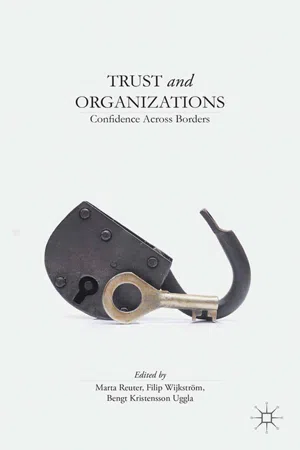
Trust and Organizations
Confidence across Borders
- English
- ePUB (mobile friendly)
- Available on iOS & Android
eBook - ePub
Trust and Organizations
Confidence across Borders
About this book
An increasing number of people work in organizations that 'trade in trust'. Institutions such as banks, accounting firms, schools, and hospitals require customers, students, and patients to have confidence in the experience and professional expertise of the staff, as well as in the effectiveness of the regulations, rules, and systems in place for quality control. What mechanisms have developed in modern society to create, manage, maintain, and convey trust in companies, public administrations, and civil society organizations? What takes place in the encounter between different cultures of confidence and what happens when confidence in or between organizations is shattered?
Trust and Organizations gathers an interdisciplinary group of academics to contextualize the dilemmas resulting from the institutionalization of trust and confidence in a wide selection of organizational settings. The importance of trust is highlighted in relation to different types of borders or boundaries - institutional, organizational, and geographical - as the overlapping and blurring of such boundaries is becoming one of the main characteristics of an increasingly transnational and re-regulated world.
Information
CHAPTER 1
Trust Contextualized: Confidence in Theory and Practice
Bengt Kristensson Uggla, Marta Reuter, and Filip Wijkström
What is the role of social trust in society and in organizational life? Does trust, as many imagine, function as a sort of a web that holds together the entire machinery of society, as a lubricant that oils the wheels of exchange and transactions? Or is it, in reality, a loose but sticky glue that produces inertia and slowness of reaction, hampering mobility and change? What mechanisms have developed in modern society to create, manage, maintain, and convey trust, not only in such different organizational settings as corporations, agencies of public administration, and civil society organizations, but also across these boundaries and other settings? What happens in the transition zone between different societal contexts, when trust is being recontextualized in diverse institutions and cultures? And—perhaps of particular importance today—what can we learn from the logic of de- and recontextualization of trust, in situations where public confidence is shattered?
Questions related to the fundamental conditions and functions of social trust have probably always been important to people. It is fairly uncontroversial to postulate that trust is an inevitable prerequisite for all kinds of human interactions, regardless of time and place. If the way in which we relate to each other and to our institutions were characterized only by distrust and lack of confidence, hardly any of us would dare to take our car on to the roads, take the bus to work, leave our children in kindergarten, or drop them off at school. Nor would we take the risk to prepare the food that we have purchased at the supermarket, go to our neighbors for dinner, or eat from the menu at a restaurant, although we seem to do this in very different ways in different countries, as shown by Kjærnes, Harvey, and Warde (2007) in their book Trust in Food. Neither would we, which brings us to the main concern of this book, dare to strike complex business deals, care to reach out to create a European Union, or, indeed, share rich flows of information between different types of organizations.
For good reasons, in many situations we have to take for granted that we can trust other people. Although most of us realize that it would be naive to approach fellow human beings with a form of blind trust that does not include some degree of skepticism, we can, nevertheless, not escape the fact that some kind of mutual confidence has to be in place for all of us to be able to live our daily lives together. This is true in the case of close dialogical relationships as well as more institutionalized and formalized contexts in today’s organization society. However, when making the transition between (informal) dialogues and (formal) institutions, as well as between different organizational, institutional, and cultural settings, we are confronted with a complexity of trust matters that asks for our attention as social scientists.
The above applies in particular to the realms of economy and politics; arguably, nothing would work in these spheres if people did not trust one another and the institutions in place. The frequently heard reference to particular fields of these realms as trust industries has thus a lot of truth to it. In today’s world, it is no longer possible to reduce trust to a “soft” issue, in comparison with more tangible phenomena such as money and legal structures. In fact, many of the profound challenges and urgent problems that we experience in our time, ranging from democratic deficits and economic crises to the lack of self-esteem in many peoples’ everyday life, become more comprehensible if we understand them as a spectrum of a trust and confidence crisis (Reuter, Wijkström, and Kristensson Uggla 2012). Such a reading of our contemporary world and the human condition opens up for more fruitful strategies to tackle the dilemmas that our societies face today, no matter if they are dressed in the language of governance (Ostrom 1990; Anheier 2013), social capital (Putnam 1993; Coleman 1996), or framed as an interplay between trust and distrust (Hardin 2004; Papakostas 2012), just to mention a few possible approaches. This applies not the least to the economic predicament dominating the European news at the time of writing and publishing this book. There are, in our view, good reasons to interpret the crippling debt and currency crisis that currently affects Europe as a crisis of trust, and that this particular diagnosis should guide the actions taken in order to cope with the situation.
Trust and Organizations
For the purposes of this book, we have assembled a number of social science scholars from different disciplines, and asked them to reflect on the intricate relationship between social trust and organizational life, as well as on the ways in which these two constitute and shape each other. It is nowadays almost a truism to say that we live in an organization society; at the same time, many of us are probably not even aware of the degree to which organizing and organizations pervade the late modern world, governing, structuring, and framing most, if not all, societal activities, processes, and exchanges (see, e.g., Ahrne 1994 and Brunsson 2010). In this increasingly organization-based web of societal relations, trust plays a number of pivotal roles, which, however, have so far not been satisfactorily explored by the social sciences.
Our point of departure in this anthology is the conviction that the idea of trust holds one important key to the understanding of matters related to the existence, functioning, and behavior of organizations, and that this has become even more evident in postindustrial societies. At the most basic level, trust could be seen as the key ingredient holding organizations and institutions together; after all, what are these if not imaginary creations of the human mind, sustained only by our sheer belief—or confidence—in their existence, stability, and operational capacity? If the elemental trust of citizens, in the workings of the organizational and institutional system that we all are embedded in, were at some point withdrawn, that system would crumble to dust within moments. From this point of view, all organizational structures and governance practices are fundamentally dependent on a degree of trust, no matter how different its empirical form in different contexts. At the same time, however, the reverse is also true; in the late modern world, characterized by an increasingly impersonal nature of human relations, organizations and institutions themselves can be understood as instruments or vehicles that help create, relay, and administer basic trust across geographical, cultural, and social distances. As some of the chapters in this book will illustrate, organizational practices that aim at confidence building can, however, also be a potent instrument in processes that ultimately call into question and/or undermine trust, creating spirals of mutually reinforcing need for control and lack of confidence.
This interdependent and context-bound nature of the relationship between trust and organizations is the focus of the present volume. Strangely enough, the importance of trust and confidence—two related concepts that, despite the nuanced difference in meaning, will be used interchangeably in the book—has become a major theme in the social sciences only in the recent decades. Despite the growing interest in this subject, however, the common tendency to think of trust in a univocal, rather simplistic way, has generated a situation where the concrete trust-related practices developed in the spectrum of different contexts have been given scant attention. As a result, a contextual approach to trust is largely missing in the social science literature. Here, the chapters and authors of this book make a valuable contribution, and hopefully also open up a more nuanced scholarly conversation about the context-bound nature of trust and confidence in organizational and social life. The texts assembled in the volume offer a rich variety of perspectives that may contribute to a better understanding of the potential conflicts and dilemmas arising when trust is constantly being (re)contextualized in ever-new organizational, institutional, and cultural settings.
In order to understand how differently trust can be expressed in different contexts, the best place to start may be from firsthand experience. Several years ago, one of us editors participated in a Swedish delegation visiting a top-ranked university in the United States, with the purpose of initiating cooperation between that university and our Swedish institution. The discussions during our meetings went well, and there seemed to be no real complications in the negotiations with our American colleagues. A feeling of mutual understanding and trust arose surprisingly quickly, and after a few intense days, during which pleasant meetings had been interspersed with social activities, our delegation returned to Sweden with high expectations in terms of possible future cooperation between the two institutions.
Shortly after returning, we received a follow-up email from the American partners with many kind words—and an attachment. As we opened and read the attachment, however, our mood changed completely: suddenly, it was as if all of the trust that had emerged during the visit in the United States had been taken away, and the enthusiasm disappeared. Why? The reason may, at the first sight, seem trivial. The attachment contained an extensive draft of a contract, where each paragraph in detail regulated the obligations and commitments to the project. Every single part the delegation had discussed could be found in the document—but the information was now presented in a dry, dense legalese that immediately produced a feeling of confusion on our part. What had happened? Did the American friends get cold feet about the collaboration? Did they no longer trust us? Time passed and the email remained lying in the in-box, without any replies from us Swedes. The motivation to follow up the initiative seemed literally crushed, and we felt as if this entire ambitious project, with all its positive energy, had with one blow run out of steam.
After some time, we received a phone call. It was our American colleagues who, from across the Atlantic, sounded somewhat surprised and confused, wondering what had happened to us. Why didn’t we respond to their enthusiasm? Had something dramatic happened and changed the scene since we had parted ways? Why had we not responded to their email in order to continue with our cooperation? Their disappointment was evident.
Only then did it dawn upon us, what we undoubtedly had known in theory, but in practice, and in a rush, had forgotten: contracts and formalizations are assigned very different meanings and functions in Sweden and the United States. While we, in our informal Swedish everyday life, usually tend to view a handshake as the ultimate sign of trust—and a contract, in contrast, as a signal of lack of confidence, due to the fact that some form of “insurance” is required to trust the counter party—on the other side of the Atlantic, a contract actually manifests a tangible expression of mutual trust.
The Complexity of Trust and Organizations: The Importance of the Context
Misunderstandings in interorganizational interactions that arise from cultural differences are naturally not a new object of interest for social scientists. However, within the academic debate on trust and its role in human and organizational relations, the importance of the context has not received enough attention. The above-described experience of how the prerequisites for trust and reliance can change when entering into new settings discloses a complexity far beyond the instrumental logic of those who attempt to portray trust as a capital easy to manage. Thus, this example may serve as an appropriate starting point for a conversation about the fundamental conditions of trust in different organizational, institutional, and cultural contexts.
First, we can learn something about how complicated it is, in terms of trust, to move between theory and practice when trust is being contextualized, because in this transition a number of unpredictable transformations take place—transitions in both directions—which reinforce the conviction that trust is not something simple and univocal.
Second, the above anecdote demonstrates that a “trust capital” cannot be treated as an abstract and universal asset that may simply be transferred and used in new situations, because trust can only exist as something strongly contextualized and situation dependent. Furthermore, the prerequisites for the distribution and organization of trust also differ distinctively between different countries, cultures, organizations, and institutions.
Third, we can learn something about the profound ironic logic of formalization. In the transition between theory and practice, and boundary transgression between different settings, the occurrence of not only control systems, rules, and institutionalizations, such as the contract in our story above, but also different kinds of auditing, have a fundamentally ambiguous effect on trust. These kinds of institutionalizations and follow-up mechanisms can in some contexts strengthen, but in other contexts weaken, the capital of trust.
Fourth, and indirectly laying the foundations for this book, the anecdote says something about our embeddedness—as social scientists but first and foremost as humans—in our own institutional (in this case Northern European) trust culture. The above-described incident illustrates the need for an autoreflexive stance—a skeptical attitude toward one’s own assumption about trust and its workings, if you wish—in any discussion of trust as a societal phenomenon that aspires to relevance beyond the present particular cultural context. We will return to the implications of this ambition for the present volume further in this chapter.
Finally, in a list that certainly could be made longer, the story above points toward the need to take the role and complexity of trust in interorganizational relations seriously. This is of extraordinary importance in a world characterized by increasingly transnational relationships and by an increasingly global information logic. In today’s society, trust-related challenges are not limited to a local or national specificity, as we are all confronted, on a daily basis, not the least due to the new digital information system, with the most diverse organizational, institutional, and cultural logics, and constantly forced to face our counterparts across the many increasingly blurry boundaries in the globalizing world.
Trust across Borders
The last of the above reflections serves, in fact, as the main departure point for most of the contributions in this book. In a recent analysis of the interplay of trust and distrust in society, the sociologist Apostolis Papakostas (2012) draws attention to the role of boundaries—spatial, social, and organizational—in the creation and management of trust and of its counterpart, distrust. Sharing this perspective, the research presented in most of the chapters in this volume is grounded in the realization that trust-related dilemmas are at their most pronounced at broadly understood junction points, where established boundaries between organizations, institutions, and/or geographical/cultural settings are being put into question, stretched, or crossed. Indeed, one of the main conclusions that can be drawn from the empirical studies presented in this volume is that when we move between distinct geographical, institutional, and organizational contexts and differing social practices, trust itself undergoes a series of profound transformations.
Most of the contributions in the book revolve in one way or another around the question of how trust logics play out—and, frequently, are instrumentalized—across organizational, institutional, or national borders; these three dimensions of boundary crossing form a sort of a font for the discussion that runs as a red thread through the individual chapters. In some of the texts, this may mean investigating what happens to trust and its prerequisites in interactions and exchanges between individual organizations and their distinct organizational cultures. For others, it may entail enquiring how trust is affected, transformed, and used—but also what role(s) it plays itself—in the meeting between different institutional logics (cf. Friedland and Alford 1991), or when societal actors operate across the border between different institutional spheres. Finally, in yet other chapters, it can involve exploring the ways in which trust is used, managed, reproduced, and recreated in the world of increasingly ubiquitous transnational interactions. Notably, these three dimensions are certainly not mutually exclusive; on the contrary, as the texts in this book illustrate, the significance of trust and the complexity of the trust-related societal dynamics and mechanisms become even more acutely visible when these dimensions overlap—as they most often do in real life.
Trust in Theory and Practice
Today, a comprehensive range of international literature, both academic and more popular in tone, addresses trust and confidence in depth, linking often the challenges and dilemmas associated with trust to related concepts, such as social capital (see, e.g., Putnam 1993; Fukuyama 1995; Hardin 2004 and 2006; Cook, Hardin, and Levi 2005; Trägårdh 2009). We do not intend to repeat here the insights from this meritorious literature, although several of the contributions to this anthology build upon and refer to some of the theories and concepts developed there. Neither do we have the ambition of developing a theory of trust of our own. The aim of this publication is, instead, to illustrate and shed light on the richness of the organizational and institutional contexts in which the complexity of trust—and the dilemmas related to trust management—manifest themselves.
As several of the book’s chapters show, the issue of trust and distrust at the societal level is intimately linked to issues of control and monitoring, key concepts in governance literature. Today’s organization society is, however, less characterized by micromanagement and hierarchical delegation, and increasingly dominated by self-organizing and self-reporting systems, regulated by objective-based management, decentralization, and local autonomy in the form of a kind of control “from within.” These trends have led to the emergence of a generalized accounting and control culture that is becoming increasingly pervasive in our societies, giving rise to concepts such as “audit society” (Power 1999). The “control addiction,” which according to critics such as Power emerges as a result of the excesses of the audit society, is characterized, among others, by the ironic development logic also characterizing other addictions: although there are short-term profits, in the long run, more trust-related problems are created than solved.
In this context, it is important to recall that the opposite of trust is not suspicion or distrust. Just as it would be both naive and devastating for the concept of trust if we, in all situations, blindly trusted others, it seems a simplification to identify...
Table of contents
- Cover
- Title
- 1 Trust Contextualized: Confidence in Theory and Practice
- 2 Currency for Europe: Monetary Solidity, Trust, and Identification across National Borders
- 3 Can Auditing Generate Trust? The Organization of Auditing and the Quality of Government
- 4 From Global Consumer Power to Local Worker Power
- 5 The Certification Paradox: Monitoring as a Solution and a Problem
- 6 The Triumph of Feelings: On the Power of Imagery in Business
- 7 The Creation of a Crisis of Confidence: A Study of the Mediatization of the Red Cross
- 8 Trust in the Monitoring of Publicly Funded Services: A Case Study of Two Outsourced Care Homes for the Elderly
- 9 The Grammar of Trust as Ethical Challenge
- 10 The Historical Incubators of Trust in Sweden: From the Rule of Blood to the Rule of Law
- List of Contributors
- Index
Trusted by 375,005 students
Access to over 1.5 million titles for a fair monthly price.
Study more efficiently using our study tools.
Frequently asked questions
Yes, you can cancel anytime from the Subscription tab in your account settings on the Perlego website. Your subscription will stay active until the end of your current billing period. Learn how to cancel your subscription
No, books cannot be downloaded as external files, such as PDFs, for use outside of Perlego. However, you can download books within the Perlego app for offline reading on mobile or tablet. Learn how to download books offline
Perlego offers two plans: Essential and Complete
- Essential is ideal for learners and professionals who enjoy exploring a wide range of subjects. Access the Essential Library with 800,000+ trusted titles and best-sellers across business, personal growth, and the humanities. Includes unlimited reading time and Standard Read Aloud voice.
- Complete: Perfect for advanced learners and researchers needing full, unrestricted access. Unlock 1.5M+ books across hundreds of subjects, including academic and specialized titles. The Complete Plan also includes advanced features like Premium Read Aloud and Research Assistant.
We are an online textbook subscription service, where you can get access to an entire online library for less than the price of a single book per month. With over 1.5 million books across 990+ topics, we’ve got you covered! Learn about our mission
Look out for the read-aloud symbol on your next book to see if you can listen to it. The read-aloud tool reads text aloud for you, highlighting the text as it is being read. You can pause it, speed it up and slow it down. Learn more about Read Aloud
Yes! You can use the Perlego app on both iOS and Android devices to read anytime, anywhere — even offline. Perfect for commutes or when you’re on the go.
Please note we cannot support devices running on iOS 13 and Android 7 or earlier. Learn more about using the app
Please note we cannot support devices running on iOS 13 and Android 7 or earlier. Learn more about using the app
Yes, you can access Trust and Organizations by M. Reuter, F. Wijkstrom, B. Uggla, M. Reuter,F. Wijkstrom,B. Uggla in PDF and/or ePUB format, as well as other popular books in Business & Business Ethics. We have over 1.5 million books available in our catalogue for you to explore.