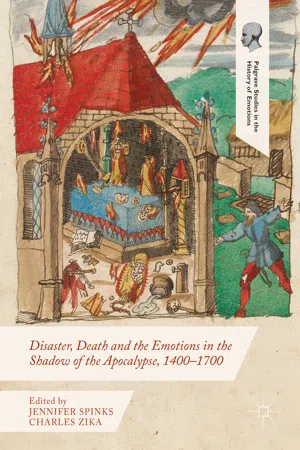
eBook - ePub
Disaster, Death and the Emotions in the Shadow of the Apocalypse, 1400–1700
- English
- ePUB (mobile friendly)
- Available on iOS & Android
eBook - ePub
Disaster, Death and the Emotions in the Shadow of the Apocalypse, 1400–1700
About this book
Information
© The Author(s) 2016
Jennifer Spinks and Charles Zika (eds.)Disaster, Death and the Emotions in the Shadow of the Apocalypse, 1400–1700Palgrave Studies in the History of Emotions10.1057/978-1-137-44271-0_11. Introduction: Rethinking Disaster and Emotions, 1400–1700
Jennifer Spinks1 and Charles Zika2
(1)
School of Arts, Languages and Cultures, The University of Manchester, Manchester, UK
(2)
ARC Centre of Excellence for the History of Emotions, The University of Melbourne, Melbourne, Australia
Under the pressure of the global climate change debate, and in response to increased reporting of major local and regional natural disasters in recent years, such as the south east Asian tsunami, the Haiti and Nepal earthquakes, or cyclone Katrina, the literature on disasters continues to grow at a remarkable pace. 1 A wide range of experts in multiple sectors have become involved in endeavouring to establish better systems by which governments and social agencies can help predict disasters, mitigate their impact, assist in recovery, and minimise future risk.
I
Prior to the last two decades or so, historians have had little to say about disasters. Conceptualised for the most part as single, exceptional and unpredictable events, disasters seemed beyond the scope of historical analysis. 2 They were considered one-off events beyond history; ‘acts of God’ which did not allow for detailed analysis and understanding. But in contrast to traditional historical analyses that have concentrated for the most part only on major and dramatic disasters—such as the Great Fire of London of 1666, the Lisbon Earthquake of 1755, or even perhaps the Basel Earthquake of 1356—recent attention is being given to those numerous smaller disasters which affected European communities on a more regular basis—such as the flooding of various rivers like the Arno and the Rhine, or of the North Sea coastal communities of Germany and the Netherlands, the numerous earthquakes to strike central and northern Italy, Switzerland and parts of France, and the avalanches of the Alpine regions. And more detailed attention has also been given to the epidemics and famines that struck most of Central and Northern Europe at the time of dramatic cooling associated with the Little Ice Age from the 1560s through to 1650–1700, reaching its peak in Western Europe between 1565 and 1628. 3
This new interest has been predicated on new models of conceptualising nature-induced disasters. Social scientists have increasingly viewed ‘natural disasters’ as social and cultural phenomena, rather than simply ‘natural’. Natural hazards become disasters because of social, political, economic and cultural conditions. As the anthropologist Anthony Oliver-Smith has argued: ‘Disasters do not just happen. In the vast majority of cases, they … take place through the conjuncture of two factors: a human population and a potentially destructive agent that is part of a total ecological system … A society’s pattern of vulnerability is a core element of a disaster.’ Disasters occur ‘at the intersection of nature and culture and illustrate, often dramatically, the mutuality of each in the constitution of the other.’ 4
As a result, there has been much greater focus on the recurring nature of disasters, on their longer-term causes, on common patterns of individual and collective response, on the longer-term impacts on social and cultural organisation. The ‘vulnerability’ of societies to hazards is critical—whether that be the ‘risk culture’ of the Philippines, for instance, with its proneness to earthquakes, volcanic eruptions, typhoons and flood, or the ‘risk culture’ of the so-called hydrographic or dike cultures of early modern Netherlands or coastal Northern Germany, with their propensity to recurrent flooding. 5 A critical question is how these hazards are recognised and confronted—culturally and emotionally, as well as through agriculture, architecture or other forms of technology.
When dealing with early modern European societies, however, the line between the sphere of ‘nature’ and the sphere of the human is extremely elastic and complex. Both are firmly within the scope of divine providence and action. What we understand to be natural disasters and human-induced disasters have the divinity as their primary cause. All are subordinate to the divine will and plan. Warfare in particular is one of the most terrifying disasters visited by God on human society. The four horsemen of the Apocalypse in the Book of Revelation, for instance, ride the horses of Conquest, Famine, Death and War. So in this book we include warfare in particular among the disasters European societies faced in the early modern period. Indeed, we seek to put different sorts of disaster into a common framework of religious meaning and emotional impact. For early modern Europeans experienced human-generated disasters such as warfare with terrible regularity, not least because of the unfolding of the Reformation and its frequently violent aftermath in the sixteenth and seventeenth centuries. This is most vividly apparent in violence shaped in part by religious fault-lines, such as the Peasants’ War (1524–25) and the Schmalkaldic War (1546–47) in German lands; the French Wars of Religion (1562–98); the Dutch Revolt (1568–1648); and the Thirty Years’ War (1618–48).
The intersections between natural and human-generated disasters such as war were profound, for whether due to battle, marauding troops, flood or earthquake, the devastation of homes and lands led to hunger, dislocation, the disruption of human relationships, and the witnessing and experience of death. Grief and fear were often woven through the fabric of life. 6 For early modern Europeans, particularly from the later sixteenth century, also lived through periods of deprivation fostered by climate change that led to cold winters and wet summers, as well as waves of plague and other disease. 7 Such smaller-scale and incremental patterns of want and deprivation experienced by many form a background to the dramatic and disastrous upheavals on a larger scale that constitute the subject of this book.
Just as scholars are beginning to pay more attention to the multiple smaller disastrous events that formed part of the pattern of life in late medieval and early modern Europe, they are also considering in more nuanced fashion the different ways the fears and desires of emotional life shaped religious belief and practice and thereby the human responses to such events. 8 The notion of the Last Days was one of the most profound ways in which early modern Europeans made sense of the disorder around them. They read the signs of natural disaster and warfare as an accumulating pattern of terrible events that would lead to the Apocalypse and Day of Judgment, when the dead would rise. Apocalypse made sense of disorder, and also of death.
The concept of apocalypse was most substantially articulated in the Book of Revelation, with its heavenly, ferocious angels blowing trumpets and opening vials that set off waves of utter disaster; its monstrous beasts and false prophets; and its mercilessly riding four horsemen, who trample all underfoot. Images of the Last Days became extraordinarily popular in this early modern period, in painting cycles and above all in widely circulating prints, revealing their significance for people at many levels of society. 9 Recourse to the Book of Revelation is perhaps the most fully developed example of how a visionary, prophetic, apocalyptic mindset could inform the ways early modern Europeans—Protestant and Catholic—read what they believed was a terrifying collapse of the natural and moral order around them, from earthquakes to floods, from monstrous births to comets, and from extreme human cruelty to the disasters of war. As Charles Zika argues elsewhere in this collection, this was a way of experiencing not just the physical world but also the unfolding of time, in ways that generated strong and even contradictory emotional responses. More broadly, this apocalyptic mindset was part of a world in which God’s providence was visible—if not always legible—in the changing, sensory and emotional world of human experience. 10 A comforting—as well as terrifying—sense of God’s providence, and communal forms of emotional coping strategies were also part of the pattern. 11
While notions of apocalypse and of God’s providence could provide a framework for understanding the disordered world, and even provide consolation and hope, it is indisputable that disaster wreaks terrible havoc in the lives of individuals and communities. It destroys infrastructure, brings death, and produces violent emotions and trauma. But it also reinforces coping strategies and develops new pathways to recovery. The particular focus of this collection is to explore how individuals and communities understood and responded to disasters and mass death in sixteenth- and seventeenth-century Europe, and the crucial role that emotions played in shaping these understandings and responses, as well as devising the techniques and instruments used to cope with such events and minimise their future impact. It therefore aims to bring together this new interest in the historical meanings and impact of disaster with the new directions pursued in the history of emotions.
The most frequent impulse driving the exploration of emotions within historical studies would seem to be the relationship between cognition, experience and feeling in individuals and social groups, and the manner in which embodied emotional states contribute to, or even drive, human action. 12 We have learnt that emotions are something people experience and also do; they are domains of effort exercised by mindful bodies and follow particular social and cultural scripts. Through this exercise, forms of identity can be strengthened and the borders of communities re-formed. In the experience of disaster, emotions are critical in three significant ways and at three different phases in the narrative to which we have access as historians. These phases are seldom discrete from each other in terms of effect, sequence or time, but a conceptual identification helps one understand the extensive and critical involvement of emotions in any such disastrous event. 13
First, the initial impact of a disaster brings major individual and collective loss and horror, and with it suffering, pain, confusion, shock, chaos, trauma. Second, the disaster needs to be understood through its location in a broader interpretative cosmological model that provides cultural meaning, identifying origin and cause, as well as the appropriate human response. In the early modern period the response might not only be fear, sorrow, guilt or repentance, but also awe, wonder, or even blame, hate and vengeance—given the prevalence of a theology of divine punishment and a belief in apocalyptic expectation and judgment. Third, emotions are critical for devising and practising personal and collective rituals that help to heal suffering and loss, maintain community and identity, strengthen organisation and mitigate the recurrence of similar events in future. These techniques might sublimate fear and provide consolation, mobilise hope and resilience in the face of suffering and death, channel anger at perceived agents or causes of misfortune, offer gratitude for survival, generate hope in future safety and even stimulate joy at the punishment of the wicked and the assurance of ultimate salvation. The contributions to this book attempt to describe and analyse these different phases in narratives of disaster within the particular context of time and place.
II
The chapters in this book focus on a number of different European societies between the fifteenth and seventeenth centuries, bringing together materials that will hopefully facilitate systematic future comparative analyses of the emotional experience of disasters within diverse cultural and religious communities. First workshopped at a symposium in 2012, in the context of an exhibition project that focused on early modern print culture and images of apocalypse, death and disaster, the chapters also reach across disciplines. 14 Experience of death and disaster, their frequent framing in apocalyptic terms, as well as their emotional expression and management, were manifested in a wide variety of cultural, social and political ways, pervading and underpinning early modern life. These essays deploy evidence and methodologies from the fields of history, art history and literature, often in cross-disciplinary ways. In so doing, they pose and answer questions about how the emotional dimensions of the early modern world intersected with violent social upheavals like disaster and war. By focusing on the complex interrelationship between disasters, apocalyptic scenarios, and the emotional experiences of actors and observers in fifteenth-, sixteenth- and seventeenth-century Europe, the collection aims to offer new perspectives on the cultural, social, and religious worlds of early modern Europe.
Part I of this book focuses on a conceptual understanding of the key terms that underpin the more particular studies in this collection—disaster, providence, emotions, apocalypse. It attempts to locate these terms and their usages within the changing intellectual, social and religious context of late medieval and early modern Europe. It is particularly concerned to demonstrate how, prior to the momentous changes in the understanding of nature between the seventeenth and nineteenth centuries, disaster, divine judgment, emotions and apocalypse were very often conceptually and inextricably linked. While recent approaches to a history of disasters in this period have acknowledged the significance of apocalyptic thinking and emotional impact, it is seldom the case that scholars working in the field of apocalypse studies have considered the way disasters influence and sustain the historical relevance of apocalyptic thought. The multi-faceted and critical impact of emotions to both fields of historical study remains quite marginal.
Alexandra Walsham opens Part I by demonstrating how a language of emotion was at the very heart of the idea of divine providence in the religious literature concerned with disaster in sixteenth and seventeenth-century England. For disasters were primarily experienced and imagined as divine punishments. Despite theological claims that the divinity was not prey to human passions and affections, disasters were routinely described as ‘legible characters’ of God’s rage, as vials of his indignation, signs of his exasperation. Yet at the same time, they were considered proofs of the overwhelming love of an ‘affectionate father’, God’s instruments for communicating hope and providing consolation. The faithful in turn were encouraged to express their repentance through a profusion of tears and groans, an outpouring of emotion meant to deflect God’s anger. A highly affective form of repentance testifies to Puritanism as a ‘heart religion’—at least through to the later seventeenth century, when the passions imputed to God were modified, sorrow began to be internalised, and emotion was increasingly removed from the public religious realm.
Gerrit Schenk explores the long history of key words and semantic usages related to disaster in order to open up ...
Table of contents
- Cover
- Frontmatter
- 1. Introduction: Rethinking Disaster and Emotions, 1400–1700
- 1. Conceptualising Disaster, Providence, Apocalypse and Emotions
- 2. Violent Upheaval: Unleashed Emotions
- 3. Visual Media and Circulation: Manufacturing and Managing Emotions
- 4. News Reporting: Reading and Mobilising Emotions
- Backmatter
Trusted by 375,005 students
Access to over 1.5 million titles for a fair monthly price.
Study more efficiently using our study tools.
Frequently asked questions
Yes, you can cancel anytime from the Subscription tab in your account settings on the Perlego website. Your subscription will stay active until the end of your current billing period. Learn how to cancel your subscription
No, books cannot be downloaded as external files, such as PDFs, for use outside of Perlego. However, you can download books within the Perlego app for offline reading on mobile or tablet. Learn how to download books offline
Perlego offers two plans: Essential and Complete
- Essential is ideal for learners and professionals who enjoy exploring a wide range of subjects. Access the Essential Library with 800,000+ trusted titles and best-sellers across business, personal growth, and the humanities. Includes unlimited reading time and Standard Read Aloud voice.
- Complete: Perfect for advanced learners and researchers needing full, unrestricted access. Unlock 1.5M+ books across hundreds of subjects, including academic and specialized titles. The Complete Plan also includes advanced features like Premium Read Aloud and Research Assistant.
We are an online textbook subscription service, where you can get access to an entire online library for less than the price of a single book per month. With over 1.5 million books across 990+ topics, we’ve got you covered! Learn about our mission
Look out for the read-aloud symbol on your next book to see if you can listen to it. The read-aloud tool reads text aloud for you, highlighting the text as it is being read. You can pause it, speed it up and slow it down. Learn more about Read Aloud
Yes! You can use the Perlego app on both iOS and Android devices to read anytime, anywhere — even offline. Perfect for commutes or when you’re on the go.
Please note we cannot support devices running on iOS 13 and Android 7 or earlier. Learn more about using the app
Please note we cannot support devices running on iOS 13 and Android 7 or earlier. Learn more about using the app
Yes, you can access Disaster, Death and the Emotions in the Shadow of the Apocalypse, 1400–1700 by Jennifer Spinks, Charles Zika, Jennifer Spinks,Charles Zika in PDF and/or ePUB format, as well as other popular books in History & European History. We have over 1.5 million books available in our catalogue for you to explore.