eBook - ePub
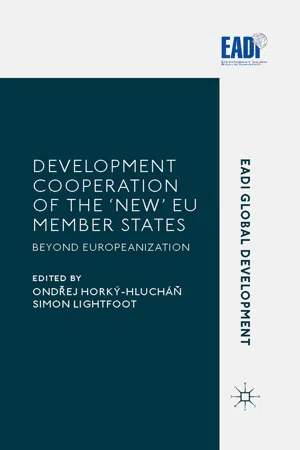
Development Cooperation of the ‘New’ EU Member States
Beyond Europeanization
- English
- ePUB (mobile friendly)
- Available on iOS & Android
eBook - ePub
About this book
The book provides a comprehensive analysis of the international development policies of ten Central and Eastern European countries that joined the EU between 2004 and 2007. The contributors offer the first thorough overview of the 'new' EU member states' development cooperation programmes, placing them in a larger political and societal context.
Information
Part I
Members of the OECD Development Assistance Committee
1
Czechia: The ‘Foreign Development Cooperation’ as a Policy without Politics
Ondřej Horký-Hlucháň
Introduction: Internationalization and path dependence as two faces of the Czech coin
This chapter maps and evaluates two decades of the Czech development policy with an emphasis on the period after the accession to the European Union.1 Before Czechia entered the OECD in 1995, it was the first of the European post-communist countries to restart its development cooperation programme (Czech Government, 1995).2 It was also the first of the ‘new’ EU Member States to be presented with an offer to join the OECD’s Development Assistance Committee in 2013 as a recognition of its compliance with its development cooperation standards. In terms of quantity of aid, the Czech ODA/GNI ratio has been surpassed only by that of Slovenia (OECD, 2014). In addition to that, Czechia is also the most successful country in applying for the funding for non-state actors from the European Commission and the USAID Emerging Donors Challenge Fund, two sources that are not reflected in the ODA volume (Badan & Sutrop, 2014; Eisen, 2012). Since there is no trustworthy comparative evaluation of the donors, this capability is also an appropriate indication of the formal quality of the Czech aid. It could be argued that among the other countries of the region, Czechia has been, in many respects, at the forefront of internationalization in the field of global development. Czech and other development actors often stress this point, by which they implicitly accept the assumption that a ranking of donors according to their level of ‘development’ can be established.
However, there is another dimension of Czech development cooperation that is reflected in the title of this chapter. It starts with the official, yet globally quite unusual name of the policy: Foreign Development Cooperation (zahraniční rozvojová spolupráce, ZRS). This term dates from a 2004 strategy paper that prepared the Czech institutional setting for development cooperation policy-making before the EU accession (Czech Government, 2004). Yet the original name of the Czech development cooperation programme since its inception in the mid-1990s was Foreign Development Aid (zahraniční rozvojová pomoc) (Czech Government, 1995). This change illustrates the fact that Czechia was sensitive to the international rhetorical shift from ‘aid’ to ‘cooperation’, which was similar to the replacement of the term ‘partners’ by the term ‘recipients’ in the OECD’s discourse around the turn of the millennium. However, the government did not replace the adjective ‘foreign’ with the more frequently used term ‘international’. The current hybrid name of the Czech development policy stresses its close association with the foreign policy, which creates a tension between both terms: the word ‘foreign’ implies the domestic context as its reference point while ‘cooperation’ suggests an equal relation.
This introduction started with a comparison of the international and domestic standing of Czech development cooperation to underline that its advancement as measured by OECD-ization and Europeanization is intrinsically related to its path dependence. Looking back at the Czechoslovak and, later, Czech contemporary history, the year 1995 cannot be considered as the start of the Czech development cooperation. The five-year period after the end of the Cold War appears merely as a short interruption in a long history during which Czechoslovakia was divided by its new elites and underwent major political and economic transition. In spite of that, some elements of the aid, such as tertiary education scholarships and contributions to international organizations, were not discontinued. Czechoslovakia was the donor which spent the second largest amount in the Council for Mutual Economic Assistance (after the Soviet Union) in the late 1960s, and it was followed by the German Democratic Republic in third place; it was bypassed by Romania in this respect only in the early 1970s (Robinson, 1979; see also Oprea, 2012). In the late 1980s, the Czechoslovak ODA/GNI ratio allegedly hit as much as 1 per cent, notwithstanding the unknown extent of military assistance to liberation movements in Africa (Halaxa & Lebeda, 1998). Economic interests played as strong a role in shaping the policy as they do nowadays but it is important to stress that the relatively heavy international presence of a country of 10 million people on the international stage is also due to identity issues. In fact, the Czech Republic has considered itself as an inheritor of the legacy of the democratic Czechoslovakia established in 1918, which took itself for a successor of the Austro-Hungarian Empire in international terms (Olša, 2005). In addition to that, the industrial Czechoslovakia between the First and Second World Wars is still a source of nostalgia among the current elites and a reminder of their belonging to the then developed nations at the time. This status was reconfirmed by the entry of Czechia to the OECD in 1995 since aid-giving to poor countries makes one a rich donor.
Unlike in the book’s introduction, however, the geopolitics and the politics of identity are not the main focus of this chapter. All the topics contained within the book’s analytical framework are tackled from a perspective that is more related to the democratic legitimacy of the policy and that has been explored elsewhere (Horký, 2010a, 2011a). This perspective has been built partly on the post-development theory and more precisely on the contribution of James Ferguson (1994). By applying his concept of the anti-politics machine to Czech development cooperation, I argued that the external commitments and the related funding combined with the particular interest of the Czech development actors led to the depoliticization of Czech development cooperation and to a handling of it as a technical problem by experts. This in turn led to further disconnection of the policy from the politics and society at large, thus undermining the popular and political support for increasing development aid and policy coherence to the benefit of the global South. The current aid stagnation after the end of the global recession is a symptom of this policy isolation. I do not have much to add to the earlier diagnostic, except perhaps a certain restoration of the ‘national interests’ against the ‘European values’ as explored in the introduction. Nevertheless, from the previous research I maintain here the basic conceptual distinction between (the so-called high) politics and (technocratic) policy as a way of narrowing the scope of the chapter and tackling the issue of power in the Central and Eastern European development policy, a topic rarely analysed in a country case study.
The following chapter is divided into two parts and a conclusion. Since the OECD played a singular role in the making of the Czech development cooperation, the first part explores Europeanization on a par with OECD-ization, but it also mentions the role of other multilateral and bilateral donors in shaping Czech development cooperation. It pays special attention to the construction of the dichotomy between the allegedly idealistic international norms and the pragmatic local resistances to them. Yet the international and the national cannot be perfectly divided, and it is the relation between both levels that is relevant in studying the distinction between the political and the technical. Generally, while the first part focuses on the download of norms and their acceptation, the second part is focused on their refusal and the upload of norms. The power relations and the role of the government are studied transversally on the example of the significantly delayed ‘transformation’ from a fragmented aid system to a concentrated structure similar to that that of most European donors, including the role of non-state actors. Attention is also paid to the limited role of the ideology promoted by the governments in power, and the limited interventions in policy making at the government level and in the parliament are emphasized. The conclusion summarizes the subsequent particularities of the Czech aid and the upload of preferences to the European and global level with the Czech presidency of the Council of the EU in 2009 as an example and, more broadly, the impact of the policy–politics divide on policy coherence for development.
A not-so-shallow OECD-ization and Europeanization as a tool of aid concentration in the hands of the foreign ministry
The introduction of this book has already linked the restart of Czechia’s development cooperation in May 1995 to its accession to the OECD in December of that year. Oral history and searches in historical archives are now needed to learn more about the period before the widespread use of the internet and the better transparency of policy making. What is certain is that the influence of the OECD has not weakened over time, and besides being still quoted side by side with the EU in the strategy documents of Czech development cooperation, the OECD has exerted its influence especially through its reviews, which have been taken as the most important feedback and a source of recommendations to the system of providing aid. Even though peer review is the main and only tool of the European Commission and the Member States for enforcing the Union’s soft law, they never made use of the detailed assessments of compliance with recommendations in the way the OECD’s Development Assistance Committee has been doing since 1962. The DAC’s recommendations are regularly addressed to specific countries and shaped to fit their problems. In this way, not only are they easier to implement, monitor and evaluate, but they also have a heavier weight in the arsenal of the policy instruments that the domestic development actors can raise to promote compliance with the good practice of the DAC donors. In the Czech case, the main user of the reviews were not the non-governmental organizations in their role of watchdog as could be expected, but the Ministry of Foreign Affairs (MFA), which coordinates the development policy.
Unlike many Central and Eastern European governments that were building their aid systems on a green field, the initial thirteen-point decision by the Czech Government (1995) institutionalized the MFA as the coordinator of the policy with only one specific task – reporting ODA to the OECD. The implementation of aid and the corresponding budgets were originally entrusted to other line ministries that kept the contacts from the socialist era. Even though this part of the chapter deals with the international context of Czech development cooperation, it is crucial to explain this domestic aspect here in order for us to understand the reception and the use of international norms at the national level. The conflict between the policy-making foreign ministry and the other aid-implementing ministries with different raisons d’être lasted until 2007, the year when the special review by the OECD DAC (2007) was initiated by the Czech MFA, and the ‘transformation’ of the system was enacted. The special review played an important role in the victory of the MFA over the projects and budgets of the other ministries. The most important points that the review critically addressed were the sectoral, territorial and institutional fragmentation of the Czech aid, its poor focus on results and the export interests that were unrelated to poverty reduction in the projects of the Ministry of Industry and Trade (MIT). At that time, the MIT was holding the largest slice of the pie ahead of the ministries of agriculture and environment. On the other hand, the brain drain inducing scholarships for students from the global South, which were co-managed by the MFA and the Ministry of Education, Youth and Sports, were practically left out of the reform since they continued to serve the political interests of the foreign policy (see Němečková et al., 2014). The international organizations could serve as allies of the domestic actors for their largely domestic political agenda during the period of the non-relevance of the development policy as an issue for the government as a whole.
Whatever the motivations of the MFA, the recent accession review of Czechia by the OECD DAC (2013) shows that almost all the recommendations were put into practice – from the legal framework through the institutional processes to the establishment of an evaluation system. The remaining criticisms were addressed to the volume of aid, the extent of tied aid and the insufficient reform of the scholarship programme that was put into practice the year before. Since the evaluations have shown that ownership and partnership are a necessary condition for the sustainability of the projects, it can be argued that a part of the spirit of the Paris Declaration on Aid Effectiveness (High Level Forum, 2005) has also been accepted by the Czech development cooperation system. Yet again, the use of partner country systems remains a contested issue. The increases in aid volume and the actions undertaken to untie aid will be assessed in the first regular peer review in 2016. Until then it is difficult to evaluate the influence that the OECD will exercise following Czechia’s accession to the DAC in 2013. While the issue of tied aid can be tackled theoretically by the MFA alone against the expected resistance by Czech businesses and a number of non-governmental organizations, the issue of aid quantity remains in the hands of the government as a whole. In any case, it can be asserted that the OECD-ization of Czech development cooperation is relatively deep, which was eventually confirmed by its positive accession assessment, to the reported surprise of the reviewers.
While there is an ongoing discussion on the OECD-ization of the European development policy (Orbie & Versluys, 2008), the analysis above shows that the OECD’s criteria are more focused on formal processes that lead towards greater aid effectiveness, which reflects the need to accommodate the differences and experiences of twenty-nine members from four continents. The EU’s norms also focus on aid effectiveness and they include some specific concerns, such as coordination and complementarity, which address the fragmentation of the European aid. Yet unlike the OECD’s recommendations, some of the EU’s norms, which allegedly aim at improving aid, are in conflict with the principle of complementarity and the use of the particular advantages of the different donors that the OECD seems to respect. Most importantly, some of these rules are not formal, but rather focus on content. As the introduction of this book has argued, the focus on absolute poverty, Africa and the LDCs is an example of the institutionalized preferences, experience and capacities of most of the ‘old’ EU Member States and especially the former colonial powers. This leads me to a reconsideration of the relatively harsh diagnostic of the shallow Europeanization of the Czech Republic (Horký, 2010d, 2010d), particularly in the light of the general assessment of the Europeanization of the EU Member States as a whole (Orbie & Lightfoot, 2015).
There are still soft norms that are not implemented, and especially in the field of aid volume, untying, concentration and policy coherence of development remain to a large extent dependent on the relevance of the development agenda in the government. However, since 2010, when the MFA and the Czech Development Agency became de facto the only policy maker and aid implementing institution, respectively, the MFA substantially stepped up the pace of increasing aid effectiveness. This is due to the personal leadership within the ministry, especially at the level of the development cooperation department, but also to the fact that once the ‘war’ against the other ministries over the management and funding of projects was won by the MFA, it could concentrate on the problem of effectiveness. The mid-term review of the current 2010–2017 development cooperation strategy paper approved by the government in mid-2014 could be seen to hint at some evidence of de-Europeanization. In fact, aid to the Eastern neighbourhood would be increased in Georgia and Moldova in the following years and, more recently, in Ukraine, while it will be abandoned soon in Afghanistan, which is an LDC, and definitely stopped in Angola (where it has already been phased out). Ethiopia will remain the only country in Sub-Saharan Africa on the expected list of eight priority countries, though this list will have an open door for the return of Zambia with the new strategy. On the other hand, the middle-income countries of Mongolia and Serbia were also dropped. Even though the final list of the Czech territorial priorities could be understood by some observers as the business-as-usual pragmatic focus of the ‘newcomers’ on their immediate neighbourhood, the crucial thing is that the review was based solely on an evaluation of a series of aid effectiveness criteria. Moreover, the whole process of evaluating the programmes and projects was participatory and consensual among the Czech development actors, with some resistance from business stakeholders to the withdrawing of Serbia, for example.
While the picture presented in the introduction has also stressed the low level of social learning, the changes that the Czech development cooperation has undergone during the last five years since 2010 point to a relatively high socialization in international norms at the MFA, and hence to a not-so-shallow – or more penetrating – OECD-ization and Europeanization. The changes happened during an absence of conditionality since at the time, Czechia was already a member of the EU, and the MFA did not particularly desire Czechia to become a DAC member soon because of the personal capacities required in Paris and Prague to strengthen its participation in the committee. Internationalization certainly did not take place in the fields where government bodies other than the MFA are concerned, and the resistance of the MFA to some norms due to capacity building is discussed in the next part of this chapter. This is also due to the fact that many individuals were socialized in the international norms by the external actors in Czechia, and they joined the MFA and the Czech Development Agency (CzDA) later. Especially the United Nations Development Programme (UNDP) played an important role in nurturing a number of experts through its large capacity building project implemented from 1999 to 2003, which led to the foundation of the Development Centre (Rozvojové středisko) in 2001 as a partly counselling, partly implementing body to the MFA; the Centre transformed into the CzDA in 2009. It was also under the umbrella of the UNDP in 2001 that the Czech Trust Fund for implementing the transition experience by the Czech experts was establ...
Table of contents
- Cover
- Title Page
- Copyright
- Contents
- List of Figures and Tables
- Lost in Transition?
- Acknowledgements
- Notes on Contributors
- List of Abbreviations
- Introduction: Diverging Theoretical Approaches to a Normative Research Field
- Part I: Members of the OECD Development Assistance Committee
- Part II: Non-DAC Member States of the OECD
- Part III: Other EU Member States since 2004
- Part IV: EU Member States since 2007
- Case Study 1: The Transfer of the Transition Experience: What Contribution to the EU Development Policy?
- Case Study 2: The European Transition Compendium: Much Ado about Nothing?
- Conclusion: Reflections from the Outside
- References
- Index
Trusted by 375,005 students
Access to over 1.5 million titles for a fair monthly price.
Study more efficiently using our study tools.
Frequently asked questions
Yes, you can cancel anytime from the Subscription tab in your account settings on the Perlego website. Your subscription will stay active until the end of your current billing period. Learn how to cancel your subscription
No, books cannot be downloaded as external files, such as PDFs, for use outside of Perlego. However, you can download books within the Perlego app for offline reading on mobile or tablet. Learn how to download books offline
Perlego offers two plans: Essential and Complete
- Essential is ideal for learners and professionals who enjoy exploring a wide range of subjects. Access the Essential Library with 800,000+ trusted titles and best-sellers across business, personal growth, and the humanities. Includes unlimited reading time and Standard Read Aloud voice.
- Complete: Perfect for advanced learners and researchers needing full, unrestricted access. Unlock 1.5M+ books across hundreds of subjects, including academic and specialized titles. The Complete Plan also includes advanced features like Premium Read Aloud and Research Assistant.
We are an online textbook subscription service, where you can get access to an entire online library for less than the price of a single book per month. With over 1.5 million books across 990+ topics, we’ve got you covered! Learn about our mission
Look out for the read-aloud symbol on your next book to see if you can listen to it. The read-aloud tool reads text aloud for you, highlighting the text as it is being read. You can pause it, speed it up and slow it down. Learn more about Read Aloud
Yes! You can use the Perlego app on both iOS and Android devices to read anytime, anywhere — even offline. Perfect for commutes or when you’re on the go.
Please note we cannot support devices running on iOS 13 and Android 7 or earlier. Learn more about using the app
Please note we cannot support devices running on iOS 13 and Android 7 or earlier. Learn more about using the app
Yes, you can access Development Cooperation of the ‘New’ EU Member States by Ondřej Horký-Hlucháň in PDF and/or ePUB format, as well as other popular books in Social Sciences & Development Economics. We have over 1.5 million books available in our catalogue for you to explore.