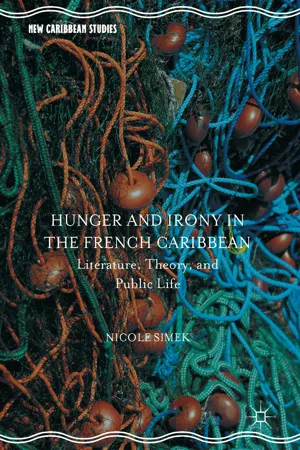
eBook - ePub
Hunger and Irony in the French Caribbean
Literature, Theory, and Public Life
- English
- ePUB (mobile friendly)
- Available on iOS & Android
eBook - ePub
About this book
Through a series of case studies spanning the bounds of literature, photography, essay, and manifesto, this book examines the ways in which literary texts do theoretical, ethical, and political work. Nicole Simek approaches the relationship between literature, theory, and public life through a specific site, the French Antillean islands of Guadeloupe and Martinique, and focuses on two mutually elucidating terms: hunger and irony. Reading these concepts together helps elucidate irony's creative potential and limits. If hunger gives irony purchase by anchoring it in particular historical and material conditions, irony also gives a literature and politics of hunger a means for moving beyond a given situation, for pushing through the inertias of history and culture.
Information
© The Author(s) 2016
N. SimekHunger and Irony in the French Caribbean New Caribbean Studieshttps://doi.org/10.1057/978-1-137-55882-4_11. Introduction: Living on the Edge
Nicole Simek1
(1)
Dept of Foreign Languages and Literatures, Whitman College, Walla Walla, Washington, USA
- Ariel:
- It’s evil to play with their hunger as you do with their anxieties and their hopes.
- Prospero:
- That is how power is measured. I am Power.—Aimé Césaire, A Tempest1
- The ethnographer:
- —But, Papa, what to do in such a situation?—Laugh at it first, said the tale-teller.—Patrick Chamoiseau, Solibo Magnificent2
And [the island] provides sustenance for all kinds of strange creatures, men and beasts, devils, zombies and the rest, all seeking something which has not yet come but which they dimly hope for without knowing its shape or name. It also serves as a stopover for birds that come down to lay their eggs in the sun.—Simone Schwarz-Bart, Between Two Worlds3
From the starving island of Aimé Césaire’s Notebook of a Return to the Native Land to Simone Schwarz-Bart’s sun-swallowing beast in Ti Jean L’horizon (translated as Between Two Worlds) and Maryse Condé’s voracious narration in The Story of the Cannibal Woman, hunger’s capacity to evoke both material suffering and immaterial desire has given it a prominent role in French Caribbean literature. The evocation of hunger has long functioned, in social realist fiction but also in poetry, essay, and experimental texts, as an embodiment or trace of historical violence, as a call to conscience, and as an indictment of a contemporary society or political system that valorizes human rights in the abstract while neglecting the concrete disparities between those who eat their fill and those who go without. If eating, and providing or withholding sustenance, is a mark of imperial or colonial power, as Césaire’s Prospero bluntly admits, hunger occupies an important position within Guadeloupean and Martinican literary history as a motivating force driving anticolonial critique. When Suzanne Césaire famously declared, in 1942, “Martinican poetry will be cannibal, or will not be” (La poésie martiniquaise sera cannibale ou ne sera pas),4 she made hunger both a target of anticolonial critique and also its mode of practice, a creative, digestive practice singled out as essential to the future existence and health of French Caribbean aesthetics.
This book takes up French Caribbean literature’s conjunction of hunger as biological need, as figure for desire, and as a concept or aesthetic structure we might best describe as ironic. In one sense, as a trope associated with playfulness, ambiguity, or deception, irony appears politically and morally incompatible with calls to attend to hunger as a threat to biological survival. Hunger’s urgency appears material, self-evident, even non-discursive, and thus beyond irony; as an instinctual force, located at least partly outside or before language itself, hunger seems to escape the very structures required for ironic signification, which relies on language’s inherent ambiguity, on the gap between signs and referents, in order to function, to “turn” a statement away from its ostensible meaning. To ironize in the face of hunger is, in one view then, to deny its materiality and exigency. It is to refuse to acknowledge the value of life itself, and to reveal one’s indifference or even murderous intent (the longevity in popular memory of Marie Antoinette’s fabled quip “Let them eat cake” attests to the outrage such an attitude inspires). Yet the body and its experiences remain enmeshed in fluid social, political, and economic relations. To approach hunger with an eye for irony is to a certain extent to insist on the discursive lives of hunger, and to scrutinize the biopolitics of “bare life” that relies on an (over)investment in physical survival. It is also to take the entanglement of discourse and corporality as a double bind, and irony as one response to the need to attend to incommensurable, competing demands. Reading hunger and irony together, as mutually elucidating and complicating terms, brings into view both the analytical uses and the ethical or political implications of metaphor, indirection, and earnestness, as well as those of a series of tensely related terms: mimesis, antimimesis, and ethico-political change; opacity and transparency; intellection, affect, and knowledge; intentionality, autonomy, and agency; and theory and practice.
Through a series of analyses spanning fiction, essay, manifesto, and photography, I set out to trace specific ways in which irony and hunger function together to address contemporary problems and to intervene in social and political life. In taking up texts that range in genre and audience, I aim to scrutinize the bounds of “the literary,” asking whose appetites hungry ironies fuel or thwart, what forms of enjoyment or critique they sustain or create, and how they produce particularity or difference. It is worth recalling that, in itself, irony—whether we understand it as the creation of multiple, antagonistic meanings, as the act of saying one thing but meaning another, as an existential paradox, or as a procedure of infinite negation—can serve multiple and politically opposed ends. Ironists can both corrode oppressive norms or thwart revolutionary transgressions, and in contemporary postcolonial studies, the “uncritical fetishisation” of ironic self-reflexivity tends to produce circular, self-enclosed interpretations rather than robust critique.5 At the same time, irony’s very negativity gives it a productive, creative edge. Reading hunger and irony together helps us locate the limits and quality of this edge. If hunger gives irony purchase by anchoring it in particular historical and material conditions, irony also gives a literature—and politics—of hunger a means for moving beyond a given situation, for interrupting the inertia of historical determination.
In bringing these concepts together to explore their convergences and productive frictions, Hunger and Irony in the French Caribbean aims to further current inquiry into literary deployments of hunger, eating, and cannibalism in the postcolonial context, but also into the contested relationship between literature and theory, and the political efficacy of literature and critique in a neoliberal era. In its focus on hunger as a preoccupation of French Caribbean texts and a metaphor for repression or creative production, this book follows on from my previous explorations of the ethics of “eating well” in Maryse Condé’s novels,6 and joins the work undertaken by critics such as Njeri Githire, whose Cannibal Writes: Eating Others in Caribbean and Indian Ocean Women’s Writings addresses sexualized and gendered dimensions of the use of metaphors of consumption and digestion in women’s writing, and Valérie Loichot, who explores, in The Tropics Bite Back: Culinary Coups in Caribbean Literature, the ways in which “the culinary” functions as a means to push back against controlling colonial images of the starving or gluttonous colonized subject. Yet in giving significant weight to irony, this book also aims to take up recent calls to reconsider the assumptions critics make in attributing politically resistant values to postcolonial literature, and to attend more carefully to the genres, boundaries, scope, and diverging impacts of various forms of literary production.7 Holding irony and hunger in view together obliges us to consider in tandem the specifics of poetics and form at work in given texts, as well as the broader material, cultural, and political relationships within which these texts take shape and produce effects. In other words, Hunger and Irony in the French Caribbean strives to respond to the need Jane Hiddleston has identified “to articulate a more nuanced understanding of the ways in which form and genre can engage with the political.”8
In pursuit of this goal, this book takes up literature’s role in stimulating or satisfying critical appetites, examining irony as a self-reflexive mode of knowing or communicating knowledge, perhaps akin to the type of laughter proposed by Solibo Magnificent’s tale-teller, in the epigraph above, as an alternative to “rational,” objectivizing discourses. If critics and writers have often praised irony for its politically resistant potential—despite, or because of, its reliance on ambiguity and indirection—the question remains, why opt for literature broadly, or irony more specifically, over or alongside other modes of resistance? What whets an appetite for irony, and how might or should this type of hunger for critique be understood in relation to Theory, which has been disparaged as a bloodless abstraction and as a symptom of Western cravings for dominance, cravings for postcolonial raw materials to be digested then fed back as finished knowledge products to subalterns in need? How might a hunger for irony relate to desires for epistemological justice, or “a mode of theorizing that is integral to the living practices of being and knowing”?9
The question of irony’s epistemological status and efficacy becomes particularly urgent when such practices involve living “on the edge,” in precarious material, cultural, political, or ecological conditions. Postcolonial studies’ increasing awareness of its own collusion with commodification and co-optation, the very forces it purports to combat, as well a...
Table of contents
- Cover
- Front Matter
- 1. Introduction: Living on the Edge
- 2. Theory or Over-Eating
- 3. Ironic Intent
- 4. In the Belly of the Beast: Irony, Opacity, Politics
- 5. Hunger Pangs: Irony, Tragedy, Constraint
- 6. Thirsty Ruins, Ironic Futures
- Back Matter
Trusted by 375,005 students
Access to over 1.5 million titles for a fair monthly price.
Study more efficiently using our study tools.
Frequently asked questions
Yes, you can cancel anytime from the Subscription tab in your account settings on the Perlego website. Your subscription will stay active until the end of your current billing period. Learn how to cancel your subscription
No, books cannot be downloaded as external files, such as PDFs, for use outside of Perlego. However, you can download books within the Perlego app for offline reading on mobile or tablet. Learn how to download books offline
Perlego offers two plans: Essential and Complete
- Essential is ideal for learners and professionals who enjoy exploring a wide range of subjects. Access the Essential Library with 800,000+ trusted titles and best-sellers across business, personal growth, and the humanities. Includes unlimited reading time and Standard Read Aloud voice.
- Complete: Perfect for advanced learners and researchers needing full, unrestricted access. Unlock 1.5M+ books across hundreds of subjects, including academic and specialized titles. The Complete Plan also includes advanced features like Premium Read Aloud and Research Assistant.
We are an online textbook subscription service, where you can get access to an entire online library for less than the price of a single book per month. With over 1.5 million books across 990+ topics, we’ve got you covered! Learn about our mission
Look out for the read-aloud symbol on your next book to see if you can listen to it. The read-aloud tool reads text aloud for you, highlighting the text as it is being read. You can pause it, speed it up and slow it down. Learn more about Read Aloud
Yes! You can use the Perlego app on both iOS and Android devices to read anytime, anywhere — even offline. Perfect for commutes or when you’re on the go.
Please note we cannot support devices running on iOS 13 and Android 7 or earlier. Learn more about using the app
Please note we cannot support devices running on iOS 13 and Android 7 or earlier. Learn more about using the app
Yes, you can access Hunger and Irony in the French Caribbean by Nicole Simek in PDF and/or ePUB format, as well as other popular books in Literature & Literary Criticism. We have over 1.5 million books available in our catalogue for you to explore.