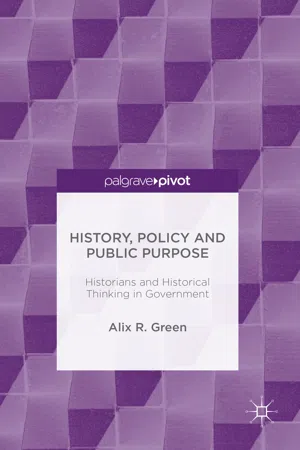
This book takes a fresh look at the connection between history and policy, proposing that historians rediscover a sense of 'public purpose' that can embrace political decision-making – and also enhance historical practice. Making policy is a complex and messy affair, calling on many different forms of expertise and historians have often been reluctant to get involved in policy advice, with those interested in 'history in public' tending to work with museums, heritage sites, broadcasters and community organisations. Green notes, however, that historians have also insisted that 'history matters' in public policy debate, and been critical of politicians' distortions or neglect of the past. She argues that it is not possible to have it both ways.
eBook - ePub
History, Policy and Public Purpose
Historians and Historical Thinking in Government
- English
- ePUB (mobile friendly)
- Available on iOS & Android
eBook - ePub
About this book
Information
© The Editor(s) (if applicable) and The Author(s) 2016
Alix R. GreenHistory, Policy and Public Purpose10.1057/978-1-137-52086-9_11. Introduction
Alix R. Green1
(1)
University of Central Lancashire, Lancashire, UK
Abstract
The introduction to History, Policy and Public Purpose makes the case that historians should consider government a vital domain for historical practice. Insisting that historical perspective is essential for good policymaking is not compatible with a refusal to engage seriously with the demands and difficulties of practical politics. The introduction outlines the aim of the book to go beyond the model of the external expert translating academic research for policy audiences. The alternative approach proposed is to integrate historical thinking into the policymaking process. Doing so means critically examining assumptions about scholarship and attitudes to history outside the university. Public history has proved a problematic concept and label for such work and Green suggests reimagining it as history with public purpose, an agenda of concern for the whole discipline.
Politics matters, from decisions taken on a global stage—authorising air strikes, responding to epidemic disease, controlling carbon emissions—to local issues of potholes and policing. Our lives, and the lives of others, are affected by what governments do or choose not to do. As citizens, we know this even as we decide not to vote in elections and claim that Parliament is remote from our lives. We are critical of how the political system functions and express profound distrust of our elected representatives, while at the same time regarding democracy and its associated institutions as the only legitimate model. Rather than cultivating a healthy scepticism of power and the rhetoric of the powerful, a pervasive and corrosive cynicism conditions our attitude to politics. The policymakers of popular caricature are inevitably and irredeemably self-interested and incompetent, yet we still look to them to make decisions of great complexity and consequence.
Academics often find themselves subject to similar internal tensions and contradictions. We are in the knowledge business; we operate within disciplinary frameworks that give us intellectually coherent ways of understanding, explaining and shaping the world (and beyond). However diverse those processes may be—from behavourial psychology to astrophysics to literary studies—we deal in evidence and substantiated argument. We contend, sometimes among ourselves, sometimes addressing wider audiences (often in vociferous tones) that academic enquiry matters. Historians are not alone in claiming a distinctive purchase on the problems facing contemporary society. And yet we are often reluctant, even hostile, to the idea of getting directly involved in finding policy solutions.
It is easy to recognise in the abstract that politics is necessary. In complex societies, where many different groups must ideally coexist peaceably and productively, a ‘political method of rule’ provides structures and processes for conciliating their interests. This is the classic defence of politics.1 There may, of course, be many deficiencies and flaws in any particular political system. The UK General Election held in 2015 demonstrated the distortions of ‘first past the post’. A 50% share of the vote delivered 56 of the 29 seats in the Westminster Parliament to the Scottish National Party (or 25,972 votes per seat). By contrast, the UK Independence Party and the Green Party needed 3.9 m and 1.2 m votes respectively for their single seats.2 Large majorities in individual constituencies mean ‘wasted’ votes, yet at the same time some concentration of support is needed to win at all.
It is no great claim that political systems of rule based on the principle of conciliation, however imperfect they may be, are preferable to alternatives that involve coercion: dictatorship or totalitarianism, for example. I rehearse this argument not for its own sake but to draw attention to a dissonance in how the relationship between academe and policy is conceived. We can broadly accept that conciliating diverse interests is an essential task of political systems, while holding the assumption that our ‘expertise’ should prevail in the policymaking process.
As experts, we may be sceptical of politicians’, particularly government ministers’, motives for seeking our input. We may question their willingness to listen or even have little confidence in their ability to understand and assimilate our advice. How critically attentive are we to preconceptions such as these? Speaking truth to power is an alluring notion but how many of us have stopped to consider what we are actually saying by using this phrase, what status we are claiming for ourselves and what relationship we are describing between academe and government?3
The uses and abuses of history in the twentieth century—including the justification of war, genocide and terror—have given historians a particular set of problems in its dealings with political elites. The explanatory and rhetorical power of historical narrative has made the past a prized possession, invoked, celebrated and represented not just in political speeches, parliamentary debates and propaganda, but also in school textbooks, university curricula, film, journalism, memorials and museums, among many other sites and settings. Historians have had understandable misgivings in particular about the risks of placing history in the service of the state. A ‘practical bias’ makes history ‘frankly propagandist’, as V. H. Galbraith warned in 1964: ‘You cannot, in fact, make history pay a dividend’.4 At the same time as expressing scepticism about and aversion to connecting scholarship and politics, historians have insisted on the value of historical perspective for policymakers. This has led in the UK context to notable intiatives to translate the findings of academic research for consumption inside Westminster and Whitehall, such as the History and Policy network.
This book is different. It aims to go beyond the model of the external expert ‘translating’ academic research for policy audiences and engage with ways of rethinking historical practice inside government. I also have broader themes and audiences in mind than British historians addressing British policymakers. I am interested in a more fundamental sense of ‘public purpose’: a moral, methodological and intellectual impetus for working in ways that contribute to public life and societal good. What constitutes a vital public life or a ‘good’ society is, of course, a matter of conviction. Attitudes and beliefs differ significantly and may rest on received opinion, cultural norms or perceived common sense, as well as informed judgement. Among scholars, differences of definition, emphasis or substance are profound; journals, seminar rooms and conferences provide contexts for the exchange of views. That disagreement exists does not, however, release us from the wider responsibilities suggested by public purpose. Given that politics must manage, even if it cannot fully reconcile, a diversity of interests, commitments and priorities, it would seem preferable for scholars to contribute to the process than to remain remote from it. Our differences can invigorate and inform processes of debate and decision-making.
Public scholarship provides a useful framework for thinking about the responsibilities that may arise from the privilege of pursuing knowledge.5 Few of us occupy (or would wish to occupy) the ivory towers of media mythology and research is only one of the many competing demands on our time and energy. Nonetheless, we should acknowledge the privilege of intellectual enquiry, however imperfectly the structures, funding and expectations of academic employment may allow it to be realised. Since the 1970s, many disciplines have gone through a process of debating the meaning and implications of public purpose for their particular fields of knowledge, including philosophy, sociology, geography, anthropology and archaeology, as well as history.
The term ‘public’ can usefully be recognised as a code or shorthand for complex questions about the nature and use of power. As an adjectival descriptor—public philosophy, public sociology and so on—it poses a series of challenges to academic fields: what are their purposes and responsibilities, to what end are they pursued and in whose interests?6 These questions are, or should be, of fundamental concern within and across disciplines. In the case of history, however, ‘public’ has come to carry rather different connotations, which have diverted historians away from the complex, reflexive issues of practice inherent in the term.
Public history is different from its analogue fields, perhaps because history is already in public in so many powerful and pervasive ways, from memorials to museums, and online, on the news and in built and natural environments. It is an important currency in which transactions of society are made, from the rhetoric of high politics to the forming and reforming of individual identities and affiliations. People claim, consume and construct history without the inevitable mediation of the academic discipline. This is, in many senses, a positive and productive basis for scholarship with public purpose, and historians in many national contexts have embraced the possibilities of collaboration and shared authority with their publics. But this defining quality of public history is, at the same time, a problem for the field.
As a concept or label, public history tends to be identified by its non-academic or ‘popular’ character and this seems to me to distinguish it from analogues in other disciplines. We should recognise that such associations cannot simply be put down to unfamiliarity with the terminology. To interpret ‘public’ in terms of its essential difference from ‘academic’ approaches and concerns is a decision—and a political one—even if it is made instinctively. Public history must have space for popular history under its umbrella but there are adverse consequences to rendering the two synonymous. Most clearly, it is easy to marginalise public history if it can be characterised as the past presented for mass consumption; this, indeed, was the core of the critique of heritage as ‘bogus history’ in the 1980s.7 More nuanced engagement with issues of ownership and agency has followed, along with greater attention to communicating historical research to wider audiences and, more recently, the emergence of co-production models, incentivised in the UK by funding streams. Yet the fundamental challenges posed by the term ‘public’ have not prompted substantial and sustained debate within the wider discipline.
Recognition of public history as a specialist sub-field, now well-established in the USA, does not resolve but reconfigures these difficulties of status and credibility. Following established patterns of professionalisation, graduate training programmes have been developed to accredit practitioners for work in historic preservation, archives, museums, consultancy, government and so on. Membership associations—most notably the National Council on Public History—provide an organisational identity for the field, and conferences and periodicals forums for discussing matters of professional interest. Institutionalising public history as a specialism does create a space in which those fundamental questions—‘whose history?’, ‘why history?’—become a central concern. But it also ensures that the wider discipline need not address them. ‘Public’ is not operating as a code (or a signal) for historians to confront the purposes and aims of the discipline. Instead, public history is often treated as an entity in its own right, without critical and reflexive attention to its constituent parts. That is, it is neither ‘public’ (in the sense of inflected by concerns about the power, purpose and point of scholarship) nor ‘history’ (as in belonging to the field of academic enquiry) but something in and of itself. Understandings of ‘historianship’—to borrow John Lukacs’ term—have not been greatly expanded and enriched through the advent of public history.8
In countries where historians are still exploring the shape and scope of public history, the question of whether it should pursue specialist status or develop as an intregrated part of the discipline is a live and a significant one. This book takes a clear position in favour of integration, insisting that public history as history with public purpose raises questions relevant to the whole discipline. Public scholarship provides a framework in which to locate and redefine public history, which in turn allows us to reconceptualise historical practice in government. The case for the integrity of public scholarship, and for seeing history in policy as valuable and valid, is the focus of Chap. 2.
Scholarship with public purpose may entail not just public engagement—now prominent in funders’ criteria for awarding research grants, particularly in the humanities—but a more significant reconsideration of how and where historical understanding is made. Engagement and ‘impact’ (another term that has come to loom large in British academic life, essentially a way of asking researchers to demonstrate a return on public investment) have not fundamentally challenged the linear model of knowledge production and dissemination.9 Only recently, as the concept of co-production has moved from periphery of practice (including, notably, in public history) to the mainstream of funding policy, has this logic come under pressure.
It is surely no great insight to recognise that public scholarship, of whatever disciplinary flavour, may need to happen in the contexts in which it is required, valued and used (even if it still draws intellectual energy from an ‘academic’ core). Historians—or philosophers, sociologists and economists—may need to be ‘insiders’, actively involved and committed to the objectives of the organisation, as opposed to being critics, commentators, consultants, participant observers or taking other roles premised on retaining an external standpoint. If we are to become co-producers of knowledge inside a particular context, then it is reasonable that we gain a working understanding of how it operat...
Table of contents
- Cover
- Frontmatter
- 1. Introduction
- 2. Integrity, Advocacy and the Public Purpose of Scholarship
- 3. Historians on the Inside: Thinking with History in Policy
- 4. The Historian’s Toolkit
- 5. Disciplinary Training and Public Purpose in University History Teaching
- 6. Conclusions: Towards a History with Public Purpose
- Backmatter
Trusted by 375,005 students
Access to over 1.5 million titles for a fair monthly price.
Study more efficiently using our study tools.
Frequently asked questions
Yes, you can cancel anytime from the Subscription tab in your account settings on the Perlego website. Your subscription will stay active until the end of your current billing period. Learn how to cancel your subscription
No, books cannot be downloaded as external files, such as PDFs, for use outside of Perlego. However, you can download books within the Perlego app for offline reading on mobile or tablet. Learn how to download books offline
Perlego offers two plans: Essential and Complete
- Essential is ideal for learners and professionals who enjoy exploring a wide range of subjects. Access the Essential Library with 800,000+ trusted titles and best-sellers across business, personal growth, and the humanities. Includes unlimited reading time and Standard Read Aloud voice.
- Complete: Perfect for advanced learners and researchers needing full, unrestricted access. Unlock 1.5M+ books across hundreds of subjects, including academic and specialized titles. The Complete Plan also includes advanced features like Premium Read Aloud and Research Assistant.
We are an online textbook subscription service, where you can get access to an entire online library for less than the price of a single book per month. With over 1.5 million books across 990+ topics, we’ve got you covered! Learn about our mission
Look out for the read-aloud symbol on your next book to see if you can listen to it. The read-aloud tool reads text aloud for you, highlighting the text as it is being read. You can pause it, speed it up and slow it down. Learn more about Read Aloud
Yes! You can use the Perlego app on both iOS and Android devices to read anytime, anywhere — even offline. Perfect for commutes or when you’re on the go.
Please note we cannot support devices running on iOS 13 and Android 7 or earlier. Learn more about using the app
Please note we cannot support devices running on iOS 13 and Android 7 or earlier. Learn more about using the app
Yes, you can access History, Policy and Public Purpose by Alix R. Green in PDF and/or ePUB format, as well as other popular books in History & Social Science Biographies. We have over 1.5 million books available in our catalogue for you to explore.