eBook - ePub
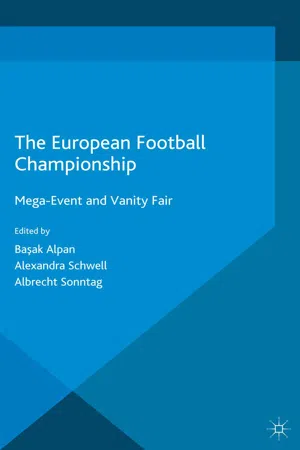
The European Football Championship
Mega-Event and Vanity Fair
- English
- ePUB (mobile friendly)
- Available on iOS & Android
eBook - ePub
The European Football Championship
Mega-Event and Vanity Fair
About this book
The UEFA European football championship was the first European mega-event to take place in post-socialist Europe. Taking this as a departure point, this volume focuses on football as a realm of constructing and negotiating identities using rich ethnographic fieldwork and in-depth media analysis.
Information
Print ISBN
9781349575336
9781137455055
Subtopic
Civil Rights in Law1
Introduction
Negotiating Europeanness: the Euro 2012 Championship and Spectator Narratives in an Enlarged European Perspective
Başak Alpan and Alexandra Schwell
Football and the constitution, performance and negotiation of identities
In June 2012 teams and supporters from all over Europe and beyond gathered in Poland and Ukraine to attend the UEFA European Football Championship. Sixteen national teams, including the hosts, qualified for what was to be the first European championship to take place in post-socialist Europe. While some football-crazy countries such as Turkey did not qualify, the media in the countries that did soon bowed their heads in sorrow: would Poland and Ukraine be capable of organising such a challenging event? And, more importantly, would they be able to ensure that visitors could survive the trip to the ‘Wild East’? Not only international observers, but also local populations, put the host countries under scrutiny. The critics questioned the huge public spending and the effect this had on the weakest members of society.
Such critical anticipations have become a recurrent feature of football mega-events. Each of them, depending on the international perception of the host, is different in the expectations, fears and warnings that it raises. For instance, the main narrative that underpinned the 2010 FIFA World Cup in South Africa was the expectation that the World Cup would be a catalyst for ‘bringing the nation together’ (Bolsmann, 2014; Ottosen et al., 2011). Indeed, after the end of the apartheid regime and the transition to multi-party politics in 1994, the 2010 World Cup gave a message of reconciliation, nationhood, and unity. At the same time, there were repeated warnings about security risks and (somewhat condescending) concerns about the young state’s capacity to be up to the organisational and logistical challenge of such an event.
Four years later, the fears and warnings raised by the 2014 FIFA World Cup in Brazil focused on the social protest movements against the costs of the event (and, more generally, against budgetary priorities of the government and widespread corruption) that had occurred during the 2013 Confederations Cup. Depending on ideological attitudes, some were concerned that the tournament might be seriously disturbed if not put to a halt altogether by the protesters, while others feared that the event would be well organised, but only at the costs of police brutality that would cast a lasting shadow on what was supposed to be a celebration of the host country.
As for Euro 2012, according to Yatsyk, the event was initially represented as a de-bordering project aimed at demonstrating the opportunities for co-hosting a mega-event by an EU member state (Poland) and its neighbour eager to move closer to the European normative order (Ukraine). In early 2012, however, the sharpening of the normative and value-driven issues in EU–Ukraine relations (in particular, the debate on the liberation of Iulia Timoshenko) led to the portrayal of Ukraine as a country drifting away from European standards and governed by a corrupt and undemocratic regime, which fortified the symbolic and political contrast between Ukraine and Poland (Yatsyk, 2014).
What these football mega-events, beyond the country-specific risks, apprehensions and warnings, all have in common is that they bring to light questions of longing and belonging, of loyalties and rivalries, of identity and alterity, issues that in everyday life often go unquestioned and tend to operate in the background. During a tournament, there is no diplomatic courtesy or polite behaviour. The concept of ‘may the best team win!’ does not exist. It is either black or white, unconditionally and wholeheartedly. If your team is not playing tonight, or if it has – God forbid – dropped out altogether, then you are again faced with the dilemma: who to support?
Football is a sport highly charged with emotions and because it is a social arena where various social forces culminate and are negotiated it has for a long time attracted scholarly attention from various fields and disciplines. This volume mainly stems from an attempt to delve into football as a realm of constructing and negotiating identities. In this respect, we aim to problematise three main phenomena:
1. The relationship between national football and national identity formation.
2. Europeanisation and transnationalisation of football and football identities.
3. The transcendence of borders of the European Union by the European football space, which renders ‘Europe’ a fruitful laboratory to attest practices/modalities of Orientalism within Europe itself (that is, ‘intra-European Orientalism’).
The notion of Orientalism was originally developed by Edward Said (1979). Orientalism refers to a set of practices, narratives, discourses and imaginaries which the West constructs about the Orient with the primary aim to define its own ‘self’ against this ‘Other’. According to Said, the Orient has thus helped to define Europe (or the West) as its contrasting image, idea, personality, experience (Said, 1979). However, the relations between the West and the Orientalised are much more complex. Gerd Baumann explains that ‘Orientalism is thus not a simple binary opposition of “us = good” and “them = bad”, but a very shrewd mirrored reversal of “what is good in us is [still] bad in them, but what got twisted in us [still] remains straight in them”’ (Baumann, 2004, p. 20). As will be argued by Schwell in Chapter 2, Orientalising practices aptly describe the relationships between various social groups, for example between nation-states in Europe, but also within societies.
Thus, The European Football Championship: Mega Event and Vanity Fair pays special attention to the ways in which football appears as an identificatory and transformatory tool. Central to this understanding is, not surprisingly, the concept of ‘identity’. The authors in this volume refer to identities as endless, relational, and contingent phenomena that are constantly under construction, where different subjects are grouped together under two diametrically opposed entities: an Other, which confronts a Self. This points to the incomplete, open and negotiable character of every identity (Laclau and Mouffe, 1985, p. 104). According to Stuart Hall, the concept of ‘identity’ does not, as in the past, specify a stable core of the ‘Self’ which develops to completion and endures social and historical changes. Modern times, Hall argues, brought about a fragmentation of identity, and at times a split identity, which is embodied in various, even contrasting, practices (Hall, 1996, pp. 5–6). Football identities are no exception.
What is in question here are not objective realities, but instead performances, subjectivities and discursive constructions in determining who is in versus who is out and who is perceived as a football supporter – in both male and female cases. Football supporters create their identities in a performance of the Self – a kind of ‘doing football fandom’. In a Foucauldian sense, discursive construction constitutes the football supporter as a subject (Foucault, 1982). We contend that, even in a postmodern world, football supporter identities are not fluid and entirely open to negotiations. Similar to what Judith Butler has argued in regard to gender, identity categories become socially fixed and are reproduced and incorporated, they become part of the actor’s own bodily experience (Butler, 1991). This is exactly what the contributions by Schwell, Szogs, as well as Buchowski and Kowalska debate in this volume. Drawing upon ethnographic fieldwork in Poland and Germany, the authors aim to capture how an international and extensively regulated event such as Euro 2012 constitutes football subjects and emerges as a performance. An actor-centred and praxeological focus on the ‘doing’ of football identities allows us to perceive identities as the focal point of various influences. Identities are negotiable and open for interpretation by the actors themselves, who use them to construct their strategies of action. In this respect, the main question that the authors discuss is how football identities are constituted, performed, and negotiated.
The marketplace of fan identities
Football identities are subject to both top-down and bottom-up influences. On the one hand clubs and national teams make offers for identification and provide an important framework for experiences but, on the other hand and more importantly, fans organise and construct their fan identities from below. Fans actively use, reframe, interpret and subvert signs, symbols, language and images of self and other. By creating their own social systems, fans also invent rituals and traditions. It is the football identities from below which invigorate the game and fill it with life beyond the restricted and increasingly restrictive space of the stadium. While already existing cultural identities are reflected and negotiated, ‘football is also an important site at which new cultural identities are created, and existing ones are reproduced and potentially transformed’ (Feixa and Juris, 2000, p. 206). This does not take place in an isolated manner, but is instead facilitated by new media, such as the Internet and social networks, through complex networks, ties and connections. Across national boundaries, particularly in Europe, fan friendship communities have a long and remarkably stable history. The mental maps of football fandom are not restricted to local and national rivalries but run transversal and cross, sometimes also unexpectedly, national boundaries.
Without any doubt, loyalties can shift. The marketplace of fan identities, where one can choose the various aspects of his/her fan identity, is not entirely liberalised. The decision to support a team (and thus reject another) is strongly influenced by factors that must be included in the analysis. Those factors are socio-cultural and historical, as well as political and involving class identities.
Shifting and reconstructed identities do not exist in an ideational vacuum. Similar to how a bricolage is not forged from scratch but rather draws upon and chooses from pre-existing components, a football fan identity draws upon cognitive patterns that shape his/her images of Self and Other (Lévi-Strauss, 1966). Using Evans-Pritchard’s research on the Nuer’s social organisation, Baumann argues that the logic of segmentation in the organisation of identity, alterity and coalition-building leads to a structure which ‘resembles that of a football league, or rather, the football fans, for while clubs do not usually merge or split up, fans do’ (Baumann, 2004, p. 22). Supporters from two separate villages might be bitter enemies, but they might easily unite on a higher level, for example when their local selection plays the neighbouring district’s champion. Likewise, support for the national team in international tournaments can temporarily unite fans by suspending lower-level rivalries. In agreement with Baumann we go beyond the very formalistic model of Evans-Pritchard and contend that football supporters’ everyday lives and loyalties are much more complex.
While traditional research on football has already extensively elaborated on national fan loyalties, it is important to pay attention to the largely under-researched realm of shifting loyalties. In the case of a national team not participating or dropping out early, most spectators will choose another team to support, even if it is only temporary. This highly contextual identification process does not happen independently. Personal experiences, historical and socio-cultural narratives, media representations, and corresponding stereotypes and prejudices all create and legitimatise loyalties and denegation. In their contribution to this volume, Alpan and Şenyuva (Chapter 4) show how national stereotypes, concerning the Euro 2008 and Euro 2012 championships in Turkey, were placed into the newspaper commentaries. The Self–Other nexus also plays a significant role within this contextual identification process. While the use of national stereotypes is considered normal and acceptable for Turkish newspapers, it created negative reactions and resentment when other European newspapers used similar discourses about Turkey.
Shifting loyalties are also likely to appear within the context of migration, be it in the form of migrant footballers, as is thoroughly scrutinized by Sonntag and Nuhrat in their respective chapters in this volume (5 and 6), or cultural integration of migrants to the host country’s culture. The intensification of multi-directional migratory movements and shifting citizenship affiliations also lead to the iteration and reiteration of football identities.
National identities in the wake of transnationalisation and globalisation of football
In recent years transnationalisation of football identities and transnational identification at supporter and spectator levels have increased dramatically. Thanks to satellite technology, growing intensity of transnational events such as European championships and World Cups, increased global mobility of football players and fans, and global marketing of teams, football may be referred to as the ‘global game’ (Giulianotti, 1999; Giulianotti and Robertson, 2004). Football is indeed an excellent tool for understanding the unfolding of globalisation processes in the final decades of the 20th century and the beginning of the 21st century because the markers of the latter, such as increasing mobility, transnational communication, formal and informal networks, exchange of information, all have a direct impact on how football events are exercised and represented. Last decade the journal Global Networks dedicated a special issue to sport and globalisation, with many of the contributions dealing explicitly with football and transnationalism (Giulianotti and Robertson, 2007). The ongoing internationalisation of teams that were previously perceived as being firmly anchored in a local or regional environment is a recent phenomenon related to commercialisation and (neo-)liberalisation, which is often dated back to the famous 1995 Bosman ruling of the European Court of Justice but actually started before. To the surprise of all those who predicted the end of supporters’ identification with club teams composed of transnational ‘mercenaries’, it appears that such transnationals can easily be localised, naturalised and perceived ethnocentrically as being part of ‘us’. As David Ranc has very convincingly demonstrated, nationality is definitely not a decisive identity marker (Ranc, 2012). In other words: the alien may become ‘ours’ at the very moment he wears our team’s jersey.
Just like globalisation has not erased differences and cleavages across the globe, football has not assumed a cosmopolitan meaning for all of its fans and followers. In an attempt to look beyond the rim of the local and national teacup and describe football in terms of cosmopolitanism – a topic which is currently high on the agenda of social sciences in general (Hannerz, 1990; Beck and Sznaider, 2010; Glick Schiller, 2010; Rapport and Wardle, 2010; Soysal, 2010) – one runs the risk of ignoring the fact that many ‘ordinary people’ hardly experience cosmopolitanism in their everyday life. We contend that people are socialised into their respective football identities in a way that reflects and is determined by their social and cultural environment. A fan’s identity fits neatly into, is reproduced by, and in turn reproduces culture as, in Raymond Williams’ (1963) famous words, ‘a whole way of life’.
While the literature on transnationalisation and globalisation of football identities draws heavily upon the ways in which football adapts to globalisation’s mechanisms of production, experience and consumption, the ongoing significance and prevalence of national identity in a transnational football context, to some extent, still maintains the national nexus of football identities. In this respect, the literature has thoroughly scrutinised the emergence of football as a marker for national identity at international tournaments. International football events, such as the Football World Cup and the European Football Championship, are often framed as...
Table of contents
- Cover
- Title Page
- Copyright
- Contents
- Preface
- Notes on Contributors
- 1. Introduction: Negotiating Europeanness: the Euro 2012 Championship and Spectator Narratives in an Enlarged European Perspective
- 2. Offside. Or Not Quite: Euro 2012 as a Focal Point of Identity and Alterity
- 3. Loyalty Jungle: Flexible Football Fan Identities in the Framework of Euro 2012
- 4. Does Qualifying Really Qualify? Comparing the Representations of Euro 2008 and Euro 2012 in the Turkish Media
- 5. Up to the Expectations?: Perceptions of Ethnic Diversity in the French and German National Team
- 6. Mediating Turkishness through Language in Transnational Football
- 7. Doing Ethnography and Writing Anthropology: A Single-site-multiple-ethnography of a Protest Event against the 2012 UEFA European Championship in Poznań
- 8. Afterword
- Index
Trusted by 375,005 students
Access to over 1.5 million titles for a fair monthly price.
Study more efficiently using our study tools.
Frequently asked questions
Yes, you can cancel anytime from the Subscription tab in your account settings on the Perlego website. Your subscription will stay active until the end of your current billing period. Learn how to cancel your subscription
No, books cannot be downloaded as external files, such as PDFs, for use outside of Perlego. However, you can download books within the Perlego app for offline reading on mobile or tablet. Learn how to download books offline
Perlego offers two plans: Essential and Complete
- Essential is ideal for learners and professionals who enjoy exploring a wide range of subjects. Access the Essential Library with 800,000+ trusted titles and best-sellers across business, personal growth, and the humanities. Includes unlimited reading time and Standard Read Aloud voice.
- Complete: Perfect for advanced learners and researchers needing full, unrestricted access. Unlock 1.5M+ books across hundreds of subjects, including academic and specialized titles. The Complete Plan also includes advanced features like Premium Read Aloud and Research Assistant.
We are an online textbook subscription service, where you can get access to an entire online library for less than the price of a single book per month. With over 1.5 million books across 990+ topics, we’ve got you covered! Learn about our mission
Look out for the read-aloud symbol on your next book to see if you can listen to it. The read-aloud tool reads text aloud for you, highlighting the text as it is being read. You can pause it, speed it up and slow it down. Learn more about Read Aloud
Yes! You can use the Perlego app on both iOS and Android devices to read anytime, anywhere — even offline. Perfect for commutes or when you’re on the go.
Please note we cannot support devices running on iOS 13 and Android 7 or earlier. Learn more about using the app
Please note we cannot support devices running on iOS 13 and Android 7 or earlier. Learn more about using the app
Yes, you can access The European Football Championship by Albrecht Sonntag, Alexandra Schwell, Basak Alpan, Albrecht Sonntag,Alexandra Schwell,Basak Alpan in PDF and/or ePUB format. We have over 1.5 million books available in our catalogue for you to explore.