eBook - ePub
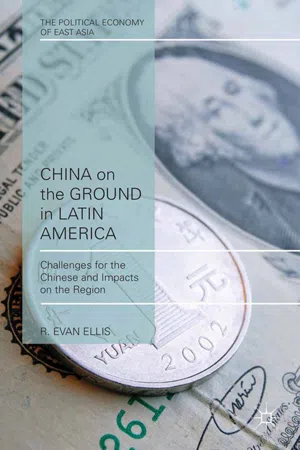
China on the Ground in Latin America
Challenges for the Chinese and Impacts on the Region
- English
- ePUB (mobile friendly)
- Available on iOS & Android
eBook - ePub
About this book
An analysis of the new physical presence of Chinese companies operating in Latin America and the Caribbean, the associated challenges that they face, and how they are impacting the region and its relationship with the PRC.
Information
PART I
WHAT IS HAPPENING . . . WHAT IS NEW ABOUT IT
CHAPTER 1
INTRODUCTION
Overview
The expansion in commercial and other activities by the Peoples Republic of China (P.R.C.) in Latin America and the Caribbean during the first decade of the twenty-first century has understandably captured the attention of political leaders, businessmen, and academics in the region, as well as in the United States and other parts of the world. In the decade from 2003 through 2012, bilateral trade between the P.R.C. and Latin America and the Caribbean increased by a factor of ten, from $29 billion in 2003 to $270 billion in 2012.1 During this period almost without exception, there have been multiple presidential-level visits each year between the region; within weeks of Chinese leader Xi Jinping’s ascension to the presidency in March 2013, the leaders of Peru and Mexico made pilgrimages to China to meet with him on the sidelines of the Boao Forum, rapidly followed by President Xi’s June 2013 trip to the region, with state visits to Trinidad and Tobago, Costa Rica, and Mexico, including separate meetings with presidents and prime ministers from a total of ten different countries of the region, before eventually arriving in California for talks with US president Barrack Obama.
The present book is not another account of China’s expanding commercial and political relationship with Latin America and the Caribbean, about which much has been written. Rather, it focuses on a specific aspect of that engagement with transformational implications for both the P.R.C. and the region. Since approximately 2009, Chinese companies have begun to establish a significant physical presence in the region in sectors from petroleum and mining to construction, manufacturing, telecommunications, and banking. Though this new physical presence is a byproduct of the growth and maturation of the P.R.C.–Latin American commercial relationship more broadly, it changes the relationship and its imperatives in ways that the exponential trade growth of the preceding decade did not. On one hand, the new presence is creating significant challenges for the companies themselves, from securing approval of mergers and acquisitions, to successfully winning bids and launching projects, to dealing with labor forces and subcontractors, local communities, governments at all levels, and broader interest groups including environmentalists, indigenous groups, commercial competitors, insurgents, and criminal entities.
Such challenges, and the ways in which the companies deal with them, in turn, force the Chinese government to consider how, and under what circumstances to use its growing influence in the region to promote or protect the interests of its companies and nationals. Chinese commercial activities in Latin America and the Caribbean also elevate the profile of ethnic Chinese communities which have long resided in the region, forcing the Chinese government to consider how to protect and support these persons, and the type of relationship the P.R.C. wishes to have with overseas communities of Chinese in general.
For Latin America and the Caribbean, the new physical presence of the Chinese is equally transformational, with Chinese companies becoming employers and key actors for both good and bad in the communities in which they operate, as well as sources of revenue, builders of infrastructure, and partners with the government in important national projects.
In short, during the previous decade of exponential trade growth, it was possible for China and Latin America to do business together without fully confronting the contradictions inherent in the objectives, needs and character of each side. That is no longer the case. The new physical presence of Chinese companies in Latin America is forcing private, corporate, and government actors on both sides of the Pacific to deal with, and adapt to each other in a more intimate, more intensive fashion. The interaction will change both sides and the relationship between them in both positive and negative ways, as well as the relationship of each with third parties such as the United States. This book tells the beginning of that story.
Stages of China’s Engagement with Latin America
To understand the significance of the new Chinese physical presence in Latin America and the Caribbean, it is useful to review how the P.R.C. relationship with the region has evolved.
From the assumption of power by the Communist government in 1949 until the late 1990s, the P.R.C. relationship with Latin America was limited, focused primarily on winning diplomatic recognition from those countries which recognized Taiwan as the legitimate government of China, and building political relationships and ties of friendship and influence in general. Relations were characterized by occasional party-to-party exchanges and principally symbolic cultural events.
While the economic reforms initiated by the government of Deng Xiaoping in 1978 increased China’s economic engagement with the world, growing Chinese exports to the world were initially focused on developed country markets such as the United States, Europe, and Japan. With the exception of Cuba, prior to the twenty-first century, the P.R.C. did not make the list of top-ten trade partners for any country in Latin America or the Caribbean, and was often not even in the top 20.2
An important milestone in China’s global economic expansion came in 2001, when the P.R.C. was accepted into the World Trade Organization, facilitating the expansion of its trade not only with partners such as the United States and Europe, but also with developing nation markets such as those of Latin America and the Caribbean.3
A second important milestone occurred in 2002, when the Chinese Communist Party adopted the policy of “go out” (Zǒuchūqū Zhànlüè) as part of its tenth five-year plan. The policy effectively gave an official “blessing” to state-owned enterprises (SOEs) and emerging private companies to follow the imperatives of China’s economic expansion and develop ties abroad to develop new markets and ensure reliable access to the factor inputs they needed to meet the growing demands of their Chinese clients.
Although trade between China and Latin America was growing at an unprecedented pace during this period, such growth received relatively little attention from of Latin America’s businessmen, leaders, and population, save for a handful of specialists whose work directly involved them in the emerging relationship.
Although P.R.C. trade with Latin America and the Caribbean was growing rapidly even prior to China’s 2001 ascension into the World Trade Organization, November 2004 is arguably when the region “woke up” to the expanding new relationship. In this month, Chinese president Hu Jintao traveled to the region for the Asia-Pacific Economic Cooperation Forum (APEC) leaders’ summit in Santiago, Chile.4 During the trip, which also included stops in Argentina, Brazil, and Cuba, he announced numerous possible Chinese investment projects, producing a flurry of media attention. In an address to the Brazilian congress, President Hu spoke of the possibility of $100 billion of Chinese “investment” within the region within the next ten years. Although later, the Chinese government claimed that the comment had been mistranslated, and actually referred to $100 billion in bilateral trade, the remarks grabbed particular attention given that inflows of foreign direct investment (FDI) to Latin America and the Caribbean had fallen to a historic low during the previous year.5
During the years that followed, P.R.C. trade with the region not only continued to expand in a very visible fashion, but was accompanied by the growth of connections between businessmen and government officials between the two regions, as well as the formation of new infrastructure to enable a larger, more intimate commercial relationship. This included the expansion of Pacific coast port infrastructure and roads and rail links better connecting the Pacific to the rest of the continent, as well as financial, regulatory, and intellectual infrastructure such as Chinese language programs and China-focused business programs in Latin American and Caribbean universities.
Examples include a new Asia-oriented masters program at the Universidad San Francisco de Quito in Ecuador,6 as well as the establishment of the institution CECHIMEX at the National Autonomous University of Mexico (UNAM). In parallel with this process, the number of Mandarin and other China language studies programs in the region also began to take off, including the establishment of the semi-official Chinese-government sanctioned Confucius Institutes, classrooms, and associated facilities, which increased from 8 in 2006 to 32 by 2013.7
Despite the expansion of trade ties and associated infrastructure, prior to 2009, there was almost no physical presence by Chinese companies in the region. Indeed, of the $38.5 billion in Chinese FDI estimated to have reached Latin America and the Caribbean between 1990 and 2012, all but $6.3 billion of it arrived after 2009.8 Moreover, the limited quantities of Chinese investment officially registered as entering the region during this period did not involve Chinese operations on the ground, but rather, principally involved financial flows for “tax shelter” purposes, with Chinese investors sending capital to the Cayman Islands or British Virgin Islands, in order to channel it back to mainland China in a manner that would receive preferential tax treatment there as “foreign” capital.9
The contradiction between exponentially expanding Chinese trade with the region and the absence of Chinese companies during this time is understandable when that trade is examined at the micro level. By contrast to Japan and Korea, whose for...
Table of contents
- Cover
- Title
- Part I What Is Happening . . . What Is New About It
- Part II China’s Emerging Struggles in Latin America
- Notes
- Bibliography
- Index
Trusted by 375,005 students
Access to over 1.5 million titles for a fair monthly price.
Study more efficiently using our study tools.
Frequently asked questions
Yes, you can cancel anytime from the Subscription tab in your account settings on the Perlego website. Your subscription will stay active until the end of your current billing period. Learn how to cancel your subscription
No, books cannot be downloaded as external files, such as PDFs, for use outside of Perlego. However, you can download books within the Perlego app for offline reading on mobile or tablet. Learn how to download books offline
Perlego offers two plans: Essential and Complete
- Essential is ideal for learners and professionals who enjoy exploring a wide range of subjects. Access the Essential Library with 800,000+ trusted titles and best-sellers across business, personal growth, and the humanities. Includes unlimited reading time and Standard Read Aloud voice.
- Complete: Perfect for advanced learners and researchers needing full, unrestricted access. Unlock 1.5M+ books across hundreds of subjects, including academic and specialized titles. The Complete Plan also includes advanced features like Premium Read Aloud and Research Assistant.
We are an online textbook subscription service, where you can get access to an entire online library for less than the price of a single book per month. With over 1.5 million books across 990+ topics, we’ve got you covered! Learn about our mission
Look out for the read-aloud symbol on your next book to see if you can listen to it. The read-aloud tool reads text aloud for you, highlighting the text as it is being read. You can pause it, speed it up and slow it down. Learn more about Read Aloud
Yes! You can use the Perlego app on both iOS and Android devices to read anytime, anywhere — even offline. Perfect for commutes or when you’re on the go.
Please note we cannot support devices running on iOS 13 and Android 7 or earlier. Learn more about using the app
Please note we cannot support devices running on iOS 13 and Android 7 or earlier. Learn more about using the app
Yes, you can access China on the Ground in Latin America by E. Ellis in PDF and/or ePUB format, as well as other popular books in Social Sciences & American Government. We have over 1.5 million books available in our catalogue for you to explore.