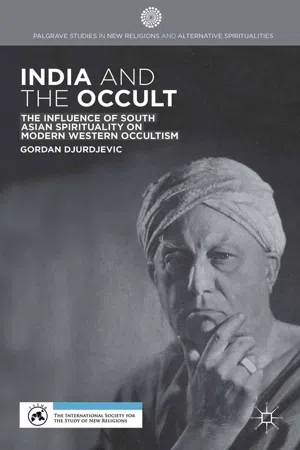
India and the Occult explores the reception of Indian spirituality among Western occultists through case studies. Rather than focusing on the activities of Theosophical Society, India and the Occult looks at the 'hard-core' occultism, in particular the British 20th century currents associated with Aleister Crowley, Dion Fortune, Kenneth Grant, etc.
eBook - ePub
India and the Occult
The Influence of South Asian Spirituality on Modern Western Occultism
- English
- ePUB (mobile friendly)
- Available on iOS & Android
eBook - ePub
India and the Occult
The Influence of South Asian Spirituality on Modern Western Occultism
About this book
Information
1
A Web of Relations: Interpreting Indian Yoga and Tantra as Forms of Esotericism
Permeable boundaries generate anxiety.1 Academic disciplines and scholarly categories tend to aspire toward clear marks of delineation and mutual distinction. This is particularly the case with newly established areas of research. It is thus not surprising that Antoine Faivre, one of the founders of the academic study of Western esotericism, in several instances argued against the inclination to make a claim for a “universal esotericism.”2 According to this view, which is not isolated, esotericism should be seen as a specifically Western cultural phenomenon. The reasons for this position appear sound: there is a historic continuity among Western esoteric currents, and in the West there exists a specific esoteric universe of discourse that is closely related to its own exoteric wing, represented by the normative Abrahamic religions, in particular Christianity. Closer analysis, however, will demonstrate that the above conceptualization of esotericism lies principally in its heuristic expediency: it does make sense, and it is appropriate to study esotericism as a Western phenomenon for the reasons mentioned above, but there is no inherent rationale to adopt this orientation as the only valid approach. Like any other cultural notion, the category of esotericism is a theoretical construct3—a discursive formation—and as such it may be used as a tool with which to approach what appear to be reasonably similar manifestations of human thought and behavior in other cultures. What follows is a suggestion of how this may be done with respect to Indian (South Asian) traditions, with an implicit assumption that something similar may be done relative to the other area studies.
A note of caution against the attribution of the category of esotericism to the Hindu tradition was also voiced early on by a Traditionalist author, René Guénon. According to his assessment, there is no strict opposition between the exoteric and esoteric teachings in Hinduism; instead, there is only a progressive deepening of esotericism.4 As a matter of fact, a similar view was already propounded much earlier. In the middle of the eighteenth century, John Zephaniah Holwell, in the second volume of his Interesting Historical Events, Relative to the Provinces of Bengal, and the Empire of Indostan, albeit with a somewhat different agenda in mind, wrote that
It is worthy notice that the Metempsychosis as well as the three grand principles taught in the greater Eleusinian mysteries; namely the unity of godhead, his general providence over all creation, and a future state of reward and punishment . . . were preached by the Bramins, from time immemorial to this day, throughout Indostan: not as mysteries, but as religious tenets, publicly known and received; by every Gentoo, of the meanest capacity. (1767: 25; emphasis in the original.)
Broadly speaking, Guénon’s argument has reasonable merit, since it is true that in Hinduism the divine is typically not construed as existing solely outside of the believer—this is a fairly common view. But there are many shades of meaning to this assertion. There are, in fact, Indian traditions that internalize their doctrines in a more restrictive, exclusive, and secretive manner so that access to teachings and practices of this kind is possible only with guidance from a guru, which typically presupposes the necessity of initiation (dīksā, abhiseka), transmission of secret knowledge, employment of coded discourse (sandhyā bhāsā), and a claim of absolute knowledge and supernatural powers (siddhis). All these elements inhere in the category of esotericism. But even if we accept Guénon’s interpretation, this does not have to mean that we must necessarily and completely abandon the use of the category of esotericism when studying Hinduism. Instead, we need to acknowledge that there exists more than one form of esotericism and that the particularity of the Western branch lies in the sharp distinction between it and normative, exoteric religion, while in India the distinction tends to be one of degree rather than kind.
Historically, the view of India as a repository of occult knowledge is quite ancient, captivating the Western imagination subsequent to Alexander the Great’s military conquest of the northwestern region of the country. The archetype of the Indian sage was encapsulated into and represented by what the Greeks called a gymnosophist, a “naked philosopher,” an image probably based on wandering Jain ascetics. In classical antiquity, Indian priests, the Brahmins, were considered to be equivalent of Persian magi, who also gave us the word for magic itself. Renowned wise men such as Pythagoras and Apollonius of Tyana were believed to have traveled to India and learned from her sages. Actual contact between the two cultures, however, was scarce, in particular after the rise of Islam, which created a virtually impenetrable zone between them. In the absence of veritable information, India, the land of Prester John, remained a land of marvels in the Western medieval imagination.5 This state of affairs lasted virtually unchanged until the period of colonial explorations and expansions. There was a curious lore, mentioned by Samuel Richter (Sincerus Renatus), according to which the brethren of the legendary Rosy Cross fraternity abandoned their work in Europe and “departed for India in order to live there in greater peace” (qtd. in McIntosh, 1997: 53).6 Toward the end of the eighteenth century, translations from Sanskrit and other Indian languages began to appear, and both the knowledge of and interest in the East extensively grew. The year 1858 marked the beginning of the British Raj, and India remained under colonial rule until 1947.7 The colonial phase also saw the emergence of Neo-Hinduism and the beginning of westward-bound missionary activities of its exponents. The most influential of these was arguably Swami Vivekananda (1863–1902), whose Raja Yoga (1896) was highly regarded by Aleister Crowley, who assigned it to the reading list of his students and described it (1997: 452) as an “excellent elementary study of Hindu Mysticism.”8
The association of India with the occult gained its strongest momentum after the formation of the Theosophical Society in New York City in 1875. Helena Petrovna Blavatsky (1831–91) and her colleagues created a romanticized image of the “mystic East” with its omniscient Mahatmas meditating in hidden sanctuaries in the Himalayas and monasteries of Tibet. This particular stance of the Theosophists provoked, among others, the famous Victorian orientalist Friedrich Max Müller (who considered Madame Blavatsky the founder of “esoteric Buddhism”) to express his exasperation regarding the issue in no uncertain terms. “Who has not suffered lately from Theosophy and Esoteric Buddhism?” he asked rhetorically (1888: 77), rejecting unequivocally both of them. And while Müller was by and large correct in his criticism of the Theosophical construct of India’s religious traditions, in some respects he went too far. For example, he argued with a sweeping gesture of dismissal:
There is nothing esoteric in Buddhism. There was much more esoteric teaching in Brahmanism. There was the system of caste, which deprived the Shudras [servants], at least, of many religious privileges. But . . . even in Brahmanism, there is no such thing as an esoteric interpretation of the Shastras. (1905: 218–9)
It is evident from the above that Müller equates esotericism with secrecy, which is a somewhat limited interpretation of the category (see Faivre, 1994: 32–3). Nevertheless, to the degree that it is a constitutive—as opposed to crucial—element of esotericism, it needs to be acknowledged that secrecy does play an important role in tantric and yogic teachings, particularly with respect to the minutiae of actual practice. Joseph Alter (2005: 121) argues in fact that “all techniques of yoga were conceived of as quintessentially secret, being imparted by a guru only to select highly adept disciples.”9 Even more striking, though not unusual at the time of his writing, is Müller’s equation of Buddhism with what is obviously only its Theravada branch. He neglects to take into consideration that one of the three major divisions of Buddhism, the Vajrayāna, in fact represents precisely an esoteric school, with secret teachings, initiations, magical spells (mantras), symbolic diagrams (mandalas) that analogically relate to the subtle realities of what Robert Thurman felicitously calls the “Buddhaverse,” and so on. In a similar vein, Müller glosses over those aspects of Hinduism that contain pronounced elements of esotericism and limits his remarks to the issues of social exclusivity and scriptural interpretation. In doing so, Müller overlooks tantric elements in Hinduism that define their position in a precisely opposite way to his analysis: the seminal twelfth-century Kulārnava Tantra, for example, makes a characteristic declaration that the doctrines of the Vedas, Śāstras, and Purānas may be revealed, but that those of the Śaiva and Śākta āgamas (i.e., tantras) are to be kept secret.10
In suggesting that some segments of Indian religious tradition may be included under the umbrella terms of esotericism, magic, and the occult, I have primarily in mind an array of yogic and tantric disciplines in both their theoretical and practical dimensions. But before addressing these specific forms of Indian religiosity in more detail, it is appropriate to make some remarks of a general nature. In order to avoid possible misunderstandings, and fully aware that “seemingly innocuous terminological conventions are often the reflection of hidden or implicit ideological agendas” (Hanegraaff, 2006: xiii), I want to emphasize that by labeling them as magic or the occult, my intention is not to represent aspects of Indian culture as irrational, backward, and superstitious. Quite the opposite: my deliberate intention is to argue (and this is also a basic argument behind esoteric studies in general) that the occult is an important, complex, self-consistent, and meaningful form of religious thought and behavior. In other words, I am adopting an approach contrary to (to give one example) Patton Burchett, who recently argued against translating the term “mantra” as “magical” spell, because (according to him) magic implies “condemnation, disapproval, or lack of understanding” and is a marginalized category (2008: 834–5).11 Referring to what he calls the “Enlightenment consensus,” taken for granted by the scholarly community as the epistemological standard that privileges scientific rationality, Burchett explains: “What ‘magic’ means here is not so much something in opposition to religion as something in opposition to the modern rational perspective, most especially that of science” (2008: 835; emphasis in original).
Burchett is justifiably critical of the negative conceptual baggage attached to the category of magic by post-Reformation and post-Enlightenment scholars. His explicit aim is to deconstruct the thusly conceived notion of magic and demonstrate why it is inappropriate to include it as a descriptive term in interpreting Hinduism (or more precisely, Hindu mantras, though the argument has wider connotations). Stated succinctly, to call an aspect of Indian religion “magic” typically implies an attitude of supremacy. “We” are rational; “they” believe in magic. And while I agree with Burchett’s analysis of the prevalent academic attitude toward magic and find his arguments cogent, I am nevertheless adopting an alternative strategy. I continue to operate with notions of magic, esotericism, and the occult, but I am reversing their qualitative connotations. I take them seriously. In this way I am attempting to perform the Derridean strategy of “destroying the old machinery” (Burchett, 2008: 837) of social disparity that associates “establishment” with religion and science, and “underground” with magic.
Having thus hopefully clarified that, in tre...
Table of contents
- Cover
- Title
- Copyright
- Content
- Acknowledgments
- Introduction: The Idea of India in the Imaginary of Western Occultism
- 1 A Web of Relations: Interpreting Indian Yoga and Tantra as Forms of Esotericism
- 2 The Great Beast as a Tantric Hero: The Role of Yoga and Tantra in Aleister Crowley’s Magick
- 3 Solve et Coagula: Attitudes toward the Ambrosial Aspects of Human Seed in Certain Yogic Traditions and in the Sexual Magick of Aleister Crowley
- 4 Dion Fortune: The Śakti of the Age
- 5 Secrets of the Typhonian Tantra: Kenneth Grant and Western Occult Interpretations of Indian Spirituality
- 6 When Yoga Becomes Magick: Dadaji Mahendranath, His Disciples, and the East-West Order
- Conclusions
- Notes
- Bibliography
- Index
Trusted by 375,005 students
Access to over 1.5 million titles for a fair monthly price.
Study more efficiently using our study tools.
Frequently asked questions
Yes, you can cancel anytime from the Subscription tab in your account settings on the Perlego website. Your subscription will stay active until the end of your current billing period. Learn how to cancel your subscription
No, books cannot be downloaded as external files, such as PDFs, for use outside of Perlego. However, you can download books within the Perlego app for offline reading on mobile or tablet. Learn how to download books offline
Perlego offers two plans: Essential and Complete
- Essential is ideal for learners and professionals who enjoy exploring a wide range of subjects. Access the Essential Library with 800,000+ trusted titles and best-sellers across business, personal growth, and the humanities. Includes unlimited reading time and Standard Read Aloud voice.
- Complete: Perfect for advanced learners and researchers needing full, unrestricted access. Unlock 1.5M+ books across hundreds of subjects, including academic and specialized titles. The Complete Plan also includes advanced features like Premium Read Aloud and Research Assistant.
We are an online textbook subscription service, where you can get access to an entire online library for less than the price of a single book per month. With over 1.5 million books across 990+ topics, we’ve got you covered! Learn about our mission
Look out for the read-aloud symbol on your next book to see if you can listen to it. The read-aloud tool reads text aloud for you, highlighting the text as it is being read. You can pause it, speed it up and slow it down. Learn more about Read Aloud
Yes! You can use the Perlego app on both iOS and Android devices to read anytime, anywhere — even offline. Perfect for commutes or when you’re on the go.
Please note we cannot support devices running on iOS 13 and Android 7 or earlier. Learn more about using the app
Please note we cannot support devices running on iOS 13 and Android 7 or earlier. Learn more about using the app
Yes, you can access India and the Occult by G. Djurdjevic in PDF and/or ePUB format, as well as other popular books in Social Sciences & Comparative Religion. We have over 1.5 million books available in our catalogue for you to explore.