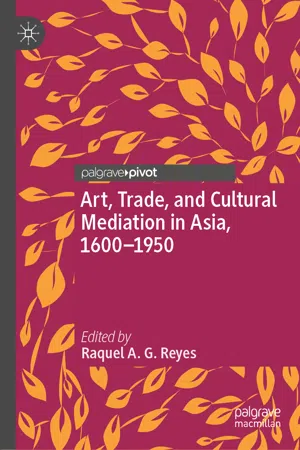
This Palgrave Pivot explores the social and cultural impact of global trade at a micro-level from around 1600 to 1950. Bringing together the collaborative skills of cultural, social, economic, and art historians, it examines how the diffusion of trade, goods and objects affected people's everyday lives. The authors tell several stories: of the role played by a host of intermediaries – such as apothecaries, artisans and missionaries who facilitated the process; of objects such as Japanese export lacquer-ware and paintings; of how diverse artistic influences came to be expressed in colonial church architecture in the Philippines; of revolutionary changes wrought on quotidian tastes and preferences, as shown in the interior decoration of private homes in the Dutch East Indies; and of transformations in the smoking and drinking habits of Southeast Asians. The chapters consider the conditions from which emerged new forms of artistic production and transfer, fresh culturalinterpretations, and expanded markets for goods, objects and images.
- English
- ePUB (mobile friendly)
- Available on iOS & Android
eBook - ePub
Art, Trade, and Cultural Mediation in Asia, 1600–1950
About this book
Information
© The Author(s) 2019
Raquel A. G. Reyes (ed.)Art, Trade, and Cultural Mediation in Asia, 1600–1950https://doi.org/10.1057/978-1-137-57237-0_4Betel, Tobacco and Beverages in Southeast Asia
William Gervase Clarence-Smith1
(1)
School of Oriental and African Studies (SOAS), University of London, London, UK
William Gervase Clarence-Smith
Abstract
There remains a historical puzzle concerning the sudden collapse in the popularity of betel chewing in Southeast Asia. A custom that was addictive, and that had become deeply entrenched in local culture over millennia, all but vanished with remarkable speed. This chapter focuses on the changing social and cultural attitudes that can lead to sudden alterations in tastes. It explores the intimately intertwined roles of religion, tobacco and hot beverages, namely tea, coffee and chocolate (cocoa), from around the sixteenth century. While cigarettes were beneficiaries of the decline of betel, this was true mainly of masculine consumption. For women, hot beverages were better placed than tobacco to substitute for betel. With such beverages popularized by world religions, secular reformers were in a better position to launch campaigns against betel.
Keywords
South East AsiaStimulantsBetelTobaccoTeaCoffeeChocolateIntroduction1
Physical properties and psychology may account for the choice of relaxing or stimulating products that are not central to nutrition , as may symbolic functions associated with religious rituals and social practices .2 Various plants produce bitter alkaloids , as insecticides or herbicides . When ingested by human beings, alkaloids alter perceptions and mental functions to varying degrees.3 Nicotine is the chief mind-altering substance contained in tobacco , arecoline in the areca nut of the betel quid, caffeine in tea and coffee and theobromine in chocolate .4 People may cling tenaciously to an accustomed product, or may switch to a new one.5 Whether alkaloids are physically or psychologically addictive, or both, remains a hotly debated topic, even in the case of opiates .6 Opium, cannabis and alcoholic beverages are only intermittently considered in this chapter, although they too were rivals in consumption practices.7
In a widely cited and influential article, Anthony Reid argues that smoking tobacco displaced the venerable and ancient Indonesian practice of chewing betel (sirih).8 This argument has been extended to Southeast Asia as a whole.9 However, Reid skates over the gender issue unconvincingly and distorts the part played by religion . Moreover, he fails to note that other new competitors to betel began to spread at about the same time as tobacco , from around the sixteenth century , namely tea , coffee and chocolate (cocoa).10
The Rise of Betel in Southeast Asia
Chewing is one of the most ancient and widespread human habits, and the betel quid is among the oldest of human chews, if not the oldest. The consumer wraps a betel leaf (Piper betle) around sliced areca nuts (Areca catechu) and adds slaked lime to extract alkaloids more effectively. A host of other products makes the quid more aromatic, astringent or stimulating. Areca ‘nuts’ are the fruit of a tall and graceful palm , and their intoxicating effects are greatest when they are green and fresh, but they are also consumed dried or smoked. As for betel leaves , harvested from a vine related to the pepper vine, they contain an essential oil similar to that of cloves. The leaves offset the astringency of the areca nuts , sweeten the breath and disinfect the mouth. Both the areca palm and the betel vine grow best in low-lying, hot and humid environments, close to the sea. The betel vine may be grown on the areca palm. Whereas areca nuts are readily exported in a preserved state, the betel leaf should be consumed fresh, or at least blanched, and is difficult to trade over any distance....
Table of contents
- Cover
- Front Matter
- Introduction
- Japanese Export Lacquer and Global Art History: An Art of Mediation in Circulation
- Paradise in Stone: Representations of New World Plants and Animals on Spanish Colonial Churches in the Philippines
- Betel, Tobacco and Beverages in Southeast Asia
- Domestic Interiors in Seventeenth- and Eighteenth-Century Batavia
- Back Matter
Trusted by 375,005 students
Access to over 1.5 million titles for a fair monthly price.
Study more efficiently using our study tools.
Frequently asked questions
Yes, you can cancel anytime from the Subscription tab in your account settings on the Perlego website. Your subscription will stay active until the end of your current billing period. Learn how to cancel your subscription
No, books cannot be downloaded as external files, such as PDFs, for use outside of Perlego. However, you can download books within the Perlego app for offline reading on mobile or tablet. Learn how to download books offline
Perlego offers two plans: Essential and Complete
- Essential is ideal for learners and professionals who enjoy exploring a wide range of subjects. Access the Essential Library with 800,000+ trusted titles and best-sellers across business, personal growth, and the humanities. Includes unlimited reading time and Standard Read Aloud voice.
- Complete: Perfect for advanced learners and researchers needing full, unrestricted access. Unlock 1.5M+ books across hundreds of subjects, including academic and specialized titles. The Complete Plan also includes advanced features like Premium Read Aloud and Research Assistant.
We are an online textbook subscription service, where you can get access to an entire online library for less than the price of a single book per month. With over 1.5 million books across 990+ topics, we’ve got you covered! Learn about our mission
Look out for the read-aloud symbol on your next book to see if you can listen to it. The read-aloud tool reads text aloud for you, highlighting the text as it is being read. You can pause it, speed it up and slow it down. Learn more about Read Aloud
Yes! You can use the Perlego app on both iOS and Android devices to read anytime, anywhere — even offline. Perfect for commutes or when you’re on the go.
Please note we cannot support devices running on iOS 13 and Android 7 or earlier. Learn more about using the app
Please note we cannot support devices running on iOS 13 and Android 7 or earlier. Learn more about using the app
Yes, you can access Art, Trade, and Cultural Mediation in Asia, 1600–1950 by Raquel A. G. Reyes in PDF and/or ePUB format, as well as other popular books in History & Economic History. We have over 1.5 million books available in our catalogue for you to explore.