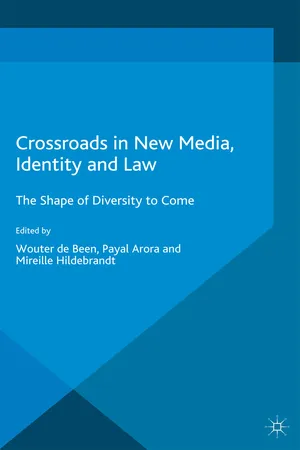
Crossroads in New Media, Identity and Law is a compilation of essays on the nexus of new information and communication technologies, cultural identity, law and politics. The essays provoke timely discussions on how these different spheres affect each other and co-evolve in our increasingly hyper-connected and globalized world.
eBook - ePub
Crossroads in New Media, Identity and Law
The Shape of Diversity to Come
- English
- ePUB (mobile friendly)
- Available on iOS & Android
eBook - ePub
Crossroads in New Media, Identity and Law
The Shape of Diversity to Come
About this book
Information
1
Introduction
Wouter de Been, Payal Arora and Mireille Hildebrandt
1. Culture and communication
Nations and national cultures are often treated as basic units of analysis, as primordial components of social life. According to the dominant view among historians and social scientists, however, this artless simplicity of nationhood and national identity is almost certainly illusory (compare Anderson 1983; Gellner 1983; Hobsbawm 1990). National cultures and nation states are historically contingent phenomena. As Saskia Sassen notes in this book, ‘the current condition we see developing with globalization is probably by far the more common one, while the more exceptional period is the one that saw the strengthening of the national state’ (Sassen, p. 17). Even though they are often thought to go back to the mists of time, nation states are of fairly recent origin and depend on a particular set of social, technological and economic circumstances to exist. Nation states, in other words, are not a natural phenomenon, but an artifice, a socio-technical constructed form of complexity. And as evolved constructs, one could say, they are subject to the law of entropy. Effort and energy need to be expended to maintain and reproduce their specific forms of complexity. Without such effort, or with countervailing forces overwhelming such energy, the complexity will take on potentially undesired new forms or revert to a disorderly state. With the momentous developments in information and communication technology of the 21st century, the nation state is mutating into something that no longer necessarily facilitates the reproduction of a shared national identity. Instead, it is developing into something that is likely to support an altogether different outcome.
What exactly this outcome will be, what shape diversity will take, is one of the overarching questions of this volume. Maybe it will bring about a splintering of communication into playful expressions of genuine individuality; or the re-emergence of a tapestry of minority identities, or a disaggregation and polarization of opinion through ‘filter bubbles’; or, perhaps, a strengthening of diaspora communities across national borders. On the other hand, it could also lead to a rise of greater global consensus, or to a drab worldwide monoculture, or to the birth of a new civility fit for the digital age, or to some combination or another of these consequences. The chapters in this book all address the connection between identity and new information and communication technologies, and they all probe the question of what shape diversity will take as a result of the changes in the way we communicate and spread information.
2. Nation, culture and networked communication
There is a fair amount of agreement about which institutions and practices support the nation state. Though the nation state emerged and consolidated before the era of mass media, we can safely say that nations have thrived with a national mass media that informs people about the goings-on of the collective and that makes people feel that they are part of an unfolding story. Mass media seem to have fortified the process of national unification set in motion by such collective institutions as the state bureaucracy, national museums and a national school system; social institutions that standardize the curriculum, impose a shared legal code on the jurisdiction of the nation, canonize a shared history and a shared cultural tradition, and rub out local and regional distinctions to create a uniform spelling and a received pronunciation. Whereas the rise of the nation states correlates with the rise and consolidation of the printing press, its 20th-century fortification is intimately tied to the institutions of modern industrial society, with a key role for modern communication technologies and the mass media.
In the last two decades, however, information and communication technologies have undergone extraordinary change. As a result, one of the mainstays of the nation state has shape-shifted into something novel and different. The local, hierarchical, one-to-many communication of the industrial age has given way to the uprooted, disintermediated many-to-many communication of the digital age. The question is how this will affect the way identity is reproduced in the 21st century. In the heyday of the nation state, the different socio-cultural domains – law, democratic politics, cultural institutions and industries, print and electronic mass media, education, economics – could be said to mesh together fairly well and to reinforce each other in the creation of a shared sense of nationhood and national belonging. Now these different domains seem to be out of step. To be sure, business and finance seem to have outgrown the nation state, and so have cultural institutions and industries to a certain extent, but law and politics – notwithstanding diligent efforts to create transnational legal and political institutions and projects – by and large remain rooted in the nation state. (Which means, in turn, that business and finance at the end of the day still depend on national enforcement mechanisms, for instance in the case of international commercial arbitration.) Meanwhile, the internationalization of law and politics is met with increasing hostility by the publics of many of today’s democracies. In short, the different spheres that used to interlock and reinforce each other to create our feeling of nationhood now seem to be out of sync.
This volume brings together a number of contributions at the nexus of new media, diversity and law. The central intuition that ties these contributions together is that information and communication technologies, cultural identity, and legal and political institutions are spheres that coevolve and interpenetrate in myriad ways. According to a statement that is often mistakenly attributed to Herbert McLuhan, because it captures his perspective so succinctly, ‘We shape our tools and thereafter they shape us.’ Even though the true provenance of this insight remains unclear, it echoes Henry David Thoreau’s observation in Walden that ‘men have become the tools of their tools.’ This insight is not only commonplace in media and ICT research, but is also implicit in the classic accounts of the nation and nationalism, which highlighted the importance of print media, radio and television for the development and consolidation of nationalism and the ‘imagined community’ of the nation state. Benedict Anderson uncovered how nations were not some primordial natural phenomenon that eventually morphed into nation states in the modern age. Rather, ‘print capitalism’ turned the aggregation of culturally and linguistically diverse groups that typically populated pre-modern kingdoms and empires into the nations we are familiar with today, with a shared and standardized language and a shared sense of self – his famous ‘imagined community’ of the nation (Anderson 1983). Ernest Gellner pointed to the importance of industrial capitalism and social institutions like law, education and the cultural canon for the development of a sense of nationhood (1983). Eric Hobsbawm noted that in the 20th century, radio and television further boosted the development of a shared national identity among people who remained largely anonymous to each other (1990). In short, the socio-technical construction of the nation depended on the concurrent and interconnected emergence of print and later electronic mass media and on the concomitant development of national, cultural, political and legal institutions. These ‘tools’ created a sense of shared experience and shared national debate, a standardized national language, a national curriculum and a cultural canon.
Anderson, Gellner and Hobsbawm wrote on the nation state of the 19th and 20th centuries and the information and communication technologies of the industrial age. With the shift from analogue to digital and the enhanced communication enabled by Web 2.0, many of the connections they described between mass communication, cultural identity and the nation state have been pulled out of joint. Whereas the institutions of the nation state were largely shaped in an environment of print and analogue media, in many ways these institutions now lag behind the developments in information and communication technology; they no longer form a natural fit with their digital and networked communication environment. Arjun Appadurai, moreover, alerts us to the nuanced difference between the ‘politics of possibility’ and the ‘politics of probability’ when delving critically into the shaping of the nation state through so-called new media, new nations and new social collectives (2014).This compilation takes stock of the present state of these shifting inter relationships and dis-equilibriums.
3. Global archipelago, global community or a new civility
Discussing these shifting interrelationships, the pieces all address two large and contradictory consequences that have been attributed to the shift in information and communication technology. On the one hand, new ICTs have, in effect, turned mass communication into a cottage industry. As Manuel Castells notes in Communication Power, there has been a shift from ‘mass communication’ to ‘mass self-communication,’ a turn from a one-to-many to a many-to-many model (Castells 2009, pp. 63–7). Information has seemingly become ubiquitous and democratized. Groups can express and maintain their own culture, or their own religious identity, without the help of the institutions that used to mediate and buoy the imagination of the nation state. Simultaneously, the experience of immigration is changing as a result of new ICTs. Immigration studies are rediscovering the notion of the ‘diaspora’ to capture the degree to which today’s immigrants can stay in contact with their culture of origin and develop hybrid diaspora cultures that bridge their home and their host cultures. These diaspora communities are facilitated greatly by the ready availability of satellite television, mobile telephony and the Internet. New ICTs are thus helping to create a global archipelago of more or less insular communities, a new cultural geography that does not necessarily coincide with the territorial divisions of the nation state.
This purported trend is both embraced and condemned. Some see the disaggregation of the public into small groups with alarm. Filtering techniques allow people to communicate only with people like themselves, to read books that people like themselves read, and to listen to music that people like themselves listen to. This leads to the creation of the so-called ‘filter bubble,’ resulting in homogeneous and inward-looking groups that no longer come into contact with dissenting voices and diverging lifestyles (Pariser 2011; Sunstein 2001). This in turn leads to an invisible polarization of opinion and the splintering of the public sphere. Others see these nascent communities in more positive terms. The Internet opens the mass media up to everybody and undercuts the social and cultural elites that used to decide who was published and who got air time. Hence, the disaggregation of the public on the Internet should be considered a boost to civil society; it has afforded a development that allows for the articulation of a more diverse range of opinion. The literature on diaspora communities, moreover, highlights how diaspora networks are sites for innovation, bridging cultures and mutual understanding.
A contrary effect of globalization and the spread of new ICTs can be detected in the processes of consolidation, standardization and centralization. From that perspective, the Internet is not so much fragmenting democratic publics around the world and boosting diaspora communities, as morphing into a space that is increasingly dominated by a global culture and global standards. New networked communication, thus, helps to institute a global community. Again, this trend is both valued and deplored. Some see the emergence of a cosmopolitan culture fit for an increasingly interconnected and interdependent world. Greater interconnectedness will breed greater understanding; it will supposedly enable everybody to comparison-shop for the best ideas and the best solutions. Others regret the lack of variance that results from the domination of the Internet by a small number of corporate giants: Google, Facebook, Amazon, Apple. These big companies are creating an Internet of standardized formats; a glimmering, global monoculture dominated by uniformity.
Moreover, the problem of the ‘tyranny of the majority’ is something that gains a new urgency on the Internet. To manifest yourself on the Internet is to open yourself up to the scourge of mass opinion. Everything becomes subject to the glare of the connected. In his recent book The Circle, set on the campus of a high tech company in the near future, Dave Eggers presents the image of a translucent shark as a – somewhat heavy-handed – metaphor for social media and networked information technology. In the book, a newly discovered species of shark is displayed in a fish tank on the campus of The Circle, where it quickly devours all other creatures and transforms all diversity into amorphous excrement deposited on the floor.
Though blind, it found its meals immediately, no matter how big or small, alive or dead, and digested them with alarming speed. One minute a herring or a squid would be dropped into the tank with it, and moments later the shark would deposit, on the aquarium floor, all that remained of that animal – a tiny grainy substance that looked like ash. This act was made more fascinating given the shark’s translucent skin, which allowed an unfettered view into its digestive process.
(Eggers 2013, p. 308)
A world that is completely open and transparent may very well turn out to be a world where everybody will conform to the common denominators of mass taste and mass opinion, and where everything that is quirky, individual or unusual will be devoured and processed into gray matter.
The purpose of this volume, however, is not only to provide incisive and critical accounts of these emerging trends. Some of the contributions do not reduce to merely describing the way novel ICT architecture and new forms of interconnectivity are currently shaping the diversity of our social world; they also address the question of how these technologies can be designed to nourish a new civility and urbanity, how ICTs can be redesigned to support a form of networked public life that steers clear of the shortcomings and failings listed above. How can we avoid the ‘filter bubbles’ of excessive sorting, or the conformity of global networks? How can we imagine digital and geographical spaces that allow for interconnectivity without accepting the increased personalization that leads to unprecedented surveillance and social sorting in both the private and the public sphere? Can we engage in the global conversation that these new ICTs make possible, without succumbing to the narrow formats and built-in limitations that now characterize many Internet platforms? Some of the authors engage with these substantive questions and suggest solutions and policy alternatives.
4. Networked communication, law and politics
When it comes to charting the shifting relationship between new ICTs, cultural identity and the nation state, this volume is divided into three sections that focus on different aspects of the association between these interdependent spheres. The first section stresses the legal-political dimension of the changing relations between identity and communication. Citizens increasingly engage with networked forms of civic life that transgress national borders. In today’s hyperconnected world, the focus of political engagement often moves beyond the scope of the nation state, not only because the economic structures and the political questions have an international reach, but also because the affected groups and communities, even though they are dispersed and located in different countries, can now trace each other and organize despite their geographical dispersal. The chapter by Saskia Sassen addresses this aspect of increased interconnectedness and globalization. For Sassen the blurring of borders is a complex and multifaceted phenomenon. There are many facets to the borderings of the nation state. Borders are not just a geographical circumstance, but a phenomenon that can be disaggregated into multiple components. Globalization and digitization affect these different dimensions of border-making in various ways. Her chapter affords a kaleidoscopic glance at a range of domains such as corporate business, financial trading, legal regulation and cross-border activism, and discusses how they are affected by increased globalization and digitization.
Wouter de Been looks at the way identity and culture are reproduced in the dense digital communication networks of today from the perspective of political theory. He argues that this new networked environment is unlikely to produce the kind of autonomy, individual freedom and uncompromising authenticity that cyberspace gurus saw as the great promise in the initial wonder years of the Internet. This ideal, which is still important in shaping expectations about our new networked environments, assumes an implausible cultural plasticity. De Been argues that rather than total freedom, new ICTs facilitate a more limited form of self-realization. Jazz improvisation is the metaphor he uses to capture what freedom is like for groups that organize through new ICTs. Like jazz musicians, people who experiment with their identity on digital networks do not make things up from scratch, but build on what they know. They make variations on familiar themes. Moreover, like those of jazz musicians, people’s improvisations are further circumscribed by the collaborative setting in which they are produced – the jazz ensemble or the networked community are socio-technical settings that demand a certain degree of coordination to work. These limitations are not to be deplored, de Been argues. They make for the kind of freedom worth having.
Increased connectivity also raises more specifically legal issues. Julie Cohen addresses the normative question of how law can help foster a new civility. Cohen contends that the two great narratives about technological change are both wrong: that is, technological change will lead neither to a fragmented, disaggregated world of insular communities, nor to an enlightened, global, cosmopolitan community. The more likely outcome of technological change is modulation. New information and communication technologies, Cohen argues, shape the behavior of people in much more subtle ways than the narratives of the emerging global archipelago or global community suggest. Modulation makes certain behaviors seem easier, more natural and logical, while others are made to seem more difficult, unnatural and inappropriate. Technologies shape our perception and nudge us – no link with behavioral economics implied – into behaving in certain ways rather than in others. In order to disrupt this soft tyranny of our technological environment, Cohen suggests affirmative measures such as the creation of breathing spaces, disruptions of the smooth working of our technological environment to allow people to gain new forms of agency in their technological environment.
Sanne Taekema also addresses legal issues in her chapter. Taekema is concerned with questions of a more theoretical nature. For the construction of the nation state, a unified national legal system expressing the sovereign, democratic will of a single people was of course a crucial component. In legal scholarship there have always been perspectives that question the monolithic nature of this understanding of law, that see law as a more pluralistic phenomenon. Hence, in the recent debates about legal pluralism the Internet plays an important role. It is a place where the possibilities of state law may quickly run out. Taekema argues, however, that some versions of legal pluralism make more sense than others. Approaches to legal pluralism that see the diverse legal orders as closed and autonomous also have trouble making sense of our increasingly interconnected world. What is needed, Taekema contends, is an open, interactionist conception of legal pluralism.
5. ...
Table of contents
- Cover
- Title Page
- Copyright
- Contents
- List of Tables and Figures
- Preface
- Acknowledgments
- Notes on Contributors
- 1. Introduction
- Part I: Communication, Law and Politics
- Part II: New ICTs, Identity and Language
- Part III: New ICTs and Cultural Industries
- Index
Trusted by 375,005 students
Access to over 1.5 million titles for a fair monthly price.
Study more efficiently using our study tools.
Frequently asked questions
Yes, you can cancel anytime from the Subscription tab in your account settings on the Perlego website. Your subscription will stay active until the end of your current billing period. Learn how to cancel your subscription
No, books cannot be downloaded as external files, such as PDFs, for use outside of Perlego. However, you can download books within the Perlego app for offline reading on mobile or tablet. Learn how to download books offline
Perlego offers two plans: Essential and Complete
- Essential is ideal for learners and professionals who enjoy exploring a wide range of subjects. Access the Essential Library with 800,000+ trusted titles and best-sellers across business, personal growth, and the humanities. Includes unlimited reading time and Standard Read Aloud voice.
- Complete: Perfect for advanced learners and researchers needing full, unrestricted access. Unlock 1.5M+ books across hundreds of subjects, including academic and specialized titles. The Complete Plan also includes advanced features like Premium Read Aloud and Research Assistant.
We are an online textbook subscription service, where you can get access to an entire online library for less than the price of a single book per month. With over 1.5 million books across 990+ topics, we’ve got you covered! Learn about our mission
Look out for the read-aloud symbol on your next book to see if you can listen to it. The read-aloud tool reads text aloud for you, highlighting the text as it is being read. You can pause it, speed it up and slow it down. Learn more about Read Aloud
Yes! You can use the Perlego app on both iOS and Android devices to read anytime, anywhere — even offline. Perfect for commutes or when you’re on the go.
Please note we cannot support devices running on iOS 13 and Android 7 or earlier. Learn more about using the app
Please note we cannot support devices running on iOS 13 and Android 7 or earlier. Learn more about using the app
Yes, you can access Crossroads in New Media, Identity and Law by Kenneth A. Loparo, P. Arora, M. Hildebrandt, Kenneth A. Loparo,P. Arora,M. Hildebrandt,Wouter de Been in PDF and/or ePUB format, as well as other popular books in Social Sciences & Law Theory & Practice. We have over 1.5 million books available in our catalogue for you to explore.