eBook - ePub
Reclaiming Poch@ Pop: Examining the Rhetoric of Cultural Deficiency
Examining the Rhetoric of Cultural Deficiency
- English
- ePUB (mobile friendly)
- Available on iOS & Android
eBook - ePub
Reclaiming Poch@ Pop: Examining the Rhetoric of Cultural Deficiency
Examining the Rhetoric of Cultural Deficiency
About this book
Tracing the historical trajectory of the pocho (Latinos who are influenced by Anglo culture) in pop culture, Medina shows how the trope of pocho/pocha/poch@, which traditionally signified the negative connotation of "cultural traitor" in Spanish, has been reclaimed through the pop cultural productions of Latinos who self-identify as poch@.
Information
Print ISBN
9781137501578
Subtopic
Social History1
A Poch@ Pop Preface: Si se puede
Abstract: Chapter 1 introduces poch@ as the growing Latin@ audience in the U.S. and those pop culture artists who reflect their experiences. Autobiographical material about the author illuminates intersections among popular culture, humor, and political and social realities. The trope of pocho, pocha, or poch@ reemerges as a self-identifier for Latin@ pop culture producers who respond and resist rhetoric framing Latin@s as deficient.
Medina, Cruz. Reclaiming Poch@ Pop: Examining the Rhetoric of Cultural Deficiency. New York: Palgrave Macmillan, 2015. DOI: 10.1057/9781137498076.0005.
When I first saw Dolores Huerta give the keynote address at a conference on decolonization at the University of Arizona, I took a “selfie” with her after she spoke. Huerta’s keynote followed her highly criticized talk at Tucson Magnet High School, where she told students that “Republicans don’t care about Latinos.” At that moment of kairos, Huerta’s critique of Arizona’s ultraconservative legislators was apropos in the light of Senate Bill 1070, which legalized the racial-profiling of Latinas/os suspected of being “illegal.” While the policy of SB 1070 called the citizenship of all Latinas/os into question through the heightened policing of Latinas/os bodies, Huerta’s criticism would be later attacked in the political theater to support outlawing Mexican American Studies (MAS) at Tucson Magnet High School via House Bill (HB) 2281. The rhetoric of HB 2281 misrepresented the MAS program as promoting “governmental overthrow” and “resentment of different races,” even though the logic of higher state test scores and graduation rates demonstrated the efficacy of the culturally relevant curriculum and social justice pedagogy1.
I begin with the persuasiveness of Huerta’s oratory, which has moved generations of audiences to act since the formation of the United Farm Workers’ union with Cesar Chavez, because Huerta’s speech that day has personal reverberations in popular culture. In her address, Huerta explained that the now-iconic phrase “Sí se puede” emerged during her activist work of going door-to-door to register voters. When many of the people with whom she spoke said “no puedo (no, I can’t),” she responded “Sí, se puede (yes you can).” In my own home, I need go no further than my two year-old son’s Go, Diego, Go! (2007) compact disc with a song entitled “Si Se Puede” to see a connection with Huerta’s phrase and pop culture. Despite the appropriation of the slogan in the realm of pop culture, si se puede continues to serve as a rhetorical rallying cry to challenge political issues affecting Latinas/os.
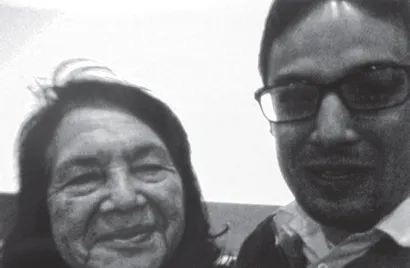
FIGURE 1.1 Dolores Huerta with Medina
In reality, I admit that after I heard Huerta’s story, I joked with a Chicana colleague that I had always thought that the phrase had come from the same source from where all great things Chicana/o originated: Edward James Olmos. For readers of this book, that joke should ring true to some extent because Olmos has been the figure who has transgressed pop culture genres including iconic roles in Zoot Suit (1981), Blade Runner (1982), Miami Vice (1984–1990), Stand and Deliver (1988), American Me (1992), My Family (1995), Selena (1997), American Family (2002), and the Battlestar Galactica TV series (2004–2009), to name a few. Because pop culture plays an intrinsic role in how culture is discussed in the U.S., mainstream pop culture is often the common referent for Latina/o and non-Latina/o audiences, as it often is for non-Latina/o audiences. For Latina/o pop culture consumers in the U.S., Edward James Olmos has represented the street-wise pachuco watching their backs, the strong role model as teacher, head of family, and captain on intergalactic voyages traversing the collective pop cultural memory. Olmos’ presence challenges the racist punchline for the joke about “why there were no Latinas/os on Star Trek,” by proving that Latinas/os want to work, and do in fact work in the future. More importantly, many of the television programs and films that Olmos has starred in have marked temporal signposts for many Latina/o audiences in the U.S.
I still recall when I was eight years old and I saw Stand and Deliver (1988) in theaters twice. For my family, the film inspired a sense of pride. Both of my parents were educators: my mother taught English as a Second Language (ESL) at my elementary school and my father taught English at a Hispanic-Serving community college. Therefore, Olmos’ portrayal of real-life educator Jaime Escalante, the East Los Angeles math teacher, who excelled in the preparation of Latina/o students for the advanced placement calculus exam, shone a positive light on the ignored efforts of Latina/o teachers and students. For me, it represented the success in school that was mirrored back at me by students who looked like me and the kids on my schoolyard. Some critics have reductively categorized Stand and Deliver as a so-called “social problems” film that promotes the rhetoric that social and political issues only require limited change.2 Still, my family no doubt returned for a second viewing in theaters because my parents valued the broader-reaching implications from the radically local microcosm of a single classroom. And while I recognize the potential dangerous interpretation of the film as promoting the bootstrap rhetoric that Victor Villanueva3 exposes as counterproductive for communities of color, I proceed with this discussion because the rhetoric of pop culture inspires, as it entertains, and disrupts oppressive narratives that dominate political and material discourse communities. Jokes aside, pop culture like Stand and Deliver interrupts dominant political and social rhetoric by reaffirming to Latinas/os that they can achieve with the important message of: si se puede.
Los nombres de nomenclature
Recently, more attention has been paid to Latinas/os for political and economic purposes. In the 2012 presidential election, the “Latino vote” served as something of a topos, or rhetorical commonplace, that political analysts integrated into their talking points. Similarly, the projected doubling of the population of people with Latin American heritage in the U.S. by 2050 has functioned as a call to action by educators working to develop culturally responsive curriculum and pedagogy to the needs of this growing population.4 Discussions of political agency and education, however, continue to paint Latin@s with a broad brush that reinforces the assumption of a false monolith—ignoring the diversity and broad spectrum of identities and experiences. A part of this monolith assumption was a resurgence of the “sleeping giant” voting metaphor when Mitt Romney courted the “Latino vote” too late in the 2012 election, a metaphor that Rudolpho Acuña rejects as “anesthetizing.”5 The sleeping giant remains a rhetorical trope in the context of politics because it recognizes “minorities” without necessarily enacting policy that shifts power in acknowledgment of majority-status population demographics.
At this point, it might be helpful to acknowledge the trope of pocha/o from which I extrapolate and identify the rhetorical power of primarily-English-speaking Latina/o pop culture producers in the U.S. Until now, there have been canonical representations of pocha/o as a trope that signifies “cultural traitor.”6 The cultural traitor connotation of pocha/o does little to demonstrate how the trope of poch@ has come to symbolize resistance through the efforts of the pop culture producers who self-identity with it—from here I will write simply “@”instead of “a/o” to demonstrate inclusivity, rather than the a/o construction that reinforces an either/or colonial binary. In most cases, I also break from the use of “o\a” and “a\o” when writing Latino\a, Latina\o, Chicana\o and Chicano\a, which has been found by Chican@ scholars to maintain a rigid binary for gender and sexuality,7 while the “@” performs a visual and queered representation of inclusivity. With regard to self-identification, I use the “@“ sign as a part of the transgressive and decolonial stance that poch@ embodies. At the same time, the spiral image conjures up images of the snake eating itself, the very same image Anzaldúa uses in conversation with Andrea Lunsford to describe the counter-knowledge of conocimiento.8 This image aptly symbolizes how her work concerning colonial borders of identity, mestiza consciousness, and the incorporation of Pre-Columbian tropes informs what I identify as poch@ pop.
To discuss poch@ requires a necessary explanation of how the trope fits into the greater spectrum of pan-ethnic nomenclatures. Recent Pew research found that the majority of people of Latin American heritage first identify their ethnicity with their country of origin, and then by pan-ethnic nomenclature such as Hispanic or Latin@.9 The rhetorical erasure of difference is often dismissed by oversimplified critiques of “political correctness,” so I submit poch@ as a nomenclature like Chican@ that seeks to right the wrongs played out in politics. I have admittedly heard dismissals from my more conservative-leaning Mexican American family members who say things like, “Latino, Chicano, Hispanic? What’s the difference? I don’t know what to call them—they’re changing what to call themselves all the time.” Not only is the use of “them” as opposed to “us” problematic, but the rhetorical question also highlights an underlying fallacy revealed in the assumed, commonly-held belief of the argument. The assertion arrived at by this enthymeme sounds correct, though the logic is spurious. It is, of course, fallacious because the construction of enthymemes as incomplete syllogisms often include...
Table of contents
- Cover
- Title
- 1 A Poch@ Pop Preface: Si se puede
- 2 Proto-Poch@ Representations in Film: Exploitation or Bust
- 3 Poch@ Methodological (Re)appropriation for Resistance: Poch@ Past
- 4 Alcaraz and Madrigal: Re-appropriating Poch@ for Resistance : A Time and Place for Poch@ Pop
- 5 Poch@ teca: Re-understanding the Historical Trajectory of a Proto-Chican@ Identity
- 6 Poch@s Strike Back: Ozomatli Members Respond to Pop Culture Commentary
- Afterword
- Bibliography
- Index
Trusted by 375,005 students
Access to over 1.5 million titles for a fair monthly price.
Study more efficiently using our study tools.
Frequently asked questions
Yes, you can cancel anytime from the Subscription tab in your account settings on the Perlego website. Your subscription will stay active until the end of your current billing period. Learn how to cancel your subscription
No, books cannot be downloaded as external files, such as PDFs, for use outside of Perlego. However, you can download books within the Perlego app for offline reading on mobile or tablet. Learn how to download books offline
Perlego offers two plans: Essential and Complete
- Essential is ideal for learners and professionals who enjoy exploring a wide range of subjects. Access the Essential Library with 800,000+ trusted titles and best-sellers across business, personal growth, and the humanities. Includes unlimited reading time and Standard Read Aloud voice.
- Complete: Perfect for advanced learners and researchers needing full, unrestricted access. Unlock 1.5M+ books across hundreds of subjects, including academic and specialized titles. The Complete Plan also includes advanced features like Premium Read Aloud and Research Assistant.
We are an online textbook subscription service, where you can get access to an entire online library for less than the price of a single book per month. With over 1.5 million books across 990+ topics, we’ve got you covered! Learn about our mission
Look out for the read-aloud symbol on your next book to see if you can listen to it. The read-aloud tool reads text aloud for you, highlighting the text as it is being read. You can pause it, speed it up and slow it down. Learn more about Read Aloud
Yes! You can use the Perlego app on both iOS and Android devices to read anytime, anywhere — even offline. Perfect for commutes or when you’re on the go.
Please note we cannot support devices running on iOS 13 and Android 7 or earlier. Learn more about using the app
Please note we cannot support devices running on iOS 13 and Android 7 or earlier. Learn more about using the app
Yes, you can access Reclaiming Poch@ Pop: Examining the Rhetoric of Cultural Deficiency by C. Medina in PDF and/or ePUB format. We have over 1.5 million books available in our catalogue for you to explore.