- English
- ePUB (mobile friendly)
- Available on iOS & Android
eBook - ePub
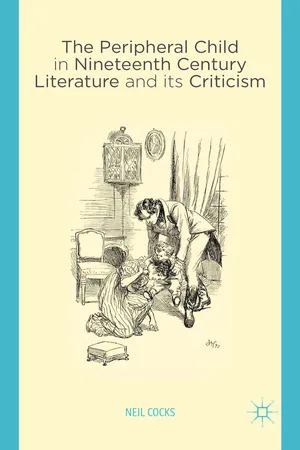
The Peripheral Child in Nineteenth Century Literature and its Criticism
About this book
Established accounts of the child in nineteenth century literature tend to focus on those who occupy a central position within narratives. This book is concerned with children who are not so easily recognized or remembered, the peripheral or overlooked children to be read in works by Dickens, Brontë, Austen and Rossetti.
Information
Part I
The Return of the Child
1
The Child and the Return
Persuasion
1 ‘the reader is hardly aware of the children at all’
David Selwyn’s account of the child in the work of Jane Austen has been introduced, with a difference set up between his project of drawing attention to a child that is too often forgotten or overlooked, and my own interest in returning the child to the text as a disruptive ‘return of the repressed.’ This initial chapter will begin to introduce some of the complexities that can attend this return through an analysis of Austen’s Persuasion, a novel widely understood to be concerned with romance and iteration, and having little or nothing to do with childhood. In my reading, the child is certainly constructed as marginal within Austen’s narrative, yet it can also be understood in terms that repeat those of the romantic couple, a repetition that, in itself, would seem to place the child at the novel’s heart. It follows that I am not so much interested in recognising the central importance of the child in Austen than in problematizing the notion of a stable material structure such centrality entails. As such, this chapter can be understood to repeat moves made in Eve Kosofsky Sedgwick’s seminal reading of repression in Austen criticism, ‘Jane Austen and the Masturbating Girl’.1 For Sedgwick, repression can be conducted in ‘anti-repressive’ readings as much as those that are explicitly ‘normal and normalising’ as long as they validate the discrete and visible ‘identity’ of the heterosexual subject as the necessary focus of critical interest, and resist reading all that such a focus requires to be forever ‘dropping out of sight’.2 A formative supplement must not be allowed to return. In engaging Sense and Sensibility through a seemingly irrelevant and forgotten sexual type – ‘the masturbator’ – Sedgwick questions the independence and structural stability of both heterosexual subject and literary artefact, with ‘the masturbator’ finally and scandalously read as ‘the proto-form of any modern “sexual identity”’.3 Although ostensibly not as shocking as ‘the masturbator’ in its return to Austen, I argue that, like it, ‘the child’ can be read as constitutive of, and repeated in, the normative, adult heterosexuality that should oppose it, and thus, as suggested above, is equally disruptive to repressive investments in the stable, the privileged and the discrete.
2 ‘conscious schematism’
For David Selwyn, what is taken to be the general marginality of the child in Austen, and the reader’s limited awareness of it, are linked to a discourse of functionality. As such, Selwyn is concerned with ‘the use of children […] as a source of comedy […] a means of revealing attitudes and responses of adults around them’, and their ‘important function in the actual structure of a scene’.4 Children are important only in so far as they illuminate adult behaviour. It follows that Persuasion is to be approached in Selwyn’s reading through, for example, its ‘extended use of a sick child’, which is ‘by far the most significant instance of childhood illness in any of the novels’, with this ‘use’ understood in relation to the activities of Anne Elliot and Captain Wentworth, the novel’s central romantic couple:5
Little Charles Musgrove suffers ‘a bad fall’; we are not told how it happens, but it foreshadows Louisa’s very serious fall on the Cobb at Lyme, which has even more important consequences for the plot. Both incidents are closely bound up with the renewal of Anne and Captain Wentworth’s relationship: Louisa’s accident eventually hastens their coming together; Charles’s, on a smaller scale, initially delays it.6
In one sense I understand this account of the child’s contribution to the structure of Persuasion to repeat an established critical reading. Take, for example, Cheryl Ann Weissman’s discussion of the novel’s ‘conscious schematism’, that explicit and yet often mysterious iteration in which ‘[n]ames and events recur in a disturbingly irrational way, reflecting a transient, uneasy [world]’.7 Weissman claims that ‘[a] striking doubleness characterizes the plot’:
Anne’s anticipated first meeting with her former lover, Wentworth, is scuttled by a domestic accident in the Musgrave household: little Charles is injured in a fall. And with a thud that is uncannily familiar, the turning point of the novel will occur when the boy’s aunt, Louisa Musgrove, falls on the Cobb at Lyme. The symmetry is as significant as the similarity; as the child’s fall heralds a courteous and cold reaquaintanceship, Louisa’s precipitates Wentworth’s recognition of love and his return to Anne.8
There is also a repetition of names, from the ‘breezy and irreverent reference to “all the Marys and Elizabeths”’ on the first page, to Charles Musgrove who ‘has a son and a cousin (his brother-in-law-to-be) with the same Christian name’.9 Finally:
[A] cadence of poetic refrain characterizes much of the novel’s diction […]:
‘She [Anne] was the last, excepting the little boys at the cot, she was the very last, the only remaining one of all that had filled and animated both houses, of all that had given Uppercross its cheerful character.’
This nostalgic sentence echoes another description of lingering lastness, the reference to the old nursery–maid who is delightedly rehabilitated by Louisa’s fall […] chanting, balladlike […] the image of the nursery is presented with the soothing monotonous rhythm of a nursery rhyme, another variation on the theme of refrain.
And refrain ‘is’ a theme. Implicit in the novel’s premise is a doubleness of time, for Persuasion is constructed like a palimpsest, an overlay through which we must decipher an original.10
As refrain ‘is’ a theme, there must be certain categories for which this is not the case. It is somewhat surprising that despite appeals to the nursery rhyme, the lingering and long-petted Master Harry, the little boys remaining in the house, the role of little Charles in constituting the scheme of repetition and the repetition of his name, ‘the child’ escapes thematic designation. Weissman, in other words, joins Selwyn in suggesting that these children are implicated in the scheme of repetition, yet differs in not understanding the category of ‘the child’ to be part of the structure. The children do not constitute a repetition in and of themselves. Thus, in the initial quotation from Weissman introduced above, structure is ‘striking’, the symmetry of it ‘significant’, yet it is ‘a thud’ that is ‘uncannily familiar’, not a child. For Weissman:
It is the nature of storytelling to etch patterns and simultaneously to violate them. In Persuasion this aesthetic conflict is brought into the foreground; the will to conserve the patterns of the past inviolate abrades against the impulse to disrupt and reform them.11
The pattern may be violated, according to this argument, but there is no doubt as to what it is: ‘In place of the unobtrusive mimetic foundations that persuasively supports earlier Austen heroines, here is fictional scaffolding illuminated with narrative searchlights.’12 The child is not part of the ‘scaffolding’, is not picked out by ‘searchlights’, nor identified as either a ‘theme’ or a constitutive aspect of the ‘conscious schematism’. Instead the child can, as it were, be constructed as that which escapes the consciousness of the text. For Weissman, the child does not repeat because it is unreadable, yet, as I have suggested, it can be returned to her structure at every turn.
In the absence of such a return, the illuminated structure is understood to be stable, and able to grant access to that which is beyond it, with Weissman claiming that in Persuasion:
Patterns of doubleness and refrain have taken the place of progressive momentum, creating a cadence exquisitely suited to the heroine’s step. For she is no Elizabeth Bennett, coming of age and learning to distinguish between appearances and reality; Anne Elliot begins her narrative journey with maturity and discernment, and in her world such phenomenological distinctions are no longer possible. Here the focus has veered from character to the perception of character, and knowledge of another person’s motives and idiosyncratic vision is always insufficient. Grounded by Persuasion’s schematically patterned narrative surface, personality emerges with a residual richness that extends beyond the borders of the text.13
I would suggest ‘phenomenological distinctions’ are possible here, despite Weissman’s insistence on the contrary, as it is claimed that there is a knowable difference between text and its ‘beyond’. I am interested in making a distinction between this absent space and the lack I have read above to be necessitated through Weissman’s ‘perception’ of the novel’s ‘narrative surface’. I do not understand this, that might be named ‘the missing child’, to be equivalent to the thick, primary real of Weissman’s ‘residual richness’. Instead, I take it to be unconscious, in so far as it is known only as a return. If the child can be understood always to have been there in Weissman’s construction of structure, it is only through a subsequent reading, a retrospective construction of it as the previously evaded. As such, my interest is not so much in the fact of the child’s exclusion as the impossibility of establishing this at the site of exclusion. The overlooked child is not to be located in its proper place.
3 ‘first return’
I will not be suggesting, then, that Cheryl Ann Weissman has missed what is truly important in her reading of structure; an idea of Persuasion as essentially a novel about children. Indeed, in so far as there are occasions in which Austen’s children are constructed as irrelevant, Weissman’s disinclination to analyse them can be understood to demonstrate a fidelity to the novel. Take, for example, the description of Anne Elliot’s extended stay at the Harville’s residence, introduced above within the quotation from Weissman: ‘She was the last, excepting the little boys at the Cottage, she was the very last, the only remaining one of all that had filled and animated both houses.’ The narrator has no difficulty in regarding these ‘little boys’ as an exception, and thus they do not impinge on Anne being ‘the very last’. They do not count, in other words, an assessment exacerbated by their namelessness, the way they are introduced merely as recipients of their father’s home-crafted toys, and reintroduced only when Louisa Musgrove’s accident on the Cobb necessitates ‘putting the children away in the maids’ room’.14 It does not follow from this that the children in Persuasion are simply understood in terms of their lack of significance, however, as if this brings matters to a close. On the contrary, the demand for the child to be insignificant is dependent on contradictory constructions that grant this status an ironically shifting significance. Thus, for example, the idea of the unimportance of the child to be read in the narrator’s construction of the Harville family above is elsewhere set up as the subject of satire, with Anne’s younger sister characterised by indolence, selfishness and unselfconsciousness precisely because of her failure to recognise children as subjects in themselves:
‘I [Mary] have not seen a creature the whole morning!’ […]
‘You have had your little boys with you?’
‘Yes, as long as I could bear their noise; but they are so unmanageable that they do more harm than good’.15
The novel’s account of Christmas with the Musgrove’s enables a further, contrary reading of the peripheral child:
On one side was a table, occupied by some chattering girls, cutting up silk and gold paper; and on the other were tressels and trays, bending under the weight of brawn and cold pies, where riotous boys were holding high revel […] Mr Musgrove made a point of paying his respects to Lady Russell […] but, from the clamour of the children on his knees, generally in vain. It was a fine family piece.16
The children are anonymous and of indefinite number, yet their ‘clamour’ can make communication between adults impossible and, as such, they are taken to be unavoidable as much as marginalised. The shifting significance of the insignificant can also be read in the absence of first names. This is not only to be understood as a refusal of identity, as, for example, ‘family’ is produced through appeals to undifferentiated boys and girls as much as named adults such as Lady Russell. Rather than a static relation between discrete subjects, ‘family’ is constituted, in part, through a lack of individuality. It is this, perhaps, that makes the ‘fine family piece’. The ‘family’ is recognisable as such because it does not trouble itself with the localised, its typicality necessitating a resistance to specificity. This can also be read in the ‘clamour’ and ‘chatter’ the children produce. Because the ‘family piece’ is not marked by the specificity and significance of language, it is available as spectacle, and thus as a ‘real’ unencumbered by difference, while also a transferable structure, a staging of the family that must, of necessity, lack the detail of any ‘real’ instance.
In contrast, the children who fail to intrude upon the reconciliation between Anne and Wentworth in the penultimate chapter of Persuasion have neither first names nor family names, the romantic couple only being ‘heedless of […] nursery-maids and children’. As neither nurses nor their charges have designated family, they oppose the family ushered in by marriage.17 If in this heedlessness there is a return to the notion of the child as exception appealed to within the quotation discussed by Weissman above, a further quotation also addressed by Weissman, and alluded to in the previous section of this chapter, repeats this construction in terms of the nurse:
A chaise was sent for from Crewkherne, and Charles conveyed back a far more useful person in the old nursery-maid of the family, one who having brought up all the children, and seen the very last, the lingering and long-petted Master Harry, sent to school after his brothers, was now living in her deserted nursery to mend stockings and dress all the blains and bruises she could get near her, and who, consequently, was only too happy in being allowed to go and help nurse dear Miss Louisa.18
Once again, however, the notion of the insignificant offered here is far from simple. The first name ‘Harry’ can be understood to signify a ‘lingering’ of the child in both the place and the condition of a ‘brought up’ childhood, while for his ‘brothers’ the absence of the name indicates a shared and normative transition, one that requires no individual designation...
Table of contents
- Cover
- Title
- Copyright
- Contents
- Acknowledgements
- Introduction
- Part I The Return of the Child
- Part II Ethics, History and Analysis
- Conclusion: Why Analysis?
- Notes
- Bibliography
- Index
Trusted by 375,005 students
Access to over 1.5 million titles for a fair monthly price.
Study more efficiently using our study tools.
Frequently asked questions
Yes, you can cancel anytime from the Subscription tab in your account settings on the Perlego website. Your subscription will stay active until the end of your current billing period. Learn how to cancel your subscription
No, books cannot be downloaded as external files, such as PDFs, for use outside of Perlego. However, you can download books within the Perlego app for offline reading on mobile or tablet. Learn how to download books offline
Perlego offers two plans: Essential and Complete
- Essential is ideal for learners and professionals who enjoy exploring a wide range of subjects. Access the Essential Library with 800,000+ trusted titles and best-sellers across business, personal growth, and the humanities. Includes unlimited reading time and Standard Read Aloud voice.
- Complete: Perfect for advanced learners and researchers needing full, unrestricted access. Unlock 1.5M+ books across hundreds of subjects, including academic and specialized titles. The Complete Plan also includes advanced features like Premium Read Aloud and Research Assistant.
We are an online textbook subscription service, where you can get access to an entire online library for less than the price of a single book per month. With over 1.5 million books across 990+ topics, we’ve got you covered! Learn about our mission
Look out for the read-aloud symbol on your next book to see if you can listen to it. The read-aloud tool reads text aloud for you, highlighting the text as it is being read. You can pause it, speed it up and slow it down. Learn more about Read Aloud
Yes! You can use the Perlego app on both iOS and Android devices to read anytime, anywhere — even offline. Perfect for commutes or when you’re on the go.
Please note we cannot support devices running on iOS 13 and Android 7 or earlier. Learn more about using the app
Please note we cannot support devices running on iOS 13 and Android 7 or earlier. Learn more about using the app
Yes, you can access The Peripheral Child in Nineteenth Century Literature and its Criticism by N. Cocks in PDF and/or ePUB format, as well as other popular books in Social Sciences & Literature General. We have over 1.5 million books available in our catalogue for you to explore.