eBook - ePub
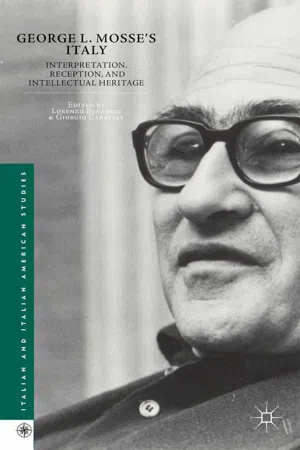
George L. Mosse's Italy
Interpretation, Reception, and Intellectual Heritage
- English
- ePUB (mobile friendly)
- Available on iOS & Android
eBook - ePub
George L. Mosse's Italy
Interpretation, Reception, and Intellectual Heritage
About this book
Twelve years have gone by since the passing of George L. Mosse, yet his work still provides essential tools for historical analysis and influences contemporary research. This volume provides a re-examination of his historiographical production and an analysis of his influence in the context of Italian history.
Information
1
Introduction
Lorenzo Benadusi and Giorgio Caravale
Rome–Madison, Round Trip, August 2007
Madison is a small city in Wisconsin, in the heart of the American Midwest, halfway between Chicago and Minneapolis. Life there in the summertime moves at a tranquil pace; with the departure of the regular students from the university area, the remaining inhabitants circulate by bicycle along the tree-lined streets, stroll leisurely on trails that crisscross the many parks, or find relief from the heat at one of the city’s lakes. It was not, however, the holiday atmosphere of the campus or the desire to get away from Italy’s enervating heat that brought the editors of this volume—two young scholars, one of us interested in contemporary and the other in modern history—to Wisconsin’s capital. Nor was it the hope of turning up some unpublished document or sensational historical event. After all, we were not protagonists of a Fred Vargas novel, nor did we possess the charm and investigative prowess of the historian detectives made famous in French mysteries. The true reason for our presence in Madison was quite another: George L. Mosse, historian, German by birth, a Jew and a homosexual, who fled from the Third Reich and eventually ended up in the Department of History of the University of Wisconsin–Madison. There he dedicated himself to the study of twentieth-century political and cultural movements. For us, the idea of pursuing Mosse’s historical legacy took serious form in this city where he spent the most prolific part of his career, and it is there that we found ourselves, somewhat by chance, collaborating in an intense month of study and research in the University’s Memorial Library.
Lorenzo Benadusi, trained in contemporary history, a student of Fascism and sexuality, had encountered Mosse’s books on university shelves and been fascinated by his ability to bring the past to life, to penetrate the minds of his protagonists with images capable of embracing art and culture, myths and rituals, ways of thinking and acting, hopes and fears. It is not an exaggeration to say that Mosse was the writer who made Benadusi think of history not only as an obligatory subject for study but as a passion and lifelong interest. In Memorial Library, further, research in the Fry Collection on the image of the soldier during Fascism repeatedly brought reminders of Mosse’s work.1
The other editor of this volume, Giorgio Caravale, trained as a modernist, had already come across early in his university years the captivating portrait of sixteenth-century Europe written collaboratively by Mosse and Helmut G. Koenigsberger. Caravale had pursued his studies on sixteenth-century religious and cultural history through the prism of the work of Delio Cantimori, student of the modern era, a fascist and later Marxist intellectual, himself a protagonist of Italian twentieth-century culture and author of a seminal volume, Eretici italiani del Cinquecento. Caravale began by working in the Department of Special Collections of Memorial Library on the trail of one of those heretics who had figured prominently in Cantimori’s great work.2 Through the Eretici he had come to admire also the incisive pages dedicated by Mosse to the irrational aspects of Nazi ideology, so close, in many respects, to the chronicles about German life in the thirties published by Cantimori in the principal journals of the time. Caravale, accustomed to foraging in dusty sixteenth-century archives, when placed in direct contact with Mosse’s personal papers (which are preserved in the original at the Leo Baeck Institute in New York, but with complete copies in Madison) could not resist the temptation to begin reading the rich correspondence, especially the part conducted with Mosse’s principal Italian colleagues. The first fruit of this archival research is Chapter 5 in this volume, titled “‘A Mutual Admiration Society’: The Intellectual Friendships at the Origins of George Mosse’s Connection to Italy.”
These brief remarks, otherwise lacking in academic interest, about the present volume’s editors point to a measure of the broad cultural horizons within which Mosse’s immense production occurs—the far-reaching interest exerted by his work on two students whose formation and interests differed so markedly even between themselves. Mosse has been one of the most widely read and best known historians in the world, and Italy probably has been the country that most profoundly expressed to him its appreciation. For testimony of the esteem in which his work is held, we can point to the honorary degree bestowed on Mosse by the University of Camerino in 1995, as well as the prizes he received: “Aqui Storia” (1975) and “Prezzolini” (1989). The German American scholar’s success, as Chapter 7 by Vittorio Vidotto in this volume makes clear, is shared by the academic community with a vast public of lay readers. Mosse’s writings have sparked a lively debate that has continued even after his death, the moment when the importance of his historiographical production was recognized virtually by everyone, as Donatello Aramini relates in Chapter 6.
What purpose does reflection on the person of George Mosse have today? The dedication of a volume to his work and to his historiographical inheritance does not signify only that Mosse was a great figure in twentieth-century studies: His personality and his books seem to us today, even more than yesterday, strikingly current and rich in fruitful and lasting teachings, especially for new generations of historians. With the passing of the years, it became ever more clear that one of the principal novelties in Mosse’s work is his introduction of cultural history into the sphere of contemporary history, without relinquishing a strong historicist stamp.3 He was able to avoid the trap of that “culturalist” drift that tended to see Fascism only as a rhetorical or aesthetic creation or something imagined in fantasy.4 In fact, Mosse came to cultural study through what Karel Plessini defines as an “anthropological and visual turning-point”—in other words, a sort of “retrospective cultural anthropology” that pays due attention also to myths and ideologies expressed through images and representations.5 His approach, thus, is tied neither to that current of historical study permeated by poststructuralism intent on deconstructing language and meanings, which is so often prone to excessive interpretation and anachronisms,6 nor even to that trend that views history from below or to microhistory, which sometimes risks vanishing into impressionism.7 The culturalist approach permitted Mosse to look beyond theoretical formulations and accommodate the contributions of popular culture and the study of mentalities and manners. This enhanced the interdisciplinary quality of his research and enabled him to contemplate from different viewpoints such familiar and thoroughly debated questions as anti-Semitism (discussed by Simon Levis Sullam in Chapter 4 in this volume) but especially to investigate the irrational components of history. It could be said that Mosse examines the irrational adopting a methodology used by Ernesto De Martino for the magical world,8 seeking out new investigative tools so as not to annihilate it a priori as being outside culture (come incultura) or merely a collective fad. The transition from “lazy” to “heroic” historicism is expressed precisely in the attempt to not undervalue the irrational but to try to capture it “through a rational exercise of the mind.”9 Instead of approaching that dimension from without, conditioned by our interpretative categories, it is observed from within, through the eyes of its protagonists, so as to be able to decipher its dynamics and describe its characteristics. This does not mean that value judgments should be eliminated but that they should be made while subjecting one’s own rationalist prejudices to a close critique, opening oneself to the other viewpoint and penetrating and studying the past through the eyes of the ethnographer observing primitive tribes and cultures.
To his credit, Mosse linked the effort to interpret meanings, representations, and mentalities to the rigorous reconstruction of the periods being studied and to the ability to provide a general portrait of an era. He was a precursor, because at a time when social history dominated, he succeeded in demonstrating persuasively culture’s strong impact on politics, thereby expanding historical investigation to heretofore unexplored fields, such as race and sexuality (see Chapter 3). As Renato Moro demonstrates in Chapter 8, it is precisely the differing reception of the “cultural turn” in different national contexts that has determined the generally favorable reception of Mosse’s work. In the case of Italy, the culturalist turn has been viewed with lively interest but without being thoroughly or systematically assimilated. Probably for this reason his writings have enjoyed great success but remain without the influence capable of orienting historical research. They have been read more than utilized, received more than revisited.
Observing Italy as an outsider permitted Mosse to analyze the general characteristics of Fascism without linking them to the historiographical debate concerning specific aspects of national identity. The perception of Italian history as an uninterrupted sequence of missed occasions, of failed revolutions, and of unfulfilled expectations has led to the view of Fascism as emblematic of Italian anomaly, the culminating moment of haphazard progress, the negative effects of which survived long past the regime itself. The antithesis between Fascism as revelation and as revolution, which had divided Italian historians, is confronted by Mosse, instead, without any ideological conditioning, without any pretense to establish a priori the “correct” outcome of a historical process. Mosse’s interest focuses on the cultural origins of Nazism and Fascism, on the background that favored their development. But for him these aspects were not the key to a general understanding of a country’s history. The roots of the two despotic systems lay in the vast terrain of Western European culture and society, and depending on the different contexts, it assumed specific traits. Building on some of Croce’s insights,10 Mosse insists that the transformation of European public spirit after 1870 was the moment of incubation for irrationalism and that extreme nationalism out of which grew the totalitarian regimes. This permitted Mosse to avoid considering Fascism the autobiography of the nation and identifying its history through the memory of anti-Fascism.
Mosse in this way has been able to circumvent both the Marxist thesis that considers Fascism a reactionary regime, the agent of bourgeois interests, as well as the liberal position that views it as an authoritarian movement, in a position to interrupt the democratic development of the country by its manipulation of the masses. Both these interpretations have in common the notion of an arbitrary authority that holds power through force or indoctrination, while for Mosse the most significant aspect of Fascism is the heartfelt participation of millions of people. Mosse’s research sets out from the question, “How is it possible that so many intelligent men and women reached the point of destroying individual freedom?” In other words, how do we explain the attraction of the persecutor?11 Criticizing the idea of Fascism as historical negativity does not require ignoring the antiliberal and brutal elements; on the contrary, it serves to explain how these very elements succeeded in helping to achieve consensus and emotional involvement. Emilio Gentile, in his interview with us in Chapter 9 in this volume, reconstructs the climate in which Mosse’s theory, and contemporaneously De Felice’s, found acceptance. However, Gentile also indicates how the path opened by their work also made it possible to go beyond it, thereby moving historiography beyond the problem of consensus from which the two great students of Fascism had begun.
To assess Mosse’s contributions more than a decade after his death entails also reflecting on the role of the historian and on the scope of his research. Mosse compels us, in fact, to interrogate ourselves anew on the public uses of history, to reevaluate the importance of looking to the past for answers to current problems, each time reworking the fundamentals according to one’s own disposition and convictions. Thanks to his autobiography, Mosse has provided us with the key to understanding the manner in which the experiences of his own life decisively influenced his scholarly work. “The cultural approach introduced by Mosse in the historiography of Fascism,” writes Gentile, “was the consequence of an existential exigency.”12 In fact, it can be said that Mosse succeeded in establishing a direction to his studies in the very moment he understood the extent to which the story of his life could favor and not impair historical reconstruction. The critique of the supposed objectivity of traditional historiography led him in fact to abandon his study of the modern period and to observe from within the twentieth-century nationalist and fascist movements (Caravale reflects in Chapter 2 on Mosse’s transition from modern to contemporary history). The subjective point of view is thus overturned by an important element leading to impartiality. Once again, Croce’s teachings are indispensable to arrive at this important historiographical juncture, which Mosse himself describes:
Mine is surely a personal concept of recent history seemingly far removed from Leopold von Ranke’s precepts, though he himself was no impartial observer who merely wanted to reconstruct the past as it had in fact existed, but a devout supporter of Prussian conservatism. Like all of my generation, I was taught his canon of writing history: to abstract myself as much as possible from my historical writing. It took me many years to realize writing about historical problems which have affected one’s own life was no barrier which stood in the way of understanding historical reality; indeed, I was helped to this realization by a colleague at the University of Iowa who once observed that I was so interesting while my books were so dull.13
From this came another of Mosse’s convictions: that the historian’s involvement in the subject under investigation transforms history into “current politics.” He has, in fact, imbued his work with important ethicopolitical valency without directly assuming a public role by regarding teaching as a fundamental tool for influencing the civic sphere. For Mosse, research and teaching are inseparable elements: only by transmitting what one knows is it possible to carry out a pedagogical mission capable of developing a critical spirit in the younger generations—the faculty to deconstruct myths and to attain a multidimensional vision of reality.14 Mosse’s gift for addressing a vast audience of students, for involving them enthusiastically and passionately in his lectures, together with the generous hearing he gave to their concerns and his willingness to engage with them, made him a widely admired figure, with a large following among students and co...
Table of contents
- Title Page
- Copyright Page
- Contents
- Acknowledgments
- 1. Introduction
- 2. A Forgotten Story: Studies on the Early Modern Age
- 3. A Fully Furnished House: The History of Masculinity
- 4. “The Outsider as Insider”: George Mosse, German Jews, Italian Jews
- 5. “A Mutual Admiration Society”: The Intellectual Friendships at the Origins of George Mosse’s Connection to Italy
- 6. Mosse after Mosse: An Ambivalent Legacy
- 7. George Mosse and His Italian Publishers
- 8. Mosse, the Cultural Turn, and the Cruces of Modern Historiography
- 9. A Lasting Intellectual Friendship: An Interview with Emilio Gentile
- Bibliography
Trusted by 375,005 students
Access to over 1.5 million titles for a fair monthly price.
Study more efficiently using our study tools.
Frequently asked questions
Yes, you can cancel anytime from the Subscription tab in your account settings on the Perlego website. Your subscription will stay active until the end of your current billing period. Learn how to cancel your subscription
No, books cannot be downloaded as external files, such as PDFs, for use outside of Perlego. However, you can download books within the Perlego app for offline reading on mobile or tablet. Learn how to download books offline
Perlego offers two plans: Essential and Complete
- Essential is ideal for learners and professionals who enjoy exploring a wide range of subjects. Access the Essential Library with 800,000+ trusted titles and best-sellers across business, personal growth, and the humanities. Includes unlimited reading time and Standard Read Aloud voice.
- Complete: Perfect for advanced learners and researchers needing full, unrestricted access. Unlock 1.5M+ books across hundreds of subjects, including academic and specialized titles. The Complete Plan also includes advanced features like Premium Read Aloud and Research Assistant.
We are an online textbook subscription service, where you can get access to an entire online library for less than the price of a single book per month. With over 1.5 million books across 990+ topics, we’ve got you covered! Learn about our mission
Look out for the read-aloud symbol on your next book to see if you can listen to it. The read-aloud tool reads text aloud for you, highlighting the text as it is being read. You can pause it, speed it up and slow it down. Learn more about Read Aloud
Yes! You can use the Perlego app on both iOS and Android devices to read anytime, anywhere — even offline. Perfect for commutes or when you’re on the go.
Please note we cannot support devices running on iOS 13 and Android 7 or earlier. Learn more about using the app
Please note we cannot support devices running on iOS 13 and Android 7 or earlier. Learn more about using the app
Yes, you can access George L. Mosse's Italy by L. Benadusi, G. Caravale, L. Benadusi,G. Caravale in PDF and/or ePUB format, as well as other popular books in History & European History. We have over 1.5 million books available in our catalogue for you to explore.