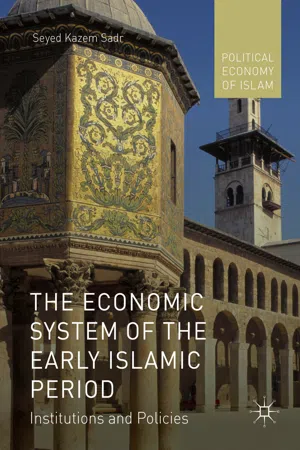
This book provides an economic analysis of the earliest Islamic society, focusing on the policies of the Messenger of Islam (Sawa) and his successors during the first four formative decades of Islam. Two institutions of great importance – the market and the public treasury (Baitul Mal) – and their roles in the development of the private and public sectors are particularly emphasized in this study. The first part of the book is devoted to the economic and cultural dimensions of life in the Arabian Peninsula during the pre-Islamic period, including an analysis of trade and financial relationships with the Roman and Persian economies; the challenges faced by the Messenger's mission and the economic policies of the Messenger after the migration to Madinah are also examined in detail. The author then moves on to a devoted analysis of the nature and functions of the public treasury, its revenues and expenditures, as well as financial and fiscal policies. Also examined is the role of the public sector in maintaining equilibrium in the financial and real sectors, as well as in promoting economic growth and employment. Analysis of the institution of the market, its characteristics, and its functions during the earliest Islamic period constitutes the third section of the book. The behaviors of consumers, producers, and investors in an economy without an interest rate mechanism are also addressed here. The final section investigates the fundamental objective of Islam for human societies – that is, justice – within the context of discussions in earlier parts of the book. The author uses historical economic data, facts, and evidences that are reported from the period, both prior to and after the establishment of the Islamic State, to explore the economic relations, policies, and models that were in practice and applied at that time.
eBook - ePub
The Economic System of the Early Islamic Period
Institutions and Policies
- English
- ePUB (mobile friendly)
- Available on iOS & Android
eBook - ePub
About this book
Information
Arabian Peninsula in the Eve of the Introduction of Islam
© The Editor(s) (if applicable) and The Author(s) 2016
Seyed Kazem SadrThe Economic System of the Early Islamic PeriodPolitical Economy of Islam10.1057/978-1-137-50733-4_11. The Economic and Cultural Situation of the Arabian Peninsula prior to Islam
Seyed Kazem Sadr1
(1)
INCEIF—The Global University of Islami, Kuala Lumpur, Malaysia
1 Economic Geography
The Arabian Peninsula, which was known as the Jazirat-ul Arab prior to the emergence of Islam, was located in the middle of three major continents; Asia, Europe and Africa. From the north, it had borders with Sham (Old Syria) and Iraq. It also had borders with the states under the influence of the emperors of Persia and Rome. The peninsula was connected to Asia and Europe through these states. The Red Sea, or “Bahr ul-Qulzum”, is located between this land and the African continent and countries such as Egypt and Habasha (Ethiopia), which were under the influence of the Romans. Through this waterway, the connection with this continent was established. Regions like Yemen, Adan and Oman were all located to the south of the peninsula and all had access to the Gulf of Aden, the Sea of Oman and the Indian Ocean. The navigable waterway to India was a route via Oman. In addition to the northern roads to Iraq and Sham, the Peninsula had sea routes with Asia via India. The geographic situation of Arabia, which is located between the three continents of Asia, Europe, and Africa, provided it with a special advantage, because the trade between Persia and Rome and their subordinate governments—that is, Sham (Greater Syria), Ethiopia and Yemen—took place through Hijaz before the rise of Islam (Fayyaz 1335/1956, 10–12). In addition, a section of the trade route between Rome and India passed through the south and east of Arabia for centuries, and was called the Southern Trade Route. The merchant caravans took advantage of the seasonal bazaars; these were set up in Yemen, Hijaz and Sham, especially in Sana (Capital of Yemen), Yathrib and Makkah, and were able to trade commodities. Also, another trade route passed through the north of Arabia. This route became an important trade route, when the Southern Trade Route lost its importance. Since that time, the commodities sent from India were shipped to Oman and, from there, were carried on land through the north of Arabia and Sham to Rome. Along this route, seasonal bazaars were set up and states in the area depended on these trading activities. Their capitals were centers of commerce for the merchant caravans that were traveling this route. The capitals of the states of Aal-Lakhm, Aal-Kindah and Aal-Ghassan (i.e., Hirah, DoumatulJandal and Bosra, respectively) were located along the Northern Trade Route. Other than the Southern and Northern Trade Routes, there was a third route between Sham and Yemen which was developed when Hashim, the elder grandfather of the Prophet of Islam, took over the leadership of the Quraysh tribe. Trade through this route was the result of the efforts of Hashim who obtained agreements and permissions from the kings of Rome, Persia, Ethiopia and Yemen for Quraysh. Subsequently, trade through this route developed and Quraysh gained a great deal of wealth. Makkah once again found its importance as a trading -center because the House of Ka’ba was located there and the Arab tribes came once a year for pilgrimage at Ka’ba. Before the Pilgrimage ceremonies, the tribes had an opportunity to trade. Being a sanctuary, the House of Ka’ba created the necessary security for trade. War and bloodshed were forbidden during four months of every year, and the concurrence of the ceremonies during the same period ensured the safe movement of merchant caravans to Makkah and their return to their destinations. The treaty of Hilful-Fodzul was made between the Arab tribes and increased the trade security in Makkah more than ever. This treaty will be discussed in Chap. 2. For these reasons, trade was the most significant activity in the economy of Arabia.
Apart from this, the Peninsula was relatively deprived of other natural attributes. The only humid region of the Peninsula, where it was possible to have some agricultural activity, comprised the southern parts of the Peninsula, which were exposed to the westbound humid winds of the Indian Ocean. For this reason, cultivation, horticulture and animal husbandry had been established since the early years. With the sea as its border, the fishing industry was established, and trade relations with India allowed the re-export of commodities to Rome. This was a third opportunity that created the economic boom in the south of the Arabian Peninsula. In this regard, the Peninsula has always had larger settlements and been urbanized; it has also seen the emergence of powerful nations and governments. To mention some of these states, we would refer to the Hemyaris, who ruled for several centuries in the south, and had confrontations and were in contest with the Persian and Roman rulers. However, there are two great phenomena in the history of south that caused the downfall of its dignity and glory. The first phenomenon was the great advances Romans achieved in developing vessels that could travel and pass through the strait of “Bab-ul-Mandab” and carry the Indian merchandise straight to Egypt, Palestine and Sham (Fayyaz 1335/1956, 11–12). This phenomenon caused the Southern Trade Route, along which the trade caravans used to go from the south to the west of the Peninsula, passing from the Hijaz region towards Sham, Palestine and Egypt, to become redundant. Consequently, people migrated from the south to the north. The second phenomenon, which occurred later on and was almost concurrent with the year of the birth of the Prophet Mohammad (SAAS), (569 or 570 AD), was the fall into disrepair of the Ma’rib Dam between 542 and 570 (Fayyaz 1335/1956, 26). This dam, which was very old and had been repaired several times, finally, due to a huge flood known as Al-Eram, which is also cited in the Qur’an (Saba, 34/16; Ibn and Muhammad ibn Ali 1352/1973, 6), was destroyed by a huge flood. The total destruction of this dam wiped out vast regions of Yemen and, consequently, people migrated to other places.
Unlike the south, the central regions of the Peninsula had a dry climate with little rain. It is probably that some regions had only a few rainy days in the course of a year. Very high temperatures and a lack of humidity turned the center of the Peninsula into a land of desert and sand, a practically non-habitable area. Only in some regions, for only a very short period each year, was the land green, at which time it was possible to engage in animal husbandry and the grazing of cattle. In a few other places, like Yathrib, Taef and Khaybar, there was a higher level of rainfall; thus, it was possible to maintain gardens and cultivate crops. Ultimately, the living conditions in the Peninsula were very harsh. Prior to Islam, the prevailing clans in this region used to move from one oasis to another until they could find suitable pasture for their cattle. This climatic condition, naturally, did not render the region suitable for settling and cultural interchange; hence, the formation and constitution of ideologies in the central parts of the Peninsula. Therefore, no state or government was formed in center of the Peninsula, and, from among the various clans of the pre-Islam era, only the Quraysh tribe in Makkah and the Thaqif tribe in Taef were settled; the remaining tribes were engaged in endless migration.
This way of life automatically led to the advent of superstition, isolationism and a struggle for individual and clan supremacy. Nevertheless, the hardship of life led to crimes such as robbery, looting from the other tribes, murder or taking revenge. In this way, murder and plundering were very common among these tribes. Accordingly, some of these tribes used to come to agreements with the commercial caravans to afford them security from other tribes, defending them against raids, and finally gaining revenue for providing these services. Similarly, because the land was arid and finding suitable places in which to camp was difficult, they used to provide guidance and also rented their pack animals (four-footed animals) to earn some income for their services.
On the verge of the emergence of Islam, there were three puppet governments ruling in the north of the Peninsula. These governments were no comparison with the governments of Hemyaris or the Persian and Roman Empire. But, compared with the central nomadic tribes, they had considerable power and dignity.
To north east of the Peninsula, the government of Aal-Lakhm prevailed from their capital, which was located in the city of Hirah. Lakhmies used to abide by Persian rule and, whenever there was a clash between Iran and Rome, they used to side with and fight for the Persians. During times of peace, they would strengthen and expand their positions (Fayyaz 1335/1956, 35–36). The main source of their income was commerce and their capital was located on the trade route towards the north. As the route to the south lost its importance and ceased to flourish, the Northern trade route was improved from Oman, where they basically used it for transshipment of the Indian imported merchandise. However, this time, movement of the caravans was from the north of the Peninsula by passing from Hirah, Dummat-ul- Jandal, Bosra and other places, heading for Qazza, Tyre (Sur) and Iyleh; that is, all the places connected to Rome, Egypt and Palestine (Fayyaz 1335/1956, 11). In the northwest was the government of Aal-Ghassan, which followed the Roman government and provided identical services to those of Aal-Lakhm to the Romans. Bosra was the capital of this state and it was located on the Northern Trade Route. Its inhabitants made their livings through trade and commerce. The third government was that of Aal-Kendeh. The capital was located in Dummat-ul-Jandal along the Northern Trade Route. Naturally, their source of income was also to be found in trade and commercial activities. Aal-Kendeh was under the influence of the governments located in the south.
Although the humidity and rainfall were more favorable in the north than those in the center of the Peninsula and even though the climate was better and there were some agricultural activities in the north, their main source of income was by way of trade. The principal reason for the extensive commercial activities in the Peninsula was due to its excellent geographical position and its comparative advantages in this field. The agricultural capacity of the Peninsula was by no way comparable with Persia and Rome, and, due to climatic conditions, it had major drawbacks. Because of the continual differences and conflicts between Iran and Rome, the Indian m...
Table of contents
- Cover
- Frontmatter
- 1. Arabian Peninsula in the Eve of the Introduction of Islam
- 2. Public Treasury and Public Finance
- 3. Market and the Private Sector
- 4. Justice
- Backmatter
Trusted by 375,005 students
Access to over 1.5 million titles for a fair monthly price.
Study more efficiently using our study tools.
Frequently asked questions
Yes, you can cancel anytime from the Subscription tab in your account settings on the Perlego website. Your subscription will stay active until the end of your current billing period. Learn how to cancel your subscription
No, books cannot be downloaded as external files, such as PDFs, for use outside of Perlego. However, you can download books within the Perlego app for offline reading on mobile or tablet. Learn how to download books offline
Perlego offers two plans: Essential and Complete
- Essential is ideal for learners and professionals who enjoy exploring a wide range of subjects. Access the Essential Library with 800,000+ trusted titles and best-sellers across business, personal growth, and the humanities. Includes unlimited reading time and Standard Read Aloud voice.
- Complete: Perfect for advanced learners and researchers needing full, unrestricted access. Unlock 1.5M+ books across hundreds of subjects, including academic and specialized titles. The Complete Plan also includes advanced features like Premium Read Aloud and Research Assistant.
We are an online textbook subscription service, where you can get access to an entire online library for less than the price of a single book per month. With over 1.5 million books across 990+ topics, we’ve got you covered! Learn about our mission
Look out for the read-aloud symbol on your next book to see if you can listen to it. The read-aloud tool reads text aloud for you, highlighting the text as it is being read. You can pause it, speed it up and slow it down. Learn more about Read Aloud
Yes! You can use the Perlego app on both iOS and Android devices to read anytime, anywhere — even offline. Perfect for commutes or when you’re on the go.
Please note we cannot support devices running on iOS 13 and Android 7 or earlier. Learn more about using the app
Please note we cannot support devices running on iOS 13 and Android 7 or earlier. Learn more about using the app
Yes, you can access The Economic System of the Early Islamic Period by Seyed Kazem Sadr in PDF and/or ePUB format, as well as other popular books in Economics & Economic History. We have over 1.5 million books available in our catalogue for you to explore.