eBook - ePub
US Foreign Policy and the Modernization of Iran
Kennedy, Johnson, Nixon and the Shah
- English
- ePUB (mobile friendly)
- Available on iOS & Android
eBook - ePub
About this book
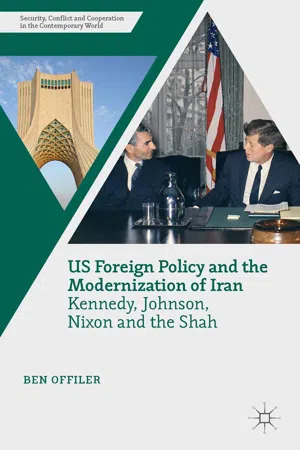
US Foreign Policy and the Modernization of Iran examines the evolution of US-Iranian relations during the presidencies of John F. Kennedy, Lyndon B. Johnson, and Richard M. Nixon. It demonstrates how successive administrations struggled to exert influence over the Shah of Iran's regime domestic and foreign policy.
Information
1
Modernization Theory and the United States Meets Iran
In the autumn of 1931, aged just 15 years, a precociously talented student named Walt Whitman Rostow enrolled at the venerable Yale University. The son of Russian Jewish immigrant intellectuals, Rostow was named after the revered American poet Walt Whitman. While he would go on to complete his PhD at Yale, as well as spend a year at Oxford University’s Balliol College as a Rhodes Scholar, Rostow later claimed that it was during his undergraduate days that he decided to write a “non-communist manifesto” to compete with that of Karl Marx’s socialist Das Kapital.1 The young economist firmly rejected Marx’s version of history and turned his attention to formulating an explanatory model of the economic development of society to counter the appeal of Leninist communism.
After writing a number of articles and a co-authored book with another eminent economist, Max Millikan, on the subject of economic and social development, Rostow finally published his magnum opus in 1960.2 The Stages of Economic Growth: A Non-Communist Manifesto provided readers with a simple, easy-to-understand explanation of economic development that, in theory, would be applicable to all societies. Central to Rostow’s thesis was his assertion that “[i]t is possible to identify all societies, in their economic dimensions, as lying within one of five categories: the traditional society, the preconditions for take-off, the take-off, the drive to maturity, and the age of high-mass consumption.”3 It was Rostow’s belief that the United States embodied the final stage, the age of high-mass consumption, itself a rebuttal to Lenin’s pejorative description of imperialism as the highest stage of capitalism. Once a society’s position on this linear and universalist scale was identified, its development could be accelerated through the use of economic aid and technical assistance.
In some respects, Rostow’s thesis represented the pinnacle of the emerging school of modernization theory that had come to dominate social science departments in American universities during the 1950s. Rostow was by no means the only academic to put forward a theory of modernization in this period, nor perhaps was it even the most scholarly rigorous. Indeed, there is a danger that Rostow’s “elevation to the symbolic head of the [modernization theory] movement” has led to the widespread misconception that modernization theory focused solely on economic development.4 Even so, as Nils Gilman acknowledges, because Rostow’s work was easily digested by policymakers and the public, he had a prominent role in advocating its use in US foreign policy.5 As the Cold War moved increasingly away from the traditional Western European centres of power to Asia, Latin America, and the Middle East during the 1950s, modernization theory appeared to offer both explanations of, and solutions to, the problems that faced the United States in the developing world.
Rostow has since become synonymous with modernization theory in a way that few of his contemporaries managed. This is in no small part due to his role as a leading proponent of modernization in the Kennedy and Johnson administrations, in spite – or perhaps because – of the murky reputation both he and modernization acquired during the Vietnam War.6 JFK in particular embraced the theory of modernization espoused by Rostow, employing him as a foreign policy advisor first during his presidential campaign and then later in key positions within his administration. It is little wonder, then, that the Kennedy years are typically seen as representing the high-water mark of modernization in US foreign policy.7 However, as this book will demonstrate, the prevailing periodization of modernization as a primarily Cold War concept that reached its height during the Kennedy administration is misleading for three reasons.
Firstly, as historians are increasingly acknowledging, issues of development have had a long history in America’s relations with the wider world.8 Secondly, in the case of US–Iranian relations, development had played an important role for much of the 20th century in various ways, from the early work of Christian missionaries to the operations of philanthropic NGOs in the 1950s. Finally, the story of modernization in US–Iranian relations does not unfold in the ways that one might expect during the Kennedy and Johnson years, despite the prominence traditional accounts of the era have given it. Rather than being the driving force of Washington’s policies towards Tehran, modernization is frequently sidelined in the 1960s as US officials pursued national security interests and sought to maintain a close relationship with the Shah of Iran.
Modernization Theory and Its Origins
Conventional accounts of the Eisenhower administration have emphasized its concern with Washington’s credibility in the bipolar conflict and its geostrategic pragmatism regarding developing countries. Such accounts tend to downplay the role that development had in Eisenhower’s approach to the Third World, which more recent scholarship has begun to highlight.9 While John F. Kennedy would later call upon the United States to produce a “decade of development” in the 1960s, the origins of his developmental rhetoric can be found in the 1950s. Michael Adamson has shown that although the Eisenhower administration was “ambivalent about foreign aid as an engine of development” it was willing to utilize aid as a short-term, emergency measure to bolster economies in order to “address an immediate security threat.”10 Elsewhere, historians have identified in Eisenhower’s policies towards Latin America the genesis of the Alliance for Progress, the centrepiece of the Kennedy administration’s development ideals.11
Eisenhower’s years in office coincided with the rise of numerous theories of modernization that sought to understand the problems facing development in the Third World. Modernization theory in the United States as understood by the Kennedy and Johnson administrations was born in the post-war social science departments of a number of leading American universities. Although there were various forms of modernization theory, Nick Cullather points out that one can see “at the core…an assumption of convergence, that there is one best form of political economy and that all states are moving toward it.”12 Nils Gilman has suggested that the nascent forms of modernization theory developed at east coast academic institutions were designed to help the United States better understand “the monumental problems that Third World countries faced,” which required “an equally enormous theoretical apparatus.”13 Although the schools of thought to which Rostow and other Kennedy policymakers belonged sprang up in the 1950s, historians such as David Ekbladh and Michael Adas have traced the long history of American modernization back to at least the beginning of the 20th century.
Ekbladh has noted “the rise of an American style of development” between the two world wars, which sought to resolve the economic crises of the Great Depression era and then later to act as a bulwark against expanding totalitarianism in Europe.14 Although “the concept of development has no clear beginning in the U.S. case,” according to Ekbladh, the 1930s saw “a vital new formulation [of development] crystallized. This shift was critical in reshaping thinking, policy, and action on development in ways that continue to resonate in the present.”15 In turn, Adas has noted the civilizing impulses that propelled early forms of thinking and action on development, particularly during the 19th and early 20th centuries, which most notably found expression in the American occupation of the Philippines.16 This gave way to a reverence for the use of science and technology as means of accelerating development.17 The expansive work in the pre-Cold War era of development policy activists such as David Lilienthal, whose enormous hydro-electric and agricultural Tennessee Valley Authority rapidly modernized great swathes of the American South, provided templates and inspiration for the scholars and policymakers who took up the mantle of modernization in the 1950s and 1960s.18
For many Iranians, their first experience of Americans was largely through the work of Christian missionaries, whose work, in addition to their religious evangelizing, involved small-scale local development projects. As Kamyar Ghaneabassiri notes, “These missionaries…labored in Persia to improve the educational, medical, and social conditions of the country, and so earned the affection and admiration of Persians for Americans and, in turn, for the United States.”19 Their immediate goals of converting and educating the Iranian people acted alongside the intention to facilitate the creation of a “Christian, scientific, vigorous, cooperative, and democratic” nation.20 Alongside this missionary intervention, two prominent American financial experts, Morgan Shuster and Arthur C. Millspaugh, were given extensive powers by Tehran to help modernize Iran’s financial system, especially its taxes and foreign investment. Although the efforts of Shuster and Millspaugh proved less than successful, their experiences illustrated the long history of American involvement in Iranian development.21
By the 1920s, American oil companies also began to explore opportunities in Iran. Although the British dominated Iran’s oil market through the Anglo–Iranian Oil Company (AIOC), American companies engaged with Iranian development and politics in complex – and at times problematic – ways.22 Indeed, the reign of Reza Shah in the inter-war years was marked by his determined efforts to enact a number of development programmes in order to modernize and Westernize Iran.23 Like his son, Mohammad Reza Pahlavi born in 1919, Reza Shah’s concept of modernization rested upon the support of the Iranian military.24 Historian Ali Ansari has observed that Reza Shah “became king on the twin pillars of tradition and nationalism while at the same time purporting to be a force for modernization.”25 Reza Shah pushed Iran down the road of development whilst constructing a form of nationalism designed to create loyalty to the Pahlavi dynasty.
During the 1950s, American social scientists increasingly turned their attention to this question of how societies develop. Scholars researching development issues began to view modernization theory in grandiose terms, positing it as the most viable paradigm for understanding the development of all world societies. As one political scientist put it, modernization theory “augured the secular deliverance not just of the discipline but of mankind itself.”26 Much of the work needed to turn modernization theory from a scholarly pursuit into a “foreign policy doctrine” applicable to the problems facing the United States in the Cold War was done at the Centre for International Studies (CIS) at the Massachusetts Institute for Technology (MIT). Like the Harvard Department of Social Relations (DSR), the CIS was an invaluable breeding ground for modernization theorists intent on applying their research to the practicalities of US foreign policy. A number of highly respected social science scholars, including Paul Rosenstein-Rodan, Lucian Pye, and Daniel Lerner, worked together to form the intellectual backbone of the CIS.27 Worried by the apparent appeal in the early Cold War of Soviet-style development methodologies, namely communist ideology achieved through centralized planning, Washington hoped institutions such as the CIS would provide viable alternatives that could be used to compete with the Soviet Union in the development field.28
Although modernization theory did not receive the widespread acceptance in the Eisenhower administration that it later did among Kennedy’s officials, elements of modernization were to be found in US foreign policy during the 1950s. In Iran’s case, private institutions intersected with Washington’s focus on Cold War security to spearhead American efforts at economic development.29 Development pioneer David Lilienthal attempted to apply his experience implementing America’s foremost beacon of development, the TVA, to the Khuzestan region of Iran by working alongside the Shah’s Plan Organization.30 Lilienthal strived to inject a dose of morality into the development discourse, seeing Iran as a case study that would help “preserve the New Deal’s idealism and fasten it to US development aid.”31 In the end, the project was subverted by the Shah, who sought to assert Iranian control over Iranian development. Indeed, Lilienthal’s failure to overcome the Shah’s resistance to an American vision of modernity would be echoed during the Kennedy years when Washington sought to pressure Tehran towards reform. Even so, Lilienthal’s efforts were a bridge between th...
Table of contents
- Cover
- Title
- Copyright
- Dedication
- Contents
- Acknowledgements
- Introduction
- 1. Modernization Theory and the United States Meets Iran
- 2. The Kennedy Administration, Internal Disputes, and Modernization
- 3. JFK, the ‘Massage Problem,’ Modernization, and Missed Opportunities
- 4. Lyndon Johnson, the Shah, and Iranian Opposition
- 5. “Papa Knows Best”: Resisting American Influence
- 6. British Withdrawal, the End of AID, and the Six Day War
- 7. Richard Nixon, the Shah, and Continuity
- Conclusion
- Notes
- Bibliography
- Index
Trusted by 375,005 students
Access to over 1.5 million titles for a fair monthly price.
Study more efficiently using our study tools.
Frequently asked questions
Yes, you can cancel anytime from the Subscription tab in your account settings on the Perlego website. Your subscription will stay active until the end of your current billing period. Learn how to cancel your subscription
No, books cannot be downloaded as external files, such as PDFs, for use outside of Perlego. However, you can download books within the Perlego app for offline reading on mobile or tablet. Learn how to download books offline
Perlego offers two plans: Essential and Complete
- Essential is ideal for learners and professionals who enjoy exploring a wide range of subjects. Access the Essential Library with 800,000+ trusted titles and best-sellers across business, personal growth, and the humanities. Includes unlimited reading time and Standard Read Aloud voice.
- Complete: Perfect for advanced learners and researchers needing full, unrestricted access. Unlock 1.5M+ books across hundreds of subjects, including academic and specialized titles. The Complete Plan also includes advanced features like Premium Read Aloud and Research Assistant.
We are an online textbook subscription service, where you can get access to an entire online library for less than the price of a single book per month. With over 1.5 million books across 990+ topics, we’ve got you covered! Learn about our mission
Look out for the read-aloud symbol on your next book to see if you can listen to it. The read-aloud tool reads text aloud for you, highlighting the text as it is being read. You can pause it, speed it up and slow it down. Learn more about Read Aloud
Yes! You can use the Perlego app on both iOS and Android devices to read anytime, anywhere — even offline. Perfect for commutes or when you’re on the go.
Please note we cannot support devices running on iOS 13 and Android 7 or earlier. Learn more about using the app
Please note we cannot support devices running on iOS 13 and Android 7 or earlier. Learn more about using the app
Yes, you can access US Foreign Policy and the Modernization of Iran by Ben Offiler in PDF and/or ePUB format, as well as other popular books in Politics & International Relations & Asian History. We have over 1.5 million books available in our catalogue for you to explore.