eBook - ePub
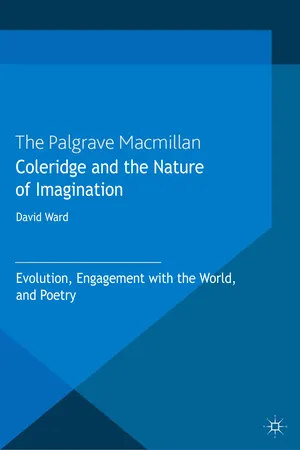
Coleridge and the Nature of Imagination
Evolution, Engagement with the World, and Poetry
- English
- ePUB (mobile friendly)
- Available on iOS & Android
eBook - ePub
About this book
Examining a range of Coleridge's writings, this book uses recent scientific research to understand how we have evolved to make mental representations of the counterfactual, how such transformative essays in Imagination have enabled humans to survive, to prosper and to express themselves in the sciences, the arts and particularly in poetry.
Information
1
Feeling, Reason, Thought and Language
Most of my readers will have observed a small water-insect on the surface of rivulets, which throws a cinque-spotted shadow fringed with prismatic colours on the sunny bottom of the brook.
(BL, 1, 124)1
(i) Head and heart
Coleridge was the most introspective of English writers. We have abundant evidence of his self-questioning in his notebooks, letters and philosophical writings. There is a myriad of links between his thought experiments and his poetry and therefore it is tempting to suggest that his poetry is dependent on his philosophical insights, rather than that his thought emerges from a poetic life in which he deliberately courted areas of experience where analytical thought gives way to obscure and unstructured motives, drawing upon the spontaneous recovery of what he calls ‘a gay & motley chaos of facts & forms, & thousand-fold experience, the origin of which lies beyond memory, traceless as life itself & finally passing into a part of our life more naked than would have been compatible with distinct consciousness’ (Logic, 8).
Hume’s remarkable insight is that: ‘We speak not strictly and philosophically when we talk of the combat of passion and of reason. Reason is, and ought only to be the slave of the passions, and can never pretend to any other office than to serve and obey them.’2 Coleridge perceived a more complex relationship between thought and feeling – arguing that there are vast areas or phases of experience in which thought and feeling cannot be separated from each other: ‘I feel strongly, and I think strongly; but I seldom feel without thinking, or think without feeling. ... My philosophical opinions are blended with, or deduced from, my feelings: & this, I think, peculiarizes my style of Writing’ (Letters, 1, 279); ‘A Poet’s Heart & Intellect should be combined, intimately combined & unified’ (Letters, 2, 459); ‘An endless activity of Thought, in all the possible associations of Thought with Thought, Thought with Feeling, or with words, or of Feelings with Feelings, & words with words’ (CN, 3, 3246).
But can we discuss ‘feelings’ – our own or Coleridge’s – without becoming subjective to the point of anarchy? There is a sense in which we cannot – the ‘feelings’ of others may only be deduced, so any discussion of them must take place in a fuzzy area confined by linguistic convention and metaphor.3 Those experiences which philosophers, psychologists and cognitive scientists call ‘qualia’ – the perceived colour of a sunset, the taste of a vintage wine, the scent of a rose – remain unknowable for anyone except the perceiver. Many psychologists and philosophers have argued that this is an insurmountable barrier to any materialist explanation of human consciousness.4 The thoroughgoing materialist could argue that all our experiences are fundamentally incommunicable. Empathy is, strictly speaking, not feeling with, or in, or together, it is being competent or at least plausible in the kind of guesses which humans make about the perceptions of others.5 That is not to reduce its value – empathy is a vital part of human interaction and consequently of human being.
The alternative to the materialist view is to propose that consciousness is an immaterial witness and agent within a material body and brain. This is a natural solution to the problem of consciousness that has evolved in the deep past of our species, a working model which seems to explain our roles within the world and which permits, urges, requires that consciousness, soul, spirit, exist within a metaphysical universe with gods, ghosts, ancestors, angels, daemons and the like. It is natural to believe in such things. As Lewis Wolpert argues, activities such as science are not in that way natural.
‘Nobody has the slightest idea how anything material could be conscious. Nobody even knows what it would be like to have the slightest idea about how anything material could be conscious.’6 Fodor’s remark is unanswerable and raises unanswerable questions about the meaning of the word conscious. However, scientific research has gone some way in exploring the way in which ‘feelings’ – whether we mean by that word sense-data, basic emotional drives such as fear, lust, love, hatred, or more complex affective states, inherent or acquired – are related to material events in the brain and in the body, the electrochemical traffic in the neurons and the complex activity of hormonal secretions, matters which are to some degree capable of measurement and demonstration. These observations may not explain consciousness or make qualia, or for that matter any experience, any the less incommunicable. But they may give us ways of seeing how emotions and sensations are intimately bound in with the inherited structures, patterns and activities of our physical make-up and ways of anticipating the form a materialist explanation might take.
Coleridge was very aware of the degree to which conscious deliberation may and must be kept in the wings in writing, implicitly in thought and in speech as well. Tomalin recollects that Coleridge traced the origin of all language in emotions: ‘Passion was the true parent of every word in existence in every language’ (LL, 1, 271). In a yet bolder proposition Coleridge wrote to Godwin in 1800, experimenting with the idea that words have power which is independent of what we normally call thought, that they grow in an environment of pre-conscious states of feeling. In the process he questions radically the nature and the role of consciousness:
I wish you to write a book on the power of words, and the processes by which human feelings form affinities with them ... whether there be reason to hold, that an action bearing all the semblance of pre-designing Consciousness may yet be simply organic. ... Are not words &c parts and germinations of the Plant? And what is the Law of their Growth? In something of this order I would endeavour to destroy the old antithesis of Words & Things, elevating, as it were, words into Things, & living Things too.
(Letters, 1, 625–6)7
Coleridge is pointing to something very profound in our engagement with the world. We may be able to say things which have little or no affective content, such as: ‘In a right angled triangle the square on the hypotenuse is equal to the sum of the squares on the other two sides’ (though even this might raise complex memories of school days). But in the majority of verbal communications words may be like the fruit of a luxuriant tree with affective roots so profoundly entwined in our mental and physical being that we cannot fully understand the sources of their power or their meaning.8 Thus ‘Images & Impressions associated with the words become more & more dim, till last as far as our consciousness extends they cease altogether; & Words act upon us immediately, exciting a mild current of Passion & Feeling without the regular intermediation of Image’ (Letters, 2, 698). If we attempt to define the affective power of words which seem to be simple and straightforward lexically, like mother or daffodil, or daybreak, or world, it begins to appear that we draw upon all kinds of inexplicable and irrecoverable resources when we speak or write, resources which do not depend upon the perceived reality or the images we can recover. This perception touched on something central to Coleridge’s understanding of the relationship between the unconscious, experience and words, and thus of what poetry and philosophy do.
Coleridge’s expression of the relationships between ideas, thought, feeling and the self in his reflective writings is sometimes so knotted as to defeat any attempt at full understanding. In 1801 he writes of Wordsworth’s lines:
– and the deep power of Joy
We see into the Life of Things –
i.e. – By deep feelings we make our Ideas dim – & this is what we mean by our Life – ourselves. I think of the Wall – it is before me, a distinct Image – here I necessarily think of the Idea & the Thinking I as two distinct & opposite Things. Now let me think of myself – of the thinking Being – the Idea becomes dim whatever it may be – so dim that I know not what it is – but the Feeling is deep & steady – and this I call I – identifying the Percipient & the Perceived –
(CN, 1, 921)
Bygrave comments ‘If the passage did not offer itself as a gloss ... its argument could be read as the dialectical opposite of its epigraph.’9 For Coleridge Tintern Abbey raises questions about the relationship of thought, idea and feeling in respect of what he called primary and secondary consciousness that seem, and perhaps are, contradictory, hazy and muddled, but are witness to a valiant attempt to find the sources of man’s engagement with the world in unconsciously rooted states of feeling and, critically, in the way in which we can be said actively to shape our experience (thus inventing and exploring the self that experiences our invention).
‘Feeling’ is an ambiguous word but for Coleridge it has more than metaphorical meaning. He was drawn to the language of sensuous, physical perception – particularly to the intimacy of tactility and taste – to describe the primary authenticity of experience:
Taste therefore as opposed to Sight and Hearing teaches us to expect in its metaphorical use, not merely a distinct notion of an object in & for itself – for that would be better expressed by Sight – but a coinstantaneous reference of the Object to our own Being. But this again holds equally good of the Touch as of the Taste.
(LL, 1, 29)
It was in taste and touch that Coleridge found the most immediate experience of the primary self and access to the ‘wisdom in Nature’, which he defines as ‘the coinstantaneity of the Plan and the Execution, the Thought and the Production – In nature there is no reflex act’ (LL, 2, 221; CN, 3, 4397).
Thus, for Coleridge, poetry as well as metaphysics depends upon an underlying synaesthesia, ‘what Bacon calls the vestigia communia of the senses, the latency of all in each’ (BL, 2, 128),10 which is akin, though not identical, to the eighteenth-century German idea of doppelempfinden11 which probably suggested Coleridge’s concept of ‘double touch’. Synaesthesia appears to be something which all or most of us experience in childhood, but it appears to become dormant or blunted in many or most adults. Coleridge’s own synaesthetic experience seems to have been focused on touch and taste, but led to a keen awareness of the common roots of all sense perception. It was therefore in the sensuous integrity of self that Coleridge believed that the special skill of the metaphysical thinker must lie, since that (it seemed) formed the royal road to the immediate and unconscious ‘coinstantaneous reference of the Object to our own Being’.
a great Poet must be, implicitè if not explicitè, a profound Metaphysician. He may not have it in logical coherence, in his Brain & Tongue; but he must have it by Tact/ for all sounds, & forms of human nature he must have the ear of a wild Arab listening in the silent Desart, the eye of a North American Indian tracing the footsteps of an Enemy upon the leaves that strew the Forest – ; the Touch of a Blind Man feeling the face of a darling Child.
(Letters, 2, 810)
Coleridge uses the word ‘Tact’ here in a way very close to its original sense of tactile sensation. Thus, the deepest feelings and the deepest truths must be mediated through something he would call ‘Tact’, or ‘Touch’; for Coleridge the nearest approach to the commonality of sensuous experience, with a seamless continuity between sense apprehension, poetics and metaphysics.
It is this quality – more a matter of affect than percept, something anterior to concept, an imaginative response to experience rather than an argument – that attracted Coleridge to Jakob Boehme and George Fox, whose writings:
acted in no slight degree to prevent my mind from being imprisoned within the outline of any single dogmatic system. They contributed to keep alive the heart in the head; gave me an indistinct, yet stirring and working presentment, that all the products of the mere reflective faculty partook of DEATH, and were as rattling twigs and sprays in winter.
(BL, 1, 152)
In this distinction he is implicitly reflecting on his brief flirtation with Unitarianism – ‘the Religion of a man, whose Reason would make him an Atheist, but whose Heart and Common sense will not permit him to be so’ (CN, 2, 2448).
The conflict between head and heart caused tensions in emotion and faith which contributed to the intensities of the great poems of 1797–98. After that period, from 1799, several events coincided to make Coleridge enquire urgently into the nature of life. The relationships between the perceiver and the perceived, the head and the heart, the active and the passive, the one and the many, were of leading importance in this enquiry and led to theories about the role of the various senses, particularly touch, in defining the essential self. It is from this process that the notions of primary and secondary consciousness and the primary and secondary imagination emerged. There is never a stage in this process, however, in which the idea is seen as having priority over the emotion; it would be better to say that Coleridge strives to find ideas which are appropriate to the problem of expression of feeling.
This presents difficulties of a kind which are not there if one is dealing with a philosopher-poet from a standpoint which takes cognizance only of conflicts or contradictions in intellectual formations or socio-political structures. Gramsci...
Table of contents
- Cover
- Title
- Introduction
- 1 Feeling, Reason, Thought and Language
- 2 ‘Something One and Indivisible’
- 3 ‘The Greenland Wizard’
- 4 ‘The Whole Soul of Man’
- 5 The Rime of the Ancyent Marinere
- 6 Kubla Khan
- 7 Christabel
- 8 Conclusion: Transformation and Evolution
- Notes
- Bibliography
- Index
Trusted by 375,005 students
Access to over 1.5 million titles for a fair monthly price.
Study more efficiently using our study tools.
Frequently asked questions
Yes, you can cancel anytime from the Subscription tab in your account settings on the Perlego website. Your subscription will stay active until the end of your current billing period. Learn how to cancel your subscription
No, books cannot be downloaded as external files, such as PDFs, for use outside of Perlego. However, you can download books within the Perlego app for offline reading on mobile or tablet. Learn how to download books offline
Perlego offers two plans: Essential and Complete
- Essential is ideal for learners and professionals who enjoy exploring a wide range of subjects. Access the Essential Library with 800,000+ trusted titles and best-sellers across business, personal growth, and the humanities. Includes unlimited reading time and Standard Read Aloud voice.
- Complete: Perfect for advanced learners and researchers needing full, unrestricted access. Unlock 1.5M+ books across hundreds of subjects, including academic and specialized titles. The Complete Plan also includes advanced features like Premium Read Aloud and Research Assistant.
We are an online textbook subscription service, where you can get access to an entire online library for less than the price of a single book per month. With over 1.5 million books across 990+ topics, we’ve got you covered! Learn about our mission
Look out for the read-aloud symbol on your next book to see if you can listen to it. The read-aloud tool reads text aloud for you, highlighting the text as it is being read. You can pause it, speed it up and slow it down. Learn more about Read Aloud
Yes! You can use the Perlego app on both iOS and Android devices to read anytime, anywhere — even offline. Perfect for commutes or when you’re on the go.
Please note we cannot support devices running on iOS 13 and Android 7 or earlier. Learn more about using the app
Please note we cannot support devices running on iOS 13 and Android 7 or earlier. Learn more about using the app
Yes, you can access Coleridge and the Nature of Imagination by D. Ward in PDF and/or ePUB format, as well as other popular books in Literature & European Literary Criticism. We have over 1.5 million books available in our catalogue for you to explore.