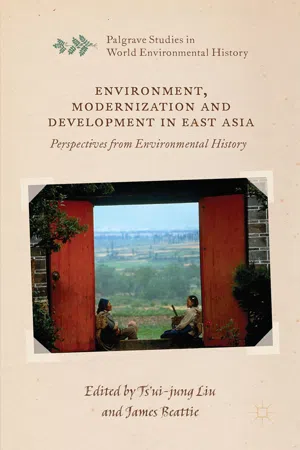
Environment, Modernization and Development in East Asia critically examines modernization's long-term environmental history. It suggests new frameworks for understanding as inter-related processes environmental, social, and economic change across China and Japan.
eBook - ePub
Environment, Modernization and Development in East Asia
Perspectives from Environmental History
- English
- ePUB (mobile friendly)
- Available on iOS & Android
eBook - ePub
Environment, Modernization and Development in East Asia
Perspectives from Environmental History
About this book
Information
Part I
Modernization and Development in Comparative Perspectives
1
Agriculture, Population, and Environment in Late Imperial China
E. N. Anderson
From the early Ming to the late Qing, China’s population grew from perhaps 100 million to over 400 million. This raised population density to previously unknown levels, stretched the capacity of the food production system, and stressed the wider ecological support system. Unsurprisingly, famines became more common, and eventually devastating, as Lillian Li’s magisterial Fighting Famine in North China shows.1 Yet the amazing thing is that China succeeded in feeding most of its millions, most of the time. Agriculture intensified, charity and famine relief developed, transportation mostly kept pace. The environment by 1900 was battered and bruised, with massive deforestation causing large-scale flooding, soil erosion widespread, and diseases of humans and crops endemic. Although severely depleted in places, there was a vast expanse of productive, well-managed land, and hardly any extinctions. Other areas of the world had similar successes, but not on such a scale.
China’s environment, already battered by everything from thousands of years of farming to the ironmongery and printed-book booms of the Song Dynasty,2 subsequently suffered many further insults. The worst problem was beyond China’s control: the Little Ice Age (c.1300–1850) dropped global temperatures to their coldest since the previous Ice Age—the Pleistocene (1.8 million years to 11,700 years Before Present). The Little Ice Age drove the monsoon so far south as to plunge China’s north and northwest into drought. Population increase, government stasis, and progressive damage to the environment by local cultivation and water management brought about environmental decline, though less than one might reasonably expect, given the challenges and given that China continued to rely on biological, rather than fossil fuel, inputs to feed its population. The real glory of China is that its people did manage to feed themselves for thousands of years. The real sorrow of China is the constant curse of famines that supervene whenever war, flood, or drought affects rural life. The incredible effort and success of China’s farmers in the face of countless challenges deserves to be emphasized.
Interlinked environmental, social, demographic, economic, and geopolitical dynamics contributed to China’s nineteenth-century ecological crisis, but with differential regional variations. Paying attention to these regional variations and complexities helps modify many leading theories of China’s development and modernization in relation to the West. The first five sections examine the importance of population, agriculture, markets, and the state in shaping development and its environmental impacts. The last two sections provide case studies of the lower Yangtze Valley and famine relief to illustrate the impacts of the above factors in contributing to the crisis of the 1800s.
Population growth
Conventional wisdom in Sinological literature sees institutional and technical checks on development imprisoning China in a slow-growth economy.3 For many of these scholars, the brake on the economy was late imperial China’s steady population growth. During the Ming (1368–1644), the population reached about 150 million by 1600.4 Then growth was interrupted by the enormous crash during the Ming–Qing transition, when population fell by at least 25 per cent and possibly more. For most of its existence, the Qing Empire (1644–1911) encompassed a greater area and had a larger population than Europe. Qing population soon bounced back from the cataclysmic Ming–Qing transition losses: to ‘313 million in 1794 and an estimated 430 million by 1840.’5 By 1800, Europe had 180 million people; Qing China had 250–300 million.
Population growth had profound impacts on agricultural growth and, by extension, the environment. Agricultural land per capita declined 43 per cent between 1753 and 1812 alone (the dates are set by the availability of fairly reliable figures). This was in spite of the steady, rapid opening of new farmland on all frontiers. William Rowe6 believes labour had previously limited the Chinese agro-ecosystem’s ability to intensify, but now land was the limit, and labour was poured into making it yield more. (In fact, the system had been intensifying for centuries, so labour was not a very dramatic limit, if it was a limit at all.) This is a variant of Ester Boserup’s famous theory of agricultural intensification7 and is also related to Mark Elvin’s high-level equilibrium trap, which sees further development in China checked by an inability of the economy to provide surpluses necessary to invest in technology to enable economic growth.8 Rowe also notes Elvin’s further development of a technological lock-in model.9 Put simply, it meant China was stuck with a labour-intensive organic model.
Most literature presents a grim Malthusian crisis created by population increase: deforestation, unsustainable conversion of wetlands, desertification, the decline of wildlife, and other impacts.10 All these and more did indeed occur and were horrific. Conditions by the early twentieth century were awful beyond modern imagination.11 But somehow those 400 million usually managed to eat. Superior water management,12 famine relief, forest control, rice field protection, access to New World crops, and many other creative and dynamic innovations were responsible.
Li Bozhong has pointed out that the effects of the new crops and cropping patterns introduced in the Song (960–1279) and Yuan (1271–1368) were not widely felt until the Ming, and thus Ming population and wealth could grow steadily in spite of that troubled dynasty’s poor governance.13 The Yangtze Delta and neighbouring areas flourished especially (see below, and Introduction map). Evidently access to this rich agricultural area was one reason the dynasty survived so long. In the Ming total yields per farm stayed about the same,14 meaning that although the size of landholdings shrank, the combination of higher yields and better measures to maintain agricultural productivity meant that people could survive.
In the late imperial period, overall, population grew, but the idea that China ‘always’ had a huge, fast-growing population is a myth. China’s population, and its rate of increase, remained comparable to Europe’s through most of this period.15 Until the late nineteenth century, China was less densely populated than the United States is today. Only when China’s eighteenth century brought peace, and Europe’s birth rate declined (and declined more in the nineteenth and twentieth centuries), did China’s forge ahead. Even then, China’s nineteenth-century rebellions reduced population so much that whole regions were left with a shortage of labour,16 leading to much more favourable terms for farmers and workers. China’s nineteenth-century population dip released land and capital for development, especially in the lower Yangtze region, the country’s richest region and one of the hardest hit by the Taiping Rebellion (1850–64; see last section).
Population pressure, then, is not a valid explanation for differences between China and Europe. One must always explain why population pressure builds up in the first place. One must then explain why people picked one particular method of dealing with it as opposed to other possible ways. Rising population certainly drove ecological degradation in China, but other choices were possible, and were in fact adopted locally. The Chinese were aware of environmental problems,17 and did a great deal to prevent them—by planting trees, maintaining forests, maintaining dikes, and when possible keeping them low and their channels deep (as famously directed by the Li family engineers in ancient Sichuan). True remedies were, however, beyond China’s administrative power. There simply was not enough government expertise or enforcement capability.
James Lee and Wang Feng have argued that China was not up against true Malthusian pressures, even in the late nineteenth century. Infanticide was widely practised—especially, perhaps, in the most densely populated areas.18 In some areas up to a quarter or more of girls were killed, and toward the end of a completed family—when the mother was too old for much further hope of a son—even higher rates were observed.19 The selective elimination of female babies disproportionately reduced overall birth rates. Lee and Wang also mention abortion, although Matthew Sommer has pointed out that abortion was rare in traditional China,2...
Table of contents
- Cover
- Title
- Copyright
- Contents
- List of Illustrations
- Acknowledgements
- Notes on Contributors
- Introduction—Environment, Modernization, and Development in East Asia: Perspectives from Environmental History
- Part I Modernization and Development in Comparative Perspectives
- Part II Waterscapes: Development, Modernization, and Society
- Part III Landscape Commodification
- Part IV Reactions to Development
- Index
Trusted by 375,005 students
Access to over 1.5 million titles for a fair monthly price.
Study more efficiently using our study tools.
Frequently asked questions
Yes, you can cancel anytime from the Subscription tab in your account settings on the Perlego website. Your subscription will stay active until the end of your current billing period. Learn how to cancel your subscription
No, books cannot be downloaded as external files, such as PDFs, for use outside of Perlego. However, you can download books within the Perlego app for offline reading on mobile or tablet. Learn how to download books offline
Perlego offers two plans: Essential and Complete
- Essential is ideal for learners and professionals who enjoy exploring a wide range of subjects. Access the Essential Library with 800,000+ trusted titles and best-sellers across business, personal growth, and the humanities. Includes unlimited reading time and Standard Read Aloud voice.
- Complete: Perfect for advanced learners and researchers needing full, unrestricted access. Unlock 1.5M+ books across hundreds of subjects, including academic and specialized titles. The Complete Plan also includes advanced features like Premium Read Aloud and Research Assistant.
We are an online textbook subscription service, where you can get access to an entire online library for less than the price of a single book per month. With over 1.5 million books across 990+ topics, we’ve got you covered! Learn about our mission
Look out for the read-aloud symbol on your next book to see if you can listen to it. The read-aloud tool reads text aloud for you, highlighting the text as it is being read. You can pause it, speed it up and slow it down. Learn more about Read Aloud
Yes! You can use the Perlego app on both iOS and Android devices to read anytime, anywhere — even offline. Perfect for commutes or when you’re on the go.
Please note we cannot support devices running on iOS 13 and Android 7 or earlier. Learn more about using the app
Please note we cannot support devices running on iOS 13 and Android 7 or earlier. Learn more about using the app
Yes, you can access Environment, Modernization and Development in East Asia by Ts'ui-jung Liu, James Beattie, Ts'ui-jung Liu,James Beattie in PDF and/or ePUB format, as well as other popular books in History & Asian History. We have over 1.5 million books available in our catalogue for you to explore.