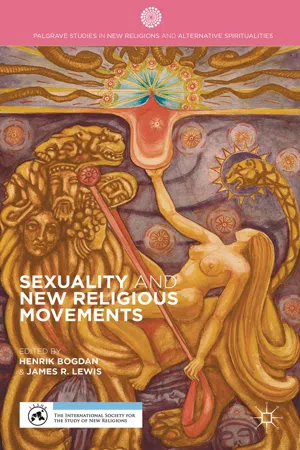
Issues relating to sexuality, eroticism and gender are often connected to religious beliefs and practices, but also to prejudices against and fear of religious groups that adopt alternative approaches to sexuality. This is especially apparent in connection with new religious movements, which many times find themselves accused by the media and anti-cultists of promoting illicit and controversial views on sexuality. This anthology aims to critically investigate the role of sexuality in a number of new religious movements, including Mormon fundamentalist communities, the Branch Davidians, the Osho movement, the Raël movement, contemporary Wicca and Satanism, in addition to the teachings of Adidam and Gurdjieff on sexuality.
eBook - ePub
Sexuality and New Religious Movements
- English
- ePUB (mobile friendly)
- Available on iOS & Android
eBook - ePub
Sexuality and New Religious Movements
About this book
Information
1
Introduction: Sexuality and New Religious Movements
Henrik Bogdan and James R. Lewis
Sexuality goes beyond the mere ability to procreate and to have erotic experiences, feelings, and responses, or the various ways in which we are sexually attracted to one another. Sexuality is intimately connected to questions of identity: who we are as individuals and also our role in society. Human sexuality is thus inextricably linked to cultural, political, and philosophical aspects of life, which are regulated through legal systems based on morality and ethics. Morality and ethics, even in our secularized and late-modern society, are to a large extent based on traditional religious doctrines and teachings (which of course differ in time and place), and it is thus perhaps only natural that new forms of religion often challenge the moral codes and deeply rooted views on sexuality prevalent in the dominant forms of religion and, by extension, in society at large.
The new religious movements (NRMs) discussed in this collection can be described as “new” in the sense that they were founded fairly recently (especially during the second half of the twentieth century, with most members being first- or second-generation members) and that the teachings differ to such an extent from the dominant religious traditions of the West that it is valid to speak of “new” forms of religion. For instance, chapters 1 to 3 deal with the Mormons, the Branch Davidians, and the Family International, respectively, movements that can be described as NRMs with a Christian foundation but which have, in different ways, altered the teachings of the host religion to such an extent that we can be said to be dealing with new forms of religion. Admittedly, there are problems connected with making such a distinction, and it should be kept in mind that a group like the Branch Davidians would not consider itself a new religious movement but rather the “true” form of Christianity. Nevertheless, for analytical purposes, it is useful to use the term NRM when discussing most of the groups covered in this anthology. As indicated, the case studies selected for this collection are Western in the sense that they are or have been active particularly in the United States and in Europe, although many of them are international movements and some of them have non-Western origins, such as the Osho movement. The fact that we are dealing with Western NRMs explains why most of the movements covered in this anthology challenge in different ways the Christian notion of sexuality as something connected to sin and needing to be controlled. Many NRMs react against Christian teachings on sexuality and what they perceive as an oppressive religious system, and instead advocate what they consider to be a positive understanding of sexuality, where sexual liberation is often seen as an important aspect of spiritual enlightenment.
Critics of NRMs—who often refer to these movements as “cults” or “sects,” with all the negative connotations associated with these terms—tend to claim that NRMs are potentially harmful since the leadership often more or less systematically abuses their members sexually. By emphasizing those NRMs that have propagated controversial sexual teachings and practices, such as the use of sex in a ritualistic setting or marriage with multiple partners, the critics (who often belong to what is usually referred to as the “anticult movement”) argue that the religious dimension of these teachings and practices is just an excuse or a cover for sexual abuse. What these critics often fail to take into account, however, is the way that sexuality is actually understood and used by the groups themselves, and to place these teachings and practices within the broader context of the history of religions.
As this anthology aims to show, sexual practices that, at face value, seem bizarre or even dangerous might be understood differently when placed in their proper context. That being said, it should be emphasized that sometimes the criticism levelled against certain NRMs is a valid critique, as demonstrated in chapters 3 and 4 of the present collection. One should, however, be careful in dismissing a contemporary movement as sexually abusive based on events that happened early in the movement’s history, and instead analyze how the movement has developed over the years and whether it has dealt with past abusive practices. One should also be careful about condemning an entire organization based on local or regional cases of abuse. By way of comparison, one might consider contemporary criticism of the Catholic Church and the numerous cases of sexual abuse by priests: one rarely encounters criticism of the entire Church based on these cases. Furthermore, although questions related to sexuality and gender are central to most of the movements discussed in this anthology, sexual abuse and criminal activities related to sexuality are no more common in NRMs than in other kinds of religious organizations.
The basic aim of this anthology is thus twofold: first, we wish to challenge many of the misconceptions—propagated by the anticult movement and, by extension, the popular media—about sex, sexuality, and gender in NRMs; second, rather than looking only at more-established forms of religion when discussing sexuality and religion in contemporary society, we hope that the case studies selected for this anthology will give a deeper and more complex understanding of sexuality and religion in late modernity.
In chapter 2, “Gender, Sexuality, and Women’s Empowerment in Mormon Fundamentalist Communities,” Jennifer Lara Fagen and Stuart A. Wright argue that critics and outsiders view women in polygamous religious communities, such as the Fundamentalist Latter Day Saints (FLDS), as victims in a patriarchal system. These assumptions are based on the dominant discourse about gender in which gender—and therefore sexual—asymmetry is central. As such, accounts of disgruntled apostates find a receptive audience in the larger society that serves to validate the victim narrative. But it may be argued that in castigating FLDS men for confining women to these traditional roles, secular society—not the FLDS—is devaluing women. Previous studies of insulated religious communities have challenged conventional assumptions about gender roles and sexuality. Women in these communities often find empowerment in ways that are not fully understood. Women may carve out emergent and evolving roles that expand gender consciousness but are unmatched in the secular world. Fagen and Wright’s research begins by excavating these experiences through interviews with FLDS women. In this study, the women are treated as subjects, rather than objects of investigation. The authors examine apparent inconsistencies between women’s “subservience” and empowerment by suspending conventional preconceptions about FLDS women that have been used to amplify a perceived threat that the group poses. It is here that we find the complex realities of their lives as actually experienced.
One of the more controversial NRMs with a Christian foundation is the Branch Davidian movement, discussed by Martha Sonntag Bradley in chapter 3, “Gender among the Branch Davidians.” While most studies of the Branch Davidians focus on the deadly fire outside Waco, Texas, in 1993, which killed 76 members of the group, Bradley discusses the importance of gender in the movement. Although two women, Florence Houtleff and Lois Roden, preceded David Koresh in the leadership of the Davidian movement, Koresh’s construction of the gender roles of men and women in the religious community resulted from his own eccentric interpretation of scripture and what he considered to be a new revelation. Ideas about gender were expressed in the group’s family and marriage organizational patterns, the group’s architecture, and Koresh’s “New Light” doctrine. After revealing this doctrine, Koresh taught Branch Davidian women the concept of “spiritual wives,” convincing the group’s women—both married and unmarried—to join him in a new, radical family organization in which couples were split apart, marriages dissolved, and all men and those women not connected to Koresh were instructed to live celibate lives. Functioning as both a boundary and a source of meaning, gender helped women interpret the religious significance of their lives with behaviors wrapped around Koresh’s understanding of the world. As a charismatic prophet, he exercised authority over gender definitions and provided clear-cut gender roles within the context of the Branch Davidian community. Overwhelmingly patriarchal in character and religiously based, they departed from and set aside the gender, marriage, and familial patterns members had experienced in mainstream society. Gender helped create intelligibility in an ambiguous world and a collective identity crucial to their religious enterprise.
If the Branch Davidian Movement stands out as one of the most controversial Christian NRMs, Osho was an equally controversial representative of the Eastern-inspired NRMs that were so popular during the 1970s and 1980s. In fact, Osho was often referred to as a “sex guru” and a “guru of the rich.” In chapter 4, “Sex and Gender in the Words and Communes of Osho,” Roshani Cari Shay and Henrik Bogdan explore the words of Osho regarding sex and gender in some of his many books—the most accessible transcriptions of his many discourses. There are 732 references to the words sex, sexuality, gender, and women in these works. A summary of Osho’s spoken attitudes toward these topics will be attempted with the proviso that he counselled his sannyasins not to take him as an authority, but to implement the teachings in their own lives and to make their own conclusions. The chapter also explores sex and gender in three phases of Osho’s communes, most specifically in Rajneeshpuram, based on extensive interviews with sannyasins who lived there.
In chapter 5, “Sexual Practice, Spiritual Awakening, and Divine Self-Realization in the Reality-Way of Adidam,” Michael (Anthony) Costabile analyses the use of sexual practices in the Adidam movement. The world’s religious and spiritual traditions, East and West, offer no a priori ontology of sexuality, and the thorny relationship between sexual life and spiritual life remains problematic. Upon opening his ashram in Hollywood, California, in 1972, Adi Da Samraj observed that his early devotees, although interested in spiritual life, were a textbook microcosm of the emotional and sexual fascinations, concerns, and obsessions of mainstream society. Further, he quickly concluded that emotional-sexual patterning, extending from one’s early-life experiences, impedes both ordinary human growth and spiritual maturity. This led him to undertake a decades-long “ordeal of ‘consideration,’” during which he “submitted to teach and instruct” his devotees in the midst of their emotional-sexual lives and spiritual practice. Together—with striking candor and directness—they experimented with the gamut of human emotional-sexual possibilities, examining the attitudes, taboos, patterns, and neurotic limitations uncovered in the process. This chapter examines this specific dimension of Adi Da’s life and work within the context of his spiritual teachings and work with devotees in toto. It also argues that Adi Da’s dramatic engagement with devotees—in what is conventionally regarded to be a proscriptive area of their personal lives—was, in fact, the requisite basis for a breakthrough in humankind’s understanding of sexuality and its relationship to spiritual life and realization.
Johanna J. M. Petsche provides in chapter 6, “Gurdjieff on Sex: Subtle Bodies, Si 12, and the Sex Life of a Sage,” a preliminary sketch of the place of sex and sexuality in the teachings and personal life of George Ivanovitch Gurdjieff, a flamboyant Armenian-Greek teacher of esoteric doctrine. Gurdjieff’s rather candid teachings and views on sex, scattered throughout his writings and those of his pupils, are intrinsic to his overall vision of human beings and their potential for spiritual development. This chapter examines Gurdjieff’s teachings on the “sex center,” which he understood both as an essential tool for spiritual transformation and liberation, and as the chief cause of one’s mechanical and disharmonious condition. The sex center is assessed within the context of Gurdjieff’s “three-octave” system of food transformation outlined in Pyotr Demianovich Ouspensky’s In Search of the Miraculous (1949). Gurdjieff’s views on heterosexuality, homosexuality, masturbation, and gender, with a focus on his contentious statements about women, are also investigated within the context of his teaching. It is demonstrated that Gurdjieff condemned the notion of sex for pleasure as destructive and strenuously argued that the purpose of sex was only for spiritual development or for producing a child. Any other uses for sex were, in his view, perversion. Yet, although Gurdjieff’s teachings on sex were rigorously conservative, he himself preferred not to live by them. Pupils describe Gurdjieff’s sex life as unpredictable: at times he led a strict, almost ascetic, life; at other times he was extremely sexually active, and this activity involved a number of female pupils.
It is frequently stated that Paganism is one of the fastest-growing NRMs in the West. The dominant form of Paganism is the modern witchcraf...
Table of contents
- Cover
- Title
- Copyright
- Contents
- List of Tables
- 1 Introduction: Sexuality and New Religious Movements
- 2 Gender, Sexuality, and Women’s Empowerment in Mormon Fundamentalist Communities
- 3 Gender among the Branch Davidians
- 4 Sex and Gender in the Words and Communes of Osho (née Bhagwan Shree Rajneesh)
- 5 Sexual Practice, Spiritual Awakening, and Divine Self-Realization in the Reality-Way of Adidam
- 6 Gurdjieff on Sex: Subtle Bodies, Si 12, and the Sex Life of a Sage
- 7 Sex Magic or Sacred Marriage? Sexuality in Contemporary Wicca
- 8 Cult of Carnality: Sexuality, Eroticism, and Gender in Contemporary Satanism
- 9 Raël’s Angels: The First Five Years of a Secret Order
- 10 Fantasies of Abuse and Captivity in Nineteenth-Century Convent Tales
- Contributors
- Index
Trusted by 375,005 students
Access to over 1.5 million titles for a fair monthly price.
Study more efficiently using our study tools.
Frequently asked questions
Yes, you can cancel anytime from the Subscription tab in your account settings on the Perlego website. Your subscription will stay active until the end of your current billing period. Learn how to cancel your subscription
No, books cannot be downloaded as external files, such as PDFs, for use outside of Perlego. However, you can download books within the Perlego app for offline reading on mobile or tablet. Learn how to download books offline
Perlego offers two plans: Essential and Complete
- Essential is ideal for learners and professionals who enjoy exploring a wide range of subjects. Access the Essential Library with 800,000+ trusted titles and best-sellers across business, personal growth, and the humanities. Includes unlimited reading time and Standard Read Aloud voice.
- Complete: Perfect for advanced learners and researchers needing full, unrestricted access. Unlock 1.5M+ books across hundreds of subjects, including academic and specialized titles. The Complete Plan also includes advanced features like Premium Read Aloud and Research Assistant.
We are an online textbook subscription service, where you can get access to an entire online library for less than the price of a single book per month. With over 1.5 million books across 990+ topics, we’ve got you covered! Learn about our mission
Look out for the read-aloud symbol on your next book to see if you can listen to it. The read-aloud tool reads text aloud for you, highlighting the text as it is being read. You can pause it, speed it up and slow it down. Learn more about Read Aloud
Yes! You can use the Perlego app on both iOS and Android devices to read anytime, anywhere — even offline. Perfect for commutes or when you’re on the go.
Please note we cannot support devices running on iOS 13 and Android 7 or earlier. Learn more about using the app
Please note we cannot support devices running on iOS 13 and Android 7 or earlier. Learn more about using the app
Yes, you can access Sexuality and New Religious Movements by J. Lewis, J. Lewis,Kenneth A. Loparo,Henrik Bogdan, J. Lewis, Henrik Bogdan in PDF and/or ePUB format, as well as other popular books in Social Sciences & Comparative Religion. We have over 1.5 million books available in our catalogue for you to explore.