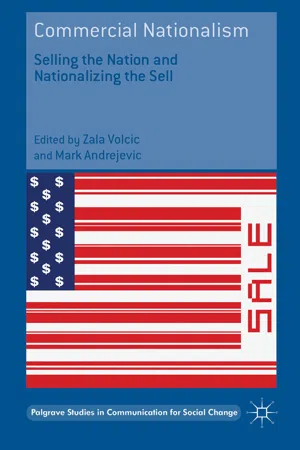
eBook - ePub
Commercial Nationalism
Selling the Nation and Nationalizing the Sell
- English
- ePUB (mobile friendly)
- Available on iOS & Android
eBook - ePub
Commercial Nationalism
Selling the Nation and Nationalizing the Sell
About this book
This book intervenes in discussions of the fate of nationalism and national identity by exploring the relationship between state appropriation of marketing and branding strategies on the one hand, and, on the other, the commercial mobilization of nationalist discourses.
Information
1
Introduction
As recent history suggests, developments typically associated with the term ‘globalization’ go hand in hand with assertive and resurgent nationalisms – both enhancing and reconfiguring national identities. We might include in this category of globalization attributes the following: emerging forms of economic interdependence, the more widespread global circulation of news, information, and mediated forms of culture associated with digital media technologies, enhanced forms of physical mobility for leisure travelers and some categories of labor. In the era of mass customization and the rise of identity politics, it should not be surprising that nationalism is an important aspect of current forms of globalization. We are very familiar with the notion that the assertion of unique identity markers has become a mass phenomenon – and a strategy for addressing the economization of social relations at the national and individual level. Without placing too much weight on the homology, we might note the similarity between self-branding and nation branding: the recognition that, in the global economic context, the ability to channel and capture attention is a crucial one. The displacement of ‘trust relations’ by rationalization and bureaucratization described by James Carey (1983) as symptomatic of the rise of electronic communication is followed rapidly by the rise of ersatz personalization and individuation. Facebook and Twitter provide us with interactive training in the art of the ‘parasocial’ (Levy, 1979). The triumph of the parasocial (including relations to brands themselves) coincides with the personalization of bureaucratization – the displacement of the impersonal functioning of the bureaucratic machine, and the forms of objectivity and neutrality to which it laid claim, by the mobilization and modulation of affect. Walter Cronkite gives way to the rise of cable TV’s 24-hour affective news network.
One of the main registers in which the expression of nationalism is reconfigured for the current version of globalization is, unsurprisingly, the commercial one. We can approach this observation from several directions: a consideration of the way, for example, that in many parts of the world current and former state media organizations are embracing the logic of commerce and finding ways to blend it with the mobilization and exploitation of nationalist sentiment. Nationalism sells, as Rupert Murdoch’s News Corporation (among others) has discovered. Indeed, nationalism is perhaps the ur-form of the brand – a means of channeling affective sentiment around a floating signifier. At the same time, state sanctioned forms of nationalism in the era of the ‘enterprise state’ piggyback on commercial entities and strategies. The United States Department of Homeland Security, for example, uses a brand tie-in with a Disney movie (Big Hero 6) to promote its national ‘readiness campaign,’ which enlists the populace to help secure the nation in the face of potential threat. It is the conjunction of these two tendencies that we mean to highlight with the notion of commercial nationalism: the use of nationalism to sell (or gain ratings) and the use of commercial strategies by public sector entities to foster nationalism and national agendas. The notion of commercial nationalism does not assume that either of these developments are, on their own, novel; rather, it is meant to designate the new constellation of inter-relations they designate, one that takes on different shapes in different regional contexts, while simultaneously responding to economic and cultural shifts related to international capitalism. In parts of Europe, for example, the rise of commercial nationalism in the media is a function of post-communist market reforms combined with the emergence of post-Cold War nations. Fostering national identity becomes, in part, a commercial project, both for the promotion of local industries and for the establishment of commercial broadcasters. In China, the success of commercial media remains closely articulated to state interests and priorities, leading to a unique formation of commercial nationalism. With the notion of commercial nationalism, then, we mean to designate a model for interrogating contemporary media relations by considering how commercial and nationalist priorities remain both intertwined and in tension with one another. Our wager is that this is a fruitful angle of approach for exploring the social function of the media in shaping forms of competition – both commercial and national – in the era of global capitalism.
As an approach, commercial nationalism continues in the tradition of bringing together political economic approaches with the theorization of nationalism and national identity. Nationalism has been explained in terms of ethnic identity (Smith, 1991; 2008a; 2008b), waves of industrialization (Gellner, 1983), print capitalism (Anderson, 1983), or culture, identity, and discourse (Calhoun, 1997). Specifically, crucial works on nationalism and national identity have related the origins of the nation to industrialization and modernization (Gellner, 1983; Hobsbawm, 1992; Hobsbawm & Ranger, 1983; Smith, 1991), but they have not fully recognized the importance of markets, commerce, and consumption in the process of nation-building. These works have been criticized in particular for overlooking popular culture and everyday life as important dimensions of nationalism (more in Mihelj, 2011). Furthermore, in the field of ‘everyday, and ordinary nationhood,’ although scholars have acknowledged the significance of consumer culture in the reproduction of nations (Billig, 1995; Caldwell, 2002), we connect the banalization of nationalism with the nationalization of commercial culture. The work of Robert Foster is exemplary in this regard – he analyzes different national contexts (from Australia to Papua New Guinea) with an emphasis on the consumption of commodities as part of specific national ways of life (Foster, 1995, 1999). We seek to push this analysis further with a contemporary exploration of the deliberate mobilization of nationalism by commercial media alongside the embrace of commercial techniques by state institutions and actors.
Such an approach has links to Billig’s notion of ‘banal nationalism,’ but with an emphasis on the registers of commerce, marketing, and consumption – and on the appropriation and mobilization of commercial strategies, consultants, and institutions by the state actors. This emphasis, in turn, considers the ways in which marketing has become a default paradigm for governance via the canalization of sentiment. Thanks to processes of economic and cultural globalization, the state’s political legitimacy to control a territory, to exert power over its inhabitants, and to insure obedience from them has been reconfigured to adjust to the rise of global capital. In the period of global neo-liberalism, the political shifts toward the commercial where both the state and the market become reference points for national identification (Volčič & Andrejevic, 2011). The economic and political interconnectedness of contemporary nation states against the backgrounds of economic globalization has fostered an altered and fragmented notion of the state as an entity that is undergoing fundamental structural changes.
In many parts of the world, globalization is combined with the emergence of neo-liberal political and economic transformations that ‘mar-ketize’ state forms of governance and transpose nationalist ideological formations into a commercial register. This creates a particular situation – one in which nationalism entails corporate thinking (in the era of ‘the enterprise state’) (Plant, 2010) and combines patriotic emotional ideas with marketing goals, integrating commercial and national appeals. By the same token transnational media corporations (which have shed their own national identities) have simultaneously fanned the flames of resurgent forms of nationalism for commercial purposes.
This book’s unique contribution is to consider an emerging formation characterized by the following complementary (and related) developments: the ways in which states come increasingly to rely on commercial techniques for self-promotion, diplomacy, and internal national mobilization on the one hand and, on the other, the ways in which new, emerging, and legacy forms of commercial media rely on the mobilization of nationalism for the purpose of selling, ratings, and profit. We see this formation as a unique reconfiguration of the formation of nationalism associated with the contemporary context. Often these processes are approached separately by considering either the economic role of nationalism or, on the other, the media’s participation in the formation of national identity. This book’s contribution is to suggest that the way in which the state conceptualizes and mobilizes conceptions of national identity in the current conjuncture needs to be thought alongside the ways in which commercial entities piggyback on and exploit conceptions of national identity for commercial ends – as well as the ongoing relationship between commercial media and the state. We think it is important to consider these developments together because of the emerging logic of national identity associated with the myriad ways in which nations are offloading processes of civic mobilization and international relations on to the private sector and because of the rapidly transforming media environment associated with the emergence of transnational media conglomerates in the digital era. The notion of commercial nationalism takes developments in the realm of state policy and commercial strategy as complementing one another in the ways in which they displace citizenship with consumerism. Also important in this regard is the rise of newly or recently privatized media sectors in a wide range of nations (thanks to the decline of state and public service media and their ‘national’ function) and emerging contexts of media ‘glut’ (the multiplication of outlets, channels, platforms, and devices – and the ways in which these mobilize nationalism as a means of gaining market share). These processes are complex, nuanced, and localized, which is why the book takes a case study approach that looks at several different regions of the world, each characterized by a unique constellation of relationships between the state and commercial media outlets. We propose the notion of ‘commercial nationalism’ as a means of thinking through these developments in their relevant contexts. In this regard, the contributions seek to place together an exploration of the impact on nationalism and national identity of changing pressures and circumstances facing nation states and the pressures and priorities faced by commercial media outlets.
Clearly, the contexts in which commercial media in China make nationalist appeals are quite different from those in which Fox News in the United States does so – and yet there is a shared set of shifting logics that allow these quite disparate case studies to inform one another. Something similar can be said of the ways in which nation states seek to mobilize nationalist identity using marketing-based tactics – both internally and externally. This has been picked up by the literature on nation branding, which we see as fitting within the larger umbrella of commercial nationalism. So, to be clear, this book is not envisioned as an extension or variation on the literature on ‘nation branding,’ despite the fact that many of the authors here write and think about nation branding in specific national contexts as a layer of commercial nationalism. Rather, we envision it as helping to explain (among other things) the context in which nation branding comes to seem (to some) an important way of building a sense of national identity and a tool for international relations and tourism by relying on commercial techniques and outsourcing the formation of civic identity and responsibility to marketing subcontractors. Nation branding is one of the phenomena that emerge when states start to think of themselves through the lens of the nation as corporations or ‘enterprise states’ (Plant, 2010).
The selection of chapters included in the volume serves as a fruitful starting point for exploring the specificities of the relationship between state mobilization of the commercial and commercial mobilization of nationalism. The selection is meant to be productive rather than exhaustive: it represents a diversity of regions and contexts (and their associated uniqueness and complexity), but by no stretch of the imagination can it cover the entire range of contemporary permutations of commercial nationalism. It is therefore meant to be an incitement to further research and theory development. We hope that the notion of commercial nationalism might prove fruitful for considering the emerging formations of nationalism and their uptake by commercial media.
We start from the premise that no historical formation is entirely ‘new’ – and, by the same token, that every historical conjuncture is also unique (not an identical copy of what came before). Thus, we want to acknowledge elements of continuity with historical processes of national identity formation and commercialism. Ever since the birth of the nation state, commercial and economic concerns have had an important role to play. However, as the world economy develops alongside media technologies and practices, and as political regimes and relations transform, the historical context develops into new and unique configurations. We take this for granted: that when we say ‘new’ we mean in it in this sense, and not in the absurd sense of ‘without any historical continuities or connections.’
The notion of commercial nationalism helps us to understand not only, for example, the processes of nation branding associated with foreign-investments and tourism (marketing to other nationalities) but also the marketing of nationalism to domestic audiences. Citizens are addressed not simply as consumers; rather, they are positioned and produced as nationalist(ic) consumers. They are socialized in new forms of national belonging that rely upon the dynamic of consumption: national belonging is not just the locus of a particular form of imaginary identification, but of reiterated practices of consumption. In this regard, commercial nationalism is about transforming consumers into particular kinds of national subjects. In the commercial sector, even though there is a strong ideological agenda underlying the constructions used, it is also true that the primary goal is selling. While forms of nationalist appeal have long played a role in marketing campaigns, this participation now takes place against the background of the state embrace of marketing and branding as a strategy for international relations, self-promotion, and ‘soft power.’ Consider, for example, ‘There’s nothing like Australia,’ a nation-branding campaign developed through a ‘crowd-sourcing’ initiative that encouraged citizens to share photos of their holidays in Australia via social media networks, claiming to empower them in the construction of a more democratic and authentic image of their country. It is the conjunction of these developments (the state’s self-identification as a brand with the commercial mobilization of nationalist appeals) and their relationship to one another in the era of global capitalism and neoliberalization that is unique and in need of interrogation.
The model of commercial nationalism fits neatly with the participatory promise of the interactive era – and it echoes its logic: the invitation to participate not just in marketing to oneself, but in ‘propagandizing’ oneself. The logic of the market reinforces the mobilization of nationalism not as a top-down imposition but as the reflection of the aggregated desires of individual consumers. In this regard, we might think of commercial nationalism as a ‘neoliberal’ form of ideological identification: a kind of propagandizing ‘at a distance.’
The chapters that follow all engage with the notion of commercial nationalism and offer specific examples of its manifestations in Australia, Italy, Poland, Colombia, South Africa, the USA, Vietnam, and China. Some scholars who draw on the critical literature on nation branding (Louw, Kaneva, Carah, this volume) reveal how countries’ self-promotional efforts offer useful case studies for tracing the rearticulation of national interests and identities in commercial terms. The authors argue that all forms of nationalism mobilize people and work to transform them into national subjects in order to advance specific political, economic and cultural interests. The following section provides an introduction to the main themes of the contributions in order to provide a road map of the topics engaged by the volume’s contributors.
Chapter themes
Graeme Turner’s opening chapter sets the scene for an understanding of commercial nationalism internationally and comparatively. He provides a useful overview of the changes in ‘structures and functions’ that contribute to the ‘instrumental deployment of the discourses of nationalism’ with both commercial and political consequences. What is new about this deployment, he suggests, ‘is what we might describe as the political agnosticism (or perhaps, more pointedly, the political opportunism) of so much commercial nationalism.’ In this regard he is interested in the ways in which the commercialization of nationalism in mediated contexts unmoors it from particular state commitments – and the forms of accountability with which these were once associated.
In their chapter, Carah and Louw focus on Australia, where one form of commercial nationalism exploits synergies between public and private interests, such as when Australia Day is sponsored by the company that makes Vegemite (which is now owned by a US conglomerate). On Australia Day, Australians are invited to go online and become co-creative consumers by media giant Fairfax Media, which organized an ‘iPhoneography Challenge’ during which mobile users were invited to share iPhone pictures showing what being an Australian, means to them on that day. Carah and Louw look beyond traditional models of nation construction, and pay attention to commercialized forms of nationalism in everyday life, where nationalism and consumer culture intersect. They argue, for example, that Baz Luhrmann’s film Australia (2008) is an example of how commercial films form part of the nation-branding industry. While exploring how Luhrmann and the Australian government turned a postcolonial apology narrative into a message that promoted Australia as a tourism destination, they examine how the apology is deployed in Australia’s efforts to brand and position itself within the global tourism industry. In particular, they look at how the political act of apology (to the country’s indigenous peoples) has been used as a device in commercial and state-subsidized popular culture and nation branding. Through focusing on the film and touristic nation-branding efforts (Luhrman’s Come Walkabout advertisements), they show how ‘the commercial nation-state not only appropriates the identities of indigenous people for commercial and political gain but also turns its own apology to indigenous people into a commercially valuable claim.’
In his chapter on commercial nationalism in Columbia, Juan Sanin looks at how nation-making has been transformed into a promotional activity. He explore the double logic of commercial nationalism: on the one hand, commercial organizations incorporate nationalism in their promotional activities, and on the other, governments implement marketing to advance their nationalistic projects. He focuses on the ‘Colombia is Passion’ branding campaign, while analyzing the branding strategies it implemented to create a new sense of Colombianness that was successfully ‘sold’ to citizens through market and media products. Interested in revealing some of the internal effects of nation branding in the commercial construction of Colombianness, Sanin analyses ‘the joint work of the government, corporations and brand consultants in the creation of a new symbol for representing a new sense of Colombianness.’ The success achieved by ‘Colombia is Passion‘ within the country, he writes, has to do with the main target of its strategy, focused not only on international publics but especially on local cit...
Table of contents
- Cover
- Title Page
- Copyright
- Contents
- List of Figures
- Notes on Contributors
- 1. Introduction
- 2. Setting the Scene for Commercial Nationalism: The Nation, the Market, and the Media
- 3. The Apologetic Brand: Building Australia’s Brand on a Postcolonial Apology
- 4. Colombia Was Passion: Commercial Nationalism and the Reinvention of Colombianness
- 5. Rethinking Commercial Nationalism: The ‘Chinese Dream’ in Neoliberal Globalization
- 6. Personal Wealth, National Pride: Vietnamese Television and Commercial Nationalism
- 7. Nation for Sale? Citizen Online Debates and the ‘New Patriotism’ in Post-Socialist Poland
- 8. Borderless Nationalism: Italy’s RAI Transnational Brand
- 9. South African Nation Branding and the World Cup: Promoting Nationalism, Nation Branding, and the Miracle Nation Discourse
- 10. Commercial Nationalism and the Affective News Network
- 11. Nation Branding and Commercial Nationalism: Notes for a Materialist Critique
- Index
Trusted by 375,005 students
Access to over 1.5 million titles for a fair monthly price.
Study more efficiently using our study tools.
Frequently asked questions
Yes, you can cancel anytime from the Subscription tab in your account settings on the Perlego website. Your subscription will stay active until the end of your current billing period. Learn how to cancel your subscription
No, books cannot be downloaded as external files, such as PDFs, for use outside of Perlego. However, you can download books within the Perlego app for offline reading on mobile or tablet. Learn how to download books offline
Perlego offers two plans: Essential and Complete
- Essential is ideal for learners and professionals who enjoy exploring a wide range of subjects. Access the Essential Library with 800,000+ trusted titles and best-sellers across business, personal growth, and the humanities. Includes unlimited reading time and Standard Read Aloud voice.
- Complete: Perfect for advanced learners and researchers needing full, unrestricted access. Unlock 1.5M+ books across hundreds of subjects, including academic and specialized titles. The Complete Plan also includes advanced features like Premium Read Aloud and Research Assistant.
We are an online textbook subscription service, where you can get access to an entire online library for less than the price of a single book per month. With over 1.5 million books across 990+ topics, we’ve got you covered! Learn about our mission
Look out for the read-aloud symbol on your next book to see if you can listen to it. The read-aloud tool reads text aloud for you, highlighting the text as it is being read. You can pause it, speed it up and slow it down. Learn more about Read Aloud
Yes! You can use the Perlego app on both iOS and Android devices to read anytime, anywhere — even offline. Perfect for commutes or when you’re on the go.
Please note we cannot support devices running on iOS 13 and Android 7 or earlier. Learn more about using the app
Please note we cannot support devices running on iOS 13 and Android 7 or earlier. Learn more about using the app
Yes, you can access Commercial Nationalism by Zala Volcic, Mark Andrejevic, Zala Volcic,Mark Andrejevic in PDF and/or ePUB format, as well as other popular books in Law & Law Theory & Practice. We have over 1.5 million books available in our catalogue for you to explore.