eBook - ePub
Theatre and Performance in the Asia-Pacific
Regional Modernities in the Global Era
- English
- ePUB (mobile friendly)
- Available on iOS & Android
eBook - ePub
Theatre and Performance in the Asia-Pacific
Regional Modernities in the Global Era
About this book
Theatre and Performance in the Asia-Pacific is an innovative study of contemporary theatre and performance within the framework of modernity in the Asia-Pacific. It is an analysis of the theatrical imaginative as it manifests in theatre and performance in Australia, Indonesia, Japan and Singapore.
Information
Subtopic
Art GeneralPart I
Changing Forms of Theatre and Drama
1
Modern Australian Drama: Haunted by the Past
Australian drama is a drama of the modern era and is modelled on the European realist form. As a dramatic form it is primarily constituted around the figure of the playwright, the written dramatic text and the theatrical performance of the text. Its evolution as a national drama has occurred as European themes, language, character and setting are replaced with local character, situation and voice. By the 1960s, scenography and performance style came to reflect Australian locations, culture and voices. In the twenty-first century, a further change is discernible in dramatic texts that radically alter the temporality of modern drama to interrogate the unresolved, perhaps irreconcilable, consequences of the past and to think more critically about the co-presence of past, present and future. The plays discussed in this chapter, Holy Day (2001) and When the Rain Stops Falling (2009) by Australian playwright Andrew Bovell, are but two of a larger body of dramatic works from different playwrights that might equally belong to this category. Bovell’s plays are chosen, however, for their historicized, epic representations of European settlement and hence lend themselves to the reflexive modernities that parallel the rise of more liquid forms discussed in later chapters. Reflexive modernity is understood here as creative practice that opposes a colonizing, imperialist modernity from the perspective of a more contemporary liquid modernity that bears its legacy. Reflexive modernity is evident in dramatic writing practices that resonate with Andreas Huyssen’s notion that under the onslaught of modernity, ‘we need both past and future to articulate our political, social, and cultural dissatisfactions with the present state of the world (2003: 6) and with Elin Diamond’s concept of ‘modernity’s drama’ that thinks about and dramatizes ‘historical time’ (Diamond, 2001: 5). The idea of reflexive modernity also resonates with, although is not the same as, Peter Boenisch’s spectator-oriented concept of ‘reflexive dramaturgy’ discussed in Chapters 9 and 12.
The shift towards the re-examination of the past is exemplified in the 1990s by Indigenous dramas such as The 7 Stages of Grieving (1996) by Wesley Enoch and Deborah Mailman, Stolen (1998) by Jane Harrison and Yibiyung by Dallas Winmar performed at the Malthouse Melbourne in 2008. The 7 Stages of Grieving, performed by Mailman, is a monodrama that describes and embodies the impact of European settlement on Aboriginal and Torres Strait Islander peoples (see Casey, 2005; Gilbert and Lo, 2009: 61; Grehan, 2001). The rise in the 1990s of a significant group of Indigenous playwrights and companies, such as Ilbijerri Theatre, occurs within a broader Indigenous human and land rights movement but it is also possible that liquid modernity, like postmodernism, provides a hospitable climate for pluralist voices to be heard. Indigenous drama changes the Anglo-Celtic form of Australian drama and challenges both cultural and political institutions, such as theatre and drama and the nation, to recognize and atone for the past. Hence, by enacting reflexive modernities that critique the dominant narrative of progress, modern Australian drama begins to offer more complex representations of the social, political and cultural impact of colonial and settler modernity.
It is therefore significant that Andrew Bovell, one of the most prominent of a new generation of leading Australian film and theatre writers, turns his attention to history. We are not attributing to him a conscious intervention in the politics of land rights and reconciliation that reached its most visible global form in the closing ceremony of the Sydney 2000 Olympic Games (when musicians wore black T-shirts printed with the word ‘Sorry’). Rather, as a member of the postmodern, postdramatic and multimedia generation of theatre artists, Bovell makes the transition from middle-class, anglophone relationship dramas; first, to collaborative political theatre with Who’s Afraid of the Working Class? (2000), three interlinked urban social dramas, co-written by Bovell, novelist Christos Tsiolkas, playwrights Melissa Reeves and Patricia Cornelius and musician Irene Vela. And then, with Holy Day and When the Rain Stops Falling, he turns to the hidden stories behind European settlement and the irreconcilable contradictions of Australian modernity. Both plays exemplify a politicized, historicized, epic form with striking patterns of repetition and coincidence that together affect a change in the temporality and stratagem of modern Australian drama.
Maryrose Casey’s extensive and ongoing research into nineteenth-century and contemporary Indigenous theatre and performance provides a vast body of knowledge that goes a considerable way towards redressing the erasure of Indigenous performance from modern Australian history (Casey, 2004; Fensham and Varney, 2005: 199–237). Our study of regional modernity, while following a different epistemological pathway, builds on Casey’s research by suggesting that Indigenous drama has prompted white writers, such as Bovell and John Romeril and others before them, to think reflexively about European settlement. This form is not quite liquid – the hegemony of text-based drama endures – but its emergence coincides with the greater fluidity, shape-changing and pluralism of culture in liquid modernity.
Australian colonial modernity: Indigenous dispossession and white prisons
Australian modernity is augmented in ‘the era of territorial conquest’, a period of ‘heavy’ modernity in which Europe expands into the New World (Bauman, 2000: 114). The discovery and conquest of the New World was typically directed at discovering, accumulating, trading and colonizing human and non-human resources for strategic, geopolitical or military advantage.
In January 1788, when the British Crown established a colony on the east coast of Australia, Indigenous peoples were denied prior ownership or occupation of the land under the European principle of terra nullius – land that belongs to no one and that can be claimed by a sovereign state – with devastating effects on a way of life developed over thousands of years of continuous occupation. Denied sovereignty and land rights, Aboriginal and Torres Strait Islanders became native subjects of the crown and subservient to the white population’s plans for the colony. This was in the first instance to establish a self-sustaining penal colony to house England’s growing prison population. Land clearing, building, farming and other industries were established to support the enterprise in which more than 165,000 British and Irish convicts were transported from England in the late eighteenth to the mid-nineteenth century. Prisoners served their sentences under brutal conditions and later worked as indentured labourers assigned to free settlers, before being released but not repatriated to England. Indigenous populations were wiped out by disease, massacres and the loss of a sustainable way of life or herded into missions where life resembled those of other ‘stateless’, dependent ‘national minorities’ that modernity creates (Butler and Spivak, 2007: 12).
In December 1992, Prime Minister Paul Keating delivered the Redfern Speech at the Australian Launch of the International Year for the World’s Indigenous People, in which he recognized on behalf of the nation state that European settlement had brought ‘devastation and demoralization to Aboriginal Australia’ (Keating, 1992). As the speech records with a dramatic gesture, ‘We took the traditional lands and smashed the traditional way of life.’ (Keating, 1992)
The path from 1788 to 1992 proposes that the arrival and implantation of European modernity in Australia was marked by the establishment of a British colony whose finer accomplishments are forever associated with the deterritorialization and massacres of Indigenous peoples, the virtual enslavement and demoralization of Indigenous survivors, and the brutality of the penal system. Australian scholars and artists, including playwrights and novelists, have long represented the consequences of European settlement in terms of a haunted, anxious and unsettled modern nation (Davis, 1986; Ginibi, 1999; Manne, 2001; Tompkins, 2006; Wright, 2006). Bovell’s Holy Day is subtitled ‘The Red Sea’ in a move that attaches the violence of colonization to the disputed lands of the biblical era that also continue to haunt the modern era. In terms of the present of its performance, the ‘history wars’ (Glow, 2007: 39) of the late 1990s seep into the play. These ‘wars’ refer to the history debates led by conservative Prime Minister John Howard, who in a 1996 speech repudiated Keating’s 1992 Redfern Speech as politically motivated and filled with leftist rhetoric:
This ‘black armband’ view of our past reflects a belief that most Australian history since 1788 has been little more than a disgraceful story of imperialism, exploitation, racism, sexism and other forms of discrimination.
(Howard, 1996)
Holy Day and When the Rain Stops Falling counter the solidity of Prime Minister Howard’s belief ‘on balance’ in the ‘heroic achievement’ of nationhood (Howard, 1996) by representing the violence at the heart of nation building. The discussion that follows highlights what we present as examples of a reflexive modernity that addresses the secret and haunted histories of settlement.
Holy Day: European settlement and frontier violence
Holy Day begins as a representation of hardship and racial division in the nineteenth-century colony and descends into a dramatization of abject horror in which settlers massacre an Indigenous community and brutalize the young. The play stages, in visually and verbally confronting ways, the secret history that haunts historical and literary accounts of the period but has become the focus of Indigenous, feminist and post-colonial theatre and scholarship in the last two decades. In the Adelaide performance, the words ‘Terra Nullius’ are inscribed on a charred cross in a stark reference to the colonization of Indigenous lands. Representations of racial and child abuse invert nineteenth-century distinctions between civilized man and savage; the displaced Aboriginal population bears witness to the white settlers’ descent into barbarism. Referring to historic accounts of actual massacres, dramatic characters describe the violence that takes place, epic style, off stage. By these dramatic and rhetorical means, the play constructs colonial modernity as the irreconcilable difference between the project of European settlement and the survival of the Indigenous way of life. The audience, too, bears witness to the violent process through which modernity takes root in the spaces of racial difference and produces two opposing versions of history.
In the play, the white frontier is far removed from town and governance and is poorly fortified and exposed. It is depicted as a lawless zone and a space of deep anxiety demarcated by The Traveller’s Rest, a ‘halfway house between distant settlements’, and the bush where a deterritorialized Indigenous community has regrouped (Bovell, 2001: 1). Bovell emphasizes the inversions that cross the two zones. Settlers treat the presence of Indigenous peoples as vestiges of the primitive pre-colonial era, ‘moving shadows’ who spear both settlers and their sheep (2001: 11), while for the Indigenous community ‘white men on horses’ are the harbingers of little other than violent death (2001: 64). The bifurcation of the nineteenth century into black and white is the backdrop and logic of the drama that presses its point about the violence of nation building by focusing on the fate of three children: a missing baby and two damaged teenagers. Revenge for the supposed kidnapping of the non-Indigenous baby leads to the massacre at the riverbed, while the teenagers are without protection in a society that tolerates brutality as the ‘cost’ of ‘building a nation here’ (2001: 62).
From the settler perspective, ‘here’ is isolated and the wisdom of building a nation is questionable. In the apocalyptic opening scene of the play, Elizabeth Wilkes, a Christian missionary’s widow, stands on a rise with thunder rumbling in the distance, asking the Lord why he has abandoned her ‘so far away’ from ‘the Holy Day’ (Bovell, 2001: 1). The question hangs unanswered in both the darkening sky and the secular modern drama, but it resonates with colonial perceptions of Australia as isolated, remote and uncivilized. The moral authority she presumes as an English woman and a Christian is thoroughly undermined when she wrongly accuses an Indigenous woman of abducting and murdering her newborn daughter, as an alibi for her own suspicious behaviour. When the settlers chain the woman, Linda, to a tree, force a false confession from her and leave her for dead, Elizabeth watches from a distance, harbouring her white mother’s guilt, for it becomes clear she has harmed her own baby. The settlers’ lust for revenge is easily transferred on to the Indigenous woman in a race-based case of injustice founded on hatred of the Other, but the more salient point that emerges from the episode is how violence unites and underpins the settler community.
Director Rosalba Clemente’s production at The Playhouse, Adelaide Festival Centre in 2001 emphasizes the enforcement and the constant collapse of the spatial distance between Indigenous and non-Indigenous communities. When Linda is chained to a tree in the yard of The Traveller’s Rest, Nora, the Irish-born owner of the establishment, prevents her adopted Indigenous daughter, with the slave name Obedience, from approaching her (see Figure 1.1). In a move that casts Nora as the ‘Mother Courage of the Outback’, the play makes it clear that her idea of a better life for Obedience is devastatingly flawed (Bramwell, 2001: 10). In the final scene, having born witness to the massacre at the riverbed, the audience is plunged into a tragedy of classical and Shakespearean proportions when it is reported that Obedience has been raped and had her tongue cut out. The final image in the profoundly unsettling drama is of Obedience facing the audience with ‘her mouth bleeding, her stare vacant’ (Bovell, 2001: 66. Italics denote stage directions).
Between the opening and closing images of the hysterical white woman and the bleeding Indigenous girl, the performance focuses on three white travellers – two ex-convicts, the violent Nathanial Goundry, the decent but weak Samuel Epstein, and a mute boy, the blond-haired 16-year-old Edward Cornelius. Edward’s fate parallels that of Obedience, whom he befriends and loves, but his story alludes to the violence within the settler community itself towards its most vulnerable members, in this case the children. Nathanial, an indentured ex-convict labourer, has murdered his employers, Edward’s parents, cut out their son’s tongue to ensure his silence, and abducted and sexually enslaved him.
The double image of Obedience and Edward, the enslaved, raped and silenced teenagers, resonates in contemporary Australia with the losing of language of Indigenous peoples and the sexual abuse and silencing of both Indigenous and non-Indigenous youth. Modernity’s outer reaches are unflinchingly represented in this play as spaces of endemic violence coated in silence.
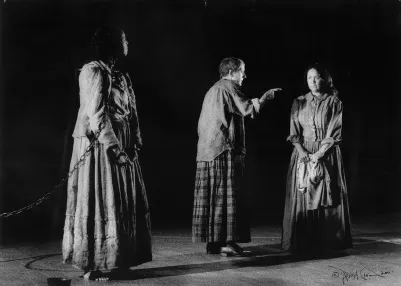
Figure 1.1 Rachael Maza as Linda, Kerry Walker as Nora and Melodie Reynolds as Obedience. Holy Day. Adelaide Festival Theatre. 2001. Courtesy of State Theatre Company of South Australia. Photo: David Wilson
As narrated by Obedience, the massacre at the riverbed, an act of vengeance for the loss of the white baby, follows a plan that targets the young:
OBEDIENCE: … They heard the shots coming from the other way. They looked to see a group of eight men on horses crossing the river. The two girls who had gone for the children were the first to be shot. Several younger children fell quickly after. The women ran toward their children and were shot in turn. The men ran for their weapons and were cut down. One woman grabbed a small child and managed to hide her in the bush. But when she went back for another she too was shot. When the full brunt of the shooting was over twenty-two people lay dead. Twelve of them children. Another fourteen injured. Eight had managed to escape in the bush. The old woman was spared. … This is our history.
(Bovell, 2001: 64)
The genocide motive is clearly set out in the speech, which emphasizes the killing of mothers and children, that is to say, the future. The detail of the little girl left in the bush resonates with abandonment and extreme vulnerability. The representation of the violence towards the mothers and babies and the subsequent rape and mutilation of the witness, Obedience, confronts audiences with the brutality of the European conquest of the Australian continent.
In 2001, when the play is first performed, in the period of raised public awareness of reconciliation, land rights and the increasing self-representation of Indigenous artists, the narrative can pl...
Table of contents
- Cover
- Title
- Copyright
- Contents
- List of Illustrations
- Series Editors’ Preface
- Acknowledgements
- Introduction: Regional Modernities in the Global Era
- Part I Changing Forms of Theatre and Drama
- Part II Mobile Performance and Fluid Identities
- Part III Beyond Regionality: The Asia-Pacific’s Global Reach
- Part IV Regional Flows
- Conclusion
- Notes
- References
- Index
Trusted by 375,005 students
Access to over 1.5 million titles for a fair monthly price.
Study more efficiently using our study tools.
Frequently asked questions
Yes, you can cancel anytime from the Subscription tab in your account settings on the Perlego website. Your subscription will stay active until the end of your current billing period. Learn how to cancel your subscription
No, books cannot be downloaded as external files, such as PDFs, for use outside of Perlego. However, you can download books within the Perlego app for offline reading on mobile or tablet. Learn how to download books offline
Perlego offers two plans: Essential and Complete
- Essential is ideal for learners and professionals who enjoy exploring a wide range of subjects. Access the Essential Library with 800,000+ trusted titles and best-sellers across business, personal growth, and the humanities. Includes unlimited reading time and Standard Read Aloud voice.
- Complete: Perfect for advanced learners and researchers needing full, unrestricted access. Unlock 1.5M+ books across hundreds of subjects, including academic and specialized titles. The Complete Plan also includes advanced features like Premium Read Aloud and Research Assistant.
We are an online textbook subscription service, where you can get access to an entire online library for less than the price of a single book per month. With over 1.5 million books across 990+ topics, we’ve got you covered! Learn about our mission
Look out for the read-aloud symbol on your next book to see if you can listen to it. The read-aloud tool reads text aloud for you, highlighting the text as it is being read. You can pause it, speed it up and slow it down. Learn more about Read Aloud
Yes! You can use the Perlego app on both iOS and Android devices to read anytime, anywhere — even offline. Perfect for commutes or when you’re on the go.
Please note we cannot support devices running on iOS 13 and Android 7 or earlier. Learn more about using the app
Please note we cannot support devices running on iOS 13 and Android 7 or earlier. Learn more about using the app
Yes, you can access Theatre and Performance in the Asia-Pacific by D. Varney,P. Eckersall,C. Hudson,B. Hatley in PDF and/or ePUB format, as well as other popular books in Media & Performing Arts & Art General. We have over 1.5 million books available in our catalogue for you to explore.