- English
- ePUB (mobile friendly)
- Available on iOS & Android
eBook - ePub
About this book
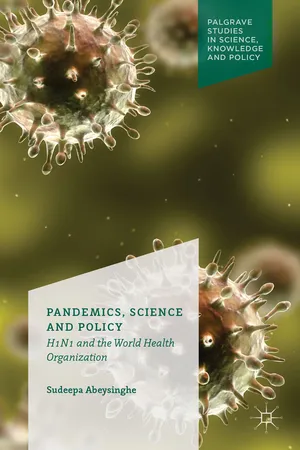
Pandemics, Science and Policy analyses the World Health Organisation's (WHO) management of the 2009 H1N1 Pandemic. Abeysinghe illustrates the ways in which the WHO's account was vulnerable to contestation, and ultimately how uncertain risks can affect policy and action on the global level.
Information
1
Introduction
There has been increasing public health emphasis upon the management of global disease threats. In particular, it has been suggested that, judging from the historical rate of incidence, a severe worldwide influenza pandemic is likely to be imminent (Lazzari & Stohr, 2004; Webby & Webster, 2003; Webster, 1997). Such an event carries the potential to cause widespread social and economic disruption. This risk therefore gives rise to a range of institutional and public expectations and reactions. A climate of heightened vigilance and surveillance, and both pre-emptive and reactionary health measures, result.
Intensified awareness surrounding the pandemic potential of influenza has resulted in a number of global pandemic scares. Prominent examples include SARS (2003) and H5N1 avian influenza (2004–2006). The largest recent global alert surrounded the 2009 A/H1N1 strain of influenza, which is commonly referred to as swine flu. Critically, unlike both SARS and avian influenza, on 11 June 2009, H1N1 was officially declared by the World Health Organization (WHO) to constitute an influenza pandemic – the first pandemic declaration in 40 years (Cohen & Enserink, 2009). From a critical social scientific perspective, this declaration was not merely a result of a set of scientific facts which objectively characterized H1N1 as a ‘pandemic’. Rather it was a consequence of socially negotiated definitions of both the H1N1 virus and the term ‘pandemic’, which was apparent in the discourse and actions of various public health stakeholders. The most notable of these actors was the WHO.
Within the contemporary framework of global public health, the WHO is principally responsible for the monitoring and reporting of infectious disease threats and for organizing and coordinating global reactions. Most importantly, the WHO is also solely responsible for producing authoritative global definitions of the term ‘pandemic’, and declaring whether any given threat constitutes a pandemic event. In this way, the actions of the WHO, and the conceptions of disease which underlie these actions, are fundamental to the social framing of a disease as ‘pandemic’, and the global reactions that follow. The WHO’s June 2009 declaration of the H1N1 pandemic produced reactions from governments and public health bodies worldwide. It prompted the implementation of national pandemic preparedness plans and global reactions, such as the production and distribution of vaccines and a heightened interest in border control.
The H1N1 virus spread globally and at a rapid rate following its initial detection (refer to Appendix 1 for a timeline of events). However, as the situation developed, it became increasingly clear that the 2009 strain would not result in high morbidity and mortality. By the WHO’s official declaration of the end of the pandemic on 10 August 2010, only approximately 18,500 laboratory-confirmed deaths had resulted from H1N1 globally (WHO Situation Update, 11 August 2010). Though the measurement of mortality in the case of pandemics is difficult to quantify (Monto, 1987), it is clear that in relation to previous influenza pandemics, which produced death rates from approximately 33,800 in the USA and 30,000 in England and Wales for the least severe (Hong Kong Influenza, H3N2, 1968/1969) through to 50 million globally for the most severe (Spanish Influenza, 1918/1919), the H1N1 pandemic was comparatively mild (Cox & Subbarao, 2000; Nguyen-Van-Tam & Hampson, 2003; Taubenberger & Morens, 2006).
As a reaction to a perceived lack of impact, the pandemic declaration by the WHO, and the actions which followed it, were called into question by numerous state and public bodies. These actors questioned fundamental facets of the WHO’s construction, including the organization’s characterization of H1N1, its definition of the concept of ‘pandemic’ and its depiction of risk. First and foremost among the institutional critics was the Council of Europe, which projected the concerns of European member states with regard to the WHO’s management of H1N1. The ensuing controversy highlighted the centrality of the WHO’s construction of the threat in framing reactions, and the fragile nature of those constructions.
The evidence that the WHO’s perspective was susceptible to criticism shows that the its construction of H1N1 had not obtained scientific closure. In fact, the WHO’s depiction of the H1N1 pandemic was fundamentally unstable, rendering the critique of its response possible. The case study of the H1N1 pandemic therefore demonstrates the centrality of the social construction of scientific fact in framing the perception and management of infectious disease threats. It also demonstrates how the accounts of the actor responsible for defining the ‘fact’ of infectious disease (here the WHO) can become contested. This contestation was a consequence of the lack of closure and inherent ambiguity in the underlying construction of the phenomenon.
In attempting to understand the contestation of the WHO’s management of H1N1, two important questions emerge: How was the disease constructed by the WHO in such a way as to precipitate global action, and how was this construction rendered liable to fundamental critique? This book seeks to understand how the H1N1 pandemic was constructed and managed by the key defining organization of the WHO. It furthermore aims to explain the mechanisms which rendered those constructions and management strategies vulnerable to critique by outside actors. In doing this, it investigates the way in which the WHO represented the H1N1 pandemic, including the organization’s risk narrative surrounding the event. Second, the book explores the wider social and institutional structures which formed the WHO’s account and subsequent management of the disease. Third, given that the WHO’s perspective became widely contested, the book seeks to understand the lack of scientific closure surrounding the concept of the H1N1 pandemic. It investigates why the WHO’s construction was fragile, and demonstrates how this led to the contestation of the WHO’s account by the prominent critic of the Council of Europe.
Through an analysis of statements and documents from the time of the pandemic, the book investigates the way in which the WHO conceptualized and constructed both the specific infectious agent, influenza A/H1N1, and the notion of ‘pandemic’. It focuses upon the following key questions:
- How did the WHO represent the nature of H1N1?
- How did the WHO characterize H1N1 as a ‘pandemic’?
- How did the WHO represent the risk surrounding H1N1?
- How did the WHO characterize its reactions to H1N1?
- What institutional structures underpinned the WHO’s representation and management of H1N1?
- What other social factors played a part in producing the WHO’s representation and management of H1N1?
- Given the contestation of the WHO’s account, in what ways had it been rendered susceptible to contestation?
- What was the basis of the Council of Europe’s contestation of H1N1, and in what ways did the WHO’s representation determine the substance and form of this critique?
- Thus, as this work progresses I will explore the characteristics of the WHO’s representation of the H1N1 pandemic, and the way in which this representation became open to contestation.
Embedded within a context of scientific uncertainty, and following an institutionalized reaction to infectious disease and a reframing of roles within global public health, the WHO’s construction of the H1N1 pandemic was rendered liable to significant external critique. As I examine each aspect of the WHO’s management of H1N1 in turn, I show that that the WHO’s framing of H1N1 as a pandemic threat was fragile and unstable as a result of the context of scientific uncertainty, institutional path dependence and shifting institutional roles within global health. Combined with the perceived mildness of the disease as events unfolded, and the democratized nature of scientific research, the WHO’s account became susceptible to contestation by outside actors.
I take a look at the problem of H1N1 in a holistic manner, starting from the small-scale characterization of the problem (the definition of the virus itself) and enlarging my focus to look at the problem of H1N1 in relation to the structures of global public health. I first explore the WHO’s construction of the H1N1 virus (Chapter 2), which is key to framing actors’ reactions to the pandemic. I investigate the inherent fragility of that construction, and examine the ways in which this uncertainty underpinned subsequent events. I move on to studying the way in which the WHO framed the problem of pandemic risk, and show how the organization attempted to maintain this characterization of risk despite the evident mildness of the disease over time (Chapter 3). Next (Chapter 4) I explore the fact that this risk construction was only possible through the institutional definition and classification of pandemic threats, made through the WHO’s Pandemic Alert Phases. As such, I investigate these phases, looking at their definitional ambiguity, and demonstrating that the WHO’s classification of ‘pandemic’ was ill-constructed and, combined with the lack of disease severity (and with the fragility of the initial construction of H1N1), was liable to outside critique.
Moving away from the act of defining the pandemic, I broaden my gaze to examine the institutional processes and politics that underpinned the response to H1N1 (Chapter 5). I start by examining the WHO’s reaction. Since the WHO had depicted H1N1 as a high risk, it needed to take some action in its management. I demonstrate how this action was framed through path-dependent institutional processes, which led to a significant emphasis upon mass vaccination. The WHO’s characterization and actions surrounding H1N1 were formed within conditions of scientific uncertainty and (path-dependent) entrenched institutional process. This resulted in the contestation of the organization’s decision-making by many outside actors.
Looking at these criticisms sheds further light on the WHO’s construction and management of H1N1. An important voice among these was that of the Council of Europe, whose critique of the WHO I explore next (in Chapter 6). Here, the fragility of the WHO’s construction of H1N1 and ‘pandemic’ come to the forefront, and this is fundamental to the Council of Europe’s critique of the institution. To end, (Chapter 7) I broaden my focus even further – to the effects and impacts of this event on the structures and institutions of global public health. I demonstrate that the instability of the WHO’s constructions, and the ability of the Council of Europe to question them, were framed within the wider structure of global public health. Here I show that the changing nature of public health undermined the authority of the WHO and in part helped to produce the lack of clarity and closure in the its construction of the H1N1 pandemic.
It is clear that the instability of the WHO’s construction of H1N1 was a function of the social context within which the organization was acting. This book demonstrates the manner in which the definition of a pandemic can become fundamentally open to contestation. It illustrates the impact of scientific uncertainty on the management of contemporary global risks, contributing to the understanding of scientific knowledge production under conditions of uncertainty. The case study of the WHO’s management of H1N1 therefore helps to illuminate both the contemporary reaction to pandemics and the problems of risk-managing institutions in dealing with fundamentally uncertain and novel events.
2
Narrating the Nature of H1N1
For a scientific object or idea to be accepted by all actors who engage with it, it first needs to reach stability as an incontestable ‘fact’. In the case of H1N1, the institution responsible for this fact-making was the WHO, since it is accountable for defining and managing global disease threats. Throughout this book I will examine how the WHO failed to effectively mobilize a stable construction of the ‘H1N1 pandemic’, ultimately resulting in the contestation of the concept by prominent global health actors. However, in order to explore the reasons why the H1N1 pandemic proved to be a fragile concept, it is first necessary to illustrate the elements of the WHO’s initial construction. This chapter examines the WHO’s attempt to define the phenomenon of H1N1. It argues that there were several factors of the construction that lent to its fragility as a scientific fact. These include a lack of early consensus on the name, a failure to articulate a robust and coherent origin narrative, and ineffectual comparisons with seasonal influenza and historical pandemics. These inadequacies meant that the concept of H1N1 did not reach definitional ‘closure’ (Callon, 1986; Pinch and Bijker, 1984), rendering it open to contestation.
In explaining the importance of constructing a stable notion of the H1N1 pandemic, the concept of ‘translation’ from actor-network theory (ANT) is valuable. ANT understands social life as consisting of associations of actor networks, such that each social actor is in fact underpinned by a complex network of other actors, as well as relationships between actors. What we understand to be the actor is rather a ‘punctualization’ – it is the condensation of an actor network onto one point (Latour, 1996; Law, 1992; Prout, 1996). The process through which these actor (network)s are formed, and punctualization is stabilized, is known as ‘translation’.
As first developed by Callon (1986), the term ‘translation’ refers to the process by which actors (including concepts/‘things’, such as a H1N1 pandemic in this case) come into existence. Translation occurs in four stages. The first is problematization, where the actor network (i.e. the ‘thing’ in question) is initially built. This stage is the subject of Chapter 3, which will explore the way in which the network-building agent (i.e. the WHO) attempted to build a stable actor network for the concept ‘H1N1 pandemic’. The second and third stages are ‘interessement’ and ‘enrolment’, which refer, respectively, to the representation of the new ‘thing’ to outside actors and the enrolment of other actors into an association with the thing. Although the successful enrolment of actors such as national governments was necessary to the translation of the pandemic (see Chapter 6 for a discussion of the WHO’s failure in enrolling outside actors in to the H1N1 actor network), this did not occur. In the case of H1N1, these processes were not achieved effectively because of the fragility of the initial problematization. The fourth and final stage – ‘mobilization’ – should occur when the developed actor network (H1N1 pandemic) is stabilized and can act in an uncontested manner – by now, effective punctualization has been performed (Callon, 1986; Latour, 2005; Law, 1992). In the case of HN1, as will be furthered argued in subsequent chapters of this book, mobilization was ineffective. As a result, the H1N1 pandemic became a questioned and contested concept.
The WHO narrative failed to demonstrate that H1N1 fulfilled the characteristics of a ‘pandemic’. Furthermore, it failed to effectively distinguish H1N1 from ‘non-pandemic’ disease. Thus the initial problematization of H1N1 was not conducted successfully. This meant that the WHO did not mobilize an effective translation of the ‘H1N1 pandemic’, a fact which eventually led to the breakdown and contestation of the concept as a whole.
What/when is a pandemic?
To appreciate the WHO’s attempts to translate H1N1 as a pandemic threat, it is necessary to understand the way in which the organization depicted the general category of ‘pandemic’. Prior to the controversy and criticism surrounding H1N1, the concept was treated by the WHO (and other health authorities) as unproblematic. It was taken for granted that a true pandemic could be distinguished as such; if a pandemic event occurred, it would be easily and clearly discerned. In short, using the terminology of ANT, the concept of ‘pandemic’ was well-punctualized and ‘black-boxed’; the network behind the actor ‘pandemic’ had been rendered invisible, and was indisposed to investigation or ‘opening’ by other actors which interacted with it (Latour, 1987). Prior to H1N1, the term ‘pandemic’ was utilized unproblematically, underpinned by the implicit assumption that all relevant actors understood what constitutes a pandemic. Since the concept was taken to be unproblematic, this black-boxed conceptualization was the frame through which early reports of H1N1 were viewed by the WHO.
The concept of ‘pandemic’ became increasingly problematic as the case of H1N1 developed. Through the initial problematization of the ‘H1N1 pandemic’ actor network, the concept was necessarily associated (i.e. was networked) with the broader idea of ‘pandemic’. When the actor network of ‘H1N1 pandemic’ failed to be effectively mobilized, the formerly unproblematic concept was also rendered liable to critique through association (see Chapter 4). However, during the initial construction of H1N1, a black-boxed understanding of ‘pandemic’ was used in referring to H1N1, in the attempts to problematize it as a pandemic. To appreciate the subsequent contestation of both concepts (H1N1 and pandemic), I will investigate these early uses.
In the early WHO documentation, a pandemic was depicted as characterized by a number of distinct features. These were the novelty of the pandemic agent; the unpredictability of the virus; the ability of the virus to spread quickly over a large geographical region; the ability of the virus to swiftly mutate into different forms; the mass susceptibility of global populations to the virus; and a differentiation from seasonal influenza. In part, these assumptions were ineffectively articulated by the WHO’s representatives. This is because the black-boxed nature of the concept ‘pandemic’ rendered it difficult for actors to propound a definition, since meaning was assumed. However, given the problematic nature of H1N1, the WHO’s representative...
Table of contents
- Cover
- Title Page
- Copyright
- Contents
- 1. Introduction
- 2. Narrating the Nature of H1N1
- 3. Risk and Scientific Uncertainty
- 4. Categorizing H1N1 – The Pandemic Alert Phases
- 5. Vaccines, Institutions and Pandemic Management
- 6. Contestation and the Council of Europe
- 7. Globalization and Global Public Health
- 8. Conclusions
- Appendices
- Notes
- Bibliography
- Index
Trusted by 375,005 students
Access to over 1.5 million titles for a fair monthly price.
Study more efficiently using our study tools.
Frequently asked questions
Yes, you can cancel anytime from the Subscription tab in your account settings on the Perlego website. Your subscription will stay active until the end of your current billing period. Learn how to cancel your subscription
No, books cannot be downloaded as external files, such as PDFs, for use outside of Perlego. However, you can download books within the Perlego app for offline reading on mobile or tablet. Learn how to download books offline
Perlego offers two plans: Essential and Complete
- Essential is ideal for learners and professionals who enjoy exploring a wide range of subjects. Access the Essential Library with 800,000+ trusted titles and best-sellers across business, personal growth, and the humanities. Includes unlimited reading time and Standard Read Aloud voice.
- Complete: Perfect for advanced learners and researchers needing full, unrestricted access. Unlock 1.5M+ books across hundreds of subjects, including academic and specialized titles. The Complete Plan also includes advanced features like Premium Read Aloud and Research Assistant.
We are an online textbook subscription service, where you can get access to an entire online library for less than the price of a single book per month. With over 1.5 million books across 990+ topics, we’ve got you covered! Learn about our mission
Look out for the read-aloud symbol on your next book to see if you can listen to it. The read-aloud tool reads text aloud for you, highlighting the text as it is being read. You can pause it, speed it up and slow it down. Learn more about Read Aloud
Yes! You can use the Perlego app on both iOS and Android devices to read anytime, anywhere — even offline. Perfect for commutes or when you’re on the go.
Please note we cannot support devices running on iOS 13 and Android 7 or earlier. Learn more about using the app
Please note we cannot support devices running on iOS 13 and Android 7 or earlier. Learn more about using the app
Yes, you can access Pandemics, Science and Policy by S. Abeysinghe in PDF and/or ePUB format, as well as other popular books in Social Sciences & Education General. We have over 1.5 million books available in our catalogue for you to explore.