- English
- ePUB (mobile friendly)
- Available on iOS & Android
eBook - ePub
About this book
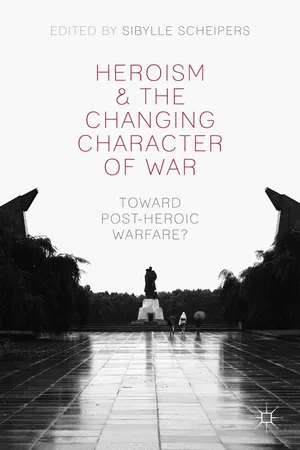
Post-heroism is often perceived as one of the main aspects of change in the character of war, a phenomenon prevalent in western societies. According to this view, demographic and cultural changes in the west have severely decreased the tolerance for casualties in war. This edited volume provides a critical examination of this idea.
Information
Part I
Heroism and Self-Sacrifice What For?
1
Heroism and the Nation during the French Revolutionary and Napoleonic Wars and the Age of Military Reform in Europe
I
According to a common understanding, European wars in the period from the French Revolution to the mid-twentieth century were national wars. One nation attacked another and war was fought for the sake of the nation. Things seem to have completely changed today: not only has coalition warfare become the rule and wars of one nation against another much less frequent, it even appears that ‘nation-building’ – for instance in a country like Afghanistan – became part of a ‘peace building’ strategy. Thus the reference to the nation has completely changed its meaning: from a motivation for war, and even for total war, to a ground on which peace is to be built. In order to understand this apparent paradox, it is necessary to enquire what historical actors were actually talking about when invoking the nation as a motivation for fighting, for heroism and for self-sacrifice. Many scholars of the nation and of nationalism have underlined that it is quite difficult to define the nation. However, a basic understanding today seems to involve a definition of the nation as people sharing a territory, a common language and culture, as well as some community of ethnic descent. It is immediately clear that processes of globalization and of migration have effectively challenged this meaning today. However, it is the contention of this chapter that the nation was right from the onset an unstable ground for a motivation to fight and that the concept carried multiple and partly contradictory meanings that have always been incompatible with the above-outlined understanding of the nation and of nationalism. More precisely, if any motivation to fight could be derived from a reference to the nation, this term should be understood in a strictly political sense, rather than in ethnic, cultural or linguistic terms. In order to illustrate this, I will analyse some contemporary references to ‘nationalism’ as an impetus for war, derived from different contexts and by different actors: political decision-makers, public intellectuals and soldiers themselves.1
II
My first example is from the time of the Seven Years War and more precisely from 1761.2 Prussian writer Thomas Abbt published a patriotic pamphlet entitled Vom Tode für das Vaterland (On Death for the Fatherland), which was, to my knowledge, the first modern expression in the German lands of the idea that the fatherland was something worth fighting and dying for.3 In order to make this idea acceptable, Abbt had to confront a crucial question: did Prussian subjects have a fatherland at all? The question may sound unrelated to our conceptual framework in which the nation related to culture, language, territory and ethnic descent. But the question was not without meaning in the eighteenth century. Following a traditional argument, only citizens of republics were seen to have a fatherland, whereas subjects of monarchies did not. A fatherland, and thus a nation in the modern sense, only exists when the individual is politically linked to the state.
In order to make his point and to demonstrate that Prussian subjects not only had a fatherland, but that this fatherland was even something worth dying for, Abbt had to confront the common opinion at his time that a monarchical fatherland was nothing but ‘an empty fantasy’, that is pure ideology.4 Abbt drew heavily on Montesquieu for whom ‘honour’ was the basic mental disposition on which monarchical statecraft relied.5 However, in contrast to Montesquieu, Abbt argued that each citizen should be to some degree a bearer of honour. National honour, as embodied by the monarch and the laws given by him, could thus become an object of the citizens’ passions. According to Abbt, this would have a moralizing impact: rather than pursuing their narrow individual and egoistic ends, citizens would be elevated to contemplating some higher objective. As a consequence, the citizen’s (Bürger) attachment to earthly things – and especially to one’s own life – would be elevated to a sense of honour and glory.
However, the view that military service could contribute to the elevation and moral education of the citizen was quite marginal in the debates of the eighteenth century. Attempts to construct national citizenship within the framework of the monarchical state were intrinsically contradictory. In fact, the early modern state was characterized by its attempt to neutralize religious and political ‘opinions’ from the sphere of a bureaucratically backed sovereignty and thus tended to exclude ideological struggles from the political sphere. ‘Opinions’ such as religious faiths or political convictions were thus relegated to the individual’s ‘inner moral space’.6 Absolutist subjects could have private opinions, and they could even share these opinions with other individuals, but they were not part of any political community because their political existence depended entirely on the state. The state, however, excluded any feeling of belonging inasmuch as it banned all opinions. This exclusion of all communitarian bonds was the reason for the transcendence of the state.7 Accordingly, there was hardly a possibility for soldiers or citizens to identify with the state as Abbt advocated it.
III
This situation changed with the French Revolution. The citizen is now conceived of as a part of the sovereign and is, as such, not only endowed with the capacity of autonomous political action, but also with political ‘opinions’ in contemporary parlance. Today, we would use the term ‘ideologies’. ‘Wars of opinions’ seemed to be banned from Europe since the religious civil wars, and especially conservative political and military observers were horrified by the fact that, from 1792 onwards, these ‘barbaric’ wars of opinions reappeared on the European scene.8 In contrast to wars that were waged for material interests, wars of opinion were more difficult to settle by compromise, because each belligerent party was fighting for values. Wars fought for material interests were thought to be more likely to be limited, whereas wars of opinion had a tendency to unlimited escalation, precisely because they were fought in the name of values worth fighting and ultimately dying for.
However, which values precisely were involved? Many actors of the French Revolution invoked the nation. For instance, Robespierre depicted the French army as
the glory of the nation and of humanity; our virtuous warriors are shouting Vive la République when marching towards victory; falling by the enemy sword, their scream is Vive la République. Their last words are hymns to liberty; their last sighs are vows to the fatherland.9
However, this quotation shows that the nation is here synonymous for a whole series of politically key concepts: liberty, republicanism and even – perhaps more surprisingly – humanity. Especially this last reference to humanity conveys a universal value that seems utterly incongruent with our modern understanding of the nation. It is interesting and puzzling that the nation from the onset carried meanings that did not really fit into the narrative of war of one nation against another. The same holds true for the concepts of liberty and republicanism, because it is not immediately clear why these should be the exclusive property of one nation rather than of another.
Even when looking at examples of nationalization of the armed forces in a more traditional sense the picture does not become any clearer. In August 1792, a couple of months after the beginning of the war, the National Assembly decided to disband units of foreign troops in France. Jacques Pierre Brissot de Warville, adversary of Robespierre and one of the apologists of the war within the Jacobin Club, presented a report to the Assembly in which he explained the reasons why foreign units should be disbanded. His main point was that ‘free men ought to defend themselves’. In contrast to the Frenchmen who had recently conquered their political liberty, the Swiss units of the French army were depicted as ‘an isolated and particular force, foreign to our principles, to our system of government’.10 It would thus be an error to interpret Brissot’s argument as simply nationalistic. When he claims that the Swiss are not part of the French political community, this exclusion is not justified on ethnic, cultural or national ground in the modern sense, but premised on political reasons. Brissot explicitly invoked the fact that the Swiss soldiers under French colours were actually not supposed to fight external enemies, but against the revolution within France. They were supposed to help a tyrant oppressing the French population.
This is a perfect expression of the fragility of the concept of the nation. As historical research on nationalism has amply demonstrated, the first meaning of the nation was political, rather than nationalist in the modern sense – it signified ‘the people’ and more precisely the sovereign people endowed with civil rights. Accordingly, the Swiss could be said not to belong to the nation exactly in the same sense in which the tyrant they were supposed to defend against the sovereign people was not a part of the nation in this understanding.
However, as Eric Hobsbawn argued in his standard account of Nations and Nationalisms since 1780,
the very act of democratizing politics that is of turning subjects into citizens, tends to produce a populist consciousness which, seen in some light, is hard to distinguish from a national, even a chauvinist, patriotism – for if ‘the country’ is in some way ‘mine’, then it is more readily seen as preferable to those of foreigners, especially if these lack the rights and freedom of the true citizen.11
Brissot’s argument is one example among others of this fragile line where the older political understanding merges with the modern understanding of the nation in terms of a common culture or ethnicity.
IV
However, when looking at ego-documents from soldiers of the French Revolution it becomes clear that nationalist motivations in the modern sense hardly play a role. Where these soldiers expressed any intrinsic motivations, their rhetoric is political and they depict their fight as a fight for liberty and republicanism rather than in national terms. Their ideological mindset was indeed very close to the one expressed by intellectuals or political decision-makers like Robespierre. We thus find very often references to liberty,12 the republic13 and the fatherland14 in the writings of soldiers of the French Revolution. Especially during the first years of revolutionary war soldiers considered themselves as fighters for liberty and human rights and were happy to be recognized as such by the population.15 Accordingly, they were unable to understand when this feeling was not shared by those they wanted to ‘liberate’. A volunteer of 1792 described this disarray in front of civilians in Germany who ‘behaved very badly, many fired on our troops; it was even said that they committed the inhumanity of throwing the sick out of the windows’.16 Hence, the population had to be brought to recognize the justice of revolutionary war. Another soldier wrote about ‘rendering patriotic the town by arms’17 and about ‘warming up’ the population’s patriotism by threatening them with the ‘holy guillotine’ in order to ‘bring them to reason’.18 On the other hand, in these years few soldiers stressed national belongings, and if they mentioned their ‘Frenchness’ in the face of the enemy, their concept of nationality conveys the same ambiguities as mentioned above. The volunteer Joliclerc expressed this in the following words: ‘I like myself, but I like even more my family and I like more my fatherland than my family, and the entire word more than my fatherland. One needs always to be ready to sacrifice oneself.’19 These examples demonstrate that the nation was not per se a cause worth fighting for, but only inasmuch as it conveyed either a political meaning – liberty and republicanism – or as a potentially universal entity that embraced humanity as a whole. This concept of the nation bears little resemblance to modern nationalism. However, Joliclerc added that he felt ‘French in the face of the enemy for the defence of the fatherland, which is a glorious cause that should animate the whole world’.20 Here, the internal tension of the revolutionary concept of the nation becomes the most visible: the universal value of the fight for liberty and human rights (‘that should animate the whole world’) is clearly associated with the cause of the French army. The French Republic, in other words, is conceived of as the concrete historical embodiment of universal human values. It is only a small step from such a conception to the ‘moral annihilation’ of the enemy: if I fight for universal values of humankind, my enemy is of necessity conceived of as the enemy of these universal human values. If I embody humanity, my enemy embodies the non-human.
V
The same holds true when turning to the perhaps most prominent advocate of German nationalism of the period, the philosopher Johann Gottlob Fichte. In 1793 he published a Beitrag zur Berichtigung der Urtheile des Publikums über die französische Revolution (Contribution to the Correction of the Judgement of the Public on the French Revolution) which made him one of the most influential defenders of the French Revolution among the German intelligentsia, and this precisely at a time when most German intellectuals were horrified by the execution of Louis XVI in January 1793. Yet in a few ye...
Table of contents
- Cover
- Title
- Copyright
- Contents
- List of Figures and Tables
- Acknowledgements
- Notes on Contributors
- Introduction: Toward Post-Heroic Warfare?
- Part I Heroism and Self-Sacrifice What For?
- Part II Casualty Aversion
- Part III Combat Motivation
- Part IV From Heroes to Victims?
- Select Bibliography
- Index
Trusted by 375,005 students
Access to over 1.5 million titles for a fair monthly price.
Study more efficiently using our study tools.
Frequently asked questions
Yes, you can cancel anytime from the Subscription tab in your account settings on the Perlego website. Your subscription will stay active until the end of your current billing period. Learn how to cancel your subscription
No, books cannot be downloaded as external files, such as PDFs, for use outside of Perlego. However, you can download books within the Perlego app for offline reading on mobile or tablet. Learn how to download books offline
Perlego offers two plans: Essential and Complete
- Essential is ideal for learners and professionals who enjoy exploring a wide range of subjects. Access the Essential Library with 800,000+ trusted titles and best-sellers across business, personal growth, and the humanities. Includes unlimited reading time and Standard Read Aloud voice.
- Complete: Perfect for advanced learners and researchers needing full, unrestricted access. Unlock 1.5M+ books across hundreds of subjects, including academic and specialized titles. The Complete Plan also includes advanced features like Premium Read Aloud and Research Assistant.
We are an online textbook subscription service, where you can get access to an entire online library for less than the price of a single book per month. With over 1.5 million books across 990+ topics, we’ve got you covered! Learn about our mission
Look out for the read-aloud symbol on your next book to see if you can listen to it. The read-aloud tool reads text aloud for you, highlighting the text as it is being read. You can pause it, speed it up and slow it down. Learn more about Read Aloud
Yes! You can use the Perlego app on both iOS and Android devices to read anytime, anywhere — even offline. Perfect for commutes or when you’re on the go.
Please note we cannot support devices running on iOS 13 and Android 7 or earlier. Learn more about using the app
Please note we cannot support devices running on iOS 13 and Android 7 or earlier. Learn more about using the app
Yes, you can access Heroism and the Changing Character of War by S. Scheipers in PDF and/or ePUB format, as well as other popular books in History & Military & Maritime History. We have over 1.5 million books available in our catalogue for you to explore.