- English
- ePUB (mobile friendly)
- Available on iOS & Android
eBook - ePub
About this book
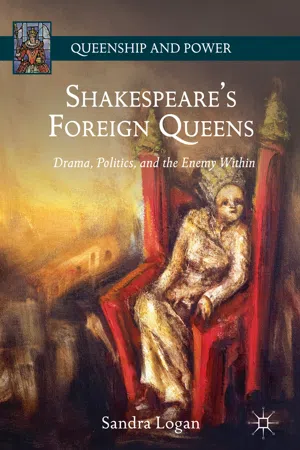
This book examines Shakespeare's depiction of foreign queens as he uses them to reveal and embody tensions within early modern English politics. Linking early modern and contemporary political theory and concerns through the concepts of fragmented identity, hospitality, citizenship, and banishment, Sandra Logan takes up a set of questions not widely addressed by scholars of early modern queenship. How does Shakespeare's representation of these queens challenge the opposition between friend and enemy that ostensibly defines the context of the political? And how do these queens expose the abusive potential of the sovereign? Focusing on Katherine of Aragon in Henry VIII, Hermione in The Winter's Tale, Tamora in Titus Andronicus, and Margaret in the first history tetralogy, Logan considers them as means for exploring conditions of vulnerability, alienation, and exclusion common to subjects of every social position, exposing the sovereign himself as the true enemy of the state.
Information
© The Author(s) 2018
Sandra LoganShakespeare’s Foreign QueensQueenship and Powerhttps://doi.org/10.1057/978-1-137-53484-2_11. Introduction: Foreign Queens, Abusive Sovereignty, and Political Theory in the Past and the Present
Sandra Logan1
(1)
Michigan State University, East Lansing, MI, USA
Overview
This book considers how, in Shakespeare’s plays, the presence, conditions, and experiences of foreign queens make visible the abusive potential of embodied sovereignty, and reveal the sovereign himself as the most likely internal enemy. Each of the four main chapters focuses upon Shakespeare’s use of a foreign queen to reveal and embody the tensions within early modern English politics, and additionally, demonstrates how contemporary political terms and concepts can help us to recognize less obvious aspects of Shakespeare’s plays. Much excellent scholarly work has probed the historical conditions and literary representations of queenship in early modern England, and of gender in early modern historical and literary contexts. In this book, I consider Shakespeare’s depiction of four foreign queens within the courts of his plays—Katherine of Aragon in Henry VIII, Hermione in The Winter’s Tale, Tamora in Titus Andronicus , and Margaret in the first history tetralogy.1 I take up a set of questions not widely addressed by early modern queenship scholars: How did Shakespeare engage with and make use of the foreign queen at the heart of the nation? How does his representation of such women challenge the apparently straightforward opposition between friend and enemy that, according to major early modern and contemporary political theorists, defines the context of the political? What are the effects of sovereignty’s authority above law, its capacity to decide on the exception and the emergency , on the internal and external enemy? What are the options if the sovereign himself becomes the enemy to the state and the commonweal ? How can subjects respond to such a situation? And how does the intersection of patriarchy and monarchy point up the problems associated with embodied sovereign authority?
While focusing on alien women in Shakespeare’s royal families, this book does not primarily aim to explore gender relations per se. Rather, I consider how, in these plays, the experiences of foreign queens epitomize conditions that potentially affect men and women from every point within the sociopolitical structure. Through these queens, I explore a cluster of political themes of continuing importance: what it means to be divided between nations in loyalties and identity ; how hospitality is offered, and whether unconditional hospitality can be achieved; how to navigate the relationship between citizenship and subjection ; how banishment or exile constitutes a condition at once disabling and enabling.2 In other words, my interest here is in how Shakespeare employs women characters of a particular sort—those who enter the social and political system from beyond its boundaries—as a means to explore various conditions of vulnerability, alienation, and exclusion common to domestic subjects of every social position.3 Foreign queens are uniquely vulnerable within the domestic and political space they enter, subjects of and subject to the intersecting forms of authority of the husband/king. As such, they comprise the potential target of extreme abuse, but all subjects are vulnerable to similar, though less personal, forms of political violence. Even when explicit abuse is not at issue, as it is not in the Henry VI plays , the effects of dislocation and isolation instigate forms of disenfranchisement and resistance that may also arise in subjects beyond the royal family and the relatively rarefied atmosphere of the court.
Foreignness: Subjects and Aliens
Legal status in England in the early modern period was primarily a function of birth: one was born either an alien, or a subject. In Aliens in Medieval Law, Keechang Kim emphasizes that the concept of alien status was longstanding, but that it underwent a transformation over time as part of a larger shift in legal definitions of personal status, from its earlier basis in “liberates and privilegia to the abstract notion of political faith and allegiance .”4 One important step in this transformation came from John Fortescue, who argued that the people born into a kingdom were naturally bound in a mystic relationship to the king who was their head. Fortescue argued, as Kim summarizes, “Law (Lex) was responsible for the internal cohesion and unity of the mystic body of the kingdom, but fealty to the king was essentially an effect of birth.”5 Perspectives on alien status continued to shift as jurists debated succession questions during the reign of Elizabeth I. By the late sixteenth century, aliens in England were unable to inherit property because they were not considered bound in fealty to the English sovereign; the sovereign therefore owed them no protection, and thus their right of inheritance was not supported by law. Bodin makes this point in Six Books.6
The 1608 legal case known as ‘Calvin’s Case’ refined these ideas. For example, where John Fortescue argued that civil law bound subjects together in fealty to the king, in his decision on the case, Edward Coke determined that such fealty was based on natural law.7 Further, he emphasized that this fealty was to the mortal body of the king, not to his immortal political body, for in cases of an attempted regicide, for example, the attempt was on the body of the living king, not on the body politic as a whole.8 This decision, which relied upon changing views of the relationship of subjects to each other, to the commonwealth , to the sovereign , and to the law, revealed clearly that ‘alien’ was no longer purely a spatial designation—“to be born ‘within’ or ‘without’ the legeance was [now] a question of faith and allegiance.”9 In effect, birth outside the boundaries of England (and now, Scotland) marked the absence of the naturally occurring bond of loyalty that all English-born subjects held through birth. Parentage, which had been a factor in the succession arguments, was not part of the consideration at this point. The decision affirmed that the notion of allegiance to the king was the defining characteristic of subjects, and its absence the defining characteristic of aliens. By the first decade of the seventeenth century, these legal decisions had thus codified a bizarre abstraction through which place of birth was translated into a bond of fealty to the mortal body of the monarch—a direct commitment to obedience which was naturally occurring and instigated by the eternal law of nature. These decisions also suggest that the body politic and the body natural of the king were not bound inextricably together.
However, as Jane Pettegree reveals, beyond legal definitions and perceptions of ‘native’ and ‘alien’, national identity was neither stable nor essential. Specifically addressing representations of national identity on the early modern English stage, she explains, “The collective recognition of native identity relies on a consensual agreement that certain attributes should form a ‘natural’ core … [which] reflect[s] an aspirational identity rather than one based on unadulterated reality.”10 Pettegree suggests that, in terms of lived experience, such alignments were anything but fixed and stable: “At any point in history, collective identities are being continuously formed and re-formed as individuals experience and reflect upon their place in society.”11 Beyond this internal reconfiguration, she notes, “The metaphors that generate political identities often express … not simply a binary opposition between ‘us’ and ‘them’, but more often a complex and interpenetrated matrix of ideas of ‘foreign’ and ‘native’.”12 Thus, despite the legal notion that one is born into legeance to the king, we can see that the perception of self in nationalistic ...
Table of contents
- Cover
- Front Matter
- 1. Introduction: Foreign Queens, Abusive Sovereignty, and Political Theory in the Past and the Present
- 2. Katherine of Aragon’s Fragmented Identity in Henry VIII
- 3. The Friend, the Enemy, the Wife, and the Guest: Conditional and Unconditional Hospitality in The Winter’s Tale
- 4. Strange Bedfellows: Friend, Enemy, and the Commonweal in Titus Andronicus
- 5. Margaret and the Ban: Resistances to Sovereign Authority in Henry VI 1, 2, & 3 and Richard III
- Back Matter
Trusted by 375,005 students
Access to over 1.5 million titles for a fair monthly price.
Study more efficiently using our study tools.
Frequently asked questions
Yes, you can cancel anytime from the Subscription tab in your account settings on the Perlego website. Your subscription will stay active until the end of your current billing period. Learn how to cancel your subscription
No, books cannot be downloaded as external files, such as PDFs, for use outside of Perlego. However, you can download books within the Perlego app for offline reading on mobile or tablet. Learn how to download books offline
Perlego offers two plans: Essential and Complete
- Essential is ideal for learners and professionals who enjoy exploring a wide range of subjects. Access the Essential Library with 800,000+ trusted titles and best-sellers across business, personal growth, and the humanities. Includes unlimited reading time and Standard Read Aloud voice.
- Complete: Perfect for advanced learners and researchers needing full, unrestricted access. Unlock 1.5M+ books across hundreds of subjects, including academic and specialized titles. The Complete Plan also includes advanced features like Premium Read Aloud and Research Assistant.
We are an online textbook subscription service, where you can get access to an entire online library for less than the price of a single book per month. With over 1.5 million books across 990+ topics, we’ve got you covered! Learn about our mission
Look out for the read-aloud symbol on your next book to see if you can listen to it. The read-aloud tool reads text aloud for you, highlighting the text as it is being read. You can pause it, speed it up and slow it down. Learn more about Read Aloud
Yes! You can use the Perlego app on both iOS and Android devices to read anytime, anywhere — even offline. Perfect for commutes or when you’re on the go.
Please note we cannot support devices running on iOS 13 and Android 7 or earlier. Learn more about using the app
Please note we cannot support devices running on iOS 13 and Android 7 or earlier. Learn more about using the app
Yes, you can access Shakespeare’s Foreign Queens by Sandra Logan in PDF and/or ePUB format, as well as other popular books in History & British History. We have over 1.5 million books available in our catalogue for you to explore.