This volume examines the impact of the wars in the Atlantic world between 1770 and 1830, focusing both on the military, economic, political, social and cultural demobilization that occurred immediately at their end, and their long-term legacy and memory.
eBook - ePub
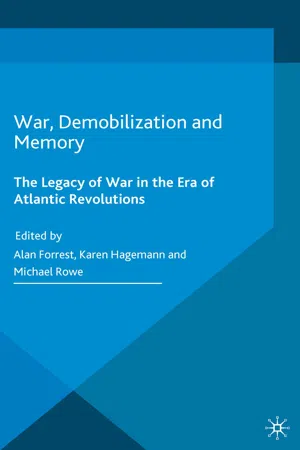
War, Demobilization and Memory
The Legacy of War in the Era of Atlantic Revolutions
- English
- ePUB (mobile friendly)
- Available on iOS & Android
eBook - ePub
War, Demobilization and Memory
The Legacy of War in the Era of Atlantic Revolutions
About this book
Information
Part I
Rethinking the Legacy of Conflict in the Era of Atlantic Revolutions
1
Introduction: War, Demobilization and Memory in the Era of Atlantic Revolutions
The picture that appears on the cover of this book, Moritz Daniel Oppenheim’s The Return of the Volunteer from the Wars of Liberation to his Family still living in Accordance with the Old Customs, may seem a strange choice for a volume that purports to speak to war, demobilization and memory in the Era of Atlantic Revolutions—starting in the 1770s and ending in the 1830s. The German-Jewish painter Oppenheim, born in 1800 in the Hessian town of Hanau, was too young to volunteer for the Wars of 1813–1815, the final struggle to liberate Germany and Europe from Napoleonic rule. But in this painting, which dates from 1833–1834, Oppenheim invoked the memory of these wars. He referred to the participation of young Jewish volunteers in what he saw as a fight for liberation and liberty.1 His painting portrays the return of one of these victorious fighters after demobilization to the warmth of his family. Like many other Jewish families that had allowed their sons to participate in these ‘people’s wars’, they had hoped to become part of the German people as a result of their patriotic support for the war. The Jewish volunteers also expected to get equal citizenship rights after the wars—as was promised by kings and princes—because they had done their military duty as men and protected family, home and country.2
Though for us today the painting seems to have little that is revolutionary about it, for Oppenheim’s contemporaries it clearly spoke to the national myths of the uprising of the German people against Napoleon and their struggle for liberation, liberty and national unity. The painting is especially interesting for our subject because it represents broken promises in a dual sense: both the hopes of the population at large for German unification and greater political liberty and the hopes of the Jewish community for their own emancipation were crushed in the period of postwar restoration. For both reasons, the painting seems to have enjoyed considerable popularity in its time, as the many reproductions indicate.3
Oppenheim, who was the first academically trained Jewish painter in Germany, did not create a heroic history painting in the traditional sense of the term. National governments commissioned paintings that focused on events of high-political and military importance to hang in their national galleries and public buildings. Thus the US Capitol is decorated with John Trumbull’s 1820 painting Surrender of Lord Cornwallis, commemorating a key moment of American pride in the Wars of Independence, and the Palace of Westminster with Daniel Maclise’s 1861 painting of The Meeting of Wellington and Blücher after the Battle of Waterloo. Windsor Castle is endowed with an entire Chamber in memory of the battle and Allied military heroes, whilst the Winter Palace in Saint Petersburg boasts its Military Gallery containing the portraits of hundreds of generals who fought in the ‘Patriotic War’ of 1812. Napoleon, most famously, turned to the finest artists of the day—Jacques Louis David, Antoine-Jean Gros and Jean-Auguste-Dominique Ingres—to provide heroic images of his victories and portraits that would capture the imagination of a continent.4
Art remained a political weapon even after the guns fell silent, recording victories and emphasizing the martial qualities of nations. Almost unavoidably these were highly gendered images, highlighting the role of warriors and kings. Women were generally absent from such paintings, or were relegated to domestic scenes. Oppenheim’s The Return of the Volunteer is very different, revealing subtly changing sensibilities about war and depicting soldiers and civilians, women as well as men, and people of every generation from the youngest to the oldest. It places emphasis on the idea of inclusion, on status that is related to ability and aspiration rather than to the old order of estates. It suggests the emergence of new nations bound together by the principle of citizenship, and equates that citizenship with the performance of military service.5 It has left the world of the eighteenth century far behind.
Oppenheim’s painting was a product of Germany in the period of the Vormärz. Painted in the years after the July Revolution of 1830 in France and the German Hambach Festival of May 1832, where thousands had demonstrated for national unity and liberty at Hambach Castle in present-day Rhineland-Palatinate, it expresses universal aspirations, too. On the one hand it represents the hope for more political rights and equal citizenship as recognition of the military service that many soldiers, especially volunteers and militias, had shared during the Era of Atlantic Revolutions. On the other hand it embodies the desire of soldiers everywhere to return to their families and the relief of their loved-ones upon their homecoming. It was a moment that had kept men going in the midst of terrible deprivations, and only accentuated the plight of those who emerged from the conflict with nowhere to go to, whose families had been killed, whose homes had been destroyed, and whose prospects had been ruined in the fighting.
This close entanglement of the political, social and personal was true of all the conflicts during the Era of Atlantic Revolutions: wars about empire and global hegemony as well as wars of liberation and decolonization. During this era the Atlantic became a highway for exchange not only of peoples and commodities but also of ideas and cultural practices. Improving literacy and the spread of the printed word meant that the public in both Europe and the Americas was made aware of events from across the ocean and the new ideas of fraternity, liberty and unity. For the new forms of mass struggle that characterize this era, patriotic-national propaganda attempted to mobilize soldiers and civilians, men and women, rich and poor, free and enslaved alike. This was most clearly seen in the American, French and Haitian Revolutions and in the Wars of Liberation in Spanish America.6
It is not the purpose of this volume to examine the processes of military, political and cultural mobilization for revolution and war—here many important studies have already been published.7 Instead, it focuses on the much less explored theme of the military, economic, political, social and cultural demobilization after these conflicts, not only by states but also by local communities and individuals, and examines the long-term legacy of these conflicts and their collective memories, because the transition from war to peace was a huge challenge for all the states and societies involved. In the following pages we will first reflect on the specific character of war and postwar in the Era of Atlantic Revolutions, and then discuss the agenda of the book in more detail and explore the different areas of demobilization and collective memory construction.
Rethinking war and postwar
The decades between the 1770s and 1830s were scarred by war throughout the Atlantic world. The period began with the American Revolutionary Wars (1775–1783) (see Map 1.1), included the French Revolution (1789–1799) and its Wars (1792–1799) and the Napoleonic Wars (1803–1815) (see Map 1.2), the Haitian Revolution (1791–1804) and the conflicts in the Caribbean, and ended with the Spanish American Wars of Independence (1808–1833) (see Map 1.3). The Americas and Europe were part of an Atlantic world which shared a collective identity shaped by the twin forces of revolution and war. Earlier periods had, of course, been marked by lengthy periods of warfare, including such global conflicts as the War of the Spanish Succession (1701–1714) and the Seven Years War (1754–1763), the second of which had actually broken out in the Americas. But it is the linking of war and revolution that makes the half-century between the 1770s and 1830s distinctive, with its huge concentration of wars and the resultant dislocation which demobilization incurred.
Wars in these years were of unprecedented scale and extent, requiring a massive mobilization of men for the military. Mass armies were deployed, composed of conscripts, militias and volunteers, as well as long-service professionals. As revolutionary and conservative regimes alike used armies of increasing size across Europe and the Americas, the conduct of warfare was transformed, too. This was not so much through the introduction of new weaponry, which largely remained unaltered, but by the new demands of mass armies. These demands also imposed new burdens on the economy and society, which in turn transformed the political, social and gender orders on both sides of the Atlantic. Soldiers and civilians of all classes, races, and ethnicities—men and women—were mobilized for war with a greater intensity than ever before. Extensive financial and material support by civilians through taxes and tributes, requisitions and quartering, outfitting soldiers, medical care and war charity was badly needed by all war powers. Without these varied forms of civilian war support mass warfare on this scale would not have been possible. To mobilize this support, coercion alone was not enough. Even conservative governments used intensive patriotic-national propaganda that addressed civilians and soldiers alike. Often it promised soldiers—regardless of race—personal freedom and political rights in return for military service. When necessary, the armed forces on all sides admitted to their ranks groups of men that had previously been marginalized, including, in some instances, slaves.8
The global scale of warfare, the extent to which the wars of the era included civil society, and the close entanglement of war, politics and culture have led some historians of the period, among them David A. Bell and Jean-Yves Guiomar, to suggest that these were wars of a quite different kind from previous conflicts, to the extent that they should be thought of as the first instances in history of ‘total war’—war that affected all classes of society, independent of their ethnicity, gender or race, and necessitated massive economic and cultural resources.9
The term ‘total war’ has been contested, of course, not least by historians of twentieth-century warfare. But there is no doubting the scale of these conflicts or the overarching ambition of the powers engaged in them. They were fought over continents and across oceans, involving India and the Orient as well as the Atlantic world. They were characterized by their maximalist war aims and by the huge systemic changes which they brought about. Wars were now fought to change social and political regimes and to free colonized peoples from the rule of multinational empires; they involved mass armies, armed populations and civilians, and already crossed the lines between ‘front’ and ‘homeland’. The civilian population became a target long before the two World Wars, as the siege of a number of cities—including Boston (1775), Breslau (1806), Saragossa (1809), Moscow (1812), Hamburg (1813–1814) and Washington (1814)—and the destruction of thousands of towns and villages indicate.10 War atrocities are also no invention of the twentieth century. They were quite common in the Era of Atlantic Revolutions, as several new studies have shown.11 The civilian population was already being targeted, too, by economic blockades like the Continental System (1806–1814), declared by Napoleon with the Berlin Decree in November 1806 in response to the naval blockade of the French coasts enacted by the British government in May of the same year.12
As a result, the wars of this era fused the military and civilian worlds more closely than in previous generations: Oppenheim’s image is unmistakably one of war fought in the period from the 1780s to 1830s, and would have been barely conceivable earlier, even during...
Table of contents
- Cover
- Copyright
- Title
- Contents
- List of Figures, Graphs and Maps
- Series Editors’ Preface
- Preface and Acknowledgements
- Notes on Contributors
- List of Abbreviations
- Part I. Rethinking the Legacy of Conflict in the Era of Atlantic Revolutions
- Part II. Peace Making, Occupation and Military Demobilization
- Part III. The Aftermath of War in Politics and Political Culture
- Part IV. Restoring Postwar Economies and Reordering Societies
- Part V. Postwar Cultures and Contested War Memories
- Part VI. Conclusion
- Bibliography: The Legacy of War in the Era of Atlantic Revolutions
- Index
Trusted by 375,005 students
Access to over 1.5 million titles for a fair monthly price.
Study more efficiently using our study tools.
Frequently asked questions
Yes, you can cancel anytime from the Subscription tab in your account settings on the Perlego website. Your subscription will stay active until the end of your current billing period. Learn how to cancel your subscription
No, books cannot be downloaded as external files, such as PDFs, for use outside of Perlego. However, you can download books within the Perlego app for offline reading on mobile or tablet. Learn how to download books offline
Perlego offers two plans: Essential and Complete
- Essential is ideal for learners and professionals who enjoy exploring a wide range of subjects. Access the Essential Library with 800,000+ trusted titles and best-sellers across business, personal growth, and the humanities. Includes unlimited reading time and Standard Read Aloud voice.
- Complete: Perfect for advanced learners and researchers needing full, unrestricted access. Unlock 1.5M+ books across hundreds of subjects, including academic and specialized titles. The Complete Plan also includes advanced features like Premium Read Aloud and Research Assistant.
We are an online textbook subscription service, where you can get access to an entire online library for less than the price of a single book per month. With over 1.5 million books across 990+ topics, we’ve got you covered! Learn about our mission
Look out for the read-aloud symbol on your next book to see if you can listen to it. The read-aloud tool reads text aloud for you, highlighting the text as it is being read. You can pause it, speed it up and slow it down. Learn more about Read Aloud
Yes! You can use the Perlego app on both iOS and Android devices to read anytime, anywhere — even offline. Perfect for commutes or when you’re on the go.
Please note we cannot support devices running on iOS 13 and Android 7 or earlier. Learn more about using the app
Please note we cannot support devices running on iOS 13 and Android 7 or earlier. Learn more about using the app
Yes, you can access War, Demobilization and Memory by Alan Forrest, Karen Hagemann, Michael Rowe, Alan Forrest,Karen Hagemann,Michael Rowe in PDF and/or ePUB format, as well as other popular books in History & European History. We have over 1.5 million books available in our catalogue for you to explore.