- English
- ePUB (mobile friendly)
- Available on iOS & Android
eBook - ePub
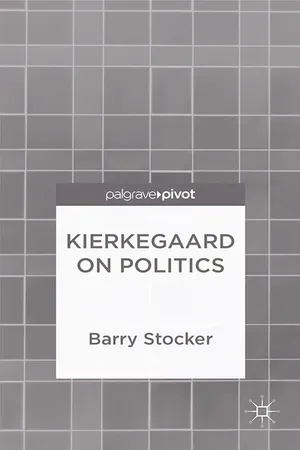
Kierkegaard on Politics
About this book
This investigation of Kierkegaard as a political thinker with regard to the Danish context, and to his place in the history of political thought, deals with the more direct discussion of politics in Kierkegaard, and the ways in which political ideas are embedded in his literary, aesthetic, ethical, philosophical ,and religious thought.
Information
Topic
PhilosophySubtopic
Philosophy History & Theory1
Introduction
Abstract: The argument is made that Kierkegaard is not just an apolitical thinker, who is an extreme conservative when he has anything to say about politics. There is a look at the ways that philosophers bring in political ideas when discussing other areas of philosophy, which is relevant to the way that Kierkegaard expresses his political thought. The argument is made that his response to the liberal and democratic tendencies of his time was sympathetic if critical. The more indirect ways in which Kierkegaard deals with politics are mentioned, with reference to his thoughts about literature and religion.
Keywords: Descartes; individualism; J.S. Mill; Leibniz; 1848 revolutions
Stocker, Barry. Kierkegaard on Politics. Basingstoke: Palgrave Macmillan, 2014. DOI: 10.1057/9781137372321.
This book addresses political thought in a writer who was not attempting to make a contribution to political thought. Such a seemingly perverse enterprise is justified, and necessary, because political thought does not only exist in texts explicitly devoted to expounding a position in political theory. For example, understanding of political thought is clearly enhanced by knowledge of Homer, Greek tragedy, Shakespearean tragedy, and the masterpieces of the ‘realist’ nineteenth-century novel. This arbitrary list, which is by no means a complete selection, refers us to literary works which give an archaic view of kingship, a classical antique view of law and monarchy, a Renaissance view of government and tyranny, and some more recent explorations of individual freedom and democracy. We can imagine someone engaging in political theory without knowledge of literature, but that theorist would have lost a lot in terms of understanding the different possibilities of thinking about politics.
Equally the more epistemological and metaphysical parts of philosophy may use, or even depend on, political ideas. Descartes, in Discourse on Method 2, partly explains the benefits of his attempt to reconstruct philosophy from first principles, as like the creation of the best possible state through the laws of a single wise legislator, so that laws have a unified end (1968, 36). In ‘Discourse on Metaphysics’ 36, Leibniz compares the metaphysical relation of God to the world with that of a prince to his people in a law governed state (1998, 88–89). John Stuart Mill thought that knowledge benefits from the liberty of speech in general, in On Liberty 2 ‘Of the liberty of thought and discussion’ and liberty is partly justified by that benefit (1991, 52). Kant sets up his Critique of Pure Reason, in the preface to the first edition, with reference to the model of government through law, as opposed to despotism or anarchy (1997, 99–100/Prussian Academy Edition A IX).
One indirect, but significant, justification for thinking about Kierkegaard as a political thinker is then that he was a literary writer, and narrative literature at least contains a good deal of material of political and social interest, by virtue of representing action over time in a properly formed social world. That argument is only going to have limited force if there is some more direct political content to Kierkegaard’s writing, whether taking him both as a literary and philosophical figure, and there is in two senses. One sense is that on occasion political issues are at the centre of his writing; the other is that much of what Kierkegaard writes has distinctly political implications. We can look at Kierkegaard as a political thinker in his literary and philosophical aspect; and taking into account both explicit and implicit meanings. That is the program for the present book.
It is not only that the literary nature of Kierkegaard’s writing suggests that we look for political thought there in the way we do for literary fiction, but also his philosophical discussions of literature which suggests that we look for implicit views about politics. Either/Or [Enten-Eller], Repetition [Gjentagelsen], and Stages on Life’s Way [Stadier paa Livets Vei] provide good examples of the former aspect; Either/Or also provides good examples of the second aspect as does The Concept of Irony [Om Begrebet Ironi]. The major example of Kierkegaard as political thinker through discussion of literature takes place in his discussion of tragedy, a literary genre very directly engaged with political issues of law, kingship, justice, power, and tyranny; and his discussion of Romantic Irony, which touches on the politics of Romanticism. There is another way in which politics enters into Kierkegaard’s thought, in relation to the religious aspect of his writing. That is the role of God in Kierkegaard, which is clearly a major theme for this deeply Christian thinker, though it is not the constant object of direct attention. The idea of God and the idea of government have always been intertwined. The Leibniz reference earlier is an illustration of a connection that has always been made. The idea of just rule of the other world or of the universe as a whole is never going to be completely separable from the idea of the just rule of a state in this world. Divine and secular governance can never be completely distinguished, and the idea of divine governance is a frequent point of reference for Kierkegaard, though most obviously from how it is distinct from political power rather than the long tradition of seeing a model.
The idea of God as model of political government is just one part of how Christian themes in Kierkegaard have a political aspect. The other major part is the status of the single individual, just one word in Danish, Enkelte, and a word that Kierkegaard often uses, as essentially in relation to God, but with less directly religious aspects of the single individual also coming into his writing. Further references to Enkelte will be in English as ‘the Single Individual’ or in Danish with the definite article ‘den Enkelte’. The Single Individual is defined by a relationship with God, but the connections with political understandings of individuality are unavoidable (Kierkegaard 1998a, 76), and further connect with Kierkegaard’s more direct social and political comments.
Questions of how we can have a relation with God, know of God, have faith and communicate with the absolute being are central to Kierkegaard, and connect with questions of the existence of societies as unified political entities under some supreme agency of sovereignty. We come to two political theory issues now. First the issue of what the individual who has political interests and rights is, and why the individuality of that single individual is important in politics. Second the issue of the relation between the single individual and the state, or the political world as a whole. The individual is a particular compared with the universal nature of the political sphere and of civil laws; the individual is a particular compared with the absolute nature of sovereignty, wherever it is we locate sovereignty, of the people, the ruler, the state, and so on. The issues of the relation of subjective particularity to ethical universality and to the absolute sovereignty of God are at the heart of Kierkegaard’s writing. The nature of that subjectivity, that moral agency, raises issues about political liberty, the history of subjectivity’s understanding of itself in relation to its social world in Pagan and Christian worlds, how that is intertwined with the history of political liberty, of the changes in the concept of that liberty in ancient and modern times.
Kierkegaard’s own references to the political events, and conflicts, of his time are brief, but no less significant for their brevity. He lived through the one really successful transition to constitutionalism and representative government, amongst the many European revolutions of 1848. Kierkegaard was sensitive to this drama and the underlying tension it exposed in modern politics: the tension between revolutionary idealism and mundane pragmatism, a tension that parallels his view of Christian life. He was critical of democracy as a political movement and as a social tendency towards equality, but much of his criticism is similar to that of those recognised as thinkers about liberal democracy, who wished to protect it against its own negative tendencies. Our understanding of thinkers, like Tocqueville and Mill, will be enriched by comparison with Kierkegaard, as will our understanding of Kierkegaard.
The reading of Kierkegaard that follows is one that rejects any idea that philosophical texts can or should be identified as only pertaining to one very well defined and delimited branch of philosophy. Kierkegaard is a particularly strong example of a philosopher whose work does not even try to divide itself between discrete branches and sub-branches of philosophy, in different texts, and which does not engage in well-ordered steps of pure deduction within texts. Kierkegaard certainly makes arguments that are well ordered and deserve reconstruction and reflection, but he is not purely engaging with one step at any moment. His works demand to be read in a dialectical or interactive way, with regard to the interaction of ideas, interaction of texts, the interaction between the parts and the whole of his thought. Furthermore his thought cannot be defined as just philosophy, as it also encompasses theology, literary writing, religious sermons, and journalism. These are not all equally present at all times, but Kierkegaard’s work as a whole is conditioned by their interaction. That interaction provides a rich context for Kierkegaard’s relatively limited explicit comments on politics.
The approach taken to Kierkegaard here is the extension of a very broad movement over some decades to look at political theory, not just as about a series of isolated classics studied in connection with each other, but in a larger context including minor classics and forgotten works of theory, everyday political culture and texts, linguistic and rhetorical analysis, religious background, and so on. This development has various sources, but Cambridge School of political thought is the most recognisable label for this current. Reading ‘Cambridge School’ writers like Quentin Skinner and J.G.A. Pocock has certainly had some influence on the approach of this book. Skinner, himself, refers to the influence of Michel Foucault on his work (1998, 112), and that influence is very present for the current book, as is indicated in some of the scholarly apparatus. The more direct influence is not so much the very total approach Foucault takes to discourse in the book referenced by Skinner, Archaeology of Knowledge (1989), or in Discipline and Punish (1977), but in the texts referenced in the book which develop overarching historical understanding of the development of ethical, legal, and political concepts. Writing on Kierkegaard as a political theorist builds on the Cambridge School and Foucauldian approaches by looking at how an apparently non-political thinker is sometimes directly concerned with political themes, and is very often indirectly concerned, something that becomes clearer by looking at Kierkegaard’s work as a whole, and its context in Danish history.
This introduction is not the only introduction the book has. Inevitably Chapter 1 has some introductory characteristics in setting up the ways of looking at Kierkegaard and the frames that can be used. Even Chapter 2 has introductory characteristics, because a large part of it is literature review. Rather than follow one classic scholarly pattern in which the literature review precedes exposition of an argument, the present book reviews literature where this is useful in the exposition of the general argument. The literature review is most concentrated in Chapter 2, where it helps to further build up the approach to Kierkegaard presented in Chapter 1, but it is also dispersed across the book according to where discussions of literature are most necessary.
Note on references
Nearly all references to the writings of Kierkegaard use the Princeton University edition of Kierkegaard’s Writings, directed by Howard V. Hong and Edna H. Hong. References to other editions are made for comparative purposes alongside references to Kierkegaard’s Writings.
References to the life of Kierkegaard are based on Søren Kierkegaard: A Biography (Garff 2005) and Encounters with Kierkegaard: A Life as Seen by His Contemporaries (Kirmmse 1996), along with the excellent contextual information provided by the scholarly apparatus of the Hong and Hong edition of Kierkegaard’s Writings. Since this book addresses Kierkegaard’s thought rather than his biography, no attempt has been made to give references for mentions of Kierkegaard’s life, or to enter into any controversies about his biography, which would tend to follow from precise referencing, on the grounds that this would distract too much from the purpose of the present book.
2
Tarquinius and Brutus: Political Fear and Trembling
Abstract: The focus is on Kierkegaard’s Fear and Trembling with regard to the way that he uses the ancient Roman story of Brutus’s republican uprising against Tarquinius Superbus, the last king of Rome. This brings in both Kierkegaard’s sympathies with ancient Republicanism and the necessity of state sovereignty, along with allegorical approaches to politics. Kierkegaard is also placed in the context of the history of political thought, particularly with regard to the interaction of republican and autocratic aspects of political community. The German Idealist approach relates that interaction to the nature of subjectivity, which is very relevant to Kierkegaard’s understanding of subjectivity as well as politics.
Keywords: ancient Rome; autocracy; Carl Schmitt; German Idealism; republicanism
Stocker, Barry. Kierkegaard on Politics. Basingstoke: Palgrave Macmillan, 2014. DOI: 10.1057/9781137372321.
On My Work as an Author [On Min Forfatter-Virksomhed, 1851]
‘Appendix’ 2 ‘My Strategy [Min Taktik]’
With regard to an ‘established order [Bestaaende]’, I have consistently – since my position has indeed been the single individual [den Enkelte], with polemical aim at the numerical [Numeriske], the crowd [Mængde], etc. – always done the very opposite of attacking. I have never been or been along with the ‘opposition’ that wants to do away with ‘government [Regjering]’ but have always provided what is called a corrective, which for God’s sake wishes that there might be governing [regjeret] by those who are officially appointed and called, that fearing God they might stand firm, willing only one thing – the good.
Kierkegaard 1998b, 18
The political themes of fear and trembling
Kierkegaard’s most widely read book Fear and Trembling [Frygt og Bæven, 1843] begins with, or is framed by, a political story from early Roman history, itself a topic deeply tied up with republican political thought. Kierkegaard does this through a reference to Hamann (2007), one of the German philosophers whose work he had studied deeply, rather than through direct reference to Roman history – ‘What Tarquinius said in the garden by means of the poppies, the son understood but the messenger did not’ (Kierkegaard 1983, 2) – but does often refer directly to ancient history.
The obvious source for this legendary moment in history would be Livy, who recounts the story in The History of Rome, Book I.54–55 (Livy 2002, 96–97), and whose Histories are themselves a part of antique republican thought. The indirectness of Kierkegaard’s approach to political issues is typical of the appearance of politics in his writing, but that does not lessen the significance of such references. What Kierkegaard refers to is Tarquinius Superbus, the last king of Rome, communicating to his son, Sextus Tarquinius, the message that the leading men of Gabii, a city in conflict with Rome at that time, must be executed. The message is conveyed by the king cutting off the heads of poppies in front of the royal messenger without speaking to him so that he thinks there is no message to convey. When the messenger reports the scene to the son, he will understand what is to be done, with regard to bringing Gabii under the control of the Roman monarchy through the murder of the leading men. This story precedes the fall of Tarquinius Superbus and the birth of the Roman Republic, one of the major events of history, and a decisive event for the tradition of republican thinking. The fall of Tarquinius Superbus, and the birth of the Republic, involved Lucius Junius Brutus, the ancestor of Marcus Junius Brutus, the assassin of Julius Caesar, in a failed attempt to preserve and revive the republic, which had become increasingly dominated by generals seeking absolute power. Marcus Junius Brutus was murdering a surrogate father figure, as Caesar has been a close friend and mentor. Not only that, Caesar had been the lover of Brutus’s mother Servilia, and it was even rumoured that Caesar had fathered Brutus. That latter story has even greater resonance when we look at the history of the first Brutus.
The first Brutus’s reputation as the virtuous founder of the Republic was further enhanced by the story that he had his own sons executed for playing a part in a plot to bring back monarchy to Rome, which Kierkegaard refers to briefly in Fear and Trembling, Problema I (58), comparing Brutus with Abraham, as well as Agamemnon in Euripides’s play Iphigenia in Aulis and the biblical figure of Jephthah (Judges II:30–40). This is again one of the great legendary stories of early republicanism and is one of the ways in w...
Table of contents
- Cover
- Title
- 1 Introduction
- 2 Tarquinius and Brutus: Political Fear and Trembling
- 3 Previous Perspectives on Kierkegaard and Politics
- 4 Kierkegaard and the Danish Political Community
- 5 Communities of Liberty
- 6 Ethical and Legal Community
- 7 Tragic Community
- 8 Political Irony
- 9 Conclusion
- Bibliography
- Index
Trusted by 375,005 students
Access to over 1.5 million titles for a fair monthly price.
Study more efficiently using our study tools.
Frequently asked questions
Yes, you can cancel anytime from the Subscription tab in your account settings on the Perlego website. Your subscription will stay active until the end of your current billing period. Learn how to cancel your subscription
No, books cannot be downloaded as external files, such as PDFs, for use outside of Perlego. However, you can download books within the Perlego app for offline reading on mobile or tablet. Learn how to download books offline
Perlego offers two plans: Essential and Complete
- Essential is ideal for learners and professionals who enjoy exploring a wide range of subjects. Access the Essential Library with 800,000+ trusted titles and best-sellers across business, personal growth, and the humanities. Includes unlimited reading time and Standard Read Aloud voice.
- Complete: Perfect for advanced learners and researchers needing full, unrestricted access. Unlock 1.5M+ books across hundreds of subjects, including academic and specialized titles. The Complete Plan also includes advanced features like Premium Read Aloud and Research Assistant.
We are an online textbook subscription service, where you can get access to an entire online library for less than the price of a single book per month. With over 1.5 million books across 990+ topics, we’ve got you covered! Learn about our mission
Look out for the read-aloud symbol on your next book to see if you can listen to it. The read-aloud tool reads text aloud for you, highlighting the text as it is being read. You can pause it, speed it up and slow it down. Learn more about Read Aloud
Yes! You can use the Perlego app on both iOS and Android devices to read anytime, anywhere — even offline. Perfect for commutes or when you’re on the go.
Please note we cannot support devices running on iOS 13 and Android 7 or earlier. Learn more about using the app
Please note we cannot support devices running on iOS 13 and Android 7 or earlier. Learn more about using the app
Yes, you can access Kierkegaard on Politics by Barry Stocker in PDF and/or ePUB format, as well as other popular books in Philosophy & Philosophy History & Theory. We have over 1.5 million books available in our catalogue for you to explore.