eBook - ePub
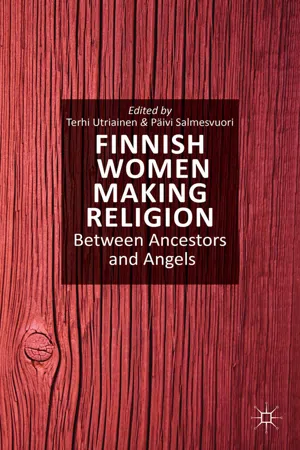
Finnish Women Making Religion
Between Ancestors and Angels
- English
- ePUB (mobile friendly)
- Available on iOS & Android
eBook - ePub
Finnish Women Making Religion
Between Ancestors and Angels
About this book
Finnish Women Making Religion puts forth the complex intersections that Lutheranism, the most important religious tradition in Finland, has had with other religions as well as with the larger society and politics also internationally.
Information
Topic
SozialwissenschaftenSubtopic
Vergleichende ReligionPart I
1
“Feeding the Dead”
Women “Doing” Religion and Kinship in Traditional Russian Orthodox Karelia
Marja-Liisa Keinänen
In traditional Karelian thinking, death did not imply nonexistence but merely a transition of the deceased from the community of the living to the community of the ancestors.1 The living and the dead members of a family formed an organic unit,2 and the relationship between them was characterized by mutual dependence. This implied that the well-being of the living and the success of their enterprises were believed to be dependent on the benevolence of the ancestors, and conversely, the well-being of the deceased lay in the hands of the living.
The relations between the living and the dead in Karelia were characterized by a constant exchange of favors. Regarded as helpers and co-owners of the common resources, the dead were entitled to their share of the common good.3 They were regularly given offerings and memorial gifts, mainly food, and were expected to return these gifts in kind—for example, in a good catch of fish, luck in hunting, or a good harvest.
The exchange between the living and the dead was to a large extent based on a gendered division of labor. Both women and men solicited the help of the ancestors in connection with their household and subsistence activities (farming, fishing, and hunting). Women, however, were more intimately involved in this interaction with the deceased. First, care for the dead, whose needs were envisaged in quite material terms, was part and parcel of women’s everyday care for their family members.4 Second, women—especially the lamenters—were the principle actors in commemorative celebrations and the traditional mortuary rituals, which coexisted with church rituals.
The aim of this chapter is to study women’s interaction with the deceased by focusing on lamentation and commemorative practices in Russian Orthodox Karelia, where the vernacular religion was a synthesis of Russian Orthodoxy and indigenous religion.5 I will study these practices as a “work of kinship,” a term coined by social anthropologist Micaela di Leonardo to denote “the conception, maintenance, and ritual celebration of cross-household kin ties.”6 In the present study, the cross-household ties refer to the relations between the two family units: the living and the dead.
I will complement di Leonardo’s concept of “kinwork” with Janet Carsten’s processual view of personhood and kinship, which implies that kinship is not something static, bestowed once and for all, but is constantly forged—“done” and “redone”—through everyday interaction.7 As far as I can see, this processual view is highly appropriate for this study. Judging by the number of vernacular verbs that denoted kinship-making, for example, the Karelian view of kinship was itself quite processual.8 These verbs were used to describe the process whereby a person—even a nonrelative—was actively made kin either by relating to him or her as kin or by treating him or her as “one’s own.”
Death is a strong antisocial force, which severely disrupts the social structure and therefore makes “doing” and in particular “redoing” kinship a matter of great importance. The mortuary and commemorative rituals provide the arena where the dislocated relationships can be “redone”—that is, redefined, renegotiated, and strengthened. In traditional Orthodox Karelia, the mortuary rituals “redid” kinship by joining the deceased person with the ancestors, whereas commemorative practices made and remade kinship by creating and upholding relations between these two communities. Since lamenting was an important part of women’s communication with the dead, I will at first examine laments and lamenting as a means of “doing” and “redoing” personhood and kinship. Second, I will analyze the lamenter’s intermediating activities between this world and the other as examples of kinwork. The lamenter accompanied and supervised the funeral preparations and ritual practices that aimed at the successful transition of the dead from the community of the living to the community of the ancestors. Third, I will analyze commemorative practices, such as everyday “remembering” and various kinds of memorial celebrations, as work of kinship. Since food played a central role in these practices, I will also examine the symbolic significance of food in kinwork.
This study will be largely based on the folkloristic archive materials that are housed at the Folklore Archives of the Finnish Literature Society in Helsinki.9 These materials mostly date from the first half of the twentieth century. In addition, various ethnographical publications along with published collections of laments have served as important sources for this study. The majority of these publications are based on fieldwork conducted by Karelian and Finnish scholars during the 1970s, 1980s, and 1990s. Finally, I will use some data that I have collected through interviews in various parts of rural Russian Karelia during the years 1995–99 with women born between 1917 and 1936.10
“Doing” Personhood and Kinship
As mentioned in the introduction, relational orientation seems to have been strong in traditional Karelia. The fact that the people’s relationship to their physical and natural environment was formed on a strong intersubjective basis is a further indication of such tendencies. Their natural environment was populated with various kinds of spirits—most important, the masters and mistresses of the water, forest, and earth—to whom the humans constantly related in culturally prescribed ways. Water, forest, and earth could also be conceptualized as nonpersonal powers with agentive properties. Even inanimate objects, beings, and substances such as holy icons, chapels, the bathhouse, as well as the dead were perceived as animate beings,11 agents that could interact with humans. These entities were even ascribed feelings, such as anger, which they were believed to act on, as we shall see later on.12
Building on Edward LiPuma’s idea that “the person comes into being in the context of relationships,”13 we may argue that Karelian women produced and reproduced the personhood of the dead through their work of kinship and care. Interacting with the deceased, contrary to the view of the church,14 women constituted them as sentient beings with tangible material needs. Moreover, women’s interaction with dead family members made them relatives in the true sense of the word—that is, those “whom one interrelates with.”15 Carsten’s observation that “personhood, relatedness and feeding are intimately connected”16 is relevant also in the Karelian context, where food played a pivotal role in kinship-making. Indeed, the close association between kinship and feeding is expressed by the Karelian verb omastoa, which denotes on the one hand “to consider as a relative” and on the other hand “the friendly and generous entertaining of one’s relatives.”17 I posit that, through remembering, women not only upheld relations with the incorporeal dead but in doing so also established them as persons and family members.
The continuous interaction between the living and the dead constituted the dead as social agents—as “one’s own ones,” or “superrelatives” (to borrow Nurit Bird-David’s term)18—who were believed to influence the lives of the living in concrete and extraordinary ways. However, I will not view agency merely as an outcome of cognitive processes but also as emotional energy, which is continually generated and regenerated through interaction rituals in people’s everyday lives.19 According to Candace Clark, the interaction within a kin group tends to be governed by the logic of “reciprocal complementarity.” Complementary role expectations mean that “some people have to give other people particular benefits as their social role obliges them to do so,”20 whereas the principle of reciprocity implies that the parties “carry out their obligations only if the partner does so as well.”21 Applied to the present context, the dead, as family elders, were entitled to respect and care, and the living expected the blessing and support of the ancestors in return. But if the living did not do their share, the dead would withdraw their assistance or could sever the bond with the living. Thus a dead person not appearing in one’s dreams was interpreted as a sign of discontent.
The sense of obligation that underlies social interaction should be seen not only as an externally imposed demand on a subject. Clark also characterizes it as a social emotion: an “inner sense of what one owes to someone else, an emotional push or urgency to give to another what is due.”22 Such perceived obligation becomes transformed into emotional energy that fuels people’s everyday interaction—in our case, the exchange between the living and the dead. The obligation to commemorate the dead is sometimes expressed by the Karelian interlocutors as the dead “wanting” or “demanding” memorial gifts. For instance, husks falling off grains of barley were seen as a sign that the dead were requesting something. The immediate reaction of the living to this perceived demand was to gather the first grains and cook some porridge or bake some bread and distribute it to their relatives and acquaintances with a specific request to “remember” the deceased. Anni Lehtonen (1866–1943), one of the foremost North Karelian informants concerning death-related ideas and practices, saw this as a way of paying one’s respects to the ancestors; being remembered, they would in return bestow prosperity on the living relatives and their enterprises.23
Moreover, in the Karelian socioemotional economy, we may view women’s affection, attention, and care for the deceased as emotional gifts that were supposed to create in the ancestors an obligation to reciprocate. As Poul Poder has pointed out, showing sympathy forces people to interact: “Expressions of sympathy work as a social force as they obligate others to respond and engage in micro-political interaction.”24 In this way, the dead were drawn into regular interaction with the living—into an exchange of food and services of care. Irma-Riitta Järvinen’s analysis of Karelian women’s dream narratives about the dead shows that care and social relationships were central themes in their dream communication.25
The strong sense of obligation felt by the living toward the dead was upheld by a fear of the dead, who in Lehtonen’s view were potentially malicious, especially those who had not willingly departed from their earthly lives. Commemorative gifts would therefore even be seen as a way of placating the potentially malevolent dead.26 A failure to live up to kinship obligations by, for instance, failing to visit the grave often enough27 or visiting it empty handed, without food,28 was believed to arouse an emotional reaction—anger—among the dead. Their anger could make itself manifest in the “mindful” bodies of the living: “When a dead [person] gets annoyed one can get all kinds of sicknesses: one gets dizzy, a leg or an arm starts to ache or something like that. The departed starts appearing in dreams, is always bothering when you lie down and in the daytime is in your mind making you anxious. The dead [person] wants you to make a visit or to give some remembrances.”29
Fear and respect for the dead were ingrained in people’s minds through sayings and legends that emphasized that the deceased who were not afforded the respect they were due, or who had not received their share of the common resources, would seek revenge. In northern Karelia, people used to say, “If you don’t give the dead their share, your own share will vanish.” The implication was that if the dead were not given what they were due, they would take it themselves, with interest.30
As the feeling of guilt was strongly tied to norms,31 it also contributed to the upholding of...
Table of contents
- Title Page
- Copyright Page
- Contents
- Preface
- Introduction: Critical and Creative Turns
- Part I
- Part II
- Part III
- Part IV
- Bibliography
- Contributors
Trusted by 375,005 students
Access to over 1.5 million titles for a fair monthly price.
Study more efficiently using our study tools.
Frequently asked questions
Yes, you can cancel anytime from the Subscription tab in your account settings on the Perlego website. Your subscription will stay active until the end of your current billing period. Learn how to cancel your subscription
No, books cannot be downloaded as external files, such as PDFs, for use outside of Perlego. However, you can download books within the Perlego app for offline reading on mobile or tablet. Learn how to download books offline
Perlego offers two plans: Essential and Complete
- Essential is ideal for learners and professionals who enjoy exploring a wide range of subjects. Access the Essential Library with 800,000+ trusted titles and best-sellers across business, personal growth, and the humanities. Includes unlimited reading time and Standard Read Aloud voice.
- Complete: Perfect for advanced learners and researchers needing full, unrestricted access. Unlock 1.5M+ books across hundreds of subjects, including academic and specialized titles. The Complete Plan also includes advanced features like Premium Read Aloud and Research Assistant.
We are an online textbook subscription service, where you can get access to an entire online library for less than the price of a single book per month. With over 1.5 million books across 990+ topics, we’ve got you covered! Learn about our mission
Look out for the read-aloud symbol on your next book to see if you can listen to it. The read-aloud tool reads text aloud for you, highlighting the text as it is being read. You can pause it, speed it up and slow it down. Learn more about Read Aloud
Yes! You can use the Perlego app on both iOS and Android devices to read anytime, anywhere — even offline. Perfect for commutes or when you’re on the go.
Please note we cannot support devices running on iOS 13 and Android 7 or earlier. Learn more about using the app
Please note we cannot support devices running on iOS 13 and Android 7 or earlier. Learn more about using the app
Yes, you can access Finnish Women Making Religion by T. Utriainen, P. Salmesvuori, T. Utriainen,P. Salmesvuori in PDF and/or ePUB format, as well as other popular books in Sozialwissenschaften & Vergleichende Religion. We have over 1.5 million books available in our catalogue for you to explore.