- English
- ePUB (mobile friendly)
- Available on iOS & Android
eBook - ePub
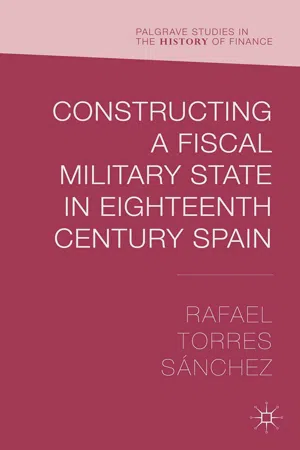
Constructing a Fiscal Military State in Eighteenth Century Spain
About this book
Historically, Spain has often been represented as a financial failure, a state limited by its absolutist monarchy and doomed to fiscal and financial failure without hope of lasting growth. The collapse of the Spanish state at the beginning of the nineteenth century would seem to bear out this view of the limitations of Spain's absolutist state, and this historical school of thought presents the eighteenth century as the last episode in a long history of decline that is directly linked to the failure of the sixteenth-century Spanish imperial absolutist monarchy.
This study provides a different perspective, suggesting that in fact during the eighteenth century, Spain's fiscal-military state was reconstructed and grew. It shows how the development of the Spanish fiscal-military state was based on different growth factors to those of the sixteenth and seventeenth centuries; and that with this change, most of the state's structure and its relationship with élites and taxpayers altered irrevocably. In the ceaseless search for solutions, the Spanish state applied a wide range of financial and fiscal policies to expand its empire.
The research in this book is inspired by current historical discussions, and provides a new perspective on the historical debate that often compares English 'success' with continental 'failure'.
Information
1
Introduction
We start with a key and little-noticed event in December 1784, just after Jacques Necker, the Swiss banker and director general of finance of the absolutist state par excellence, France, had published his book De l’administration des finances de la France, in which he warned of the irremediable collapse of its finances and of the grave consequences for the state (Burnand, 2004). Across the Pyrenees, in another equally absolutist and despotic state of the same dynasty as France, Spain’s Minister of Finance, Miguel Múzquiz, made a curious request to the country’s financial agent in Holland, passing on the desire of Charles III’s government that they should be allowed to pay back completely the loan taken up in that market during the latest war against Great Britain. The Dutch lenders’ reaction was significant. According to the reports from the Spanish government’s agent, the lenders flatly refused to accept the proposal, even though a 4% early-repayment fee was offered. The Spanish government’s pleas fell on deaf ears. In the agent’s judgement, their insistence served only ‘to cement the capitalists’ confidence in Spain’s creditworthiness… and deepen the confidence with which they made the loan’.1 In the eyes of the Dutch lenders, who were connoisseurs of the public credit situations of all European states, Spain’s very desire for early repayment was proof of its creditworthiness. For the Spanish state the burden of the loan was no great problem, neither the principal nor the interest rate, at 5%. Spain’s only reason for cancelling the loan was the fact that it now had the opportunity to refinance its lower-interest loans on its domestic market, between 3 and 4%, in line with the rates being paid in Great Britain (Heim and Mirowski, 1987). This anecdote illustrates the central theme of this book: it is our intention to try and find out how a country whose home and colonial economy looked doomed to irremediable collapse at the end of the seventeenth century could have recovered its creditworthiness just one century later. The opinions of the international credit markets and the interest rate paid for financing state debt are litmus tests of any state’s creditworthiness, and this anecdote highlights its favourable position in the 1780s. The contrast with the absolute financial collapse of Spain back in 1680 could hardly be starker; equally telling is the comparison with the contemporaneous situation in France.
Another anecdote will help us to bring out the theme of this book even more clearly. The French diplomat Baron de Bourgoing lived in Spain in the 1770s and 1790s and became with its situation. He made a shrewd and detailed critique of the country’s situation, and his most positive words were reserved for the public finance system, comments in which he even eulogised the professional attitude of its servants:
They have under their orders all the various receivers, all administrators of customs, all the satellites of excise and taxation, a legion formidable as well for its number as its talents. Europe can produce nothing better of this kind. If they were as incorruptible as they are vigilant, they might be proposed for models. I had an opportunity of appreciating this class of Spaniards when I was first in Spain. At my return in 1792, I perceived, to my cost and that of a number of claimants for whom I acted, that they had made a nearer advance to perfection. (1797, II, p. 3)
If, as Brewer (1989) argued, one of the main differences between Great Britain and the other major European states was its capacity for bringing the professional management of its public finance matters under the control of trustworthy public servants, then it could also be argued that this was a feature shared by Spain’s process of state construction. Whereas France at this time was dominated by private financiers and suffered from a precarious public credit system, Bourgoing paints a completely different picture of Spain, where public finances were managed by public servants who were not only reasonably professional and efficient but could even be regarded in some ways as a role model for the rest of Europe. In this crucial terrain Spain had also made appreciable headway.
Understanding this process of change is no easy task. This is partly because historians have traditionally interpreted Spain’s eighteenth-century state construction process as a clear example of an absolute and despotic state, one doomed to certain financial collapse, and, above all, incapable of generating any efficient dynamic of change or growth (Tilly, 1992; Brewer, 1999). It was argued that this limitation and paralysis stemmed from the type of state in Spain at this time, a product of the dynastic alliance with the French Bourbons. Absolute state, stagnation and failure were synonyms, and the Spanish estate was a carbon copy of the French absolutist model, but a poor copy with many blurred features (Jago, 1972; Noel, 1990). The alliance with the French, moreover, tended to unite the destinies of the Bourbons and rule out other successful options. As Douglas North has concluded, ‘both France and Spain failed to keep pace with the Netherlands and England. Both absolute monarchies... the result for their economies was stagnation’ (North and Thomas, 1973, p. 120). This traditional interpretation would seem, moreover, to be borne out by Spain’s early-nineteenth-century economic and military travails, ostensibly confirming the limitations of the Spanish absolute state and its irremediable doom. According to this metanarrative, the eighteenth century is presented as the last episode in a long history of imperial decadence, which is directly linked to the failure of Spain’s imperial absolutist monarchy over the course of the seventeenth century (Kennedy, 1988; Ferguson, 2001, among many others). In some ways the eighteenth century changed nothing in this picture of an empire doomed to failure; in some ways it even served as confirmation of the unstoppable descent into decadence. So powerful has this interpretation been that Jan Glete (2002) has even argued that Spain was Europe’s only case of a fiscal-military state in decline before 1700. In his judgement a fiscal-military state apparently did not exist beyond the imperial stage of the sixteenth and seventeenth centuries. This argument still holds sway. A telling sign here is that Spain is not even included in an otherwise excellent compilation of Europe’s eighteenth-century fiscal-military states (Storrs, 2008). Spain’s decision to tie its destiny to that of absolutist France has, undoubtedly, cast a surprisingly long shadow over its eighteenth-century construction of a fiscal-military state.
To present-day historians the insistence on classifying Spain as an absolute state comes across as slightly old fashioned, particularly if we bear in mind the recent forthright debunking of the absolutist ‘myth’ (Collins, 1995). Many studies have now teased out the wide variety of states that lurk under the spurious category of ‘absolutist’, the host of different power relations between political or social agents, the lingering traits of absolutism in all European states and, in short, a stack of evidence that challenges the very idea of absolutism itself (Cuttica, 2013). Everything seems to show that what is really important in these circumstances is not the type or model of the state but rather its real political capacity of obtaining the essential wherewithal for the survival of the state, of its society and its economy, namely: sovereignty, security and stability. In the Ancien Régime, as in other eras, only states capable of achieving this threefold objective were viable in the long run and were capable of setting up stable frameworks of coexistence as the basis for future expansion and increasing efficiency (O’Brien, 2011). The achievement of these objectives was not the exclusive birthright of any state model; conversely, no type of state could guarantee their indefinite achievement. The problem posed by the construction of the European states in the Ancien Régime, therefore, was how to ensure that these goals of sovereignty, security and stability were widely shared by the society making up those states. To assume that the only way of achieving these goals was, essentially, coercion, as has traditionally been argued (see, for example, Tilly, 1992), overlooks just how much the governed society tended to share these goals, seeing advantages in collaborating with the state in its ongoing sustainment. Rather than outright coercion, the best way of legitimising the state and making sure its action was effective lay in nursing the perceived advantages for wide-ranging groups of society, whether on ideological, economic or religious grounds. We would argue that the idea of the fiscal-military state chimes in with this approach. It is not a question of seeking miracle-working concepts but rather looking for conceptual handles that give us a better grasp of any particular problem. Focussing on the problem of raising the resources to wage war helps to bring out a state’s capacity and efficiency regardless of its political model. Understanding how any state managed to wring from its society an increasing amount of resources for military ends without stoking up serious opposition or causing the state’s legitimacy to be called into question could be the best way of gauging its true level of development, throwing off the yoke of any hidebound connection between state construction and its particular political regime (Torres, 2007).
For Spanish historiography the construction of a fiscal-military state poses a grave conceptual problem because there it appears to involve a contradiction of terms. A state cannot develop – or help its society to develop – if it squanders its money on warfare. Under the prism of all the abovementioned received ideas it was argued that if the state did, in fact, choose to do so, this was because eighteenth-century Spain was governed by warmongering absolutist governments who rode roughshod over any idea of ‘investing in economic development’ (Barbier and Klein, 1985, 486). There has hence been considered to be a cast-iron link between the model of an absolutist state and despotic warmongering policies. Problems arose, however, when some authors tried to tally this assumed absolutism and despotism on the part of Spain’s eighteenth-century governments with an apparently greater sensitivity towards new ideas and progress: the Enlightenment. The Spanish eighteenth-century state was hence dubbed ‘enlightened despotism’ (Dominguez, 1976, p. 306). This idea sparked off a lively debate over the meaning of this term and over whether or not the ideas of enlightened progress drove the state’s development and political activity (Sánchez-Blanco, 2002). This debate coined a maxim taken up by the bulk of Spanish historians since, to the effect that the eighteenth-century Spanish state was clearly absolutist, with ‘much of despotism and little of enlightenment’ (Artola, 1989, p. 131). Working from this much-vaunted maxim, and clearly echoing the historical account of absolutism elsewhere, there was a substantial effort to pinpoint the ‘limits of the eighteenth-century Spanish state’s absolutism’. According to this view, the biggest problem of Spanish absolutism was, precisely, that it was able to cream off so much warfare-waging revenue without needing to make any ‘modernising’ reforms. In the words of Mauro Hernández (1988, p. 4): ‘there was precious little money left over to finance reforms, however enlightened they might be’. This thicket of received ideas made it hard work to cleave through to the contrary idea that state and society development was indeed compatible with a fiscal-military state.
Fortunately, this debate has now opened up and become more broad-minded. Most of this new thrust came from the world of political and economic thought (Sánchez-Blanco, 2002; Paquette, 2011; Grafe and Irigon, 2013a, 2013b; Astigarraga and Usoz, 2013a, 2013b). As a result of this research Spain’s eighteenth-century state now comes across as much more sensitive to the political and ideological changes underway elsewhere in Europe than had previously been thought to the case. This fluid contact led the Spanish state to become less monolithic and hidebound throughout the eighteenth century, meaning that it adapted in a much more fleetfooted manner to the circumstances than it had previously been given credit for. The idea also took hold that it was not simply a carbon copy of French absolutism. It began to be presented, rather, as an original state seeking a constant dialogue with its roots and former models, particularly the Spanish political thinking of the seventeenth century; it also looked at, studied and tried to emulate English and Dutch political models. According to this revised interpretation, the eighteenth-century Spanish state was less absolutist and more European than had erstwhile been assumed.
This study aims to pursue this new way of thinking, centring the analysis on how Spain’s fiscal-military state was built up during the eighteenth century. The concept of the fiscal-military state will help us to focus the problem properly and overcome any restrictive debates about state construction and its bond with the political regime. We are focusing on the eighteenth century because it is an example of how an absolutist European state could indeed evolve and develop along various lines. In this book we show that during the eighteenth-century Spain’s fiscal-military state was reconstructed and grew. It did so in such an efficiency manner that it was even able to defend and extend its empire. This development of the Spanish fiscal-military state was based on different growth factors to those that had been present during the sixteenth and seventeenth centuries. In the course of this period it changed most of the state’s structure, and also its relationship with elites and taxpayers. In the ceaseless search for solutions it applied a wide range of financial and fiscal policies. The sources of inspiration for these policies were much broader than has traditionally been assumed. Not all was done exclusively under French inspiration; fiscal and financial ideas and solutions were also gleaned from European culture, including an adaptation of the Spanish economic-political thinking of the imperial era, which now found a better political seedbed in which to grow. In the overhaul of ideas and policies there was a clear trend towards policies that chimed ever more closely with the English experience. In 1789 Spain did not go down the French road and this was largely because by that point it had already moved away from France’s process of development. Crucial questions such as the direct control of public finances, a mercantilist and imperial taxation policy or a national debt backed up by complete state revenue had already been brought in by Spain, meaning that by 1789 the Spanish absolutist state was very different from that in France or even than Spain’s own seventeenth-century state. This book, in short, aims to explain how this process of state reconstruction came about and thus refute the traditional line of historical thought that places more emphasis on an irrevocable destiny than on the historical reality of the change.
We have tackled the problem chronologically, on the understanding that a state, working from a short-term outlook, was always shackled by the particular circumstances of each moment. Although ongoing trends and historical constants were important and could often impinge directly on political action, they acted as just one more factor – never the only or overriding one. In order to shed light on this development we have broken it down into several stages. Nonetheless, the whole book has a common thread running through it, which is addressed in each of the established stages; namely, how the state dealt with the authority problem, for therein lies the key to the construction of a fiscal-military state. State authority, accepted by the whole of the Spanish society, was the only viable way of organising and expanding a fiscal-military state. Only on the basis of a general recognition of the legitimacy of state authority could changes be brought in and the state developed in this way. For its authority to be considered legitimate the state had to garner widespread backing and even collaboration from important stakeholders within the society it governed.
The first section deals with the inheritance received from the Habsburgs, because it is the starting point for the analysis and is also the point when the true problem of building up a fiscal-military state comes to the fore. The Spanish empire was tottering on the edge of the abyss precisely because state authority had been dispersed into a host of public and private institutions and agents. In 1680 the Spanish empire was not beset by any crushing resource problem; neither was France, which was just as wealthy as Great Britain (Felix, 2006). Some of the richest regions of Europe lay under Spanish hegemony and it also boasted an immense overseas empire. What it did lack, however, was the authority to change access conditions to the economic resources of its territories, and its legitimacy for moving resources from one part of its empire to another was also being called into question continuously. This broken-down authority prevented it from sustaining any public financing arrangements and also tended to engender chaos in public and private finances. It behoves us, therefore, to look at state financing arrangements at the end of the seventeenth century to find out if there were any changes as state creditworthiness crumbled. Our argument will be that it was then, and not with the advent of the Bourbons, that the state reconstruction stimulus was at its greatest and when the longest-lasting bases of the eighteenth-century fiscal-military state were laid down.
In the next chapter we will look at the changes brought in with the advent of the Bourbons. Here the problem is to distinguish between the traits of the French model and the system that actually ended up being applied in Spain. If the Spanish case has traditionally been interpreted as a copy of the French, our analysis will show that there were a number of differences as well as similarities. We would argue that the key to this stage was the chances offered by the War of Succession to perform a reconstruction of state authority. Our particular interest here resides in finding out exactly how this authority was redesigned, on which bases, and how this might have affected the development of the fiscal-military state itself. We will centre on three essential sources – namely, public finances, private finances and public debt – to attempt to answer the essential question of how the state managed to increase the state’s warfare-financing resources. One of the most important consequences of this stage is that it generated dynamics of innovation and change that linked up perfectly with those initiated in the last third of the seventeenth century, but which did not become perfectly visible until the mid-eighteenth century. The moot point here is why Spain’s fiscal-military state evolved so rapidly towards an original model, which we have called the ‘Spanish system’, since this was the period during which Spain veered away so clearly from the French model. The key to this new system is an increased insistence on fiscal and financial control. An increasing of control always involves two things: a confrontation with vested interests and the need to create different management models. The system introduced at this time aimed to kill both these birds with one stone. However, it had its own complications and brought out all the limitations of hobbling state action. It was the growth limits that prompted a further renewal of the whole state model. On this occasion the source of inspiration was England rather than France. The crux of the matter is to understand why the Spanish state plumped for a taxation system based on indirect taxes, greater liberalisation, more aggressive mercantilism and a greater confidence in a national public debt system. This model distanced it definitively from French practice, but moved Spain onto a path that was now being followed in other European countries. In this stage of state development there are two salient points to investigate, as the very essence of the fiscal-military state under construction: the priority conceded to the construction of a possible Spanish fiscal-military empire and the change in the public borrowing policy. Finally, we will offer a series of reflections on the efficacy of this fiscal-military state in terms of such variables as per capita cost, the speed of revenue collection and the revenue-collecting cost for the taxpayer.
The objective, in short, is to offer some fiscal and financial insights to allow us to interpret the development of eighteenth-century Spain, helping us to overcome the hackneyed absolutism-based image of a decadent state in continual crisis and incapable of generating dynamics of change. In this endeavour we are spurred on and encouraged by the shrewd response of the noted historian of the country Professor John Elliott to the question, ‘Why Spain?’:
The interpretation of Spain to a non-Spanish public therefore involves questioning and confronting a set of deeply entrenched stereotypes. The persistent challenge is to make Spain comprehensible to an international readership whose knowledge of the country may be limited to a few distorted images, or, alternatively; who may wonder why there is any need to bother with Spain at all. ‘Why Spain’ was a question that I had to answer for myself even as I attempted to answer it for others. My own answer, as it has evolved over the years, is that this is an endlessly fascinating country whose history, made up of striking successes and equally striking failures, embraces topics of universal import. (Elliott, 2012, p. 39)
2
The Habsburg Fiscal and Financial Inheritance
When the new Bourbon king Philip V came to Spain in 1700 he inherited a declining empire from the previous Habsburg monarch Charles II (1665–1700). It had been run ragged by nearly 200 years of continual struggles across the globe and also many internal territorial problems. Its finances and resources were by now entirely unable to maintain any substantial war effort, and the international supremacy of Spain’s imperial forces had hence been slipping away. By the middle of the ...
Table of contents
- Cover
- Title
- Copyright
- Contents
- List of Figures
- List of Tables
- Foreword Patrick Karl O’Brien
- Acknowledgements
- List of Abbreviations
- Glossary
- 1 Introduction
- 2 The Habsburg Fiscal and Financial Inheritance
- 3 French Inspiration
- 4 The Spanish System
- 5 In the Wake of the English
- 6 The Efficacy of Spain’s Fiscal-Military State
- 7 Conclusions
- 8 Appendix
- Notes
- Bibliography
- Index
Trusted by 375,005 students
Access to over 1.5 million titles for a fair monthly price.
Study more efficiently using our study tools.
Frequently asked questions
Yes, you can cancel anytime from the Subscription tab in your account settings on the Perlego website. Your subscription will stay active until the end of your current billing period. Learn how to cancel your subscription
No, books cannot be downloaded as external files, such as PDFs, for use outside of Perlego. However, you can download books within the Perlego app for offline reading on mobile or tablet. Learn how to download books offline
Perlego offers two plans: Essential and Complete
- Essential is ideal for learners and professionals who enjoy exploring a wide range of subjects. Access the Essential Library with 800,000+ trusted titles and best-sellers across business, personal growth, and the humanities. Includes unlimited reading time and Standard Read Aloud voice.
- Complete: Perfect for advanced learners and researchers needing full, unrestricted access. Unlock 1.5M+ books across hundreds of subjects, including academic and specialized titles. The Complete Plan also includes advanced features like Premium Read Aloud and Research Assistant.
We are an online textbook subscription service, where you can get access to an entire online library for less than the price of a single book per month. With over 1.5 million books across 990+ topics, we’ve got you covered! Learn about our mission
Look out for the read-aloud symbol on your next book to see if you can listen to it. The read-aloud tool reads text aloud for you, highlighting the text as it is being read. You can pause it, speed it up and slow it down. Learn more about Read Aloud
Yes! You can use the Perlego app on both iOS and Android devices to read anytime, anywhere — even offline. Perfect for commutes or when you’re on the go.
Please note we cannot support devices running on iOS 13 and Android 7 or earlier. Learn more about using the app
Please note we cannot support devices running on iOS 13 and Android 7 or earlier. Learn more about using the app
Yes, you can access Constructing a Fiscal Military State in Eighteenth Century Spain by Rafael Torres Sánchez in PDF and/or ePUB format, as well as other popular books in History & Economic History. We have over 1.5 million books available in our catalogue for you to explore.