eBook - ePub
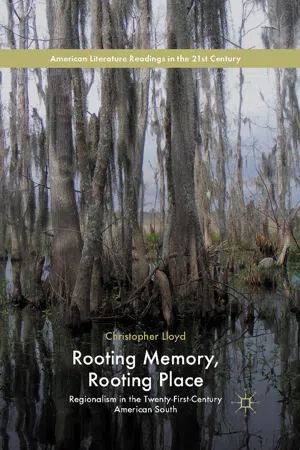
Rooting Memory, Rooting Place
Regionalism in the Twenty-First-Century American South
- English
- ePUB (mobile friendly)
- Available on iOS & Android
eBook - ePub
About this book
This timely and incisive study reads contemporary literature and visual culture from the American South through the lens of cultural memory. Rooting texts in their regional locations, the book interrupts and questions the dominant trends in Southern Studies, providing a fresh and nuanced view of twenty-first-century texts.
Information
C H A P T E R 1
Memories of Slavery: Museums, Monuments, Novels
Remembering/Forgetting Slavery
In an interview in 1989, Toni Morrison clearly articulated the relationship between the memorialization of slavery and her fiction, particularly the novel Beloved (1987).
There is no place you or I can go, to think about or not think about, to summon the presences of, or recollect the absences of slaves; nothing that reminds us of the ones who made the journey and of those who did not make it. There is no suitable memorial or plaque or wreath or wall or park or skyscraper lobby. There’s no 300-foot tower. There’s no small bench by the road. There is not even a tree scored, an initial that I can visit or you can visit in Charleston or Savannah or New York or Providence, or better still, on the banks of the Mississippi. And because such a place doesn’t exist (that I know of), the book had to. But I didn’t know that before or while I wrote it. I can see now what I was doing on the last page. I was finishing the story, transfiguring and disseminating the haunting with which the book begins. Yes, I was doing that; but I was also doing something more. I think I was pleading for that wall or that bench or that tower or that tree when I wrote the final words.1
I quote Morrison at length because here she expresses many aspects of slavery’s memorialization that I want to unpack, particularly in relation to the South. While the final sentences seem to suggest that Morrison wishes for (more) public memorials to slavery, there is the distinct sense that she sees a fuller potentiality for cultural remembrance through literary, rather than literal, monuments. Though she “pleads” for benches or monuments (which has come true thanks to the creation of benches by the Toni Morrison Society), Morrison’s own fictional output testifies to the power and force of literature as an active ingredient in the recalling of a rooted and placed cultural memory, specifically of slavery (and the larger African-American past). This is true of her books about slavery—Beloved and A Mercy (2008)—as well as her most recent Home which monumentalizes the African-American past of the twentieth century, which I will be exploring in chapter 4. Beginning with Morrison, then, frames this chapter’s argument: that particular regional memories, worked through and vitalized by literary texts, sustain regional identity in various ways. In revealing the deep roots of slavery in the region, these novels demonstrate a located sense of memory and place. This is not to discount or overlook the sense of slavery as a national and transnational phenomenon, nor displace the Black Atlantic “routes” of slavery in favor of “roots” (as Paul Gilroy would have it). Rather, this chapter wants to offer a reading of slavery that is localized, which in current transnational theory especially (and in new southern studies too) is often deemed less important than the global flows of slavery’s origins and effects. Thus, I wish not to reify slavery as a Southern institution alone, but to probe the regional shapes and textures of slavery, especially as this region was the stronghold for the institution. While the Northern states were implicitly entangled in the system, it is in the Southern states that we can most clearly see its devastating imprint.
“Toni Morrison’s statement,” Alan Rice writes, “is less true now than it was in the late 1980s. There is now more public acknowledgement of the slave past in the transatlantic world than there was two decades ago, and this has manifested itself in plaques, memorials and events in many sites throughout the circum-Atlantic.”2 While Rice lists examples from Liverpool, Haiti, London, Paris, and New Haven, his only Southern example is in Sullivan’s Island, Charleston where, in fact, the Toni Morrison Society built its first “bench by the road.” Rice claims that “[t]hese all attest to an increased level of public activity over the last two decades.”3 I want to slightly problematize Rice’s reading by suggesting that in the South particularly—which Morrison implicitly discusses in her above quote, and was the major site in the United States where slavery took hold—memorials and commemorations to slavery are not as widespread as they could be. There are two notions I want to connect here. Firstly, Rice’s interest in transnational memorials displaces localized Southern examples of memorial practice. While his scope is the Black Atlantic, his lack of focus on the South is exemplary: either because in the South there are few memorials solely to slavery and the black experience, or because the transnational mode becomes centralized. In either case, Rice demonstrates a particular de-regionalizing tendency that is dominant in contemporary critical theory. Instead of only looking to the transatlantic body of memorative work and practice, attending to the South’s relationship to slavery might produce more locally inflected and specific memory work. To further unravel this, I turn to a recent example from memorial culture.
In 2001, L. Douglas Wilder announced plans for the creation of the United States’ first national slavery museum in Fredericksburg, Virginia. While in 2015 the completion of the National Museum of African American History and Culture (linked to the Smithsonian) in Washington will mark a distinct inscription of black history into the nation’s memorial center (the Mall), the Fredericksburg museum would offer something more particular about the institution of slavery. For, as a formative phenomenon in national and Southern and cultural identities, it surely needs particular remembrance. Built mainly from glass, the museum would be in the shape of a slave ship, containing varied historical artifacts and immersive experiences. It was designed to physically materialize the slave history of America and the Middle Passage as the boat shape nestled into the landscape. In summer 2011, the museum’s development came to a halt: with soaring debt of tax bills, the project stalled and the city subsequently put the land the museum was going to be built on up for auction. It can safely be posited that the museum is far from ever getting off the ground; it may never be built at all. If this example, so framed by Morrison’s assertion, can tell us anything, it is that the legacy of slavery in cultural memory is still as conflicted, problematic, even amnesiac as ever.
On Beloved, Walter Benn Michaels writes, “[W]hat no one wants to remember, [Morrison thinks], is slavery and, whether or not this characterization is accurate, it succeeds in establishing remembering or forgetting as the relevant alternatives.”4 Thus, Morrison’s idea establishes that “although no white people or black people now living ever experienced it, slavery can be and must be either remembered or forgotten.”5 It is clear that to forget slavery would be a disastrous thing—the failure of the slavery museum might gesture in this direction however—thus, we must remember it. Clearly, Erika Doss writes, “slavery’s representation itself remains limited and highly contested.”6 The cultural memories of slavery will be the principal focus of this chapter, as a way of identifying a continued regionalism because of its deep effects in the South, particularly its lingering sociocultural structures through Reconstruction, Jim Crow and beyond. While my chapter will not necessarily touch upon these later histories, it is worth saying that slavery’s extensive social reach demands continued attention, whether it is at a local or international level. My work focuses closely on the former, as a complementation of that broader geographical study.
Astrid Erll helps us understand cultural memory as “the way of remembering chosen by a community, the collective idea of the meaning of past events and of their embeddedness within temporal processes” (original emphasis).7 While this may construct what Erll also calls normative versions of the past, cultural memory is an ongoing negotiation, which is complex and various. It can, in this way, “provid[e] the mental, material and social structures within which experience is embedded, constructed, interpreted and passed on. Memory is a kind of switchboard which organizes experience both prospectively and retrospectively. . . . ”8 This embedding and working through of slavery’s memories happens through various cultural forms, most noticeably literature. Illustrating this will be readings of two contemporary novels about slavery: Edward P. Jones’s The Known World (2003) and Valerie Martin’s Property (2003). However, “just like memory,” Erll continues, “media do not simply reflect reality, but instead offer constructions of the past” and thus “mediality represents [ . . . ] the very condition for the emergence of cultural memory.”9 I will untangle this further with recourse to other memory theory, but here I am simply proposing the necessity of remembering slavery in the South through literature. To understand this more, I return to the slavery museum in Virginia.
Though the slavery museum has all but failed, the plan to build a national museum has meant that, Stephen Hanna argues, “slavery, emancipation, and resistance entered into public discourse over the meanings of Fredericksburg’s historical landscape for the first time in over a century.”10 He continues, “Until 2001, the slave block was the only permanent memorial to any aspect of African-American history” in the town.11 Thus, the museum’s conception is a landmark in public commemoration in Fredericksburg and, arguably, elsewhere in the region and nation. Correlatively, many critics agree that “[s]lavery has long gone unmentioned at southern historic sites,” so the building of a national slavery museum is a noteworthy and significant venture in the South’s landscape of memorialization and engagement with cultural memory.12 It is not accurate to say that this landscape is completely barren: there are many plantations, small museums, and monuments to the Civil War and slavery across the South.13 The failure of a national slavery museum cannot but be seen to repeat the major absence of representation of this institution historically in America’s public realm. In the twentieth century, Ira Berlin writes, “Slavery was excluded from public presentations of American history” and it seems that the twenty-first century might be beginning with a similar situation.14 While Renée Ater would disagree, claiming that today “it seems there is a scramble to commemorate the slave past” internationally, there is still (a lack of) evidence to debate this point.15 I am not suggesting that slavery has not been memorialized in American culture at all but there is not, in the twenty-first century, a national museum to this defining historical institution. This introductory sketch provides a framework for the present chapter, which attempts to connect forms of public memorial with literary ones.
Outside of the museum, other forms of public remembrance are untangling the relationship the South has to the memories of slavery. Public memorials and monuments have received much critical commentary in recent years and will be looked at here. Monuments, particularly relating to slavery and the Civil War, have been discussed pertinently by Kirk Savage in Standing Soldiers, Kneeling Slaves (1997). In this book, Savage argues that statues, museums, and memorials “are the most conservative of commemorative forms precisely because they are meant to last, unchanged, forever.”16 Though Savage discusses the possibilities for reinterpreting monuments over time—their potential afterlife—he cements the notion that monuments “attempt to mold a landscape of collective memory, to conserve what is worth remembering and discard the rest.”17 Consequently, it seems fairly obvious that it is dominant cultures and communities which create monuments and, therefore, decide which histories are deemed worthy of remembrance. However, we need to also understand the complex work of interpretation that a monument’s viewer or museum’s visitor does, which inherently makes a monument subject to change. James E. Young’s work on counter-monuments can also be connected here as he explores, in The Texture of Memory (1993), the state of contemporary German monumentality which, Young argues, is framed by a fear that “conventional memorials seal memory off from awareness altogether.”18 Thus, he explores a variety of “counter-monuments” that resist such tendencies.
We can, here, think about memorialization in other nonmonumental ways. As Dora Apel writes of a public lynching memorial in Duluth, Minnesota, “[P]erhaps it is necessary [ . . . ] to imagine other forms of representation, other ways of acknowledging a traumatic past”—other, that is, than a traditional memorial.19 While she notes something similar to Young’s countermonument—that recent memorials “often have assumed a more abstract and minimalist aesthetic”—I would posit that we have to think more dynamically about other forms of representation.20 While Young has demonstrated how countermonuments can rethink the relationship between society and history, I want to use this argument as a springboard to suggest other modes of remembrance like literature. Marcus Wood, particularly, posits that because “[t]he experiences of millions of individuals [ . . . ] is not collectable; it is unrecoverable as a set of relics,” slavery “must not be encapsulated with a history believed to be stable, digested and understood. . . . ”21 This is because the history is “not over and evolving,” not only because the memories continue to work through contemporary life, but because the long past of slavery is a foundational block of identity today (original emphasis).22
Portable Monuments
The field of memory studies would generally agree with Wood’s notion of a moving and dynamic sense of slavery’s histories and memories. As we saw in the introduction, memory is moveable, dynamic, and constantly shifting. This understanding of memory correlates with, and informs, the transcultural and global sense of memorialization and remembrance; indeed, Erll writes, transcultural memory is the “incessant wandering of carriers, media, contents, forms, and practices of memory, their continual ‘travels’ and ongoing transformations through time and space, across social, linguistic and political borders.”23 In closer relation to the memories of slavery, Araujo’s edited collection Politics of Memory (2012) stresses, “The resurgence of the public memory of slavery and the Atlantic slave trade [ . . . ] is gradually becoming a transnational phenomenon. . . . ”24 Though this sense of memory—especially with regards to slavery—is necessary to take into account, we must also be aware, as Susannah Radstone points out, that as we emphasize and prioritize memory that moves, we must also be aware of its localized instantiations: to “buil[d] theory from the ground up [ . . . ] respecting memory’s located specificities.”25 Thus, whether it be individual or cultural, the particular and defined location of memory work should be attended to; that is, both in the origination of remembrance (the place and time) in addition to the particular contours and origins of the memory itself. As Ron Eyerman has similarly suggested, in relation to African-American culture, “[M]emory can also be embedded in physical geography. . . . ”26 This geography is as much topographical as it is social, moreover. Local particularity has as much to do with the land as those who occupy it. Cultural memory, therefore, while a complex and v...
Table of contents
- Cover
- Title
- Introduction The Region and Beyond: From the South to the Postsouth
- 1 Memories of Slavery: Museums, Monuments, Novels
- 2 “There’s a Life Here”: Hurricane Katrina’s Southern Biopolitics
- 3 What Remains? Sally Mann and the South’s Gothic Memories
- 4 The Road Home: Southern Narratives of Return
- Conclusion Beneath the Surface
- Notes
- Bibliography
- Index
Trusted by 375,005 students
Access to over 1.5 million titles for a fair monthly price.
Study more efficiently using our study tools.
Frequently asked questions
Yes, you can cancel anytime from the Subscription tab in your account settings on the Perlego website. Your subscription will stay active until the end of your current billing period. Learn how to cancel your subscription
No, books cannot be downloaded as external files, such as PDFs, for use outside of Perlego. However, you can download books within the Perlego app for offline reading on mobile or tablet. Learn how to download books offline
Perlego offers two plans: Essential and Complete
- Essential is ideal for learners and professionals who enjoy exploring a wide range of subjects. Access the Essential Library with 800,000+ trusted titles and best-sellers across business, personal growth, and the humanities. Includes unlimited reading time and Standard Read Aloud voice.
- Complete: Perfect for advanced learners and researchers needing full, unrestricted access. Unlock 1.5M+ books across hundreds of subjects, including academic and specialized titles. The Complete Plan also includes advanced features like Premium Read Aloud and Research Assistant.
We are an online textbook subscription service, where you can get access to an entire online library for less than the price of a single book per month. With over 1.5 million books across 990+ topics, we’ve got you covered! Learn about our mission
Look out for the read-aloud symbol on your next book to see if you can listen to it. The read-aloud tool reads text aloud for you, highlighting the text as it is being read. You can pause it, speed it up and slow it down. Learn more about Read Aloud
Yes! You can use the Perlego app on both iOS and Android devices to read anytime, anywhere — even offline. Perfect for commutes or when you’re on the go.
Please note we cannot support devices running on iOS 13 and Android 7 or earlier. Learn more about using the app
Please note we cannot support devices running on iOS 13 and Android 7 or earlier. Learn more about using the app
Yes, you can access Rooting Memory, Rooting Place by C. Lloyd in PDF and/or ePUB format, as well as other popular books in Literature & Historiography. We have over 1.5 million books available in our catalogue for you to explore.