This book examines how Russia, the world's most complicated country, is governed. As it resumes its place at the centre of global affairs, the book explores Russia's overarching strategies, and how it organizes itself (or not) in policy areas ranging from foreign policy and national security to health care, education, immigration, science, sport, agriculture, the environment and criminal justice. The book also discusses the structures and institutions on which Russia relies in order to deliver its goals in these areas of national life, as well as what's to be done, in policy terms, to improve the country's performance in its first post-Soviet century. Edited by Irvin Studin, the book includes contributions from a tremendous list of Russia's leading thinkers and specialists, including Alexei Kudrin, Vladimir Mau, Alexander Auzan, Simon Kordonsky, Fyodor Lukyanov, Natalia Zubarevich and Andrey Melville.
1. Introduction: Ten Theses on Russia in the Twenty-First Century
Irvin Studin1
(1)
The Institute for 21st Century Questions and Global Brief Magazine, Toronto, Canada
Irvin Studin
End Abstract
Thesis 1
The future of Russian governance is neither necessarily democratic nor strictly non-democratic. This choice is likely too binary for Russia’s extremely complex realities. Instead, a future Russia may well be—and perhaps should be—decidedly hybrid, drawing promiscuously on the best in twenty-first-century structures and practices from around the world.
Russia is a young country—even if most people, including many Russians, forget that this Russia, in its post-Soviet incarnation, is only just completing its third decade. It is therefore naturally still solidifying and indeed inventing, improvising and legitimating its governing institutions, not to mention forming (with inconsistent success) its future political elites. The country’s constitutional youth, coupled with its present unique internal and international pressures, means that Moscow can look non-dogmatically westward and eastward alike (and elsewhere besides) to adopt the best in governing approaches, even as it indigenises these and ends up with its own idiom—as is, by history and mentality alike, the Russian wont.
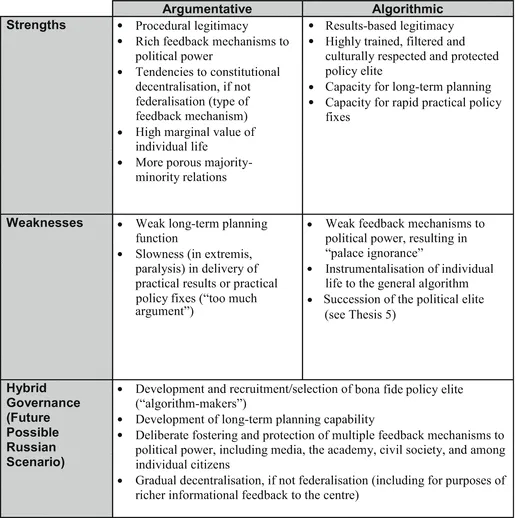
Let me propose that there are two dominant governing paradigms in the world today—on the one hand, the democratic tradition or, more tightly, what I would call “argumentative governance”; and on the other hand, “algorithmic governance”. “Argumentative governance” prevails in the presumptive West—the deeply democratic countries of North America, Western Europe and indeed much of the European Union, Australia, New Zealand and perhaps also Israel. “Algorithmic governance” is led almost exclusively by the dyad of modern China and Singapore. Most of the remaining countries in the world—in the former Soviet space, the Middle East, the Americas, Africa and much of Asia—are still in what might be called the “voyeur” world, still stabilising, legitimising or relegitimising their governance regimes and institutions according to one tradition or the other, or indeed borrowing from both.
Argumentative (or democratic) governance is characterised by fairly elected governments that are constantly opposed, challenged or corrected by deeply ingrained institutions (like political oppositions, the courts or other levels of government) or broad estates (like the media, the academy, and various non-governmental organisations and groupings, not excluding religious organisations). Algorithmic governance, however, is characterised by the centrality of a smaller, select group of national “algorithm-makers” who, having been selected largely through intense filtering based principally on technical and intellectual (and perhaps ideological) qualifications (the so-called “smartest people in the room”), are constitutionally and culturally protected in their ability to generalise these algorithms throughout the country over the long run. Algorithmic governance lays claim to legitimacy via the securing of visible, concrete results in the form of consistently rising material wealth, advanced physical infrastructure, and general public order and societal stability—and indeed the rapidity (and even predictability) with which such outcomes are realised and real-life problems are solved.
Argumentative governance, on the other hand, maintains its legitimacy via procedural argument in the contest for power among political parties, and in the information provided to power via various feedback loops. A large number of these argumentative regimes are federal in nature (just as the number of federal regimes globally has grown markedly over the last couple of decades), and so centre-region relations are both another source of procedural argument and a species of feedback to power (from the local to the general or macro) (Fig. 1.1).
Fig. 1.1
Key characteristics of argumentative, algorithmic and hybrid governance
What would hybrid Russian governance look like in the twenty-first century? Answer: It would draw on the obvious strengths of the dominant algorithmic and argumentative governance models, while guarding against the major weaknesses of each of these idioms. What are the key strengths of the algorithmic system that Russia should wish to adopt? First and foremost, Russia must invest in properly creating, over time (say, the next 15–20 years), a deep policy elite, meritocratically recruited and trained, to populate all its levels of government, from the federal centre in Moscow to the regional and municipal governments. Such a deep, post-Soviet policy elite is manifestly absent in Russia today, across its levels of government—a problem that repeats itself in nearly all the 15 post-Soviet states. Second, Russia must develop a credible long-term national planning capability (as distinct from the current exclusively short-term focus and occasional rank caprice of Russian governments, pace the various longer-term official national strategies and documents), led by the said algorithmic policy elite at the different levels of government, and implemented with great seriousness across the territory of the country. Third, as many of the writers in this book properly propose, Russia requires an intelligent degree of very gradual decentralisation (rapid decentralisation being potentially fatal to national unity, or otherwise fragmenting the country’s internal coherence across its huge territory) and, if necessary or possible, a degree of genuine federalisation of governmental power across the Russian territory (discussed further below). Fourth, Russia’s policy elites must foster the development (and protection) of many more feedback mechanisms from citizens to political power in both the federal centre and in regional governments—not for the purposes of democratic theatre or fetish but rather to avoid making major or even existentially fatal policy mistakes, or indeed to correct policy mistakes and refine the governing algorithms in the interest of on-the-ground results and real-life problem-solving (a major imperative in Chinese algorithmic governance today, where the governing elites, as with past Chinese emperors, are said to be “far away”). These feedback loops—from the media, the academy, various groups and, evidently, from ordinary Russians—help to ensure that even the smartest algorithm-makers in the future policy elite do not make catastrophic mistakes based on information that is wholly detached from realities on the ground in Russia, across its massive territory.
Thesis 2
Beyond the aforementioned decentralisation, Russia should ideally, as recommended, in various ways, by several writers in this book, from Busygina and Zubarevich, to Kryukov, Starodubrovskaya and Kynev, federalise substantively, even if the country is, according to its present constitution, legally and formally federal. At a minimum, as mentioned, the country must before long effectuate a gradual, controlled decentralisation. Uncontrolled federalisation or decentralisation, of course, could lead to the breakup of the country or to generalised chaos (a fact well underappreciated outside of Russia)—so strong are the centrifugal and also regionalised ethnic forces across Russia’s territory and its complicated regional diversity. Unintelligent or careless federalisation, for its part, could lead to excessive ethnic concentration, to the detriment of the legitimacy of the federal centre in Moscow, as well as to the overall governability of the country—including through the destruction of the critical informational feedback to the centre provided by citizens and local governments in a decentralised regime.
Critically, because there is no felt—instinctual or cultural, rather than intellectual—understanding of how federalism works in any of the post-Soviet states—most of which are not only unitary but indeed hyper-unitary states, built on strict “verticals” of power—it is perhaps appropriate (if not inevitable) that Russia should end up, through iteration and trial and error (the only way of doing policy in Russia), with what the Indians call a federal system with unitary characteristics.
Thesis 3
Mentality is critical to the future of Russia. There once was a “Soviet person”. What is a “Russian” person in the post-Soviet context? Answer: He or she is still being developed (see Chap. 3 by Andrei Melville on Russian political ideology). The Soviet collapse left Russians with at least three types of anomie or general disorientation—strategic, moral and, to be sure, in identity. All three species must be reckoned with—not with fetishistic searches for single national ideas, but rather through deliberate investments in real institutions and public achievements, and through long-term, patient investment in the legitimation of these institutions and achievements, both inside Russia and, to a lesser degree, internationally. Indeed, part of this investment and legitimation must involve the fostering of a far deeper and more robust policy culture in Russia’s intelligentsia, among its still-venerable specialists in various professional disciplines, and also for its younger people, who are both the future algorithm-makers and also the future drivers of the feedback mechanisms that are essential to the effective governance of the country. Such a policy culture is dangerously underdeveloped in today’s Russia, which militates against effective pivots to either of the argumentative or algorithmic traditions, and indeed against the creation of a uniquely Russian hybrid governance this century.
Thesis 4
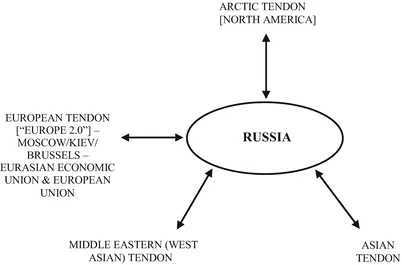
What of Russia and Europe this century? The conflict between the West (especially Europe) and Russia that erupted over Ukraine in 2014 and that endures, without foreseeable resolution and in multiplying manifestations, to this day, can be properly and fundamentally understood as what I would call an “interstitial problem”—that is, as the result of two regional regimes and geopolitical gravities (the European Union to the west and Russia and, more loosely, the Eurasian Economic Union to the east) pulling ferociously, in opposite directions, on a poorly governed space or theatre (Ukraine), with weak institutions and unstable legitimacy at its own centre (the said problem of the “youth” or “newness” of all post-Soviet states). How can this be fixed? Answer: by creating a “Europe 2.0” framework that interstitially—and tendon-like—binds Moscow with Brussels, or indeed the Eurasian and European planes, via Kiev. The “thickness” of the binding mechanisms may well be de minimis to start—that is, comprising strictly confidence- or trust-building measures and economic exchange, evolving over time to security and political arrangements.
To be sure, as Fyodor Lukyanov notes in the book, with the European Union weakened, if not existentially compromised, by several concurrent crises (Brexit, refugees, economic stasis, the Ukrainian crisis and Turkish authoritarianism at its borders, and the serious prospect of more Eurosceptic governments on the Continent), an emerging strategic perspective from Moscow would seem to be that even the “European” option or pivot is now no longer on the table for Russia, even if the vision of constructing a common space between Lisbon and Vladivostok has been, with varying degrees of intensity and coherence, in the strategic psyche of, and expressed in many public statements by, Russian leaders going back to Mikhail Gorbachev (“Big Europe”) in the late Soviet period to Vladimir Putin from the early 2000s.
Having said this, as Europe 1.0 transforms, it seems inevitable that, if peace is to be maintained on the continent, and if Russia is to avoid accidental or even narcissistic isolation and find economic and intellectual openings to Europe, then this Europe 2.0, even if it seems improbable at the time of this writing, will still have to be “invented”. As such, there is a distinct strategic opportunity here for Moscow, if it is smart and plays its cards properly, to play a key role in its formulation and erection. Indeed, as Russia, on top of its juxtaposition with the European Union, shares borders with several existing or emerging or potential economic and political blocs or international regimes in Asia, the Middle East and even, via the melting Arctic, North America (a juxtaposition still underappreciated in North American capitals), Moscow has an opportunity to play a pivotal role in constructing a wide array of interstitial bridges and mechanisms that would help both to give its strategic doctrines greater and more constructive focus, and also to drive the country’s institutional and economic development this century (see Fig. 1.2). Moreover, to the extent that collision between two or more of these international blocs or regimes may, as with the Ukrainian case, lead to conflict—including, in extreme scenarios, nuclear conflict early this century—then the opportunity for intellectual and strategic leadership in such interstitial “knitting”, as it were, by Russia assumes a world-historical character.
Fig. 1.2
Russia’s interstitial links to key global theatres
Thesis 5
Russia has a serious succession problem. If this is not negotiated properly and carefully, it could result in civil conflict or chaos, and even the breakup of the country into several parts. (This is a fact that is deeply misunderstood outside of Russia.) The absence of “argumentative” institutions in Russia, including the peculiar weakness of its political parties (see Chap. 8 by Alexander Kynev), means that the nature of the contest and process for determining the next President and other strategic leaders of Russia are not (uncontroversially) clear. This, again, is not a question of democratic fetish, but indeed one about the ability of the centre in Moscow to project legitimacy across the entire territory and population of the country. In the absence of a process deemed legitimate and a persona who, in succession to President Putin, is able to command the agreement of the masses to be governed by him (or her), there is a non-negligible risk of civil destabilisation of the country. What’s more, should the presidency end more suddenly, for whatever reason, then the country could be seriously destabilised, as the process of relegitimisation of the centre in succession will not have been triggered in time.
It is in the interest of Russian leaders to make the succession process extremely plain to the Russian people immediately. It is also manifestly in the interest of outside countries to understand this succession challenge—not least in order to be disabused of any interest in destabilising the Russian leadership artificially, in the knowledge that a weak governing legitimacy in the aftermath of President Putin could create not only wholesale chaos in Russia but indeed major shockwaves in global stability (beginning at Russia’s borders and radiating outward).
Thesis 6
The creation of a true policy elite in the Singaporean or Chinese algorithmic idiom requires significant and long-term investment in education, and the creation of top-tier educational institutions, from kindergarten to the post-secondary levels. The USSR, for all its warts, had these (including “policy” and administration academies through its Higher Party School). Russia, as a new state, does not. On top of world-class institution-building in education, as numerous writers in this book, from Kudrin and Mau to Yuzhakov testify, Russia must, in order to improve the feedback mechanisms of the argumentative tradition, invest in, and deliver, renewed institutions of politics (including federalism), economics (including credible property rights protection), the judiciary (including serious judicial protection of the legitimate constitutional powers of different levels of government), as well as other spheres of Russian social life, including the religious sphere (as Boris Knorre writes in Chap. 10 on the Russian Orthodox Church).
Thesis 7
How to solve the Ukraine conflict and, by extension, Russia’s conflict with the West? I have written about this extensively, in many languages, and confess that the window for any clean, comprehensive resolution of this conflict may by now have passed (something both leading Russians and Ukrainians know fairly well, even if some Western analysts may not yet). In 2014 and 2015, a winning algorithm for resolution, on my assessment, would have seen the insertion into the Donbass region of neutral peacekeepers (for example, from a respected Asian country like India, or even Indonesia—that is, non-NATO, but also not post-Soviet), constitutional reform in Ukraine (including possible federalisation in toto—recalling the aforementioned need for most post-Soviet states to decentralise or federalise—and/or special status or special economic zones for several regions of the south and east of Ukraine, in concert with the enshrinement of an indissolubility clause for the Ukrainian union in the national constitution, as in Australia’s constitution), and strong guarantees on the permanent non-membership of Ukraine in NATO (including through a possible UN Security Council resolution). These steps would have been accompanied by the removal (at least by the European Union) of economic sanctions not related to Crimea.
The parado...
Table of contents
Cover
Front Matter
1. Introduction: Ten Theses on Russia in the Twenty-First Century
Part I. Russian Strategy and Statecraft
Part II. Russian Public Policy
Part III. Russian Administration: State Institutions, Structures and Processes
Back Matter
Trusted by 375,005 students
Access to over 1.5 million titles for a fair monthly price.
Study more efficiently using our study tools.
Frequently asked questions
Yes, you can cancel anytime from the Subscription tab in your account settings on the Perlego website. Your subscription will stay active until the end of your current billing period. Learn how to cancel your subscription
No, books cannot be downloaded as external files, such as PDFs, for use outside of Perlego. However, you can download books within the Perlego app for offline reading on mobile or tablet. Learn how to download books offline
Perlego offers two plans: Essential and Complete
Essential is ideal for learners and professionals who enjoy exploring a wide range of subjects. Access the Essential Library with 800,000+ trusted titles and best-sellers across business, personal growth, and the humanities. Includes unlimited reading time and Standard Read Aloud voice.
Complete: Perfect for advanced learners and researchers needing full, unrestricted access. Unlock 1.5M+ books across hundreds of subjects, including academic and specialized titles. The Complete Plan also includes advanced features like Premium Read Aloud and Research Assistant.
Both plans are available with monthly, semester, or annual billing cycles.
We are an online textbook subscription service, where you can get access to an entire online library for less than the price of a single book per month. With over 1.5 million books across 990+ topics, we’ve got you covered! Learn about our mission
Look out for the read-aloud symbol on your next book to see if you can listen to it. The read-aloud tool reads text aloud for you, highlighting the text as it is being read. You can pause it, speed it up and slow it down. Learn more about Read Aloud
Yes! You can use the Perlego app on both iOS and Android devices to read anytime, anywhere — even offline. Perfect for commutes or when you’re on the go. Please note we cannot support devices running on iOS 13 and Android 7 or earlier. Learn more about using the app
Yes, you can access Russia by Irvin Studin in PDF and/or ePUB format, as well as other popular books in Politics & International Relations & European Politics. We have over 1.5 million books available in our catalogue for you to explore.