- English
- ePUB (mobile friendly)
- Available on iOS & Android
eBook - ePub
About this book
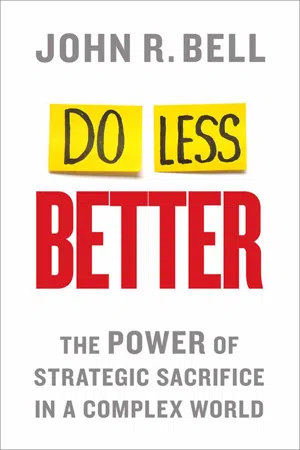
Do Less Better teaches leaders how to recognize the complexity and inefficiencies within their businesses and reveals how they can simplify and streamline through specialization and sacrifice. According to Bell, a company's willingness to focus on a particular vision or identity ensures viability and strengthens its competitive edge.
Information
CHAPTER 1
Accept the Short-term Pain
I’m willing to bet that your “to-do” list reflects as many as a dozen priorities. Sure, there are everyday tasks that have to be done to keep things humming, but how many of those priority projects are accomplishing medium- to long-term goals? How many take you away from those goals, but you would feel weird setting them aside? Why are you allowing this list to keep you from doing the most important things really well?
Complexity is in the eye of the beholder. To you and me, astrophysics is a complex discipline, but to Stephen Hawking, it is not. He made his discoveries by tackling one big problem at a time. When human beings are forced to deal with a certain state of affairs that is highly complex, such as writing, or even trying to comprehend a 1,000-page legislative bill, some will deal with convoluted minutiae better than do others. People who engage in complex situations fall into two categories: those who accept complexity as a fact of life and work with it, and those who fight it every inch of the way, eager to rectify it. I’m in the latter camp; I have never been good at managing complexity. This explains why I am such an advocate of simplicity. This is how I’ve rolled since I was a kid.
Complexity has many definitions. In my mind, excessive complication says it best. Okay, I might have simplified that a touch. That was intentional—simplification and clarity are the cornerstone of this book. Simplicity’s archenemy lurks everywhere. In business alone, there are hundreds of reasons why ambiguity and complexity rear their ugly heads to complicate your professional life—some of these reasons are externally driven, but most are self-created—maybe not by you, but by people above and/or before you. Beyond the black hole of information technology and turbulent markets and economies is a long list of self-imposed phenomena, beginning with swollen management structures and the insatiable human desire to add products, services, staff, projects, and processes in the name of strategic opportunity.
I recently read that when business complexity increases, managerial complexity isn’t too far behind. You can also say that when management complexity increases, business complexity isn’t far behind. Both scenarios are unnecessary. The theory of breaking down complicated businesses into digestible bites has been around for a long time. Multiproduct companies in various markets that appreciate this organizational strategy succeed by narrowing their businesses into manageable units. We used to call them strategic business units (SBUs), that is, individual profit centers that focus on product offerings and market segments. General Electric and Procter & Gamble (P&G) continue to do this well.
Decisions ought to be made with the same haste in big businesses as in small ones. Yes, I know this sounds utopian, but as a goal, it can be a game changer. There are countless examples of companies that have cut through the quagmires of complexity and emerged with renewed nimbleness. Some of these companies are the largest on the planet. At the outset, someone had the will to stamp out the complexity virus. That resolve must come from the top, but successful implementation and execution (pardon the pun) will elude even the most zealous simpliphyte if the rest of the organization does not buy into the notion of transformational change.
Q: Assuming corporate leaders have the will to change, how on earth do they garner the support of their followers to make the change?
A: When they convince the entire team that focus and sacrifice are in each person’s best interest because they represent everyone’s roadmap to a better place. The better place is the leader’s vision. Rational acceptance is not enough. People must accept the notion emotionally.
Within their wide-ranging mandate, chief executive officers (CEOs) in particular are taxed with the ongoing challenge of delivering superior earnings today, driving up stock prices today, and setting the best course for their company’s brighter tomorrow while not screwing up today. This doesn’t come easy; they all face problems, and with every problem, there must be a solution. They speak of scale, of critical mass, of innovation, of efficiencies, of focus, of rightsizing (that always means “downsizing”) and on, and on, and on. They nod to the importance and the success of focusing efforts, but few simplify. Few think about, or measure ROE. In this case, ROE is not return of equity. It stands for return on effort.
Thanks to the good work of the UK management consulting firm Simplicity, we now know that the cost of complexity is quantifiable. Complexity wastes needless time and adds billions of dollars to cost structures around the globe. The cost of this epidemic to the 200 biggest companies on the globe is estimated at 10.2 percent of their annual profits—in cold hard cash, $237 billion dollars in earnings before interest, taxes, depreciation, and amortization (EBITDA).1 That’s one heck of a consequence. These are inefficiency costs that come from overexpanding and alienating customers, confusing employees, and causing cultural stress that inhibits the contentment that every person deserves in his or her place of work. Reality check: throughout the course of your working life, you will spend roughly one-half of your conscious hours on the job. That amounts to a lot of working years. Don’t you think you owe it to yourself to enjoy your job, the people with whom you work, and the place in which you ply your trade?
To the plethora of leaders and managers who view complexity as an uncontrollable fact of life, I ask whether your viewpoint is the ramification of a twenty-first-century business environment that doesn’t allow focus, or is it that human beings can’t figure out how to do less, better? It’s not as though today’s young leaders and managers do not understand the sacrifice concept. More than ever, this generation strives to find the right balance between their personal lives and their business lives, and frankly, they are doing a much better job of it than did my baby boomer cohorts.
Now for the paradox: people accept that success in their lives requires some measure of personal sacrifice, but very few practice sacrifice within the workplace. Why not? Consider these possibilities:
1.Making business sacrifices is not part of their leadership or management DNA.
2.They have great difficulty sacrificing anything that has a deep personal and/or emotional attachment.
3.They do not believe that foregoing strategic initiatives and projects will improve business performance. The hard-core members of this clan go a step further—they think strategic sacrifice will only make things worse.
Let’s look at each rationale. Firstly, there exists a sector of people who consciously choose not to make business-related sacrifices. An example would be leaders who dislike placing anything on the chopping block such as brands, processes, initiatives, and employees. To the contrary, they prefer more businesses, more brands, more line extensions, more stock keeping units, more inventories, more acquisitions, more of this, more of that. The paradigm within their psyche demands they do more, ideally with less (for efficiency and reduced costs), but sometimes with more (where revenue and margins supposedly outpace increased staffing expenses). This attitude creates business complexity and the management drawbacks that go with it. The healthier solution for the long haul is injecting strategic sacrifice into the complexity and focus standoff: Complexity ÷ Sacrifice = Focus. Yes, it looks easy. E = mc2 also looks easy. The trick is making the simple formula work.
Secondly, companies are stocked with individuals who understand the value of focus, but won’t sacrifice anything to which there is a deep personal and/or emotional attachment. These people are not necessarily unsuccessful. Many pride themselves on getting others to do what they don’t want to do—some bring in consultants to do their dirty work. Others delegate to capable subordinates. A good leader or manager convinces people they should want to make that call. Admirable leaders, however, get themselves to do what they (deep down) don’t want to do. This can mean sacrificing sacred cows or drowning your puppies.
The third category is comprised of people who do not believe that strategic (and operational) sacrifice will improve business performance, but rather weaken it. As you now know from the first pages of this book, I was at this crossroad a long time ago. Having weathered that storm of product and brand rationalization, I never looked back. The experience of the difficult turnaround taught me that specialists will always beat generalists within their chosen fields. But sooner or later, C-suites, boards of directors, and investors shortchange the power of specialization and envision quick sales and earnings upsides from category proliferation—their theory being that fixed overheads are already in place, so newfound margin will drop to the bottom line. It will not. Coca-Cola, a beverage company, earns almost $9 billion on sales of $47 billion. By contrast, PepsiCo, a food and beverage company, exceeds its rival by 42 percent in turnover, but manages to deliver $1.8 billion less in earnings.
Several companies that were extremely successful operating in single market businesses such soda pop, soup, and cereal have chosen to become broad food companies to accelerate corporate growth. Wall Street likes top-line growth. They prefer seeing companies “do more and more” to get bigger and bigger, preferably with less and less—meaning fewer employees and lower operating costs. There is a cruel irony in this: those responsible for these moves have made a sacrifice, but they are blind to the sacrifice. Some forgo strategic focus and specialization to fast-track sales growth. Others look to the synergy advantages, but in case after case, profit-to-sales ratios decline. This happened to P&G when they entered the food business. P&G, believing that food manufacturing and marketing weren’t that different from selling soap, gave food a good try, but they finally saw the light and exited, preferring the fat margins within categories such as beauty care where they could add value and get a better return.
Layering acquired businesses over existing fixed costs for enhanced margin is last-century thinking. Companies can realize a “synergy” savings, as Kraft did with the Jacobs Suchard acquisition, but eventually the strategic focus wanes and complexity creeps in. The fallacy in the logic is the “fixed costs.” There is no such thing as fixed costs. Anything can be cut or sold, including bricks and mortar. Enhancing a company’s strategic health should be the primary goal of an acquisition. Synergies are nothing more than a bonus.
Don’t Let Fizz Become Fuzz
Former Coke CEO, Roberto Goizueta2 knew plenty about sacrifice. His privileged life in Havana ended in 1960 when he was forced from Cuba by the Castro regime. With a few hundred dollars in his pocket, he worked his way to the top of Coca-Cola in America. You’d think his days of sacrifice would be over. Not so. Although Goizueta would never admit it, the now infamous New Coke was his ballistic missile that was developed to annihilate the embarrassing onslaught of his rival’s taste test challenge. If you are a marketer, you know the rest of the story. New Coke became one of the greatest marketing blunders of all time.
That inference aside, take a moment to ponder the magnitude of this colossal gamble and misstep from a sacrificial point of view. When Goizueta became chief executive, he reportedly told his employees there would be no sacred cows at Coca-Cola. Most people would have viewed this edict as a tough-minded superlative. Hordes of newly appointed CEOs have made similar declarations in their initial salvos to the employee group. I’ll venture a guess that no one in the Coca-Cola organization, other than perhaps Goizueta himself, believed this edict would apply to the company’s time-honored cola recipe.
They were soon to find out that Goizueta was a man of his word. Somehow he overcame the trepidation of putting the company’s crown jewels on the line. Goizueta killed Coca-Cola’s darling. Seventy-nine days later, it was clear that the wheels had fallen off his streetcar named desire. That was the day that Goizueta reloaded his revolver and shot his puppy, New Coke. Coca-Cola Classic returned to the market, and the Coca-Cola Company returned to the fast lanes for good.
In his book, Focus: The Future of Your Company Depends on It, Al Ries states, “No two companies illustrate the power of a focus better than PepsiCo, Inc., and the Coca-Cola Company.”3 I read Al’s book a long time ago, and although I was already a believer, I recall turning the pages as though it were a best-selling mystery novel. I reference this book to illustrate the longer-term benefits of strategic sacrifice. The Coca-Cola Company has made only one major venture outside of the beverage industry, and that was the purchase of Columbia Pictures 40 years ago. Goizueta turfed Columbia for an $800 million shareholder gain,4 and after that transaction, the company never acquired anything that you could not drink. In Focus, Al Ries itemized the comparative values of Coke and Pepsi, using their 1994 and 1995 fiscal performances (see Table 1.1).
In the years to come, Coca-Cola would put corporate clarity, coherence, and specialization to good work. The company remains committed to beverages, and its performance 20 years later reinforces why specialists tr...
Table of contents
- Cover
- Title
- Introduction
- 1 Accept the Short-term Pain
- 2 The Steel and Steal of Strategic Sacrifice
- 3 Your Leadership Reality Check
- 4 The Urgency for Action
- 5 Think Like an Entrepreneur
- 6 KISS Is Not a Rock Band
- 7 Bastions of Branding
- 8 Fewer, Better People Doing Less, Better
- 9 Regrets . . . I’ve Had a Few
- Acknowledgments
- Notes
- Index
Trusted by 375,005 students
Access to over 1.5 million titles for a fair monthly price.
Study more efficiently using our study tools.
Frequently asked questions
Yes, you can cancel anytime from the Subscription tab in your account settings on the Perlego website. Your subscription will stay active until the end of your current billing period. Learn how to cancel your subscription
No, books cannot be downloaded as external files, such as PDFs, for use outside of Perlego. However, you can download books within the Perlego app for offline reading on mobile or tablet. Learn how to download books offline
Perlego offers two plans: Essential and Complete
- Essential is ideal for learners and professionals who enjoy exploring a wide range of subjects. Access the Essential Library with 800,000+ trusted titles and best-sellers across business, personal growth, and the humanities. Includes unlimited reading time and Standard Read Aloud voice.
- Complete: Perfect for advanced learners and researchers needing full, unrestricted access. Unlock 1.5M+ books across hundreds of subjects, including academic and specialized titles. The Complete Plan also includes advanced features like Premium Read Aloud and Research Assistant.
We are an online textbook subscription service, where you can get access to an entire online library for less than the price of a single book per month. With over 1.5 million books across 990+ topics, we’ve got you covered! Learn about our mission
Look out for the read-aloud symbol on your next book to see if you can listen to it. The read-aloud tool reads text aloud for you, highlighting the text as it is being read. You can pause it, speed it up and slow it down. Learn more about Read Aloud
Yes! You can use the Perlego app on both iOS and Android devices to read anytime, anywhere — even offline. Perfect for commutes or when you’re on the go.
Please note we cannot support devices running on iOS 13 and Android 7 or earlier. Learn more about using the app
Please note we cannot support devices running on iOS 13 and Android 7 or earlier. Learn more about using the app
Yes, you can access Do Less Better by J. Bell in PDF and/or ePUB format, as well as other popular books in Business & Business General. We have over 1.5 million books available in our catalogue for you to explore.