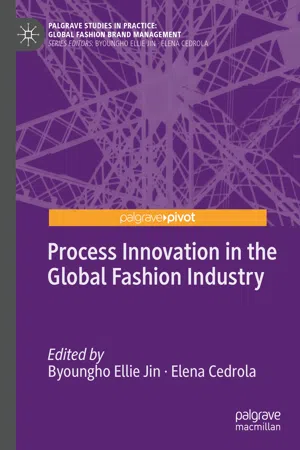
Process innovations - an improved way of doing things – help firms achieve higher-level performance by reducing the time and cost to produce a product or perform a service, and increasing productivity and growth. This book provides a comprehensive examination of process innovations occurring in the global fashion industry, with a focus on fashion brands from USA, Italy, and Japan. It offers practical insights for enhancing efficiency in the supply chain as well as management process such as work routines, information flow, and organization structures. Using case analyses, this book will help readers to grasp how successful fashion companies optimize their operations and advance their competitive position by integrating process innovations into their supply chain and management systems.
eBook - ePub
Process Innovation in the Global Fashion Industry
- English
- ePUB (mobile friendly)
- Available on iOS & Android
eBook - ePub
Process Innovation in the Global Fashion Industry
About this book
Information
© The Author(s) 2019
Byoungho Ellie Jin and Elena Cedrola (eds.)Process Innovation in the Global Fashion IndustryPalgrave Studies in Practice: Global Fashion Brand Management https://doi.org/10.1057/978-1-137-52352-5_11. Process Innovation: Hidden Secret to Success and Efficiency
Byoungho Ellie Jin1, 2 , Elena Cedrola3, 4 and Naeun (Lauren) Kim1
(1)
Wilson College of Textiles, North Carolina State University, Raleigh, NC, USA
(2)
Department of Clothing and Textiles, Kyung Hee University, Seoul, South Korea
(3)
Department of Economics and Law, University of Macerata, Macerata, Italy
(4)
Segesta—Department of Economics and Management, Catholic University of Milan, Milan, Italy
Abstract
Process innovation is an improved way of doing things across the entire supply chain including management, to expand efficiency in terms of cost, quality, and service. While being internal and invisible to customers in nature, process innovations are intermediate outcomes that serve as a means for achieving higher-level performance, rather than as a goal. Yet, by reducing the time and cost to produce a product or perform a service, and increasing productivity and turnover growth, process innovations add value to fashion firms and serve to highlight their products. In this chapter, process innovations occurring in the global fashion industry are examined using actual examples from global fashion brands in five areas—product development, production, order fulfillment, store operations, and at the service level. Notably, information systems, digital technologies, robotics, and artificial intelligence (AI) are important tools for process innovation, especially in enhancing supply chain efficiency, obtaining real-time data, optimizing deliveries, and reducing the time needed for production and service. However, process innovation should not be understood only from the perspective of information systems and technologies because it is possible to achieve without them, especially in terms of management. It is critically important for firms to clearly identify challenge areas and execute process innovation either incrementally or radically, with or without technologies, aligning with their existing systems. This chapter concludes by emphasizing the critical importance of constant process innovation for fashion firms to achieve success.
Keywords
Process innovationDigital technologiesArtificial intelligenceAgile supply chainIntroduction
The notion that innovation is essential to a firm’s competitiveness, growth, and survival is well-supported (Giacosa 2012; Tidd et al. 2001). Multiple disciplines have approached innovation; thus, the conceptual boundaries of innovation are not clearly distinguishable. Yet, the core essence of innovation, according to O’Sullivan and Dooley (2008, p. 5) is “making changes, large and small, radical and incremental, to products, processes, and services that results in the introduction of something new for the organization that adds value to customers and contributes to the knowledge of the organization.” Something new can be created at any time in all areas of the economy. Thus, innovation encompasses new products or services, new processes, and new organization structures or administrative systems (Damanpour and Gopalakrishnan 2001; Tidd and Bessant 2009).
Process innovation is a new or significantly improved way of doing things in a business that typically increases production levels and decreases costs. Such innovation might come in the form of new processes or techniques, new equipment, or new software. A classic example of process innovation is the invention of the first moving assembly line by Henry Ford. This process innovation not only simplified vehicle assembly but shortened the time necessary to produce a single vehicle. The increase in the competitiveness of Japanese firms since the 1980s is also often ascribed to manufacturing process innovations such as Just-in-Time, Kanban system (Bhoovaraghavan et al. 1996), integration and parallel development1 (Rothwell 1994). The introduction of new technology—for instance, new machines and equipment—is the traditional way of achieving greater efficiency when manufacturing a product (Vicente-Lorente and Zúñiga-Vicente 2012).
Process innovation is not only taking place in manufacturing but also occurs in business, as new processes continue to improve service and administrative operations (Khazanchi et al. 2007). In the dynamic global fashion industry, the ability to reconfigure organizational processes through technological and administrative innovations is equally significant.
The major benefits of process innovation include enhanced organizational efficiency and responsiveness (Damanpour and Gopalakrishnan 2001). Unlike product innovation, process innovation typically occurs internally, is not visible to external entities, and is thus less likely to be copied by others. Therefore, it is increasingly seen as an important source of competitiveness and organizational renewal (Hatch and Mowery 1998; Keupp et al. 2012; Reichstein and Salter 2006). Yet, much of the theoretical and empirical innovation studies are directed toward product innovation; the “what, why, and how” aspects of process innovation are relatively under-studied (Keupp et al. 2012). Discussion of process innovation in the area of administrative or business support is particularly limited. Studies of how global fashion brands are innovating their manufacturing or business processes are extremely scarce. In order to generate an initial understanding of process innovation in global fashion brand management, this chapter begins with introduction of the concept and scope of process innovation. Subsequently, the characteristics of process innovation, as opposed to product innovation, will be delineated. Within the boundary of the global fashion industry, process innovation will be illustrated at various stages of the supply chain using actual examples.
The Concept and Characteristics of Process Innovation
Unlike product innovation, which is targeted toward new product offerings or improvements to existing products and commercial activities, process innovations “is focused on the introduction or a new operating method, or improving an existing method in the production, commercial, administrative and managerial area, or generating a new way of using a production factor in order to increase production efficiency in terms of cost, quality and service” (Giacosa 2014, p. 112). The focus of product innovation is making changes in the things (products/services) which an organization offers. In contrast, process innovation involves changes in the way in which things (products/services) are created and delivered, which includes creating and improving methods and developments in the processes or systems (Oke et al. 2007). Its aim is to improve effectiveness and efficiency (e.g., reducing costs and time) in production and organizational processes, which enables firms to become more competitive (Raymond and St-Pierre 2010). Process innovation is in the middle, connecting inputs and outputs efficiently (Murat Ar and Baki 2011). In this way, product and process innovations are mutually supportive and intertwined within a firm’s innovation process and value chain (Raymond and St-Pierre 2010), jointly creating a positive performance for businesses (Damanpour and Gopalakrishnan 2001; Piening and Salge 2015; Reichstein and Salter 2006). For instance, when Prada began manufacturing its iconic trousers using a high-performance fabric, this was made possible because of their investment in the process of developing the fabric (Giacosa 2014). Product innovation can also influence a company’s processes because the new product may require modifications of the company’s process map (Brusa 2012) at both the production and sales levels.
Process innovation can be narrowly viewed as new changes in the manufacturing process, such as developments in the processes, systems, and reengineering activities undertaken to develop new products. For example, to improve the manufacture of new products, plant systems, technologies, and operational practices may be upgraded, modified, or replaced with new and advanced processes (Oke et al. 2007). However, much of the literature supports a broader scope of process innovation, encompassing production and service, as well as administrative improvements (Khazanchi et al. 2007). Organizational processes such as the sequencing of work routines and information flow can also be enha...
Table of contents
- Cover
- Front Matter
- 1. Process Innovation: Hidden Secret to Success and Efficiency
- 2. Patrizia Pepe: Unconventional Innovation and Integration in Fashion Supply Chain
- 3. MUJI: Brand Concept Creates Process Innovation
- 4. Arena Water Instinct: Process Innovation Built-in the Company DNA
- 5. Trunk Club: Revolutionizing the Retail Model in Fashion
- Back Matter
Trusted by 375,005 students
Access to over 1.5 million titles for a fair monthly price.
Study more efficiently using our study tools.
Frequently asked questions
Yes, you can cancel anytime from the Subscription tab in your account settings on the Perlego website. Your subscription will stay active until the end of your current billing period. Learn how to cancel your subscription
No, books cannot be downloaded as external files, such as PDFs, for use outside of Perlego. However, you can download books within the Perlego app for offline reading on mobile or tablet. Learn how to download books offline
Perlego offers two plans: Essential and Complete
- Essential is ideal for learners and professionals who enjoy exploring a wide range of subjects. Access the Essential Library with 800,000+ trusted titles and best-sellers across business, personal growth, and the humanities. Includes unlimited reading time and Standard Read Aloud voice.
- Complete: Perfect for advanced learners and researchers needing full, unrestricted access. Unlock 1.5M+ books across hundreds of subjects, including academic and specialized titles. The Complete Plan also includes advanced features like Premium Read Aloud and Research Assistant.
We are an online textbook subscription service, where you can get access to an entire online library for less than the price of a single book per month. With over 1.5 million books across 990+ topics, we’ve got you covered! Learn about our mission
Look out for the read-aloud symbol on your next book to see if you can listen to it. The read-aloud tool reads text aloud for you, highlighting the text as it is being read. You can pause it, speed it up and slow it down. Learn more about Read Aloud
Yes! You can use the Perlego app on both iOS and Android devices to read anytime, anywhere — even offline. Perfect for commutes or when you’re on the go.
Please note we cannot support devices running on iOS 13 and Android 7 or earlier. Learn more about using the app
Please note we cannot support devices running on iOS 13 and Android 7 or earlier. Learn more about using the app
Yes, you can access Process Innovation in the Global Fashion Industry by Byoungho Ellie Jin, Elena Cedrola, Byoungho Ellie Jin,Elena Cedrola in PDF and/or ePUB format, as well as other popular books in Business & Management. We have over 1.5 million books available in our catalogue for you to explore.