- English
- ePUB (mobile friendly)
- Available on iOS & Android
eBook - ePub
About this book
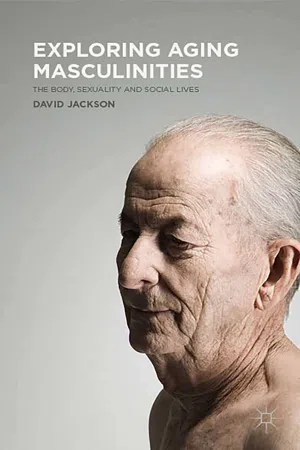
This book explores the lived, embodied experiences of aging men as a counterpoint to the weary stereotypes often imposed on them. Conventionally, in Western cultures, they are seen as inevitably in decline. The book challenges these distorted images through a detailed analysis of aging men's life stories.
Information
1
Introduction
The main purposes of this book are to challenge the stagnant representations of aging men1 in the UK; to investigate the daily, lived experiences of aging men from 60 to 75 years of age; and to explore the ingenuity and inventiveness of some aging men in defining their own terms within a social and historical context. Another key feature in this book is to acknowledge the centrality of older, masculinised bodies in the continuing attempts to connect gender and aging (Arber, 2003). All these different purposes represent ways of changing the voicelessness, marginalisation and sense of occasional uselessness experienced by some aging men following their departure from paid employment and taken for granted relationships and identities. Also it needs to be remembered that the majority of aging men live in systems of patriarchal power that still privilege men, despite their confrontations with ageism and loss, and stigmatise, penalise and oppress women (Kaufman, 1994). Therefore one of the objectives of this book is to contribute to change in creating greater gender equality.
The key aim of the book is to explore the complexity of the lived, embodied experiences of aging men as a counterpoint to the existing stereotypical notions of aging men. Conventionally, aging men in Western culture2 are seen as inevitably in decline and in a state of decay. This book sets out to challenge these distorted assumptions through a detailed analysis of the life stories of eight aging men. These arguments are framed within a wider global context that recognises the importance of labour migration, de-industrialisation, imperial legacies and the social and political effects of a free market economy.
The male research participants in this study have not been directly involved in de-industrialisation (except for Ray) but a rapidly shifting work culture has affected them in terms of an uncertain cultural climate of emotional insecurity, anxiety and loss (Walkerdine and Jimenez, 2012).
In writing this book, I am very much aware that studies of aging, embodied men have the potential to radically subvert and destabilise conventional theories of men and masculinities (Silver, 2003; Thompson, 1994). Old age, ageism, bodily changes and disruptions, and disability pose considerable problems to the established authority, social power and status of many aging men (particularly elitist, aging men from business and political hierarchies) and to their gendered, embodied identities. Old age for many men is a place of frequent change, life review and re-assessment, although for some it is also a time of avoidance and self-protection. In this book I want to be alert to the potential signs of emancipatory possibilities in the later lives of aging men and the ways that these signs might help to shift damaging gender relations both in younger and middle-aged men.
The key distinctive features of the book are the continuous presence of change in aging men’s lives and the possibility of personal and social re-invention. To make this clearer I need to explain the personal and wider theoretical background to ‘situated differences’ in the following section.
Change and Situated Differences in Aging Men’s Everyday Lives
The historical origins of aging men’s changing lives in the UK come from the late 1960s and early 1970s. With the gendered and sexual disruptions of second-wave feminism and alternative sexualities and the politics of lesbians, gays, bisexuals and transgendered activists emerged a wider destabilising of British men’s social status and normative, dominant positions. Fidelma Ashe (2007) in her book, ‘The New Politics of Masculinity’ talks of men’s traditional, masculine identities and dominant, social position becoming interrogated and problematized. Some men’s conventional centre stage positions as main breadwinners, providers and heads of households were in the process of being undermined.
Alongside these changes went a general restructuring of the family in the UK. The patriarchal, nuclear family had begun to be replaced by the development of diverse relationships between married and cohabiting partners and children (Ashe, 2007; Giddens, 1992). Many female partners began to be disappointed by their emotionally distant and frequently detached partners. As a result, divorce rates in the UK had started to increase (Ashe, 2007).
Changing patterns in the workplace also demonstrated these wider shifts and sense of precariousness in men’s lives in the UK. Against a general background of de-industrialisation, started in the 1980s, working-class masculinities were disorientated and fragmented. As a result, many working-class men had been forced to confront the rapid decline of manufacturing industry (Mac an Ghaill and Haywood, 2007) and to face up to these new economic and social changes. Traditional labour markets were now shrinking and in their place was a steadily ris-ing service sector employment. New working practices have come along with these economic changes such as downsizing, part-time, low paid contracts, out-sourcing of industrial work to countries where labour is less expensive and more docile, and long-term unemployment. The collapse and dislocation of the old manufacturing base has contributed to aging men’s sense of anxiety, insecurity and occasional depression about feeling useless (Mac an Ghaill and Haywood, 2007).
However, with a new interrogative space beginning to emerge in aging men’s lives and a much longer life span (between retirement and death) than in previous generations, alternative narratives about men and masculinities in later life are starting to emerge. These collapses of their normative, dominant positions in society have opened up the possibility of new ways of reflecting on changing and different, masculine identities with more care about increased social justice for women. The damaging restrictions and false ideals of one-dimensional models of masculinity have become more visible. This increasing visibility has called into question the notion that masculinity is a fixed, unitary and stable category rather than a constantly shifting variable, existing in a socially located position.
Along with these fresh insights went the developing awareness of the subordination of some men of lesser power (Connell, 1995), such as gay, disabled, working-class, black masculinities, caring men and, partly, the lives of aging men. Despite living through the contradictions of being partly privileged in heterosexual terms and the retaining of some aspects of social dominance, most aging men also have to confront the humiliation of ageism and stereotyping (Bytheway, 1995) as well as bodily and sexual deterioration and fragmentation.
The out of date focus on a narrow, exclusive dominance (Ashe, 2007) of white, young, middle class, heterosexual men has now been superseded by critical attention and re-focusing on the more problematical and contradictory varieties of men – in this case, disabled, aging and gay men. These changes in focus have now exposed the possible links between feminist studies like Donna Haraway’s emphasis on ‘socially situated knowledges and experiences’ (Haraway, 1991) and the critical re-positioning of aging men. Therefore, subordinated groups, like aging men, construct different versions of social reality arising out of their own situated experiences and knowledges (Johnson, Chambers, Raghuram and Tincknell, 2004). Put another way, where one stands shapes what one can see and how it is understood (Pease, 1998).
The specific, situated experiences and developing knowledges of aging men involve very different, changing circumstances of everyday life. Indeed, it is not too much to say that aging men have a unique potential for change in their later years. However, there is still great variety in some aging men’s reactions to these shifting experiences. Some aging men still cling defensively to traditional forms of manhood, and other men are blocked by depression, alcoholism, violence, addictive behaviours or damaging illness. But for other aging men there are new spaces emerging, created by the deconstruction and disruption of normative understandings of masculinity.
Aging men’s lived situations often include the experiences of loss, physical disruption and failure. As well as losing social power and status, as we have already observed in the changing family and workplace, aging, retired men are typically seen as economically non-productive. However, this negative impression needs to be moderated and balanced by a recognition of aging men’s new social productivity, seen in active grandfathering, voluntary work and in the increased practices of care found in some aging men like Brian’s informal, spousal caring for his ill wife in Chapter six.
Changes in the material bodies of aging men also involve the often traumatic experiences of sudden alteration and loss of physical function and capacity. As Peter, in my research evidence, remarks about living with Parkinson’s disease, the unpredictability of his bodily shaking and shuffling often makes him feel that his bodily fragility is uncontrollable in chapter five. Also as Robert learns to do, loss of physical strength and bodily power means re-assessing your traditional grip on your masculine identities in chapter 8. Sometimes a loss can be deceptive and, later, opens up different possibilities. For example, in Roy’s sexual experience, his loss and personal critique of the dominant, penetrative sex model led him to value touching, cuddling and hugging rather than being addicted to orgasm in chapter 4.
These losses, physical changes, the close proximity of death and dying, differences and traumatic disruptions in aging men’s lives, can generate a more self-critical, reflexive, re-positioning from which some aging men can move beyond earlier, younger and middle-aged obsessions with work, successful careers and selfish sexualities. In some cases, these processes of re-positioning also entail a loosening attachment to patriarchal values and relations. In their place, sometimes, comes a fresh focus on, ‘seeking connections with others’ (Thompson, 2006), like in Dennis’s late discovery of his other-related, empathetic, sexual selves as a man. These changes can also lead to the first stirrings of an anti-patriarchal standpoint in some curious and thoughtful, aging men.
Research Questions in this Study of Old Age
•How far can the aging process contribute to changes in the gender relations of men?
•How far can aging men re-position themselves in a different form of masculine identity in their later lives?
•What can be learnt from a close study of aging men’s embodied identities and sexualities in old age?
The Neglected Links Between Old Age, Men and Masculinities
One of the most significant gaps in our knowledge and understanding about old age is the subtle reality of aging men’s embodied and lived experiences. According to Calasanti (2004), Fennel and Davidson (2003), Fleming (1999), Hearn (1995), and Thompson (1994), most previous research on men and masculinities has largely ignored aging men. Although the work of Arber, Davidson and Ginn (2003), Emslie et al. (2004), and Sandberg (2011), have played a part in rectifying this situation, the nuanced, complex lives of aging men remain notable by their absence in the research literature on men and masculinities.
Similarly, the domain of aging studies has generally neglected the links between the processes of aging and men and masculinities. The last twenty years have seen important advances in our understandings of the lives of older women (Arber and Ginn, 1995; Bernard et al. 2000; Calasanti and Slevin, 2006). However, research on aging men has not kept up with these women-centred advances (Fennel and Davidson, 2003). Given this relative neglect, this book project represents an attempt to fill some of the empty spaces surrounding our limited understandings of the embodied lives of aging men.
The Personal Roots of my Project
My current research into the lived experiences of aging men has personal roots in the shattering destabilisation in 1986 of my own normative, embodied, masculine subjectivities. As I have documented elsewhere, in my critical autobiography, ‘Unmasking masculinity’, (Jackson, 1990) I went through a physical and emotional collapse that resulted in major heart surgery. This traumatic bodily and biographical disruption to how I thought I was as a man later generated in me a painful reassessment of my previously taken for granted, gendered ways of being in the world.
What I gradually learnt from these disorientating experiences and troubling bodily sensations was a more self-critical, reflexive perspective on aging processes, masculine identities, physical impairment and disability, bodily shifts and betrayals, and emotional transitions and turning points. In my active retirement at 75. I have sustained my interest in the lived experiences of aging men (myself included). Accordingly, my interests in aging processes have deepened and intensified as well as widened. In some ways I have wanted to share my new book on aging men with a broad, diverse reading public, not just younger academics but with many thoughtful older people who want to make sense of their changing lives.3 My developing curiosity in the greying of Western, industrial nations has developed my understandings of the interactions between the local conditions of the UK and the wider, global context. I have now expanded my research interests through engagement with the lives of eight diverse, aging men as well as continuing my own interests in critical autobiography.
From 2005 to 2008 I organised a small-scale, independent research project in the North-East Midlands in the UK that utilises a biographical, narrative, research approach (Roberts, 2002; Chamberlayne, Bornat and Wengraf, 2000) to explore eight aging men’s lived and embodied experiences. The rich data that this research project produced form the backbone of this book. I now intend to make clear some of the key, conceptual frames of understanding that organise the main themes of the book. This will start with the cultural construction of old age, then will move on to the inter-connectedness of gender and age, and will finish with separate sections on embodiment and identity.
The Cultural Construction of Old Age
I would like to start by looking closely at two life stories that were spoken, shared, collected and transcribed during the research interviews of the project on aging men. (See later in this chapter, ‘Introducing the Research Participants’ for snapshots of Brian’s and Michael’s [pages 12–15] life histories.) The first life story focuses on Brian’s (all names are pseudonyms) response to one of his daughter’s comments that he needed to fully recognise how old he is. She starts by saying:
Daughter: But, Dad, you’re 70!
Brian: So?
Daughter: Well you have to …
Brian: No, I don’t.
The second life story is an answer by Michael to my question:
Is there anything else you want to say about your present experiences of being an older man?
This is how Michael responded:
‘ … yeah, having only just had my sixtieth birthday I remember saying to a couple of people that I’m now an official, old fart. And then I thought about it afterwards and thought: “Why am I saying that? I’m proud that I am 60. It’s not a problem. I can do sod all about it. As I said before, I mean, I didn’t choose to be here, it was chosen for me and one thing we can’t stop is the clock or time and the issue for me is attitudinal really and how I feel about myself and how I feel about what I want to do with the rest of the life I’ve got left …”’
Although Brian’s daughter will possibly have different perceptions and meanings, it appears that she expects her father to conform to a certain set of cultural norms about age-appropriate behaviour (Vincent, 2003) in her comment, ‘ But, dad, you’re 70!’ There’s also anxiety and concern expressed about his risky behaviour but she seems to believe that people like her father need to go along with ‘a normal old age’ that has been socially regulated and imposed from without.
These negative cultural norms and cultural imperatives are what Margaret Gullette calls ‘decline ideology’ (Gullette, 2004) which creates barriers in aging struggles. In some ways, you could argue that Brian’s daughter is using ‘decline ideology’ to persuade her father to play safe and toe the line but Brian refuses to accept these normative ways of doing age, and he does this ...
Table of contents
- Cover
- Title Page
- Copyright
- Contents
- Foreword: Research with Older Men, Slowly
- Preface
- Acknowledgements
- 1. Introduction
- 2. Research Methodology
- 3. Aging Men’s Embodied Selves: Rethinking Aging Men’s Relationships with their Changing Bodies
- 4. An Historical and Cultural Analysis of Aging Men’s Sexualities in the UK
- 5. Learning to Live with Parkinson’s and ‘An Unpredictable Body’ as an Aging Man: An Investigation into Age, Masculine Identity and Disability
- 6. The Challenges and Opportunities of Aging Men’s Spousal Caregiving
- 7. Learning the Hidden Skills of Staying Alive: How do Some Aging Working-Class Men Survive the Processes of Aging?
- 8. Exploring Aging Men’s Embodied and Social Agency in a Free Market Economy Context
- 9. Conclusion
- Notes
- Bibliography
- Index
Trusted by 375,005 students
Access to over 1.5 million titles for a fair monthly price.
Study more efficiently using our study tools.
Frequently asked questions
Yes, you can cancel anytime from the Subscription tab in your account settings on the Perlego website. Your subscription will stay active until the end of your current billing period. Learn how to cancel your subscription
No, books cannot be downloaded as external files, such as PDFs, for use outside of Perlego. However, you can download books within the Perlego app for offline reading on mobile or tablet. Learn how to download books offline
Perlego offers two plans: Essential and Complete
- Essential is ideal for learners and professionals who enjoy exploring a wide range of subjects. Access the Essential Library with 800,000+ trusted titles and best-sellers across business, personal growth, and the humanities. Includes unlimited reading time and Standard Read Aloud voice.
- Complete: Perfect for advanced learners and researchers needing full, unrestricted access. Unlock 1.5M+ books across hundreds of subjects, including academic and specialized titles. The Complete Plan also includes advanced features like Premium Read Aloud and Research Assistant.
We are an online textbook subscription service, where you can get access to an entire online library for less than the price of a single book per month. With over 1.5 million books across 990+ topics, we’ve got you covered! Learn about our mission
Look out for the read-aloud symbol on your next book to see if you can listen to it. The read-aloud tool reads text aloud for you, highlighting the text as it is being read. You can pause it, speed it up and slow it down. Learn more about Read Aloud
Yes! You can use the Perlego app on both iOS and Android devices to read anytime, anywhere — even offline. Perfect for commutes or when you’re on the go.
Please note we cannot support devices running on iOS 13 and Android 7 or earlier. Learn more about using the app
Please note we cannot support devices running on iOS 13 and Android 7 or earlier. Learn more about using the app
Yes, you can access Exploring Aging Masculinities by D. Jackson in PDF and/or ePUB format, as well as other popular books in Social Sciences & Gender Studies. We have over 1.5 million books available in our catalogue for you to explore.