- English
- ePUB (mobile friendly)
- Available on iOS & Android
eBook - ePub
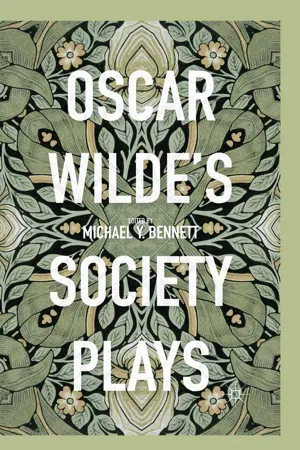
Oscar Wilde's Society Plays
About this book
Information
Subtopic
Art généralPART I

CONTEXTS
CHAPTER 1
WIT IN EARNEST: WILDE’S IRISH WORD-PLAY
Jerusha McCormack
For some time now, a veritable industry has grown up in commercial books featuring the “wit and wisdom of Oscar Wilde.” What does wit (we might ask) have to do with wisdom? And what does it say about Wilde’s own unique brand of wit?
That Wilde was witty is incontestable. He is so within the exact dictionary definition of “wit” as a “capacity for inventive thought and quick understanding”—thus demonstrating a “keen intelligence.”1 Wit in Wilde is fueled by such astute mischief that, through a mere flick of a word or a phrase, the language it works in is exposed as at once arbitrary and manipulative. Wit in Wilde becomes, in other words, a kind of warfare. And its opponent in this war was the English language itself: the official tongue of his native Ireland.
Ironically, until a few decades ago, Oscar Wilde was known as a British playwright. With all the arrogance of Empire, England claimed him as one of its sons, with a clear if unconscious disregard for his own preferences, not to say the facts of the case. In any case, Wilde himself suffered from a confusion typical of those native to colonies, a complication of identity that expressed itself as double—and self-contradictory. Born into the leading class known as Anglo-Irish, Wilde created himself by living on both sides of the hyphen. If in Ireland, his family had been a queer kind of English people—at once upholders of the embattled British regime and, at the same time, more Irish than the Irish themselves—in England, Wilde became a queer kind of Irishman.
In a sense, Wilde made a career out of such contradictions, turning them into a kind of guerrilla warfare against much that was English. Arriving from Dublin (after a distinguished undergraduate career at Trinity College) in 1876, Wilde himself claimed he lost his Irish accent at Oxford.2 What he never lost was the off-center slant at which all things British were viewed: or the off-center habits of speech that marked him as a native of Ireland. One of his contemporaries at Oxford (William Ward) remarked on “the unexpected angle” from which Wilde looked on things. “There was something foreign to us, and inconsequential, in his modes of thought, just as there was a suspicion of a brogue in his pronunciation, and an unfamiliar turn in his phrasing.”3 “Inconsequential”? An English comment on a habit of mind that was to invert systematically what was of consequence and what was not. Wilde himself said that he wrote The Importance of Being Earnest according to the philosophy “that we should treat all trivial things very seriously, and all the serious things of life with sincere and studied triviality.”4 So as not to be missed, he underlined that dictum in its subtitle, A Trivial Comedy for Serious People.
For the attentive, such habits of mind may be discovered everywhere in Wilde’s habits of speech. By this is meant not mere Hibernicisms (although Wilde was aware that he suffered from these) but strategies of utterance, rooted in an oral tradition shared by those Irish speaking in English, that have become part of the way the Irish perform themselves.
What these habits make clear is how very differently the world is articulated by Irish speakers in English as compared to the English themselves. One notes immediately, for instance, the completely contrary way in which facts are declared. Assuming the “fact” is neutral, the Englishman stating it will deviate toward understatement, while the Irish speaker will veer toward overstatement, at times to the point of heroic hyperbole. As one anthropologist has noted, “the English and the Irish have fundamentally—inherently—different relationships to language in general, and to the English language in particular,” underscoring the point with a quotation from Maria Edgeworth’s Essays on Irish Bulls (1802): “The Irish nation, from the highest to the lowest, in daily conversation about the ordinary affairs of life, employ a superfluity of wit and metaphor which would be astonishing and unintelligible to a majority of the respectable body of English yeomen.”5 Also unintelligible would be the Irish taste for spoken combat, in the form of interrogation, dialectic, or verbal dueling. For, as opposed to the genteel English, the Irish instinctively understand how language might itself be made into a site of ritual confrontation, one that inscribes their prolonged quarrel not only with England but with the English language itself.
In other words, Wilde spoke—and wrote—the way he did because, in common with many other Irish writers in English, he felt profoundly different. The ferocity with which he asserted this sense of difference may be gauged by his reaction to the threat, in 1893, of the banning of his newest play, Salomé, from the public stage. “I will not consent to call myself a citizen of a country that shows such narrowness of its artistic judgement,” Wilde said in a fury. “I am not English—I am Irish—which is quite another thing.”6 Contrast this declaration with the reaction of Stephen Dedalus. In a key scene in A Portrait of the Artist as a Young Man (in its earliest draft, written only eight years after the production of Earnest), Stephen is taken aback by the dean of studies, an English Jesuit, using the alien term “funnel” instead of “tundish.” While this might appear to be merely a question of diction, Stephen recoils sharply, exclaiming to himself,
I cannot speak or write these words without unrest of spirit. His language, so and so foreign, will always be for me an acquired speech. I have not made or accepted its words. My voice holds them at bay. My soul frets in the shadow of his language.7
Or, in the same context, one recalls Beckett’s more concise ferocity when asked whether he was English, replying with a sharp “Au contraire.”
Yet, surprisingly, no one has looked in detail at the way Wilde employs English to be “contrary,” to work systematically against the grain of his familiar, foreign speech. The strategies he employs are, in the tradition of Anglo-Irish literature, still inscribed in common idioms, where they may be found in the speech habits of Ireland today. These habits are not, in other words, merely mistakes made by natives operating in a second and unfamiliar language, but instead they are tactics developed over many generations to deflect and otherwise sabotage the primary instrument of direct rule: namely, the linguistic habits of the English oppressor. In particular, such “contrary” tactics—as enacted through the agency of the distinctively Wildean dandy—are enlisted in his battle to reinvent reality against the world of “fact.” As such, these tactics may be best understood as nothing less than power plays, intent on gaining the upper hand in any situation involving a speech act. Or, to put it another way, given Wilde’s Irish background, such speech acts may be read as having a distinctly political context—and are designed to be interpreted as such.
IRISH COUNTERSPEAK
Given his Irish background and, in particular, his mother’s involvement in nationalist politics, Wilde arrived at Oxford keenly attuned to the official idiom of the Empire at home. To an Irishman, Empirespeak mirrored its master. Just as the Englishman prides himself on his integrity, his singleness and purity of purpose, Empirespeak presents itself as single, insistent, and sincere. It is dispatched in one tone, without nuance or irony, as the voice of passion, commitment, and command—the voice of what passes as truth. And it deploys the big words that men die for—words such as God, queen, and country. As such, it presumes unanimous consent.
Inevitably, in growing up in England’s oldest colony, Wilde also would have grown conscious of its methods: those directed, through the colonial regime, to indoctrinating the tenets of Empirespeak. One result of his Irish background is that Wilde became keenly suspicious of all official cant. In his one sustained political critique of British society, “The Soul of Man under Socialism,” Wilde comments that “one of the results of the extraordinary tyranny of authority is that words are absolutely distorted from their proper and simple meaning, and are used to express the obverse of their right signification.”8 Long before George Orwell (for whom Wilde was a significant influence), Wilde registers the way official language tends to mutate into “doublespeak,” a perversion of language that renders it as an crucial means of official control.
Such an insight could only be born from a radical estrangement—not merely from the father country, but also from the mother tongue. It is well to remember that Wilde came to manhood in a colony where the peasants (as he later recalled) were often bilingual.9 During his lifetime, when native speakers lived under the compulsion of adopting a foreign language, Wilde had witnessed a policy of what can only be called linguistic terrorism. Wilde himself had learned a little Irish during the long holidays with his family in County Mayo (his own son, Vyvyan, recalls him singing him a lullaby in Gaelic).10 Wilde was also, in his own style, aware of “Celtic deviations” in an occasional turn of phrase, asking the editor of The Picture of Dorian Gray to correct his use of “‘wills’ and ‘shalls’ in proof” as “I am Celtic in my use of these words, not English” (L, 473). And finally, as a writer, it was the issue of the language that sealed Wilde’s sense of displacement, as he wrote to Edmond de Goncourt: “Français de sympathie, je suis Irlandais de race, et les Anglais m’ont condamné à parler le langage de Shakespeare” [“French by sympathy, I am Irish by race, and condemned by the English to speak the language of Shakespeare”](L, 505).
Wilde temporarily escaped that fate by writing Salomé in French. When he returned from Paris to London to new fame as the author of Lady Windermere’s Fan, he did so as a double agent: one who, under cover of wit, turned the doublespeak of Empire back on itself. His proxy, as we shall see, was the figure of the dandy, through whom Wilde created an effective double so versed in doublespeak that he managed to persuade others to put “the facts of...
Table of contents
- Cover
- Title
- Copyright
- Contents
- List of Figures
- Introduction: The Importance of Laughing in Earnest
- Part I: Contexts
- Part II: Texts
- Notes on Contributors
- Index
Trusted by 375,005 students
Access to over 1.5 million titles for a fair monthly price.
Study more efficiently using our study tools.
Frequently asked questions
Yes, you can cancel anytime from the Subscription tab in your account settings on the Perlego website. Your subscription will stay active until the end of your current billing period. Learn how to cancel your subscription
No, books cannot be downloaded as external files, such as PDFs, for use outside of Perlego. However, you can download books within the Perlego app for offline reading on mobile or tablet. Learn how to download books offline
Perlego offers two plans: Essential and Complete
- Essential is ideal for learners and professionals who enjoy exploring a wide range of subjects. Access the Essential Library with 800,000+ trusted titles and best-sellers across business, personal growth, and the humanities. Includes unlimited reading time and Standard Read Aloud voice.
- Complete: Perfect for advanced learners and researchers needing full, unrestricted access. Unlock 1.5M+ books across hundreds of subjects, including academic and specialized titles. The Complete Plan also includes advanced features like Premium Read Aloud and Research Assistant.
We are an online textbook subscription service, where you can get access to an entire online library for less than the price of a single book per month. With over 1.5 million books across 990+ topics, we’ve got you covered! Learn about our mission
Look out for the read-aloud symbol on your next book to see if you can listen to it. The read-aloud tool reads text aloud for you, highlighting the text as it is being read. You can pause it, speed it up and slow it down. Learn more about Read Aloud
Yes! You can use the Perlego app on both iOS and Android devices to read anytime, anywhere — even offline. Perfect for commutes or when you’re on the go.
Please note we cannot support devices running on iOS 13 and Android 7 or earlier. Learn more about using the app
Please note we cannot support devices running on iOS 13 and Android 7 or earlier. Learn more about using the app
Yes, you can access Oscar Wilde's Society Plays by Michael Y. Bennett in PDF and/or ePUB format, as well as other popular books in Médias et arts de la scène & Art général. We have over 1.5 million books available in our catalogue for you to explore.