- English
- ePUB (mobile friendly)
- Available on iOS & Android
eBook - ePub
About this book
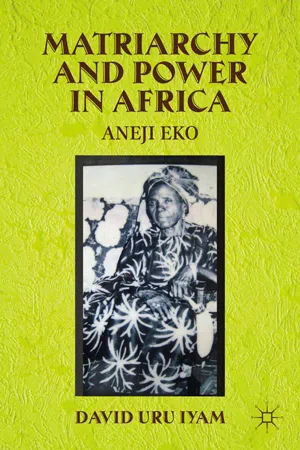
Aneji Eko was technically illiterate, but she represents a resource for understanding the complexities of African and Nigerian cultures. This is an account of matriarchy and the complex ties of kinship, their influences in shaping childhood culture, and how they determined cultural expectations across ethnic groups.
Information
CHAPTER 1

AMAMA UGIMA MASHIN
In Agwagune, if a child was not behaving properly in the family, the parents would warn the child that if he or she did not shape up, they would “send you to live with David’s grandmother.” Sometimes, my grandmother would spank you, and you would not even know what you did to deserve the punishment, but you knew you deserved it.
Everyone knew her as Amama ugima mashin (“Mama that sews machine”) because she was a tailor. Most people, including elderly men and women and people much older than my grandmother, called her “Mama.” When mail arrived for her from the numerous people she knew in one way or another, her real name, which some people only whispered, was always spelled out on the envelope: Mma Jenny Aneji Ekeko Ebok. Very close friends would occasionally call her “Aneji,” the Agwagune name by which her parents called her. People who seemed to be very important in Okopedi-Itu, where we lived far away from Agwagune, called her “Mma Jenny”; that’s how I was able to know the relative importance and social statuses of people in Itu. “Mama” is an informal term by which younger members of a household address their mothers and close older female relatives; some nonrelated members of the community also address older females as “Mama.” The term “Mma” is often used by acquaintances in a formal context, just like the term “Madam.” But the inclusion of “Jenny” in the term is an acknowledgement that my grandmother is the social equal of the person addressing her. Those who called my grandmother “Mma Jenny” were almost always very important people.
It was easy to know who was a very important person in Itu because some of the criteria for prestige were extremely limited and hard to attain. Some people were important because they owned some of the few cars in Itu. At that time, the type of car people owned was less important than the fact of ownership itself; even people whose unserviceable cars perpetually occupied a spot in some abandoned patch of ground beside their homes were respected as much as the few who drove their cars around. Even though their cars were abandoned, car owners always fit some other criterion of prestige and social importance, such as their social comportment at church services. At Sunday church services, they often sat at the center front pews and never failed to put something in the plate when it was passed around.
Very important persons, men in particular, also walked around with fancy walking sticks as part of their fashion accoutrements. It was customary for elderly males and some young men to use walking sticks, not as a response to a disability but as a response to the cultural criteria for prestige. It was ungentlemanly and a diminishing of one’s prestige to walk around without a walking stick; the walking stick completed the attire of people we perceived as important. Sometimes, when a very important person left the house without his walking stick, he would stop any child on the street and direct the child to his house to request someone in his house to send his walking stick.
Adults, even total strangers, could stop any child to run any manner of errands for them in Itu. The adult would usually scream curses at a disobedient child or even spank a child who was a little hesitant in carrying out the request; very few children disobeyed adults. All adults in Itu spanked any child they believed was disobedient. It seemed a prerogative of adulthood to keep every child in line and a generally understood form of social compliance.
Very important men also invariably had more than one wife, one of whom was also a very important person. Even though Nigerians were permitted to practice polygamy (and still are), only a handful of people did so, as having more than one wife was as expensive then as it is today. Wives of men with more than one wife were generally understood to be important not only because they were responsible for making a lot of the economic decisions in the household, but because they also sat with their husbands at the center front pews at church services and never failed to put something substantial in the offering plate. Those were the city wives; men in such marriages had their youthful sweethearts or first wives back in the village. While the village wife did not have the kind of social standing the city wife enjoyed, she was important in the village because she might have provided the man’s first children. Those children, especially if they included a boy child, ensured her importance in the relationship, particularly in the eyes of fellow villagers. But the village wife rarely visited her husband in the city, either because of her lack of city skills or simply because her village demeanor, especially her illiteracy, would embarrass her educated husband.
The houses of many very important people in Itu looked little different from the rest of the houses as most of the houses in Itu were built of mud and thatch. The major distinguishing feature of the homes of very important people was that the brown walls looked polished and well maintained, sometimes with lavish black-and-white designs adding some elegance to the monotonous brown. Also, the roofs were always covered in new thatch material. The occupants of those homes always called my grandmother “Mma Jenny.”
My grandmother owned the Itu property in which we lived. It was a U-shaped compound comprising about twelve attached mud-and-thatch dwellings, some with one or two bedrooms. She rented all but one of the dwellings to tenants. The compound opened into the street, and a big veranda at the end of the left leg of the U served as my grandmother’s sewing shop as well as her workshop for training women who came to be tutored in the art of sewing. The veranda was large enough to hold at least ten women and their hand- or foot-sewing machines at any time. Our own house, a one-bedroom dwelling with a huge living room and a pantry area, both of which doubled as additional bedrooms, was the biggest dwelling in the unit. My younger sister, Victoria, my younger brother Charles, and I shared the only bed in the one bedroom with my grandmother. Some of the other children slept in a wooden bed in the living room and on several straw mats spread out on the floor and in the pantry area. It was a very comfortable house. Behind the main house was a small rectangular hut divided into three kitchen areas, which served the cooking needs of everyone in the compound. About three or four people located their fire stalls in separate sections of each kitchen and cooked on their three- or four-legged fire stands.
At least ten children were always living in our house at any particular time. Because of various forms of youthful insubordination, their parents had sentenced every one of them to live with my grandmother. I remember the case of Ogbor; he was believed to be a witch well before he was a teenager because he was a very disrespectful child. We always liked playing with him because many grownups did not like him. He usually angered adults either for what he did or what he failed to do. For example, it is customary in Agwagune for a child to first greet an adult whenever the child encounters the adult; if the child does not do so, the adult will remind the child either by slapping the child’s back, knocking the child on the head with his or her knuckles, or simply asking, “Don’t you know how to say good morning to an older person?” Ogbor had received all those forms of reprimands several times by virtually every older person in Agwagune. We found it entertaining when he tried to dodge the beatings of adults, especially if he extended the insult by taunting older people who could not chase after him. That’s why adults referred to him as a “witch.” They did not believe he practiced witchcraft; simply, there was no other explanation for why a child would be as disrespectful to adults as Ogbor was.
Even though he was so insolent toward adults, he was a totally different person when he saw my grandmother. Anytime he saw my grandmother returning from the market, he would rush to her and relieve her of whatever item she was carrying and take it directly to our house. His parents also never bothered looking for him if my grandmother was in the village because they knew he was always at our house. My grandmother did not treat him any differently from other children, so I did not understand why he was so respectful of her and actually liked spending time around her. Most of the other children always wanted to stay away from my grandmother because she disliked seeing a child just sitting around doing nothing; she always had an errand to send you on, and Ogbor never had a dull moment around her. Yet he was always at our house—and only when my grandmother was home. One day as we got ready to return to Itu after spending Christmas in the village, Ogbor’s parents arrived in our house early in the morning to request that my grandmother take Ogbor with her to Itu. That’s how Ogbor came to live with my grandmother.
Most of the other children had committed various offenses: Ogama was not doing well in school; Ubam always went fishing instead of going to school; Ojeh always wet the bed; Abu was shy around other children and was unlikely to grow up to be a real man; and Moses was more powerful than most children his age and had to be rescued from the wrath of many parents. My brother, Eko (my cousin by blood), was forcibly taken from my junior mother (my aunt), Ubu, when he was about four. My grandmother believed Eko was being spoiled by his mother, who was known in our family for her lavish meals.
Whenever I went to my mother Ubu’s house, she would ask me to go to the kitchen and make myself as much gari (a dry toasted grain processed from cassava tubers and a staple food in many Nigerian homes) or foo-foo as I needed to eat. I always prepared a huge mound for myself. Then she would dish out soup into a bowl for me. The soup bowl was always so thick with meat, fish, snails, and other edibles that you had to start off with eating the meat so you would create some space in the soup bowl for your foo-foo balls. My grandmother was often disgusted by the way my junior mother exposed us to such extravagance and often said she had a “sweet mouth.” She had a sweet mouth because the meals she prepared either for herself or for the children often seemed like a feast. My grandmother was certain that exposing children to such extravagant displays was certain to turn them into thieves, especially when, as adults, they could not themselves afford such extravagance. Consequently, she was determined that Eko would not be raised by his mother.
Ogori came to live with my grandmother because people in the village always said that she “could never keep her legs closed.” Her parents were particularly troubled because she was likely to get pregnant before undergoing fattening, the rite of passage that prepared girls for marriage and womanhood. It is extremely important that a girl not get pregnant before an acceptable first pregnancy or marriage. Agwagune families seclude girls of marriageable age or prospective brides either in their natal homes or in the homes of their new husbands for up to two years, with the primary intention to feed the girl long enough to make her desirably fat. The seclusion may occur either before or simultaneous with marriage but must precede a girl’s first pregnancy or marriage, or the girl is deemed to be socially undesirable and an unfit marriage partner. The Agwagune do not have a specific age at which a girl is ready for marriage or by which time she must get married, but formal marriages rarely occur before a girl’s sixteenth birthday.
Ogori was several years away from her sixteenth birthday, but the rumor was that she had already been having sex—even before she was ten years old. To forestall an accidental pregnancy, Ogori’s mother pleaded with my grandmother to take her away. I did not believe the story about Ogori because she was the most efficient of all the children who lived with my grandmother. I think because she was a big girl, she seemed responsible for most of the chores and rarely had time to go out; she was often in the kitchen with my grandmother, preparing ingredients for cooking or screaming at the younger children when she felt they were getting into some mischief. My grandmother also recognized how responsible Ogori was; she did not beat her as often as she beat the rest of us; sometimes, almost a week would go by without Ogori receiving any beating.
Every child who lived with my grandmother came with a story—some good, some a little less so. But all their parents seemed assured of my grandmother’s reformative magic. Reformation often included the first beating by my grandmother. When a new child arrived to live with us, we always started counting how long it would be before his or her first beating. When the child eventually got the first beating, all the other children would wait for the child to stop crying before crowding around to congratulate the child on his or her first taste of “tea.” I have no idea why we referred to the first beating as “tea” because tea was a delicacy in our house that we had less frequently than my grandmother’s beatings. (My grandmother served tea only on one or two Sundays a month; Sunday was the day most people set aside for cooking or eating their favorite meal, such as rice with chicken stew or tea served with bread very thinly coated with margarine.) Our nosy grown-up neighbors often talked about the child’s first beating, but they often lacked the grace of us children and seemed to taunt rather than to welcome the new initiate. Nkoyo, one of our female tenants, was particularly obnoxious; she often preceded her comment with raucous laughter. “Did Mma give you your first sugar? Sweet, sweet sugar. . . .” Then she would end with another round of annoying laughter.
Even though Ogori was beaten less often than the rest of us, she received her first beating the very day she arrived in Itu. I believe she either did not understand the protocol of living with my grandmother at the time, or she was simply fascinated by how different Itu was from our village. I think she was sitting out in the sewing veranda merely enjoying her new environment just as my grandmother was about to cook the evening meal. “Wò wòp! Wò wòp!” (Get up! Get up!), my grandmother screamed at her from behind, and just as Ogori turned around, my grandmother slapped her twice on the back with her bare palm. Ogori leaped up from where she sat, as if someone had just stuck burning firewood under her bottom, and ran into the street. “Is that what you are going to eat today? Are you going to sit there and fill your stomach by staring at everything that passes down the street? Back in the village, does your mother have to wait for everyone to go to sleep before she starts cooking the evening meal? Bush girl! You have to stare at everything so everyone will know you just came from the bush.” It was usual for people to refer to others as a “bush person” to indicate the person’s lack of refinement. Ogori apparently lacked refinement for she ignored the household chore and got engrossed in marveling at her new environment. Ogori did not cry; she just stood in the street wringing her hands as if to apologize for her lack of town-life refinement. It became a characteristic of Ogori that she never cried when she was beaten—not even when the teachers at school beat her. Ogori never cried. As my grandmother walked out of the compound, Ogori ran into the house and passed directly to the kitchen area.
* * *
Everyone in Agwagune knew everyone else, and many adults knew people well beyond the borders of Agwagune. Even if a child was only a couple of years old, everyone knew the child’s name as well as the name of the parents. Any child who was able to walk from one lineage compound to another was also already familiar with my grandmother because my grandmother liked visiting people when she was in the village. As she stopped at one house after another, children from various compounds would scream greetings at her: “Amama ugima mashin, aveni!” (“Amama ugima mashin, good morning!”) All the children called her “Amama ugima mashin.” The first thing my grandmother would say in response to a child who greeted her was, “What class are you doing now?” When she asked the question, many children would try to respond at once, seizing the opportunity to impress her with how well they were doing in school: “Amama ugima mashin, ABC,” meaning the child is just starting elementary school; “Amama ugima mashin, elementary two”; “Amama ugima mashin, elementary three”; and so on. Some would skip along beside her, holding up their fingers to indicate their grade in school. She would continue on her way, shouting back at them to read their books and study their arithmetic.
There were lots of children in Odumugom, and almost every child went to the single-building elementary school in the village. The building was divided with raffia mats into six segments to accommodate the six elementary grades. I did not have the opportunity to attend the village school because my grandmother lived in Itu, but my friends always had some exciting news to share with me about events that happened at school while I was away in Itu. As much as I wanted to attend the village school, I knew I could not mention my desire to my grandmother.
THE FAMILY
My grandmother did not know how to read or write because her father, Ekeko Ebok, loved her immensely. When she was of school age, her father told her that he did not want her to be degraded by being tutored in the ways of the white man. Missionary education in the early 1900s was perceived by the Agwagune as an indulgence of the lazy and socially unloved. Ekeko Ebok had two daughters, neither of whom knew how to read or write, but they were women who grew up aggressively determined to be the men Ekeko Ebok wished they were. The Agwagune celebrate the birth of boy children more than the birth of girls, with much more drinking and dancing by the men, as well as spirited allusions to the man’s virility and sexual valor. Ekeko Ebok’s son, Esu Ekeko (my grandfather—that is, my grandmother’s brother), always called me Inam (“my father”) because he knew I used to be his father in my previous life. He generally communicated in our Agwagune language, especially when he was discussing important matters with other Agwagune chiefs. But sometimes he would break into poor English for no reason in particular. For example, whenever I went to visit him, he would ask, “Inam, how is the go go? You are read school?” (“My father, how are things going? Are you studying at school?”) Just like his sisters, he lacked formal education. Since he had children well into his old age, his two sons, Oto and Etan, were close to my age and were classified as my brothers rather than as my fathers or uncles; Oto and ...
Table of contents
- Cover
- Copyright
- Contents
- Preface
- 1 Amama Ugima Mashin
- 2 Okopedi-Itu
- 3 Malam
- 4 The Signature
- 5 A Distant Journey
- 6 A Missing Bone
- 7 Broken Treasure
- 8 The First School-Leaving Certificate
- 9 When the Onun Slept
- 10 Then She Left
- Index
Trusted by 375,005 students
Access to over 1.5 million titles for a fair monthly price.
Study more efficiently using our study tools.
Frequently asked questions
Yes, you can cancel anytime from the Subscription tab in your account settings on the Perlego website. Your subscription will stay active until the end of your current billing period. Learn how to cancel your subscription
No, books cannot be downloaded as external files, such as PDFs, for use outside of Perlego. However, you can download books within the Perlego app for offline reading on mobile or tablet. Learn how to download books offline
Perlego offers two plans: Essential and Complete
- Essential is ideal for learners and professionals who enjoy exploring a wide range of subjects. Access the Essential Library with 800,000+ trusted titles and best-sellers across business, personal growth, and the humanities. Includes unlimited reading time and Standard Read Aloud voice.
- Complete: Perfect for advanced learners and researchers needing full, unrestricted access. Unlock 1.5M+ books across hundreds of subjects, including academic and specialized titles. The Complete Plan also includes advanced features like Premium Read Aloud and Research Assistant.
We are an online textbook subscription service, where you can get access to an entire online library for less than the price of a single book per month. With over 1.5 million books across 990+ topics, we’ve got you covered! Learn about our mission
Look out for the read-aloud symbol on your next book to see if you can listen to it. The read-aloud tool reads text aloud for you, highlighting the text as it is being read. You can pause it, speed it up and slow it down. Learn more about Read Aloud
Yes! You can use the Perlego app on both iOS and Android devices to read anytime, anywhere — even offline. Perfect for commutes or when you’re on the go.
Please note we cannot support devices running on iOS 13 and Android 7 or earlier. Learn more about using the app
Please note we cannot support devices running on iOS 13 and Android 7 or earlier. Learn more about using the app
Yes, you can access Matriarchy and Power in Africa by D. Iyam in PDF and/or ePUB format, as well as other popular books in Social Sciences & Anthropology. We have over 1.5 million books available in our catalogue for you to explore.